


The land that Jim Scala and his family have been ranching for three generations is parched and brown as far as he can see. The pond where his cattle used to drink is now a puddle, ringed with cracked mud.
In other years, water pumped from the Shasta River would have periodically flooded this land, keeping his pasture alive and pond full. But the state had ordered Scala and other ranchers and farmers in rural Siskiyou County to stop irrigating when the drought-plagued river dipped below a certain level.
With bills mounting from trucking in water and buying hay to replace dead pasture, and facing the prospect of selling half his herd, Scala and others made a decision to defy the state’s order.
“We said, ‘To hell with it,’” Scala said. “We’re starting the pumps.”
In a single day in mid-August, the Shasta River’s flows dropped by more than half and stayed there for a week, which could jeopardize the salmon and other fish that spawn there.
Klamath River tribes were outraged, and California water regulators sounded the alarm. The State Water Resources Control Board ordered the Shasta River Water Association, which serves roughly 110 farms and ranches in central Siskiyou County, to stop pumping. Fines would start at $500 per day but could rise to $10,000 after a 20-day waiting period or a hearing.
“The unlawful diversion sets a terrible precedent that irrigators can egregiously violate state water rights and impact listed and tribal trust species,” said Jim Simondet, Klamath branch chief for the National Oceanic and Atmospheric Administration’s fisheries division.
A week later, on Aug. 24, Scala and the other ranchers and growers turned the water pumps off.
“We accomplished what we set out to do,” said Rick Lemos, a fifth generation rancher who also is a board member of the rural water association. “We got relief for the cattle that were out of water and wading out in the mud and getting stuck.” He said one of his cows had died in the mud.
The weeklong standoff crystallized a warning from California water watchers: The state has limited power to speedily intervene in urgent conflicts over water, which are expected to flare across the state as drought squeezes water supplies for ranches, farms, tribes, cities and fish.
“This is about the Shasta and it’s about Klamath salmon and it’s about tribes in the Klamath. But this is really about: can the state protect its water supplies, or is it just going to be the Wild West? Is it going to be every cowboy for himself?” said Craig Tucker, a natural resources consultant for the Karuk Tribe, the second largest Native American tribe in California.
‘Farmers open the floodgates’
Scala is the president and Lemos sits on the board of the Shasta River Water Association, a private, non-profit water distributor that operates in the heart of Siskiyou County in the shadow of Mount Shasta.
In normal years, the water association pumps from the Shasta River from April to October, sending the water through a network of canals to irrigate roughly 3,400 acres.
The county, where locals have long chafed under Sacramento’s authority, was primed for simmering tensions over water to boil over.
“The dictatorial whims of (the) State Water Board has no authority to tell the people of Siskiyou county what to do with their property they own,” U.S. Congressman Doug LaMalfa, a Republican whose district includes the county, said in an emailed statement. “This violates our constitutional guarantee against unlawful seizure. I encourage anyone to stop ‘voluntarily complying’ with government looters.”

This has been the fourth driest year to date in a region where drought has been tightening its grip for years. Even in 2020, the local agricultural commissioner reported an increase in fallowed acres and limited irrigation that reduced yields. Wildfires have burned through rangeland and timber.
But agriculture, too, has taken its toll on water in the region — warming the Shasta River and degrading its water quality, according to the Shasta Valley Resource Conservation District.
These changes impact key spawning and rearing grounds for fall-run Chinook salmon and threatened Coho salmon. Other fish culturally important to tribes in the region, such as steelhead and Pacific lamprey, rely on the river as well.
Salmon runs have been declining for decades and few adult coho return every year, NOAA’s Simondet said. “Fish,” he said, “are not doing fine.”
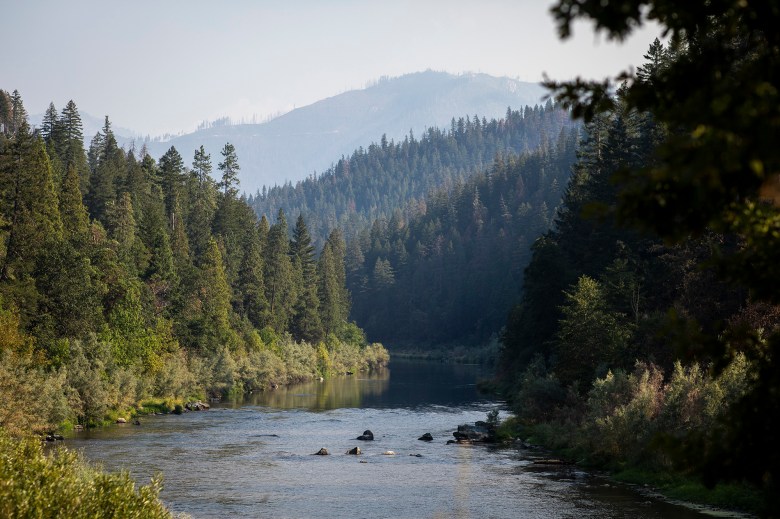
The Shasta River empties into the larger Klamath — a small source of its flow but an outsized producer of its fish.
“Can the state protect its water supplies, or is it just going to be the Wild West? Is it going to be every cowboy for himself?”
Craig Tucker, Karuk Tribe Consultant
In Happy Camp along the Klamath River, about 75 miles west from the pumps that the ranchers turned on, Karuk Tribal Council Member Arron “Troy” Hockaday has been watching the river and its salmon populations change over his lifetime.
“(If) those fish are gone, our people suffer. Those fish don’t spawn, our people suffer. We live off that — it’s our culture,” said Hockaday, a fourth generation traditional fisherman.
Hockaday has been dipping handmade nets into the rapids at Somes Bar to catch salmon since he was a child, and worries that his grandson won’t be able to continue the tradition.
“There ain’t going to be no fish for him to fish. He’s never going to learn how to catch fish and be a Karuk Tribal fisherman.”

Seeing the salmon populations decline even as water continues to flow through irrigation canals “hurts. It hurts so bad to see that,” Hockaday said. “And then to put pain into my soul, into our family, into the river — the farmers open the floodgates on the Shasta River.”
From his vantage point, he said, “Nobody gets into trouble for it.”
‘Egregious and blatant disregard’ of emergency order
Last year, the State Water Resources Control Board adopted emergency regulations that allow state regulators to curtail water users in the region when summertime flows in the Shasta River drop below 50 cubic feet per second near Yreka.
The aim is to protect salmon and trout species, including steelhead, fall-run Chinook and threatened Coho salmon. But the limit is fiercely contested by area ranchers, who note that it’s higher than the average historic flows in August since 1933.
The Shasta River Water Association petitioned in early August to continue diverting water to fill stock ponds for approximately 5,000 cattle plus calves and other assorted animals, according to a copy of the petition the water board shared with CalMatters. The water board said the request was still under review.
Lemos said the ranchers couldn’t afford to wait.
“How long do they review it while the cows are dying of thirst?” Lemos said. “We didn’t just fly off the handle and say hey, we’re going to break the law and get into a big mess. We tried the other way first.”
In a letter dated Aug. 17, the water association notified state regulators that they planned to violate the curtailment that day.
“We were in a critical situation. We have cattle out of water… We have nowhere to move them. You can’t just get them in and sell them tomorrow,” Lemos said. “So that’s why we started diverting (water).”
The pumps rapidly sucked away river water, dropping flows by more than half in a day, state officials said.
“It’s an egregious and blatant disregard for the environment and for our regulations…We are really, really interested in taking some swift action because we do take this so seriously,” said Julé Rizzardo, permitting and enforcement branch manager for the water board’s division of water rights.
The board is still investigating and determining whether to seek fines.
“We were in a critical situation. We have cattle out of water…So that’s why we started diverting (water).”
Rick Lemos, Siskiyou County rancher
It took only a day after flows began dropping for the agency to notify the water association that they had violated their curtailment and could face fines of up to $500 per day. But under state law, the ranchers had 20 days to respond and request a hearing.
Only after the 20 days are up or a hearing has occurred can the water board adopt a final cease and desist order and raise the fines to $10,000 a day. By then, fall-run Chinook salmon would have been migrating through the river.
“It’s really unfortunate that we have those limitations,” Rizzardo said.
Felicia Marcus, a visiting fellow at Stanford’s water in the west program and former chair of the California water board, was more blunt: “In theory the water board has a lot of authority to deal with illegal diversions. In practice, they have to do it blindfolded and with one hand tied behind their back.”
California water law experts have been pushing for the water board to be granted more power to act swiftly.
Jennifer Harder, a law professor at the University of the Pacific’s McGeorge School of Law urged California lawmakers to consider granting state water regulators the authority to temporarily pause water diversions and stem the damage in emergencies, while still allowing due process. Similar efforts have failed in the past.
“The bottom line is, we live in a very different world than we lived in 20, 30, 40 years ago in terms of the immediacy of some of these threats,” Harder said.

After receiving the board’s notices, Scala, Lemos and the rest of the Shasta River Water Association kept pumping the river’s water for almost a week.
“Only regret I have is we didn’t start earlier,” Scala said on Aug. 24, with irrigation water running across his land. “We’re going to lose the crop anyway. We’re going to have to pay a fine, probably.”
But later that day, Lemos said they shut off the pumps; they had accomplished what they’d set out to do, he said.
“We were going to fill our stock ponds and get some stock water and get things where we could survive, and shut off,” Lemos said. “And that’s what we basically did.”
The 20-day period before fines escalate had also factored into their discussions, Lemos said. Considering the costs of hay, replanting desiccated pasture and selling off cows, he said, “at $500 a day, it would probably be worth it, I’ll be quite honest. It’d probably be more than affordable. At $10,000 a day, it wouldn’t be.”
Lemos estimates he’s bought around $50,000 worth of hay so far this year, with more on the way; Scala counts over $100,000 in hay costs between this year and last. Both are bracing to sell off large proportions of their herds to make it through the coming year – for Scala, it could be as much as half. And he doesn’t think the water even made it a third of the way across his field.
“I’ve been pretty depressed the last couple of days,” Scala said. “There’s no future. We don’t have water. Without water, we’re done. And we can’t sell the place. Who’s going to buy a place without water?”
Pumps turned off, but will the damage remain?
Hockaday of the Karuk tribe was relieved to see flows returning to the Shasta River, but hopes to see the ranchers and growers held accountable for diversions that the state water board says are illegal.
“It’s great that they turned off the pumps. But they knew they weren’t supposed to turn them on in the first place,” Hockaday said.
The California Department of Fish and Wildlife is still evaluating the damage that the pumping may have caused, Tina Bartlett, the department’s northern regional manager, said in a letter to the water board Friday.
But the department expects that the rapid reduction in flows could have put young salmon and trout species at risk by shrinking their habitat, increasing temperatures downstream and interfering with critical food production.
“It is likely that some perished,” wrote Bartlett, who added that the rapid dewatering also “does not bode well” for adult Chinook salmon migrating from the Pacific to their spawning grounds.
“(If) those fish are gone, our people suffer. Those fish don’t spawn, our people suffer. We live off that — it’s our culture.”
Arron “Troy” Hoc, Karuk Tribal Council Member
Lemos said he doubts that fish were harmed by the diversions. He expects warm summertime temperatures kept salmon species out of the lower reaches of the Shasta. “I wish you’d go down the canyon and look for some dead fish because you won’t find them,” Lemos said. “There was nothing harmed by our diversion at all.”
But Mike Belchik, a senior water policy analyst for the Yurok tribe, said the damage goes beyond salmon.
Fish species like lamprey that also are culturally important to the Yurok people are vulnerable to being stranded by a rapidly retreating water line, Belchik said. And reducing the river’s flows can cause long-term harm to the food web that can affect production for in the years to come.
“If you interrupt the food production in the summer, you don’t just get it back. It’s like removing the oxygen from a room for 20 minutes,” he said. “It’s lethal.”
Hockaday said land can be replanted and economies rebuilt; if a species of fish disappears from the river, it’s gone forever.
The ranchers who pumped the water “need to take care of his family. I understand that,” Hockaday said. But he wants to know when it’ll be the tribes’ turn to stop sacrificing so much.
“We gave up everything since the colonist people came here,” Hockaday said. “We’ve given our land, we’ve given our water, we’ve given our homeland. We gave everything up.”
This article appears in Broken Trust.
And then groups like Peta step in claiming cruelty for starving dehydrated livestock and demand ranchers and farmers be penalized its a vicious cycle and we are at the mercy of a whacked out power tripping clueless government