


Here’s a story that might help you understand Dr. Kim Ervin.
Years before she would arrive in Humboldt County to start a decades-long career providing women with healthcare and delivering babies, she was working in a medical clinic at Frances E. Warren Air Force Base in Cheyenne, Wyoming. She was nine months pregnant but still on the job doing deliveries as one of two obstetricians at the clinic, which at that time was seeing 30 to 40 births a month.
“It’s peacetime,” Ervin says, explaining that the base is located where winters stretch nine months of the year and see 70 mph winds. “They’re having babies out the wazoo.”
So when Ervin went into labor one morning, she stayed at work. While laboring all day, she delivered other people’s babies until her shift ended. “I came home, ate dinner, got my bag and went back,” she recalls. “Two hours later, I had my baby.”
But the story doesn’t end there. About 24 hours postpartum, Ervin was settling in back at home when she got a call: Her fellow obstetrician — and patient — was now in labor. Ervin trudged back to the hospital to deliver the child.
“I had a nurse hold my baby,” she says.
The anecdote says a lot about Ervin and why — even 30 years later and 1,200 miles away — patients adore her. The story can also serve as a warning that people who underestimate Ervin do so at their own peril. She’s never been one to shy away from a challenge, from the day when she was 8 or 9 years old and the family physician laughed at her when she said she wanted to become a doctor to last fall, when she raised concerns about the quality of patient care at Mad River Community Hospital even as she says administrators told her to stand down.
Ervin is one of four doctors to have left or announced they will leave Mad River Community Hospital in recent weeks, an exodus that is stoking concerns about the institution’s future in a healthcare climate with little room for error, with the financial margins of rural medicine slimming, doctors in increasingly high demand and the median age for local physicians sitting at 57, according to the Humboldt-Del Norte Medical Society.
And while Ervin has reached an agreement to work at Open Door Community Health Centers, her departure from Mad River carried the very real possibility of her retirement, which would have left Humboldt County with the equivalent of just about six full-time OBGYNs, according to the Medical Society, which would have been a 40-percent decrease over the past decade and less than half the 13 or 14 a community of this size needs, according to a study in the New England Journal of Medicine, which recommended one for every 10,000 residents.
“It’s scary,” Ervin said of the shortage of women’s healthcare providers on the North Coast. “It’s scary for this community.”
While it may not have been obvious to those outside the healthcare industry, Ervin’s arrival at Mad River in the spring of 2017 was a big deal. The hospital sent out a press release announcing the hiring of Ervin and two other providers that contained a quote from hospital CEO Doug Shaw praising them as “dynamic professionals” whose “expertise, insight and experience” would benefit the hospital.
“We are truly excited about having these distinguished members join the Mad River Healthcare Clinic system as we are certain they will add an important and necessary dimension to our team,” Shaw said in the release.
In Ervin’s case, she was bringing a lot more to the table than expertise. Ervin had run her own local practice since 1992, earning a reputation as a devoted and skilled physician and surgeon in medical circles and amassing thousands of patients. Not only that, she brought her own furniture and equipment.
Sitting in the Journal’s office on a recent overcast afternoon, Ervin takes a sip from her pink stainless steel water bottle, her short hair an explosion of blond curls, and explains that she was somewhat desperate to get out of her practice and had limited options. She wasn’t ready to retire, she says, but her practice had also become unsustainable, so much so that for two years she’d been borrowing money from herself to pay her staff. While Ervin concedes she only started her own practice out of necessity and has never been much of an entrepreneur — “I was really good at being a doctor but not very good at being a business owner,” she says — the problem was that the business side of the healthcare industry was changing around her.
Ervin says things started to go south for her practice in 2010, after President Barack Obama signed the Patient Protection and Affordable Care Act into law. One provision of the act made electronic medical records mandatory for all providers beginning in 2014. The idea — that digital versions of old paper charts would make it easier for patients to take their records from provider to provider or hospital to clinic — has plenty of merit but the roll out was rocky, especially for small practices.
As she’s wont to do, Ervin got a jump on the new law and took out a $60,000 loan in 2010 to purchase the software needed to digitize her practice’s records. On top of that, she had to pay monthly fees for the data management service. In addition to the added expenses, Ervin says insurance companies were becoming harder and harder to deal with, reimbursement rates fell and margins tightened considerably. At one point, she says she had to let her office manager go because she couldn’t afford the salary any more. That left Ervin to take on more administrative work, which meant she was working more than she wanted. It was untenable.
So Ervin says she looked to make a change and reached out to Open Door, Mad River and St. Joseph Hospital. Open Door administrators said they weren’t interested in taking on specialists at that point, noting that primary care was the system’s mandate. Ervin says St. Joseph, after asking her for years of financial records, including tax returns, made her a very nice contract offer complete with benefits. Meanwhile, Mad River, she says, dragged its feet and was noncommittal.
Ervin says the St. Joe’s offer was very tempting but she couldn’t come to terms with the idea of practicing in a hospital that, since a bishop’s direction in 2012, prohibited sterilization procedures and birth control counseling.
“As much as it was a nice offer with good benefits, I just felt like I would be betraying women, my patients and myself,” she says.
So Ervin says she went back to Mad River and pressed the issue. Shaw hired her; she started in March of 2017. A few months later she was joined by Emma Hackett, an OBGYN fresh out of residency, and a short time later a family practice doctor and a midwife. For a time, things were good.
“We had a good working relationship, all four of us,” she says.
Unfortunately, Ervin says, external forces would intercede.
“I really wanted us to fit into the system,” she says. “I didn’t want to come in there acting like some kind of big shot. About six months in, I went to the administration and asked, ‘How are we doing? Are we billing correctly?’ They didn’t know. They didn’t know how we were doing.”
“About six months in, I went to the administration and asked, ‘How are we doing? Are we billing correctly?’ They didn’t know. They didn’t know how we were doing.”
While Ervin says she now can point back to those unanswered questions as an ominous sign, her first real frustration came with staff turnover. Receptionists, nurses, medical assistants — she says the hospital had a terrible time retaining any of them.
The biggest issue, she says, is the hospital didn’t pay a competitive wage. Ervin and others interviewed for this story say nurses at Mad River are paid more than $10 less than their counterparts at St. Joe, who are unionized. The impact of this pay disparity, they say, is that Mad River serves as a training ground, repeatedly investing the time and resources to get a new nurse up to speed only to watch them leave to work elsewhere. This in turn leaves the hospital to rely heavily on traveling nurses, adding to the steady turnover of staff.
The turnover that frustrated Ervin was also apparent to her patients, several of whom told the Journal her practice changed after she made the switch to Mad River. The patients say they quickly came to miss the familiarity of her small practice.
The Journal reached out to Mad River Community Hospital spokesperson Vickie Sleight on Jan. 10 to request an interview with Shaw or someone else from the hospital’s administration for this story. After initially indicating she’d be back in touch to coordinate, she then said she’d provide a statement from Shaw on Jan. 13. It showed up just before the Journal’s Jan. 14 press deadline.
The statement is scathing, accusing Ervin of “unprofessional behavior” and taking “liberties with her contract and the truth.”
“It is unfortunate that Dr. Kim Ervin has chosen, in complete disregard of her confidentiality obligations in her contract, to misrepresent and mislead the public about the hospital’s commitment to high quality healthcare in our small community, which has been our guiding principle for over 50 years,” it states.
For her part, Ervin says the real trouble began in late 2018, when she volunteered to become the hospital’s chief of surgery, a role she took on in addition to her work in the women’s clinic. Shortly after assuming the position, Ervin started to hear from hospital staff who were frustrated with some surgeons’ refusal to use the hospital’s electronic medical records system.
“I didn’t go to them,” she says. “They came to me.”
To be sure, Ervin says the system — CPSI — was a headache. When the hospital purchased the system some years back, she says administrators asked a handful of the hospital’s most senior physicians which of three systems they preferred. Ervin says she was told the answer was unanimous: Not CPSI. Nonetheless, she says administrators chose CPSI, the cheapest option.
While some electronic records systems include prompts — essentially an artificial intelligence function that will suggest billing codes, procedures and follow up instructions when you type in a diagnosis — CPSI does not. It’s clunky, she says, and more difficult to navigate than others.
But in Ervin’s mind, that in no way made it OK for surgeons to simply refuse to use the thing, instead leaving nurses and other staff to decipher their handwritten notes and enter them into the system after the doctor had gone home or moved on to their next patient. That was inefficient and — she says — dangerous, leaving too much room for error. After all, she quips, have you ever tried reading a doctor’s handwriting?
But it wasn’t just the electronic side of things that was lacking in some cases. Ervin says some surgeons’ handwritten notes were inadequate for today’s reality in which insurance companies require every chargeable service to be documented in a patient’s file. If a physician fails to justify a patient staying another night in their chart notes, the insurance company will refuse to cover the night, Ervin says.
“Sadly, it’s a game you have to play with insurance companies,” she says. “All these little things matter.”
So Ervin says she took a stand and insisted the surgeons start using the electronic system, pointing out that Mad River has a stellar information technology department and someone at the ready to hold a provider’s hand and walk them through using the system.
Initially, Ervin says hospital administration seemed pleased she was pressing the issue. But then Ervin says surgeons started going around her, complaining directly to Shaw and the medical chief of staff. She was told to stand down.
In February of 2019, things began deteriorating quickly. Mad River made news when it abruptly fired approximately a dozen employees, including medical assistants, office staff and nurses, almost all of them working in the hospital’s clinics. In letters to the departing staff, the hospital said it was going through a “major restructuring” and “eliminating certain redundancies and shifting various responsibilities.” Among those let go were a medical assistant and a receptionist in Ervin’s clinic.
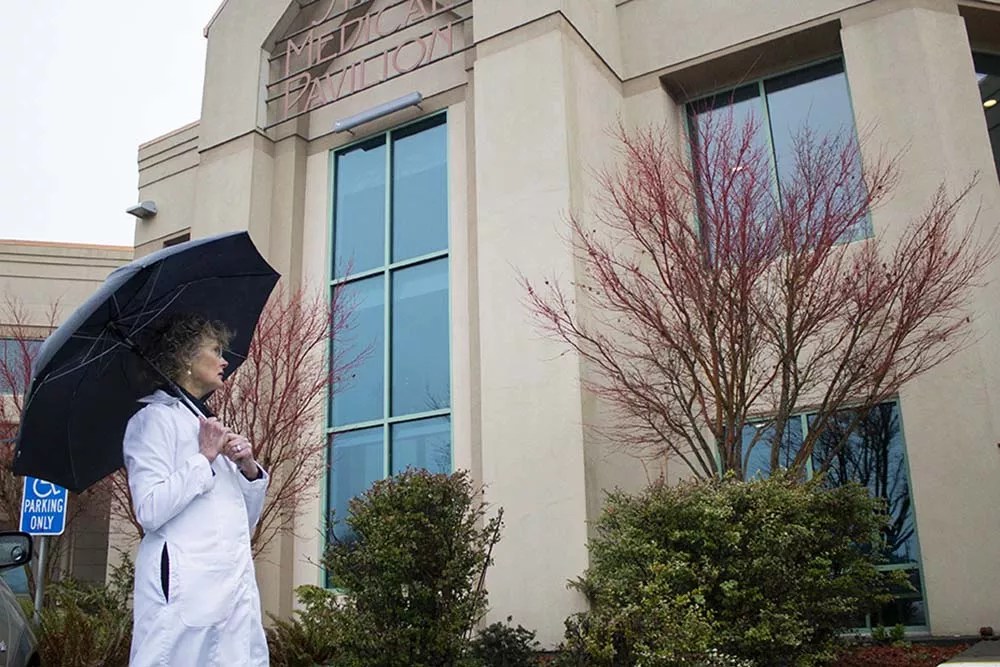
Ervin’s path to being a practicing physician in Humboldt County — much less a whistleblower at one of its two major hospitals — was in no way predictable.
The eldest of three siblings, Ervin bounced around through the Midwest with her family throughout her youth. Her father was a business man — a sales representative for Playtex, selling baby bottles, tampons, swim caps and bras in Ervin’s younger years — and her mother stayed at home. The family followed her father’s business opportunities, landing in New Jersey for Ervin’s high school years when he was promoted to vice president.
At this point in life, Ervin says she didn’t know what she wanted to do when she grew up. She was good at school — particularly math and science — but higher education wasn’t something that was encouraged. In addition to being a girl, Ervin was petite, blond and objectively pretty. On the road to graduating at the top of her high school class, and with the urging of a teacher Ervin decided she wanted to go to college. Her parents pushed her to go to fashion design school instead. They finally struck a deal: Ervin would go to Rockhurst University near the family’s home, then in Kansas City, but she would have to live at home and pay part of her own way.
At the university, Ervin says she excelled, especially in the sciences.
“Organic chemistry, calculus — those things always sort of made sense to me,” she says.
But she also became increasingly isolated as she moved into upper division science courses for her pre-med major, saying by her junior and senior years, she was the only woman in her classes. By the time she graduated — again at the top of her class — Ervin had made up her mind that she was going to medical school and had been admitted to Georgetown University School of Medicine through an early admission program. Her family was not entirely supportive.
“My mother was like, ‘I don’t think you’re going to do this. I think they’re going to eat you alive,'” she says.
Not wanting to ask her parents for money or work her way through medical school, Ervin signed up with the U.S. Air Force, which would cover all the costs of her school if she committed to serving four years after finishing her residency.
While one of only 24 women in her class, Ervin thrived at Georgetown, surrounded by smart, driven people in a nurturing, noncompetitive atmosphere. She married her first husband immediately after graduating in 1981 and the two set off for Keesler Air Force Base in Biloxi, Mississippi, where she started her OBGYN residency.
“They weren’t necessarily real happy I was there,” Ervin says, adding that she was the only woman in the residency program and that no one on the base seemed to know quite what to make of this “feminine, prissy” doctor who’d kept her maiden name. For two years, she says she endured an intensive campaign of hazing. She’d go to the fridge in the call room to find her male colleagues had taken her lunch or dinner, or simply eaten half of it and put it back. A hospital employee refused to stock rubber gloves for her small hand size. She’d often find her colleagues had peed all over the toilet seat in the call room bathroom and once she opened her locker to find it filled with dirty men’s underwear.
When she was scheduled for her first surgery — a vaginal hysterectomy — she walked into the operating room to find it was an incredibly difficult case involving an obese patient.
“I’m thinking, ‘These bastards. They want me to fail,'” she says.
But Ervin perservered and after a couple of years, more women entered the program, some of the more cantankerous male colleagues left and things improved. After completing the program in Biloxi, Ervin and her husband were stationed in Cheyenne, where Ervin headed a two-person OBGYN team. After completing her four years there — repaying her debt to the U.S. Air Force — Ervin and her husband were looking to relocate. And Bill Weiderman kept calling.
Weiderman had gotten to know the couple when he was in the OBGYN residency program in Biloxi — “He was one of the nice ones,” Ervin says — and was looking to recruit Ervin to join his OBGYN practice in Eureka. He kept sending them stuff about the practice and the area, and finally they agreed to fly out to see the place.
“It looked awfully green and there’s nothing green in Wyoming,” Ervin says. “We got off the plane and it was like, ‘OK. We’re coming here.”
So Ervin joined Weiderman’s practice in 1989. Things went well for a couple of years but by 1991, the practice’s older partner had largely stepped back and Ervin was working more hours than she wanted to. Then the Iraq War happened and Weiderman got called up — not to the front lines, but to Texas to backfill for another physician who’d been deployed — leaving Ervin as basically the only provider in a large practice that should have had four. For six months, she was on call almost constantly.
Eventually, they merged the practice with another local one, giving Ervin some relief, and Weiderman returned. Things improved for a spell but then Ervin says she and her partners began to worry that issues in Weiderman’s personal life were interfering with his being a reliable partner in the practice. She says her new partners pushed her to intervene and address it with the doctor, but when she did he grew angry, telling her to mind her own business. Frustrated, she informed the practice she was looking to leave and wanted to chart a months-long transition to make sure all her patients were accounted for.
“I got a note back from them saying, ‘We want you out in a week,'” Ervin recalls, adding that her former partners insisted that she not take any of her patients’ charts with her when she left.
On the advice of her attorney, Ervin went back into her office shortly before midnight on her last day and loaded a moving truck with the desks she’d purchased and her patients’ charts. The following day, one of her former partners called the police, alleging she’d stolen from them.
“He was angry I had the balls to walk out on them,” she says with a chuckle, adding that when officers showed up the following day and she explained what had happened — and that her former colleagues owed her money from the practice — the officers left. She recalls a conversation with her lawyer around that time in which she asked if she should sue to get her money back. “He said, ‘Screw them. You succeed. That’s how you rise above this,'” Ervin recalls.
While she ultimately would — things were bumpy at first. Ervin says her former partners spread rumors about her being lazy and incompetent, making it difficult for her to develop a solid reputation as a new female doctor in town. Then, a couple of years into her own practice, Ervin learned that her bookkeeper had been embezzling from her.
She’d had it. She and her husband put their house up for sale and started making plans to move to the East Coast. Then came the calls.
“I started getting phone calls from other local doctors,” Ervin says. “They’d ask why I was leaving and I’d say, ‘It’s just been too much.’ ‘What are your patients going to do?’ they’d ask. ‘They’ll find someone.’ ‘But nobody is as good as you,’ they’d say.”
Ervin pauses.
“That’s the last time I ever thought about leaving,” she says.

After the layoffs hit Mad River Community Hospital’s clinics in February of 2019, Ervin says patient care suffered. Without adequate support staff to answer phones, arrange prescription refills and check in patients, she says her and other providers’ time was increasingly spent fulfilling functions other than seeing patients. They were combing through phone messages, helping patients fill out their paperwork and taking blood pressures.
She says the most frustrating aspect was that with just one receptionist, the clinic simply couldn’t keep up with the volume of patient calls. Follow-up questions would go unanswered and some prescriptions weren’t refilled. The problems weren’t unique to Ervin’s clinic, multiple people interviewed for this story confirm, and a small group of clinic providers banded together to meet with hospital administration to find a path forward. The effort wasn’t successful.
Ervin and Hackett were so unnerved by the inability of the clinic to field patient messages and respond to them in a timely manner, both started giving out their cell phone numbers to all their patients so they could be contacted directly. It was unsustainable, she says.
Around the same time, Ervin says that in her role as chief of surgery she received a routine request to renew a local orthopedic surgeon’s privileges to operate at the hospital. When she looked into it, she was alarmed to find the surgeon had been on probation with the California Medical Board since 2015. According to the board’s accusation — which the surgeon admitted to — St. Joseph Hospital had suspended his privileges “due to a potential impairment impacting his clinical performance and decision making” and that a subsequent board evaluation found him to be “suffering from conditions that impair his ability to practice medicine safely.” As a part of his probation, the surgeon was to be monitored regularly, undergo psychotherapy and abstain from the use of controlled substances, including alcohol.
Looking into the matter, Ervin says she found other things in the surgeon’s file, including numerous complaints from hospital staff that he’d been verbally abusive. She took the matter to chief of medical staff Bruce Barker and Shaw, suggesting the hospital should not renew the surgeon’s privileges.
“I said, ‘Why wasn’t this addressed? Why have we been enabling this behavior?'” she says. “The response I got was, ‘Why are you bugging me about this?'”
“I said, ‘Why wasn’t this addressed? Why have we been enabling this behavior?’ … The response I got was, ‘Why are you bugging me about this?’”
Ervin says she was again told to stand down, which left her worried for both hospital staff and patients. She couldn’t understand the administration’s decision, though she did learn Barker’s license is also on probation by the California Medical Board. In Barker’s case, he pleaded guilty to a federal perjury charge stemming from a 2002 trial in which he lied under oath and was sentenced to six months in prison. The medical board suspended Barker’s license for a year and then placed him on probation in 2009, a condition of which was his agreeing to check in daily as a part of a biological fluid testing program to see if he had to submit a sample. He failed to check in 17 times over a seven-month period, according to medical board documents, and also failed to comply with therapy requirements.
In his defense, the medical board received several letters from Barker’s colleagues at Mad River, who raved about his skill, dedication, integrity and professionalism. The board ultimately found Barker had made “tremendous strides towards rehabilitation under difficult circumstances and now provides a real service to his new community,” deciding to extend his probation rather than revoke his license.
In the face of the administration’s lack of action with the orthopedic surgeon, Ervin says that in July of 2019 she reported him to the Humboldt Del-Norte Medical Society’s Physician Well-being Committee, which exists to address issues of physician health. When she referred the surgeon, she sent a letter to hospital administration explaining why she was doing so. In response, Ervin says she got a cease and desist letter via certified mail.
Fed up, Ervin informed the hospital in September that she would look to leave in March unless she and the administration could figure out a viable path forward, particularly regarding clinic staffing levels. She got a letter back in October suggesting she’d given her 60-day notice to void her contract.
There was some back and forth about when her contract would officially end but when Ervin worked her last day in late December, she says the hospital took no steps to notify her patients of her departure or put a transition plan in place. Patients who called the clinic to make an appointment with her were simply told she no longer worked there.
The hospital’s satement to the Journal regarding Ervin says that “as a result of a number of ongoing issues, including interpersonal issues with our fine staff (and) unprofessional behavior … the hospital made a decision to accept her resignation.”
At the time of Ervin’s departure from the hospital, she didn’t know if she’d find another place to practice medicine. It was a painful period but she ultimately connected with Open Door Community Health Centers, which decided it would venture into the world of OBGYN care if it meant keeping her in practice.
Tory Star, Open Door’s new CEO, says Mad River had contacted Open Door months back to ask it to come evaluate its clinics to potentially do some management consulting or even consider taking them over. Open Door declined, Star says, explaining that its status as a federally qualified health center prohibits it from consulting.
But when Ervin later approached, Open Door began having direct conversations with her, Hackett and Andrew Hooper, a primary care physician, about joining them. While a few years ago Open Door had seen OBGYN care as specialized and a departure from the network’s mandate to provide primary care, Star says that view has shifted.
“We really are primary care clinics and not designed to get into specialty work but women’s health is part of our scope of service. OBGYN falls into primary care. It fits,” he says, adding that the priority was keeping Ervin in practice. “She’s well known for being a high-quality provider. She’s been delivering excellent care for 30 years. I think we’re primarily interested in trying to maintain incredibly valuable physicians in our community.”
Star says the hope is that Open Door’s new OBGYN clinic will be up and running in March out of the same suite Hackett and Ervin occupied on the Mad River campus.
For her part, Ervin says she’s elated to be able to continue helping her patients with Open Door, though she’s a bit concerned about the transition. She says she’s been urging all of her and Hackett’s patients to go to Mad River to request copies of their out-patient records, unsure how seamless the transition will be. She notes that Mad River has locked her out of the patient records systems even though she still retains surgical privileges at the hospital.
Looking back on her tenure at the hospital, Ervin says she stands by her decisions, saying they were always motivated by providing the best patient care possible.
“If there’s something that needs to be said, I say it — people never have to wonder what I’m thinking,” she says. “I can’t play games. I am who I am.”
Thadeus Greenson is the Journal’s news editor and prefers he/him pronouns. Reach him at 442-1400, extension 321, or thad@northcoastjournal.com. Follow him on Twitter @thadeusgreenson.
This article appears in The Whistleblower.

Excellent article. Dr Kim has always been a stalwart defender of healthcare equity in the community, and partnering with Open Door makes total sense. Also I know understand how and why I fell off her patient roster two years ago …
I am a nurse at Mad River. I totally trust Dr. Barker. I recently needed surgery and Dr. Barker did it.
This is not reporting the news, it is making the news. The article starts building her reputation and credibility up as a mother and the hardships of life in Wyoming. The only thing missing was when she escaped a Cambodian brother and sex traffickers. The story continues to build her up like she was Mother Mary herself.
Let’s look through the holes for just a second. If she is that kind of an upstanding person, holding the gavel as Chief of Staff and ultimately righteous whistle-blower, then why is she breaking confidential private medical information about someone in public print?
If the California Medical Board put a plan in place for a surgeon to rehabilitate then why does she think he should be less than renewed for operating privileges? Why would a local medical society need to know and what could they do if the matter is already under the governance of the State Government’s medical board?
The article ends with more slander and comparative mirroring using the word “tenure” in the same sentence. This is little more that a Harbor Freight Tool advertisement comparing their drill to a DeWault. In the mind’s eye the HFT drill is immediately worthy because it is being compared to the big name brand.
If you don’t like your job your just say thank you and you leave your job and go elsewhere. The Mad River Hospital operates in one of the poorest reimbursement areas of the state. The General Surgeon targeted in the article has been the anchoring surgeon in that uninsured community for more than 15 years. Think of all of those deaths that he prevented. The orthopedic surgeon is the community’s only orthopedic surgeon so this medical and personal confidential information is illegal and plainly unjust. The patients place their trust in the surgeons who cut on them when they are asleep. Watch any episode of M.A.S.H. and u will see that surgeons take this role very seriously. That is one if the reasons their training is so long. Would you want a surgeon who takes the position that the buck-stops with them or someone who likes so hold hands with everyone and sings Kumbaya. I am glad that most can see through this article. It doesn’t meet the standards of journalism, moreover it reminds me of a Jerry Springer Show. Now that’s reality! Bring out her ex-husband’s gay wife’s brother the meth-head once removed Royal Family member! Please pass the remote…
I appreciate this thorough and open article of these issues which are not often discussed The article opens up about a physician’s need to be able to offer their patients the best care possible by having a decent electronica health record system and adequate and skilled back up staff and support staff. Many of us have appreciated Mad River Hospital because it is locally owned and offers open non-religiously limited options for comprehensive women’s health care And there are nurses I know who have chosen to work there despite the lower salary compared to St. Joe’s. This situation is very disappointing and concerning. These physicians are stellar and have spent the majority of their professional careers committed to our Humboldt county community.
I think many of us are willing to get involved and speak up to the administration about these issues.I believe they’re thinking that they are saving money by having less support staff and I have heard in the community that they have hired some outside consultants who have told them just that. Upsetting
I hope through this article and other local media we can come up with a plan to keep the hospital working well with good physicians
Dr. Kim Ervin is my own personal savior. (“Someone to hear my prayers. Someone who cares.”) She performed my needed hysterectomy a few years ago. I recall crying in her office, offering up the lump that turned out to be one of several fibroids. “You’re afraid you have cancer,” she said. So much compassion for anxious me.
I was afraid of cancer. But I’m not afraid anymore, thanks to Ervin’s thorough, competent care.
When people say “ugh” to Humboldt health care, I point to Ervin and say, “But Kim’s still here.”
I hope NCJ keeps reporting about the men at Mad River Hospital who are interfering with the quality of women’s health care and the hostile work environment especially for women. The fact that this has been tolerated by Doug Shaw and the Board is unacceptable!
My experience with MRCH community clinic was being moved from a Dr. to an NP. For many years I continued to see this NP regularly and yet she did not diagnose my genetic condition that nearly killed me. I had asked to be tested for it when my brother was diagnosed and she didn’t know what it was at first, she then ran the wrong test and told me I didn’t have it. No consulting with her supposed supervising Doctor, EVER. I found out later the overseeing physician had been sick and barely functioning for years. End result is I ended up with end stage liver disease because of the lack of a diagnosis of a genetic disorder that I asked to be tested for BY NAME. This could have been prevented through treatment. I got my medical records for the lawyers and found out there was NOTHING in my records about my asking to be tested which basically screwed me a second time because then it would just be a he said/she said case. Mad River had a non functioning doctor as their supervising physician and this particular NP did not do her due diligence to research my genetic disorder to even the degree of running the correct blood tests nor did she refer back to any physician or even manage to remember what we had talked about in my appt by the time she got around to writing her chart notes. I am also a healthcare provider and I KNOW if you don’t write your chart notes quickly after the appt., you lose your ability to remember a lot of pertinent information. The NP barely had the time to spend with me, let alone write chart notes, with patients scheduled every 15 mins or so. The entire system is bad. Now, I finally have a fantastic doctor and the medical board is going to run her out of business for prescribing opioids to legacy pain patients. Something’s got to give in Humboldt or ????
Each experience I’ve had at Madriver has been subpar-granted I’ve lived Memphis and Houston so I will say Humboldt county’s medical care needs improvement.
I have worked at Mad River Hospital from 1988 to 2008 in all dept. Med Surg, Discharge planning,home health,utilization review and administrative nursing supervisor.Administration never questioned
me when going out of my way to provide
patients and families with help at the hospitals expense.I made a fair wage and was always compensated for my time.All doctors I worked with were exceptional
Working at Mad River was one of my best nursing jobs.I would leave my job and feel that I had accomplished much and helped someone in need.It is very sad to read such a one sided article by what appears to be a very angry,unhappy professional.
No need to tear down your colleagues.
Just pack your bags and move on
Keep going Mad River Hospital the community needs you and congratulations on remaining
independent.
Jo Borchardt_ Smith RN. Seattle, Wa.
Dr. Ervin is a dedicated health professional who I’ve had the good fortune to call my doctor. I have far more regard for her credentials than I do a hospital bureaucracy.