


Humboldt State unveiled its hydrogen fueling station today with Rep. Mike Thompson here to help with the ribbon-cutting and talk about the role the
Schatz Energy Research Center
is playing in our renewable energy future. He’s shown above driving HSU’s hydrogen-powered car, which he’d just helped fill with fuel.
Here’s a soundbite from Rep. Mike’s speech:
audio player
Star of the show was Schatz lab director Peter Lehman (below), whose pioneering work was featured in a
Journal
story, “
Peter and the Fuel Cell,
” back in 2006.
Here’s an excerpt from Peter’s speech:
audio player

Peter Lehman addresses crowd at ribbon cutting
While this is certainly cutting edge stuff, there are limitations. The fueling station at Humboldt State is the northernmost outpost on what’s deemed
California’s “hydrogen highway.”
The Toyota Prius hydro-car (converted at a cost of cost $45,000) will only go 100 miles on a 2.5 kilogram tank of hydro-fuel, and there is not another fueling station within its range. (A
California Fuel Cell Partnership
map
shows the closest stations being in Davis and Oakland.) So, Humboldt’s lone hydro-car is mostly for show: President Rollin Richmond will be among the drivers, and as a Schatz lab tech explained to Rep. Thompson, there are plans afoot to use the vehicle to take mail deliveries up to the Telonicher Marine Lab in Trinidad.
[More pics from the Ribbon Cutting]
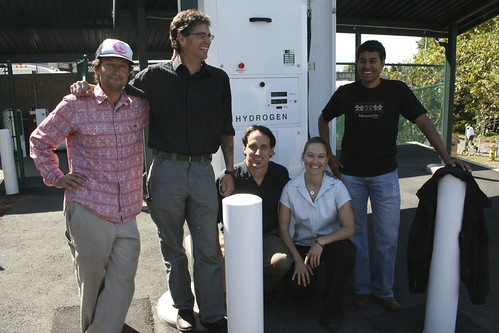
Evolution Energy Systems
Evolution Energy Systems team members: Avram Pearlman, Stephen Kullmann, Dave Carter, Juliette Bohn and Anand Gopal (l to r)
The student team won the grand prize
in the 2005 H2U international design competition sponsored by the US Department of Energy and ChevronTexaco, which led to acquisition of the Prius and building of the fueling station.
This article appears in What Now, Treesitter?.

I wasn’t aware that our hydrogen car is stranded up here at the north end of “Hydrogen Highway.”
I posted a few thoughts over at our blog:
http://www.green-wheels.org/node/420
Is hydrogen a hoax? No, it’s not, and SERC does great and necessary work. But hydrogen sure is hyped up. Here are some of the ways of getting orders of magnitude more benefits than the Prius on display can get.
Hydrogen is still too far off to solve our energy problems. There aren’t enough fueling stations, it takes energy to separate the hydrogen from the oxygen to get the fuel, the cars are far to expensive for the market, and the hydrogen isn’t compressed enough for a car to go an acceptable distance on it.
Rather than invest in Hydrogen, we should focus on making the Plug-In hybrids that are coming out in 2010 from GM and Toyota more affordable. They get 150 mpg and all you need as a darn outlet. This is what the next generation of vehicles will be, not hydrogen. By the time we actually make hydrogen economical, we’ll be driving electric cars.
so we (tax payers) just bought Rollins a ~$75,000 car that only goes 100 miles and fills up a station that cost for about $1.25 million to buy (if it generates its own hydrogen) or $150,000 if it doesn’t (Atlantic Hydrogen prices). nice, that’s sustainable.
Matt, where we gonna make all that electricity with? Coal fired power plants?
Hydrogen gas is a manufactured substance. Its not an “energy source” found in natural abundance like sunlight, wind, organic hydrocarbons, tidal and precipitation water flows, and fissionable elements. Hydrogen gas is better compared to the chemicals inside a nonrechargeable battery.
As to local efforts, they’re a joke. No one at SERC has done anything notable to advance technology. No one outside Humboldt knows or cares about SERC. The press releases of advances and discoveries are local boosterism hype. As a small testing and concept validation facility they do some local projects to install simple fuel cells, but advances in fuel cell technology are made by materials scientists and commercial manufacturers.
Just fill them up with all the flatulence that is found in these blogs. Instead of typing just hook your azz up to the car, eat a bunch of beans from a dirty taco wagon and blow, baby, blow. That wil get you 29-30 miles in your Flatulence car right there. And you’ll feel better getting that bad gas out of your system.
dig it or die…metaphorically
waxjobber, while your comments were really meant as an ignorant attack against people who see things differently, you have a point, Chinese farmers keep pigs under their houses and collect the gaseous waste from pig flatulence and dung decay and use to fire their cooking stoves. no joke.