

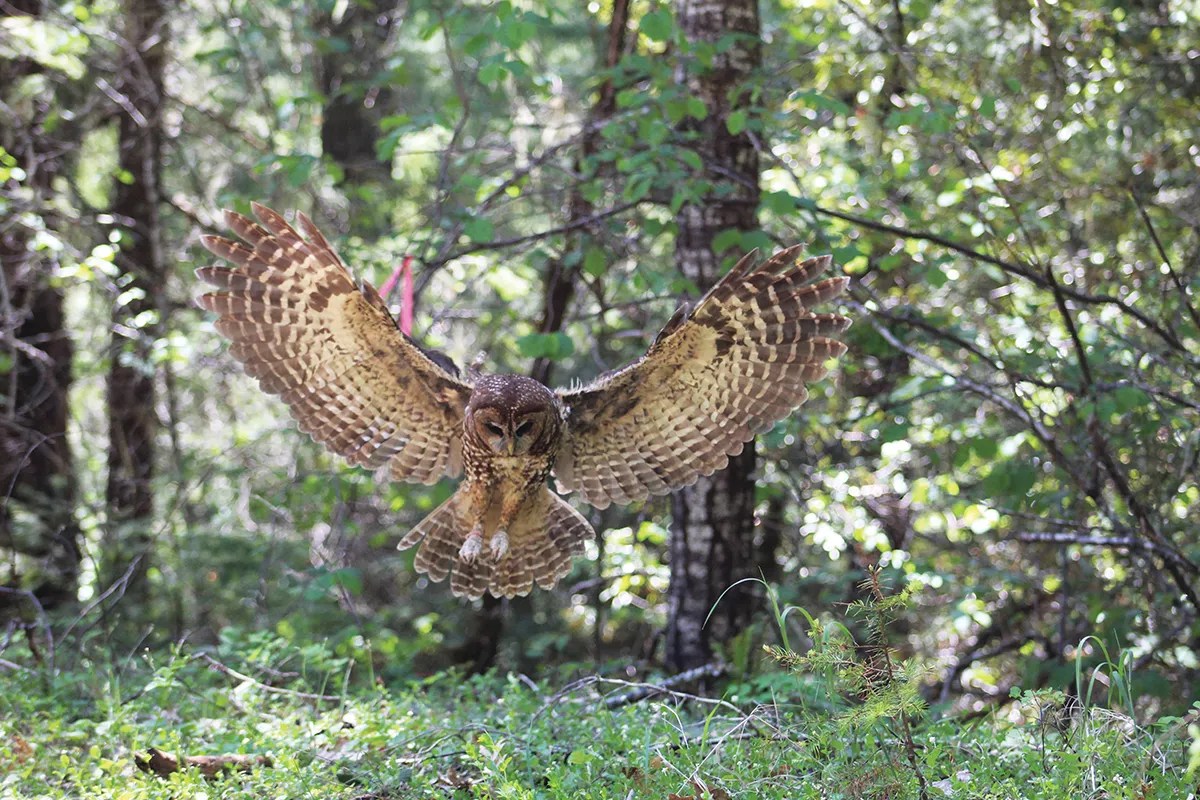
The Hoopa Valley Tribe was recently awarded a $4.5 million grant for the removal of barred owls from local forests as part of an ongoing effort to stave off the extinction of the native northern spotted owl by killing their invasive cousins.
The funding comes from the America the Beautiful Challenge program launched by President Joe Biden in 2021 with the goal of conserving “at least 30 percent of the nation’s lands and waters by 2030 and lifting “efforts to conserve, connect and restore the lands, waters and wildlife upon which we all depend,” according to an announcement.
This month, the public-private grant program, with federal partners including the Department of the Interior through the U.S. Fish and Wildlife Service, introduced 61 new grants with $122 million going to conservation projects in 42 states, 19 Tribal nations and three U.S. territories.

According to the Department of the Interior, around 42 percent of the program’s funding this year is supporting “projects implemented by Indigenous communities and organizations.”
“President Biden’s America the Beautiful initiative has been truly transformative. By working together across the federal family, and through private-public partnerships, we have built an enduring path to support hundreds of locally led collaborative conservation projects across the country,” said Secretary of the Interior Deb Haaland in the announcement.
“The America the Beautiful Challenge has advanced engagement with Tribes, funding a record amount of Tribally led efforts and elevating the use of Indigenous Knowledge to benefit endangered species and treasured landscapes,” she continued. “These innovative investments will leave a lasting legacy on our nation’s lands and waters.”
The Hoopa grant supports an ongoing study on reservation lands, with the stated project goal of eradicating “approximately 1,500 barred owls over four years to create large areas with reduced barred owl densities, providing time and habitat for northern spotted owl populations to recover,” according to the American the Beautiful.
Earlier this year, U.S. Fish and Wildlife released a controversial barred owl management strategy that calls for shooting thousands of the birds in target areas, including Humboldt County, over 30 years in an effort to save the northern spotted owl, which has been in a steady decline for decades. (Read more about the strategy in the Journal’s Oct. 10 cover story, “Combatting the Barred Owl Invasion,” here.)
Not only are the larger, brasher and more aggressive barred owls outcompeting their native cousins for food and pushing them out of their territories — impeding the northern spotted owls’ ability to breed — the barred owl has been rapidly expanding its range and population since arriving in the Pacific Northwest and California in the 1970s.
In addition, the barred owls have a more varied appetite than their cousins and their spiking numbers are negatively impacting the overall habitat and other species that evolved without their presence, including native predators beyond the spotted owl.
“Scientists have expressed concern that the barred owl’s breadth of prey and intensity of use could lead to cascading effects on the ecosystem and its food webs,” the strategy states. “This could affect not only spotted owls, but entire ecosystems.”
The USFW’s controversial management approach is built on the foundation of experimental barred owl removal studies dating back more than a decade — including the Hoopa study — that have shown promising results in stemming the tide of the northern spotted owls’ decline.
Since 2009, about 4,500 barred owls have been killed in North Coast removal programs, according to USFWS. Mark Higley, a wildlife biologist with the Hoopa Valley Tribe, recently told the Associated Press that number includes about 800 taken on a section of the reservation’s lands, where he conducts removals from early spring to fall.
“The problem has been we get like 60 to 100 new barred owls each year,” he says in the AP interview. “Don’t get me wrong; barred owls are a magnificent species. I just would really like to go see them where they’re native and not invasive.”
Related Stories

Combating the Barred Owl Invasion
This article appears in Flash Fiction 2024.