

One of the most common digs against Occupy protesters here in Humboldt County has been, “What the hell are they doing here in Humboldt County?” In the unlikely event that the CEO of Goldman Sachs has heard about the encampments in Arcata and Eureka, chances are he’s not exactly shaking in his Italian leather Guccis.
But even here in remote, working-class Humboldt County, a few people earn enough money to rank among the top 1 percent of wage-earners nationwide. They’re not exactly jumping up and down, asking to be identified, but they are here.
Before we get to that, it’s worth noting how successful the Occupy Wall Street movement has been at dividing the populace this way. Thanks to their brilliant slogan, “We are the 99 percent,” Occupiers stacked the deck in their favor, preemptively putting almost everyone on their side of the argument. Almost everyone.
The remaining 1 percent, as a group, looks downright rapacious under scrutiny. In the May 2011 issue of Vanity Fair, Nobel laureate economist Joseph Stiglitz helped lay the groundwork for the Occupy movement by saying the wealthiest 1 percent of U.S. citizens control 40 percent of the nation’s wealth. Other measures are similarly eyebrow-raising. Between 1979 and 2007, 1 percenters saw their average household income nearly quadruple while the rest of us stayed more or less flat, according to data from the Congressional Budget Office. Meanwhile their share of the country’s total income grew by more than 120 percent while the bottom 80 percent’s shrank.
Not everyone sees these numbers as problematic. Plenty of people (including many in the 99 percent) frame our cultural divisions differently, describing the wealthiest Americans as job creators, the very engines of our economy.
We decided to seek out 1 percenters here in Humboldt County to get their thoughts on the issues at play — income inequality versus class warfare; corporate welfare versus stifling the job creators, the right peaceably to assemble versus municipal camping ordinances, etc. This task proved more challenging than we’d anticipated. If there’s a local Warren Buffet — someone in the top 1 percent who’s willing to chat about it — well, we didn’t find him or her.
First we had to learn where the 1 percent line is drawn. Many in the Occupy movement talk about wealth and income as if they’re interchangeable. They’re not. Measuring wealth involves many variables, from age and income to personal property, debt and rates of return on investments. Not surprisingly, most analysts focus on income levels, which are measured by the IRS, the U.S. Census Bureau and numerous nonprofits.
Last month the Wall Street Journal produced a widget on its Real Time Economics blog that allowed readers to plug in their annual household income and find out where they fall in the 99 percent — or the top 1 percent; the cutoff was $506,600. Reporter Phil Izzo, who produced the widget, said he used data from the nonprofit Tax Policy Center. That group, in turn, uses a “micro-simulation model” that takes more than 600 words to explain.
We decided to take a straightforward approach, using IRS data on adjusted gross income. In 2009 (the most recent data available), the top 1 percent of individuals in the U.S. earned $343,927 in pre-tax income. If you made that much or more, you’re in the 1 percent. Congratulations.
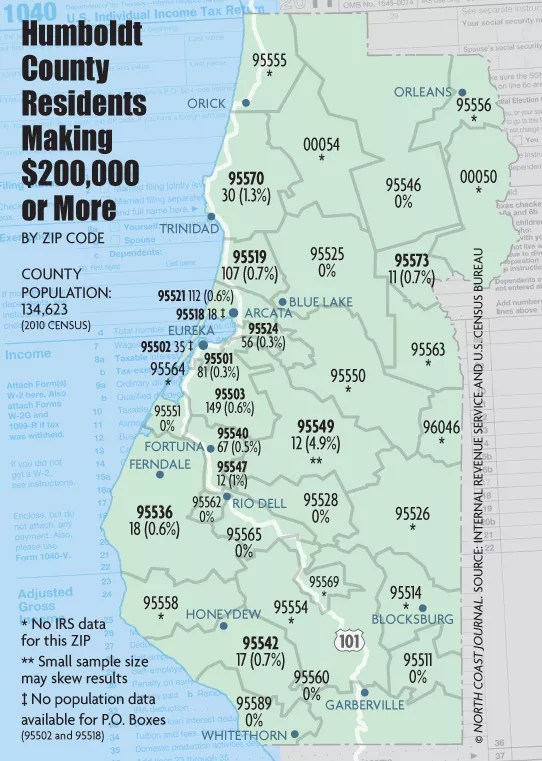
IRS reps said they couldn’t provide the total number of Humboldt County residents above the 1 percent threshold, for privacy reasons. They were able to point us the number of folks making over $200,000 — which puts them well into the top 5 percent (lower limit: $154,643.) We have more than 700 of them.
Working our way up toward the high-income peaks, we started by reaching out to locals who we know are there because their salaries are public: government employees and nonprofit executives. HSU President Rollin Richmond barely made the cut with a pre-tax 2009 salary of $352,920. Richmond couldn’t be reached because, according to an HSU spokesman, he was in “wall-to-wall meetings” in Long Beach.
Coast Central Credit Union CEO Dean Christensen easily cleared the bar, bringing in more than $1 million in fiscal year 2009-10. Reached by phone, he declined to weigh in.
St. Joseph Hospital CEO Joe Mark ($523,297) could not be reached. A St. Joe’s spokesperson said, “We are going to abstain from commenting.”
The Journal also called more than a dozen private-sector workers who we suspected might be in the top 1 percent. Very few returned our calls. Those who did either denied being in the top 1 percent or declined to comment. Security National CEO Rob Arkley was asked for his thoughts via email. He replied simply, “no interest.”
Patrick Cleary, president of Lost Coast Communications, said he was briefly part of the 1 percent, back when he was a Wall Street investment banker for Chase-Manhattan. “I know people don’t remember this,” Cleary said, “but there actually were ethics on Wall Street once upon a time.” When he was there in the 1980s and ’90s, he said, “you took care of your clients [and] did things in a gentlemanly way.”
He compared Wall Street’s transformation to that of the Pacific Lumber Co. after it was taken over by Texas businessman Charles Hurwitz and his Maxxam corporation. In other words, ruthless greed prevailed.
While Cleary finds labeling people problematic, he also believes there’s room to raise taxes on the wealthiest Americans without conjuring the demons of socialism and class warfare. “What I see is a worshiping of the 1 percent — ‘They’re the job creators; you can’t raise taxes on them in a recession,'” Cleary said. “I think that’s hogwash. I think we’re afraid to even have that discussion.”
This article appears in Occupy.

I’m one of the Humboldt 5%-ers. Last year my gross income was $247,000. I work hard and spend my money locally. I also help support two members of my family and my wife’s mother who can’t make it on her dismal SS checks. I refuse to allow my adult children to get grants for college. They are eligible because of their ages, but that just burdens the system more. Some people really need those grants. They don’t so I pay for it instead. I own a rental house and last year when my tenants (who have several small children) fell on bad times, I allowed them to live rent-free for seven months. Not looking for a medal here, just saying that not everyone in the upper income brackets are greedy slumlords or corrupt executives. Some people truly care about their families and their community.
I travel a lot for my job so I could live anywhere. I chose Humboldt for all the obvious reasons so many others have: the beauty, weather, and open-minded wonderful people. (The bud is nice too)
I’d happily pay higher taxes if that money would be used wisely. However, our governments have learned to excel at mediocrity. They are quite advanced at wasting money in needless administrative costs. Meaning, so often only a very few cents on the dollar get to the intended recipient.
There are plenty of tax incentives to give away money and I take advantage of those rules that allow me to give that money to whom I choose instead of giving it to the IRS. Sometimes I just give it away anyway, even if I can’t deduct it. Those that need the help should not be penalized just because the tax code doesn’t allow a deduction. Over the years lots of people (mostly family) helped me when I was struggling and I see the karmic value of passing in on.
You can’t legislate charity. Freely choosing to give money to others is something that comes from inside of you and if you try to legally force it, the cost of the enforcement will eat up a lot of the proceeds. Besides when a law says you have to give money away, it’s not charity any more. There’s something special about giving…the giver often gets more than the receiver.
There’s no need to live in a mansion and drive a beemer. Status never brought anyone true happiness. We live modestly in a small house and drive second hand cars. We have modest tastes and if you saw me around the county I’d just blend.
My point: the old saying that charity begins at home is true. Humboldt is our home and I call on other 5%-ers to step up to the plate…give away what you can, lord knows none of us need that much money and you sure can’t take it with you when you die. Leave something behind that will live on when you’re gone. Money isn’t the “something.” Charity and kindness are…those things last forever and you can’t lose them if the stock market crashes.
Simply – in appreciation of what you share.
To Simply:
Both Medicare and Social Security have far lower admin costs than their private sector counterparts. What programs are you referring to in your screed?
Also, don’t you think that it’s a huge advantage for many older people who received near free public secondary education over what young people are currently paying today?
At the end your post is just a sugar coated version of “Keep your grubby hands off my stuff”
“One of the 700”,
Like Harmony Thomas, I’d like to say “thank you.”
While Steve doesn’t put it very nicely, I think he has a valid point about administrative costs in medicine. I’m sure you are right that government entails waste, but I wonder if you might not have an inaccurate view of the amount of government waste as compared with waste elsewhere.
If we want a true safety net, government is the only legitimate way of maintaining it until we find ourselves in a utopia where most people behave with your generosity, responsibility, and moderation.
Mitch, yes, I might actually have an inaccurate view. I can see your point. You are correct that this government is all we have and it’s likely all we’ll ever have, so reform is the only answer. Utopia is a myth.
No need to thank me, though that’s kind of you. I do what I do because it’s what I need to do. I don’t do it for any other reason…even thanks. But you’re kind words are appreciated.
I think Steve brings some good points forward. He’s obviously a thinking person and he’s entitled to his opinion, even if he thinks I wrote a long-winded personal note. I guess it is personal and a bit long-winded.
Steve, I don’t understand your final comment
Cleary nailed it.
America isn’t ready for this discussion because mainstream media won’t allow it.
When was the last time ANY local media sought out the 1% to hold to some account?
Looks like the Occupy Wall Street movement has had some local effect after all.
Thanks Ryan.
I have a twenty five year old son who is basically homeless in your county. I actuaslly saw him on a live stream two weeks ago. He has mental health issues and believes whatever is going on in anti government at the time. I believe in waht you guys are doing but as for my son I fear for him. He has no income, no disability ssi. Lives whoever takes him in for the time being. He does have a marijuana card. This is form of medication-if he was here on the east coast he would be in jail. I love3 t5his country BUT not the present government. Seems DC doesnt listern to the people!