

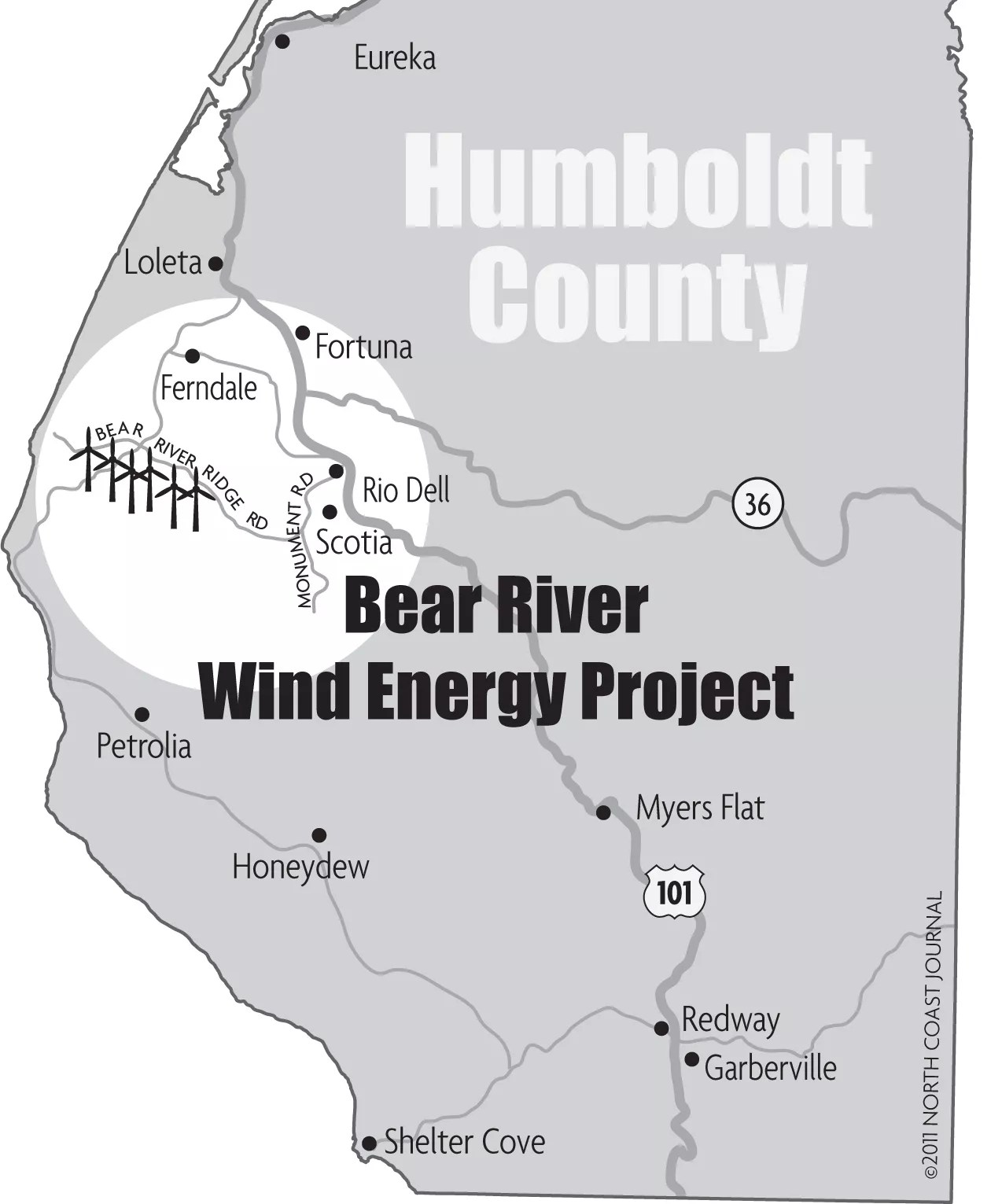
Shell WindEnergy, the corporate giant looking at building a 50-megawatt wind farm on a coastal ridge south of Ferndale, has a message it would like everyone in Humboldt County to understand.
When it comes to the Bear River Wind Power Project, tearing down homes and Victorian-era inns so that turbine-toting trucks will have room to make their way up to the high spot — known as Bear River Ridge — isn’t part of the equation.
“We will not take any homes. We will find an alternate route,” said Kevin Simmons, a Shell team leader for business development.
Ferndale resident Nancy Trujillo hopes that’s true, but she can be excused if she has her doubts. After all, until just a few weeks ago, she had no idea that her home, a 1,100 square-foot wood-frame bungalow, was even under discussion.
She learned that alarming fact one day in late July when she walked into the Cream City Cafe — a local hangout — and three or four people all wanted to know the same thing: What was she going to do about her house?
“I said, ‘I don’t know what you’re talking about,'” Trujillo recalled. “And they said to me: ‘Shell’s going to take your house down.'”
Soon Trujillo was reading a copy of the Ferndale Enterprise that had just hit the streets. Sure enough, there in black and white, in a front-page story, was ominous news.
According to a Shell consultant’s study done in March, the newspaper reported, one potential route for transporting turbine components would “certainly require the removal of the existing single family residence on the northwest corner of Fifth and Ocean.” Trujillo’s house, in other words.
“I was blown away,” Trujillo said. “It was the worst feeling in the world.”
Adding to her alarm was the fact that her residence, which she bought for $284,000 in 2005, is more than just her home. It’s also where she runs her business, a bookkeeping service called HumBooks, LLC.
Trujillo’s home wasn’t the only one targeted. According to that same consultant’s study, a house next to Trujillo’s might also have to be removed. So, under a slightly different transportation route, might a “multi-story historic building on the northwest corner” of Ocean Avenue and Main Street. That would be The Hotel Ivanhoe.
Ferndale, the “Victorian Village” out in pastureland southeast of Fortuna, is not happy. This stuff should be hashed out in public forums, residents wrote in a “letter of concern” to the town council, signed by 58 people.
In July, Shell met privately with officials in both Ferndale and Rio Dell.
“If everything is good and green about this project, why aren’t they providing this information to the public?” said Sandra Mesman, co-owner of Golden Gait Mercantile and one of the driving forces behind the letter.
The Ferndale Council seems to be getting the message. In a recent vote that City Manager Jay Parrish referred to as “guidance,” the council said future meetings with Shell must take place out in the open.
Meantime, in an apparent attempt at damage control, Shell officials are making appearances this week at — you guessed it — public forums on transportation and transmission lines. One is scheduled in Rio Dell on Wednesday, Aug. 31. A second, in Ferndale, is scheduled for Thursday, Sept. 1.
The intense focus on transportation reflects a basic fact about wind power: Wind turbines are huge.
How big are they? Well, the turbine blades are 150 feet long. And the towers, which will stand close to 260 feet tall once erected, are shipped in three pieces, each running about 85 feet.
Then there’s the nacelle, the housing for the generator at the tops of the towers. It’s extraordinarily heavy, about 80,000 pounds.
Transporting 25 nacelles to fit on top of 25 wind turbine towers, as called for by the Bear River project, is going to take its toll. “Certain road compaction requirements must be met,” was the way Shell’s Simmons put it in a telephone interview from Shell WindEnergy’s corporate offices in Houston last week.
The components would all arrive in Humboldt Bay by barge and be offloaded at a site that hasn’t yet been chosen. Then they’d be trucked down U.S. Highway 101. Once the transports leave the highway, things get thorny.
Simmons said any time a wind farm is located on a hilltop, “you’re going to have the issue of how to get the equipment up the road safely.” Construction and maintenance crews need year round access.
For the Bear River project, there is no good way to get up there. Shell has analyzed five different routes, three going through or near Ferndale and two going out of Rio Dell. All have problems.
The Ferndale routes, aside from having a few structures in the way, would travel a steep road beyond town. Wildcat Road, which eventually turns into Mattole Road, is also narrow, twisting and subject to landslides.
Given that, Simmons said, Shell is exploring the possibility of bypassing a portion of Wildcat Road and building several thousand feet of new road instead.
The most direct route to Bear River Ridge is southwest out of Rio Dell, either via Monument Road or Blue Slide Road. But these roads also present challenges in terms of steepness, tightness of turns and, in the case of Blue Slide Road, a less than sturdy bridge.
So road improvements will have to be made, Simmons said. Humboldt County’s Community Development Services Department estimates that large trucks delivering turbine components would make would make 850 trips, and construction workers would make 60 round-trips daily. That construction phase, the county says in a March 2011 “scoping report,” would also include more than 2,500 trips by dump trucks, concrete trucks, water trucks, cranes and other vehicles.
Simmons said some equipment could be flown in to lessen the impact.
“Whenever you run into problems on a project, you have to ask: ‘What can we do to mitigate this?’ In this case, airlifting in the blades would be one way to mitigate,” he said.
But mitigation has its limits. Helicoptering in the nacelles, for example, isn’t possible because of their weight.
“If those mitigations can’t be overcome, then you need to make some hard decisions,” Simmons added, sounding a bit like a man trying to give himself an out.
Actually, as the Ferndale Enterprise also reported this summer, a 2009 study done for Shell had stated flatly that transportation was “a potentially fatal flaw” for the entire project.
When asked about that last week, Rana Patana, a Shell spokesman, said the statement was still valid.
Patana said that Shell would likely finish studying the transportation issue sometime early next year and make a decision about whether to proceed with the project in the last half of 2012.
If it decides to go ahead, then a round of regulatory review — accompanied by extensive public comment periods — would follow.
Shell would need a conditional use permit from Humboldt County. It would have to prepare a Habitat Conservation Plan that satisfies the U.S. Fish and Wildlife Service about any potential harm to the marbled murrelet, an endangered seabird.
Pacific Gas & Electric Co. and the California Public Utilities Commission would also be looking over Shell’s shoulder because the Bear River project calls for building a 12-mile transmission line.
Asked when the project might actually go into operation, Simmons and Patana, along with another Shell official, Craig Scheffler, chuckled a bit during last week’s interview. Given the extensive regulations in California, they said it would be awhile.
After being pressed, Patana said: “The soonest would be by the end of 2014.”
As for Trujillo and her worries about her home, John Miller, the Humboldt County official in charge of reviewing the Bear River project, went out of his way to reassure her last week.
“I can’t imagine Shell would select an alternative that would include knocking down buildings,” Miller said. And even if the company did, he added, “That’s hardly something we’d recommend approval on.”
This article appears in Shooting Owls.
Ah yes, only in Humboldt County would they have such a problem with transportation. But where are the monster trucks in the story?
Um, the real question to ask is whether they are taking watershed rights underneath those mills.
This cracks me up. Humboldters go nuts when someone proposes erecting a cell phone tower. The road-widening project down South has been held up for how many years? How about the Waterfront project? How did this project get approved? I suppose anything labeled “Green” is okay. You want Green, you got it. lmao.
Yes, another easily handled objection to wind energy, leaving less air time to bore down on the cost-benefit analysis. The Emperor is getting chilly, but nobody seems to notice! I wonder what it would be like to live in California, but am sure glad I don’t have to find out!
So, let’s talk about “Tom Stacy.”
NIMBY, paid troll for Koch bros, or other? Who knows, but it’s safe to say we can easily discard his comment and file under “garbage.”
Environmental improvements and green energy are essential to the evolution of our planet, that’s clear. We need to wean ourselves away from fossil fuels and energy sources that are finite and politically complex; that is also true. But those very necessary efforts and noble mission statements cannot come at the “either/or” expense of destroying homes and viable, historical businesses merely for the transportation needs of the well-intended project! That is not only counter-productive to the spirit of environmental responsibility, but it is public relations madness!
Ferndale, CA is a small, very unique town whose entire “hook,” if you will, is its beautifully preserved and lovingly maintained “Victorian Village.” Small streets with picturesque vintage buildings, historic hotels and storefronts, all cared for by its townsfolk and enthusiastically visited by thousands of tourists who enjoy the old-time ambiance and rural charm of this town on the Historic Registry. It is not a generic, monochromatic “freeway town” whose loss would hardly be noticed. It is one of the gems of Humboldt County and, as such, engenders much passion and protection from its citizens.
So tell me, how does it make public relations sense for Shell Oil to even hint at the possibility of using Ferndale as its “road in” to this monstrosity of a project, particularly when the use of that fragile route would erode the Ferndale’s byways, the foundations and historic buildings by virtue of the tons and tons of trucks marauding through there many times a day? And even worse, how does it justify, even the suggestion of destroying one of the oldest and most beloved establishments in town (the Hotel Ivanhoe) and destabilizing the peace of mind of homeowners such as Nancy Trujillo whose home is threatened with destruction? How does Nancy sleep at night imagining the devaluation or loss of her home? I am outraged for her and for any of the others who will now have to live for months before all these “hints” are either enacted or dismissed.
We cannot, in our effort to take advantage of wind energy or any other admirable form of ecologically sound energy, sacrifice entire towns, businesses and deeply valued environments. And we’re not talking about a project that will actually be IN Ferndale; we’re talking about sacrificing Ferndale so the project can simply drive THROUGH there! Madness. There simply has to be another way. And, Shell Oil, it’s your job to figure it out and until you do, you will not have the support of even environmentally conscious people who support the intent, but refuse to accept the Solomon’s Choice you have proposed. There has to be another way…
I was about to write something really, really angry and unreasonable about this ridiculous NIMBY-ism, but I’ll bite my tongue and limit it to one comment:
“We cannot, in our effort to take advantage of wind energy or any other admirable form of ecologically sound energy, sacrifice entire towns, businesses and deeply valued environments.”
Yes, yes we CAN. The entire planet is involved in a war with itself right now. We have two choices: Drastically change our way of life, or take responsibility and deal with the consequences. It’s not going to be easy, it’s not going to be fun, but it’s the only choice.
There was no electric grid when Ferndale was first built, so maybe they want to just turn the power off and go back to those days as a Victorian Village. Or maybe they want to move one of the new generators from the PG&E plant into town.
Six months of construction trucks in an area where there used to be literally thousands of huge logging trucks hauling old-growth redwood trees right through the middle of town is not exactly much of a price to pay in exchange for a third of the county’s energy being supplied without relying on an out-of-area natural gas pipeline that runs directly across an earthquake fault.
Not to mention the fact that we’re due for a magnitude 9 earthquake on the Cascadia Subduction Zone fault some time in the next few decades, at which point it’s quite likely every building not built in the last couple of decades will be a pile of rubble, anyway.
All you need to do is look at what just happened to the east coast, or what’s happening due to the typhoon in Japan right now, to see what the penalty for not doing anything is. The 1964 flood caused incredible damage to the area, and that kind of thing is entirely likely to be a regular occurrence in the next hundred years.
One wind farm isn’t going to stop that from happening, but it’s a necessary step to do our part. If doing my part meant putting up a 2MW wind turbine in my back yard, I would gladly do it.
If Ferndale and the other NIMBY squeaky wheels get this plan scuttled, I will personally boycott the town’s business for the remainder of my days, and encourage everyone else I know to do so as well.
I realize that there are probably plenty of people in Ferndale and the area who aren’t against this plan, or have reasonable, valid concerns, but I did not think it was possible for me to be so angry at a small town in Humboldt County
If all aspects of this project work out, conservation, environmental, etc. and the only hold up is the lack of appropriate roads, how about using those helicoptors that logging companies use to haul out whole trees from steep terain.
If anyone can’t see a problem choppering in long items into a wind prone area…..
Well, I’ll let you think about that for a bit.
Without thinking, windmills sound very green. However, to sacrifice virgin land on a fault created ridge separating salmonid streams and over flown by marbeled murrlets… to run miles of transmission line through unwilling owners’ yards… to destroy a small town’s roads and businesses… all in the name of “environmentalism” is shallow green, if indeed it can be claimed to be green at all.
To threaten boycott against people whose properties and businesses are at risk for seeking to protect themselves is also shallow and not environmental either.
Environment means “everything which surrounds us.” That’s not only trees and cows, but homes and businesses. I don’t think there many in Ferndale where I live would be against this project if it were adjacent to infrastructure already capable of dealing with it.
However, what no one, including this newspaper has pointed out is that during the entire construction the towns of Petrolia and Honeydew would be isolated. Anyone entering or leaving those towns would be required to drive an extra hour to hour and a half (depending on where you start from) to get to Ferndale or Fortuna.
Now, tell me how causing people to buy all that extra gas, and burn up all that gas to get around the construction which itself is burning a huge amount of fossil fuels, to run that many trucks at 5mph up to the ridge and back down again, tell me how environmental that is?
Maybe the folks in Ferndale have a clearer vision of the long-term profit-making plans this Houston based company has for our area than people who take shots at others, but are too afraid to leave their name.
I’m not a company shill. My name is here. Read anonymous comments with caution, we all know anyone can post anything in an effort to sway editorial or public opinion.
And here’s one more thing Ferndalians know. The whole project is being done, not really for profit – because it is not economical – but for huge Federal Government Subsidies, which we all pay.
So this isn’t economic. This isn’t environmental. Instead, it’s pure corporate greed. And 20 years later when their project is “over,” the local people will be left with the ruins to pick up and the eternal effect on currently undisturbed land.
Don’t fall for shallow green. The green this company represents is the deep, deep green of Federal subsidies, a milk so pure and dark that the average welfare mom is green with envy.
And while we’re at it, here’s a link to a trailer for a new documentary coming called “Windfall, the Movie,” a frank, very sobering film about the unexpected and irrevocable and, unfortunately, negative impact wind farms have had in some local, rural communities. Take a look and see if you can get beyond cliches, knee-jerk reactions, and hollow accusations. There’s a bigger picture here than many of you might realize:
http://windfallthemovie.com/index_1.html