|

COVER STORY | IN
THE NEWS | ARTBEAT
TALK OF THE TABLE | THE HUM | CALENDAR
June 29, 2006
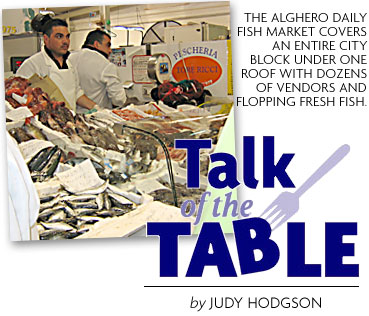
Organic Sardinia
My teacher asked
me where I came from, the place of my birth.
" So, you are Los Angel-ese?"
she said in Italian.
"No. Besides, I left L.A. in 1967 -- novemilesessantasette.
I live in the country, a place called Fieldbrook," I replied.
"So, the people there are Fieldbrook-ese?"
This spring my husband and I took a fantasy vacation
for our 40th anniversary, six weeks in Italy. We chose Alghero,
an ancient, small port city the size of Eureka on the island
of Sardinia. The sun shone every single day, and each weekday
I met for an hour or two with my Beginning Italian teacher. Alesandra
spoke no English.
By the third week, words were coming out of my
mouth, but communication was still a bit fuzzy. I learned that
no one in Italy is actually called an Italian. My teacher was
Algherese, so were her parents, grandparents and tutti
-- everyone else, even those who lived in the country nearby.
We eventually decided I was a Californian -- from
the state of Hollywood, the Golden Gate Bridge, with Las Vegas
nearby.
When my language skills improved, I told her about
the rainy, cool far North Coast of the state, the Native American
tribes and the people who came later, including immigrants from
Italy and the Azores who came to fish and run dairies.
One day I told her about the growing niche market
for organic dairies and cheese. I said consumers today actually
are willing to pay more money for organic products and food grown
locally.
She broke out laughing.
"There are cow factories in (mainland) Italy,"
she said, "but all of Sardinia is organic. Cows eat grass
and the manure goes on vegetables."
Sardinia, we decided together, is very trendy by
being so far behind.
My husband and I love to travel, to experience
other cultures, but mainly we love to eat good food. We had traveled
in Italy before, so we quickly fell into the daily routine of
life, shopping at the various markets and cooking in our apartment,
or dining out. For breakfast, we simply had a cappuccino and
a small biscuit. And a second cup at 11. Any coffee consumed
during the remainder of the day was black, very concentrated
and served with just a shake of sugar. Italians often down the
sweet hot liquid in one gulp.
By 1 in the afternoon it is time to stop whatever
you are doing, gather with friends and family, and eat. For
antipasti, we sometimes had paper-thin crispy bread drizzled
in olive oil and sprinkled with salt, or prosciutto and melon,
or olives and firm sheep's milk cheese. One favorite antipasto
of my husband's was lardo -- a raw, super-thin sheet of
pig fat wrapped around a plump prune and a chunk of creamy Gorgonzola.
These morsels, however, were just to wake up your
appetite. The first real course every single day was pasta, and
since seafood is plentiful and so very good, we often ate spaghetti
al mare, loaded with tiny clams and big mussels with wine,
garlic and flat-leaf parsley. The few days we did not eat pasta,
we ate gnocchi with a light tomato-cream sauce, or another pasta
like the flat noodle pappardelle with bits of wild boar.
The midday meal is accompanied by wine of course,
most often a good quality house wine. In Alghero, we often drank
a white from a grape called vermentino, or a red cannonau.
A large liter of water, fizzy or natural, always accompanies
the meal. Italians, we learned, are as picky about the quality
of their bottled water as they are about their wines. When you
share a liter of water along with a carafe of wine, you stay
hydrated, no one gets drunk and you can actually go back to work,
if necessary, a few hours later. By the way, workers and children
go home for three hours to share the midday meal with their families.
The second course is usually fish or a thin piece
of grilled meat accompanied by "sides" of vegetables
and/or a salad. Once or twice we were served salad first because
the waiter decided we were not Italian. Actually, I now prefer
the salad later. There is something very comforting about eating
pasta and sipping wine first, especially on an empty stomach.
I am not a dessert person, but by late afternoon
we often were craving a good gelato. I don't know why Italy makes
the best ice cream in the world, but it's true. For dinner --
which is never served before 8 or 9 p.m. -- Italians may do the
two-hour, multi-course meal all over again. But more likely they
will order just one dish or an individual wood-fired pizza ...
plus more good water and wine.
One footnote: We couldn't help but notice that
the obesity epidemic has not hit Italy -- yet. In a group of
40 young schoolchildren, you may see one or two of them overweight.
The reasons, of course, are many ... and the subject of a column
for another day.

COVER STORY | IN
THE NEWS | ARTBEAT
TALK OF THE TABLE | THE HUM | CALENDAR
Comments? Write a
letter!
© Copyright 2006, North Coast Journal,
Inc.
|