|

COVER STORY | IN THE NEWS | OPINION | ARTBEAT
| STAGE MATTERS
TALK OF THE
TABLE | THE
HUM | CALENDAR
SUMMER ACTIVITIES FOR KIDS
| SUMMER FESTIVAL GUIDE
June 1, 2006
North Coast theatergoers
are among the 120,000 annually who trek to Ashland for several
days of plays at the Oregon Shakespeare Festival. This column
is about plays they can see this summer. I'll have more on the
OSF experience next week, along with a review of Chicago
at North Coast Rep, which opens June 1.
Ashland is tucked in a serene valley sheltered
by hills and mountains, gently suggesting the topography of Shangri-La.
The restored full version of Frank Capra's Lost Horizons
reveals that mythical place to be a refuge for the best art and
thought of a besieged humanity. After a few days of experiencing
Ashland and seeing plays in two of the best-designed theatres
I've ever encountered, I was prepared to endorse the phrase used
by OSF publicist Eddie Wallace, who called Ashland a "theatre
Shangri-La."
Of the four plays I saw on our trek in mid-May,
two were by contemporary playwrights. Up, by Bridget Carpenter,
is being produced for only the second time anywhere. Set in today's
San Pedro, its central character is a man (played by Richard
Howard) who once became famous for attaching weather balloons
to a lawn chair and soaring to airliner height (based on a true
incident), but is still searching for something as fulfilling
for his life's work. He adopts as his inspiration the Frenchman
(U. Jonathan Toppo) who walked on a tightrope between the Twin
Towers in 1974 (also a real incident). But the play is as much
about his wife, a letter-carrier whose faith in him is waning
under financial pressure (Terri McMahon) and their teenage son
(John Tufts), who befriends a pregnant teenage girl (Christine
Albright) new in town, and her deep-drawling, Tarot-reading,
entrepreneurial aunt (Robin Goodrin Nordli).
Crisply directed by Michael Barakiva, with energetic
and pitch-perfect performances, the play is very funny, so you
might not realize until later that every character did something
very cruel to another. Playwright Carpenter worked on the play
specifically for this production and it takes wonderful advantage
of the capabilities of the 300-seat New Theatre, with panels
flying open and the tight-wire over the suburban kitchen. The
ending is a problem, but it's an involving and provocative play
throughout.
Intimate Apparel by contemporary playwright
Lynn Nottage is set in early 20th century New York, and concerns
a modest young African American seamstress (Gwendolyn Mulamba)
whose correspondence with a man from Barbados while he is laboring
on the Panama Canal (Erik LaRay Harvey) leads to marriage. Their
lives intersect with a wealthy and lonely white socialite (Terri
McMahon), a ragtime piano-playing prostitute (Tiffany Adams),
a Jewish cloth merchant (Gregory Linington) and a maternal landlady
(Perri Gaffney).
This drama (directed by Timothy Bond) uses graceful
language, generous acting and expressive staging (with scenic
design by Richard Hay) to portray complicated and often warm
relationships, in an historical context in which we see class,
race, ethnicity, gender roles, economics and even technology
influencing the fates of the characters. The audience in the
600-seat Angus Bowmer Theatre was spellbound, and audibly got
the main character's final secret, expressed in a single gesture.
Lynn Nottage is a fast-rising playwright, and Intimate
Apparel is a solidly built and subtle play. But the more
eccentrically structured and uneven Up had the virtue
of being continually surprising, and provoked a lot of spirited
discussion and differences of opinion on the play's meaning and
merits of various characters (such talk is frequent around Ashland).
Catch it if you can before it closes on June 23. Intimate
Apparel continues through October.
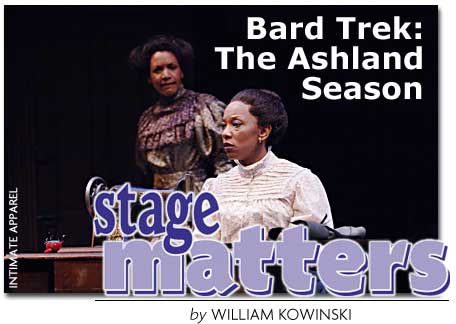
[Photo above: In Intimate Apparel, Esther
Mills (Gwendolyn Mulamba) endures Mrs. Dickson's (Perri Gaffney)
exhortations to join the engagement party downstairs and stop
feeling sorry for herself. Photo: David Cooper.]
In Oscar Wilde's The Importance of Being Earnest,
Kevin Kenerly and Jeff Cummings are fully satisfying in the male
leads, but it is the women that distinguish the production, directed
by Peter Amster. Heather Robison and Julie Oda as the young ladies,
and Judith-Marie Bergan as a more handsome than usual Lady Bracknell,
emphasize the sometimes neglected female half of the play, adding
new colors to this classic comedy. And the wit still works.
But what of the Bard? OSF's outdoor Elizabethan
Stage opens in early June with The Merry Wives of Windsor
and The Two Gentlemen of Verona (along with the play getting
the most advance buzz, Rostand's Cyrano de Bergerac).
King John begins in the New Theatre on July 4. But the
season is anchored in the Bowmer by Shakespeare's The Winter's
Tale, directed by OSF Artistic Director Libby Appel.
It begins with a burst of color, music and motion
— thanks to the excellent sound system as well as the staging,
it duplicates in the audience the mood of the characters as we
first see them. The court of the mythical Sicilia is joyful at
the reunion of its King with his childhood friend, now King of
the equally mythical Bohemia. But in the midst of revelry a single
light flashes on the face of the King as he reveals his paranoid
fantasies about his friend's involvement with his wife, Queen
Hermione. A tragic course is set, with murderous plots, betrayals
and death. But this course is broken and even reversed, in part
by intervention of the gods, and in part by love.
This late play has some of the earth-magical qualities
of The Tempest, with echoes of Greek drama and several
of Shakespeare's previous plays. The production features powerful
performances by Miriam A. Laube as Hermione and William Langan
as King Leontes, and performances by the entire cast that make
the story crystal clear as well as affecting and funny, played
against the apparently simple but highly evocative scenery of
Rachel Hauck.
Also featured is Mark Murphey as the trickster
Autolycus, whose antics delightfully prove that physical comedy
can serve a substantive text, both as relief and as integral
to the story. Shakespeare's plays are timeless partly because
they speak in different ways to every time, and in this one I
was struck by how those who served this king felt honor-bound
to dissuade him from his disastrous course. Too bad they aren't
serving in the non-mythical Washington.
I recommend all the plays I saw, but don't miss
The Winter's Tale. Also currently at the OSF are two I
didn't see: the new Wendy Kesselman adaptation of The Diary
of Anne Frank (until July 9) and Bus Stop by William
Inge (through October.)
For show dates, ticket prices, etc. go to www.osfashland.org.

COVER STORY | IN
THE NEWS | OPINION
| ARTBEAT | STAGE
MATTERS
TALK OF THE
TABLE | THE
HUM | CALENDAR
SUMMER ACTIVITIES FOR KIDS
| SUMMER FESTIVAL GUIDE
Comments? Write
a letter!
© Copyright 2006, North Coast Journal,
Inc.
|