|

COVER STORY | IN
THE NEWS | OPINION
| ARTBEAT | STAGE
MATTERS
TALK OF THE
TABLE | THE
HUM | CALENDAR
SUMMER ACTIVITIES FOR KIDS
| SUMMER FESTIVAL GUIDE
June 1, 2006
When you take out your camera
at the Grand Canyon to snap a picture, if you're not paying attention
you could end up with the National Park Service trashcan in the
lower right hand corner of your photo. If you are paying attention,
you can move your camera a skosh and there is your photo of pristine,
untouched wilderness. And there you have it — the camera's dual
capacity to tell the bald truth and to lie like a rug.
The accuracy of likeness that a photograph achieves
causes the viewer to think that a picture is telling the whole
truth, but it really isn't. Even before photo manipulation software
like Photoshop, absolute faith in the veracity of a photograph
was a bit naïve. A photograph may be an accurate representation
of a scene at a given moment, but reality is not a given moment.
Reality changes constantly. Reality is also much larger than
a four-by-five frame. The limited space and time captured in
a photograph changes reality more then we realize. For example,
have you ever looked at a photograph of someone you love and
thought, "That's not what they look like!?" It is what
they looked like for the fraction of a second that the lens was
open, but you see them as a constantly moving, ever-changing
being, which is different from the snapshot representation.
And back to the example of the Grand Canyon photo.
By excluding the trash can, the photograph may imply unspoilt
natural beauty, but the reality is that there are very few places
left on the planet that are untouched by humanity.
And this brings me around to the point of this
article and the point of the nine-person photography show at
Piante Gallery in Eureka. The show, called The New Landscape,
includes the work of eight local photographers and one from the
Bay Area, all showing their interpretation of this fairly new
genre. In 1975, an exhibition called New Topographics,
curated by William Jenkins, popularized a style of landscape
photography that turns away from the idealism of Ansel Adams,
emphasizing the documentary nature of the medium. Instead of
bringing the grandeur of wild beauty to the viewer, these photographs
confront us with nature as we have marked it. They are not always
critical statements of man's destruction (although that certainly
has been done) but can simply be a representation of how human
culture mixes with nature.
The photographers for this show are J. Patrick
Cudahy, Michael Harris, Vaughn Hutchins, Suk Choo Kim, Ben Nixon,
William S. Pierson, Jim Toms, Bruce Van Meter and Joseph Wilhelm.
The theme of The New Landscape was meant to be inspiration
and not a guideline, so each of the artists have taken their
own interpretation of the idea, making for an interesting mix.
Joseph Wilhelm's photographs probably most closely
follow the tradition of New Topographics. His images come
from a road trip down Highway 95 in Nevada. The wide open scenery
is touched subtly but very distinctly by humans — say by graffiti
or, in one case, several pairs of shoes.
Vaughn Hutchins' approach to landscape touched
by humanity is to photograph his triplet (yes, that's three)
sons among the redwoods. He states that the images are about
his sons' relationship to the environment as well as their relationship
to him and his camera. I like the juxtaposition of the boys,
tiny but quite present amid the towering redwoods.
In reading the artists' statements, one theme presents
itself, and that is the theme of nature's regenerative powers.
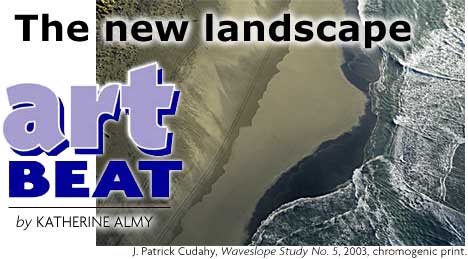
Patrick Cudahy talks about nature's ability to "draw and
redraw her palette." Michael Harris is intrigued with the
way nature reclaims abandoned human-made objects. His images
are "reflections of the impermanence of all things, and
the capacity for regeneration."
Ben Nixon's images also touch upon this theme in
a more subtle way. His images are of churning ocean waters pounding
on coastal rocks. He states that he is drawn to the coast by
news of the steadily rising oceans, but rather than focusing
on the devastation of man's impact on the environment, he allows
his photography to teach him "to see the landscape with
new eyes and insight. Scale and compression become very important
in these images."
Jim Toms takes an unusual approach. His images
include old postcards of Eureka and Arcata in photographs of
the location pictured in the postcard. He states that in some
photographs, change is hardly noticeable, but human impact is
apparent in all of them. Bruce Van Meter's manipulated images
layer human-made architecture over natural landscapes with a
haunting effect.
Suk Choo Kim and Bill Pierson were the instigators
of this show. These two artists have been photographers for many
years. Bill has always been drawn to landscape and the way "reflected
light ... falls upon the world." Suk Choo Kim's work draws
on a broad range of interests and influences. Among the images
included in this show are austere water images with subtle reference
to humanity.

Looking at these images
got me thinking about the topic of art and environment, which
has helped me gear up for an Art Tour that I'll be guiding as
part of the upcoming North Coast Open Studios. If you're an avid
fan of Open Studios, you may be interested to know that this
year they've added a new component: five guided, themed tours.
On June 3, Keith Schneider hosts Hot Art — Ceramics and Glass;
June 10 is Animals in Art with Libby Maynard; June 11
is Paintings in Vibrant Color with Frances Boettcher;
June 17 is Spiritual Dimensions of Art with Anne Pierson;
the last tour, on June 18, is Art and the Environment,
led by yours truly. Each tour includes lunch and visits with
five to six artists who will talk about their work and how it
relates to the theme. Find out more and register at www.northcoastopenstudios.com.
Got a local exhibit or art event
that might make a good story? Send your art news to almy@arcatanet.com
or write in care of the North
Coast Journal, 145 South G Street, Suite A, Arcata, CA. 95521.
COVER STORY | IN
THE NEWS | OPINION
| ARTBEAT | STAGE
MATTERS
TALK OF THE
TABLE | THE
HUM | CALENDAR
SUMMER ACTIVITIES FOR KIDS
| SUMMER FESTIVAL GUIDE
Comments? Write
a letter!
© Copyright 2006, North Coast Journal,
Inc.
|