


In this week’s cover story on the not-so-sleepy town of Loleta, Heidi Walters recalls the town’s late-19th century days as a railroad depot known as Swauger’s Station. “The townspeople,” reports Walters, “changed the name in 1897 to Loleta — a Wiyot term, lo-le-tah, meaning “pleasant place at the end of the water.”
Ah, how sweet and idyllic. And indeed, that appears to be the official word on the matter.
But today, a dim memory rose to the surface of our collective Journal-brain: Some years ago, National Geographic published an interactive map of the United States filled with definitions of town names derived from Native American languages. If you click and hover over our region of the map, you see this:
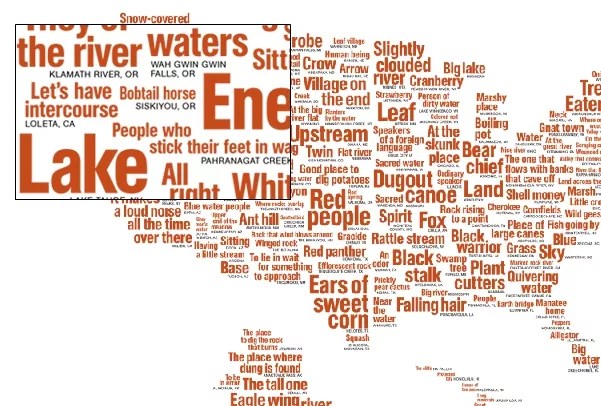
“Let’s have intercourse”?! Could this possibly be true?
Well, yes. At least according to Trinidad resident Ellen Golla, who wrote a letter to the editor of the Times-Standard back in 2007 recounting the following tale:
In 1893, the residents of what was then known as Swauger’s Station decided to change the town’s name. Mrs. Rufus F. Herrick consulted a Wiyot elder to find an appropriate indigenous appellation. The Indians actually called it katawólo ‘t.
A joke was played on Mrs. Herrick. The elderly gentleman told her that it was hó wiwItak. This does not translate as “beautiful place at the end of the river,” but rather “Let’s have intercourse!”
She interpreted the last part of the phrase, in baby-talk fashion, as Loleta. And thus she suggested “Loleta” to the residents of the town, which they accepted.
Golla cited as her source the 1970 tome “California Place Names” by the late Edwin G. Gudde, a former professor of linguistics and anthropology at UCLA. We tracked down the citation, and it turns out Gudde’s definition has an even more plaintive and explicit tone: “Come on, let’s have sexual intercourse.” (Emphasis added.)
And here we find another source, “Native American Placenames of the United States” by William Bright, that says essentially the same thing. Both authors identify their source as Karl V. Teeter, a linguist who worked extensively with the last native speaker of the Wiyot language and published a book called “The Wiyot Language” and a two-volume Wiyot Handbook, according to his obituary.
So there you have it, folks. Loleta is not just a town with a cheese factory, a meat market, a bakery and lots of nice folks. It’s also a garbled plea for sex.
This article appears in Main and Loleta.

Um…let’s not.
This is how linguist Teeter explained it:
Mrs. Herrick was a person the Indians felt condescended to them, and they bore her little love in return. When she asked a certain old Indian to tell her the Wiyot word for the place…but he was not in the mood to give out the information, and answered instead…”Come on, let’s go to bed.” (We paraphrase an unprintable word…)
Karl V. Teeter, “Notes on Humboldt County, California, Place Names of Indian Origin,” in NAMES v.6, no.1
Hilarious!
Thanks for that, Gisela. From what I’ve been able to find out about the Herricks, I’m not surprised. They had a long history with the Indians, beginning, it seems, when Mr. Herrick worked for the government “collecting” some of them for relocation (http://www.onlinebiographies.info/ca/humb/herrick-rf.htm). One can imagine.
I wrote the letter to the Times-Standard. I’d like to point out that they printed it with a few things missing. They didn’t know, apparently, how to typeset some of the phonetic characters in the Wiyot phrases and so they just left those letters out. The correct versions are in William Bright’s dictionary. William Bright also edited a newer version of Gudde’s dictionary, and that was the version I was citing (something also left out of my letter).
So there’s a bit of an edit war going on on the Wikipedia page. I had added a summary of this article and the various cites last week. One of the regular editors has completely thrown out my edit and dismisses all of the cites that originate from Teeter’s work:
https://en.wikipedia.org/wiki/Talk:Loleta,_California#Let.27s_be_consistent_with_the_edit_rules.2C_shall_we.3F
My name is Joan McMillan , Martha Herrick was my Fathers’ Great Grandmother. His name was Robert McMillan . His Great Uncle was Ralph Herrick . My Father and Mother divorced Many years ago and I never knew much about him,I was only a couple of years old. Marthas’ daughter ,Gladis Herrick did not seem very friendly to us but Uncle Ralph seemed to care about us ,I liked him alot . He died several years ago ,and his death was a mystery, and we always wondered what happened to him,where he was buried and what happened to the ranch or home he owned. If anyone knows anything about him,please contact me at-707-875-9442 . I also wondered about the real and true facts concerning Rufus and Martha Herricks’ relationship with the local Indian families and tribes ,I would like to hear their side of the stories. Why are all the business’ etc. abandoned and shut down? I would like to learn about your sweet little town-Please leave contact info.on our voice mail if I’m not available. Thankyou and take care everyone !