 
COVER
STORY | IN THE NEWS | THE HUM | CALENDAR
January 5, 2006


PARTY ON THE BRIDGE: All afternoon and into
dusk, people traipsed up and over Fernbridge and down the other
side, to where the Eel River flowed over the road. Some came
in colorful, chattering groups -- whole families, clusters of
foot-kicking boys, kids walking the dog -- while others wandered
alone up over that bridge to take a gander and film the fast
water, the islanded telephone poles, the submerged fence, the
swamped distant barn and the logjam against one of the bridge
supports, against which water slammed and swirled violently.
It was Wednesday, the rain had been falling steadily,
and sometime in the day local law enforcement had closed the
road, cutting off the main route into Ferndale. "We're going
to take Blue Slide Road," one strolling boy told a neighbor
in passing. "Blue Slide Road" was murmured a fair bit
out there on the bridge. Other than airlift, death or maybe a
log ride, it was the only other way in or out of Ferndale, via
Rio Dell (later that night it would close for awhile, when a
sinkhole formed in the road).
But nobody seemed in a real hurry. It was as if
they'd been granted a sudden holiday and were eager for the excuse
to take a leisurely walk in the half-sunlit afternoon along that
temporary park-like pedestrian walkway. If hotdog and cotton
candy vendors had suddenly popped up on the crest of the bridge,
it would have seemed the most normal thing in the world. One
man in a family cluster peered across the widened span of the
Eel and said his folks lived over there in Ferndale. "Are
they OK?" someone asked him. He squinted and tilted forward
a bit. "They've got their fishing poles out the window."
While most people moved steadily along, pushed
by the current of curiosity to get closer to the spot in the
road where the river blended with pavement, one woman stood in
the middle of the stream of people coming and going, smiling,
slowly turning to take it all in. Finally she drifted to the
upstream side of the bridge, pulled over by the sight of an approaching
floating block of white. "What do you think it is?"
another drifter asked her. "I think it's a refrigerator,"
she said. More people settled at the edge of the bridge to watch
the white block bob toward them and speculate. "Looks like
some kind of a cabinet," said someone. But when it passed
under the bridge you could see it was a fridge, doorless, bent,
headed for sea. Everybody smiled, sighed, said things akin to
"gee whiz," snapped more photos, said it wasn't like
the old days "when huge logs would fill the river,"
then wandered back down to the 101 side and their cars. It was
a big flood, most agreed, but not the biggest. And that night,
after the river crested at 4.71 feet above the 20-foot flood
stage, it slacked off. But that was just the beginning. The river
would rise again, a bit higher, and the initial party-like atmosphere
felt out on the bridge would wear into a prolonged sort of weather
hangover throughout the county.
HOW HIGH'S THE WATER, MAMA? Rain fell, rivers
swelled, wind lashed, trees crashed, tides rose and a massive
storm surge joined the party. And it was that higher-than-expected
storm surge -- along with its simultaneous convergence with high
tides and big winter waves -- that made the past week's storm
memorable. "The astronomical high tides happen to occur
in the winter because of the position of the sun and the moon,"
says Troy Nicolini with the National Weather Service's Eureka
office. So they're to be expected, as are the big winter waves.
But what happened over New Year's was the addition of stupidly
strong winds, which moved the already tide-high, big-wave water
from south to north and then, in what is known as the Coriolis
effect, Nicolini theorizes, the wind veered right (east) "and
piled the water from the bay onto the highway." Nobody's
seen that happen before, he says.
"We were surprised by the strength of the
winds," says Nicolini. The weather service had predicted
wind gusts would reach 45 to 50 miles per hour for the early
morning of New Year's Eve. But at 9:43 a.m. the weather service
office at Woodley Island had clocked the wind at 64 mph. The
Coral Sea, docked at the Woodley Island marina, clocked a gust
at 97 mph.
Meanwhile, the rain kept falling. Honeydew, because
of its high elevation, southwest orientation and its being the
first-in-line for moisture coming from oceanward, got 11 inches
of rainfall in 24 hours. The county overall averaged 5 inches
per storm during last week's two-storm wallop. The rivers rose:
During the first storm, on Wednesday last week, the Eel River
crested at 8 p.m. at 24. 71 feet. Flood stage is 20 feet. It
got within inches of flooding at Miranda and a foot below the
flood stage at Scotia, says Sten Tjaden, a meteorologist in the
Eureka weather service office. The rain let up, the tide went
out, and the river dropped some. Then the second storm hit: By
late afternoon/early evening of New Year's Eve, the Eel had crested
at 25.38 feet. It was the sixth highest level in the river's
recorded history, say the NWS' Troy Nicolini.
Up north along the coast at Klamath, the Klamath
River had begun flooding at 7 p.m. on Dec. 30 (flood stage there
is 38 feet) and by 5:15 a.m. on New Year's Eve the river had
crested at 47.12 feet by. It was the second-highest recorded
level, topping 1997's 43.8 feet but a far cry from the 1964 flood,
when the Klamath rose to 65.29 feet. The Klamath didn't quite
reach flood stage at Orleans, and the Trinity fell short of expectations,
says Nicolini. (And, contrary to local mythology, snowpack --
when there is one -- has very little effect on local flooding,
says Nicolini.)
Even the Mad River busted its banks. At 8:15 a.m.
on New Year's Eve, it crested at 23.33 feet, less than a foot
above flood level.
GRIDLOCK: People began joking about living
on "Humboldt Island" as soon as the treacherous Confusion
Hill section of Highway 101 slid out, seemingly at the first
drop of rain last week. The Confusion Hill slide -- an near-annual
Humboldt County party-crasher in recent years -- blocks access
to the south, with only a detour up Bell Springs Road (sometimes)
available. The Department of Homeland Security has donated a
big chunk of money to bypass the Hill, but Caltrans doesn't expect
the project to be finished until 2009 at the earliest.
"Humboldt Island" became something more
than a joke in the days that followed, as Highway 299 to the
east and 101 near Orick both suffered their own slides and closures.
In fact, as someone noted on the radio, "Humboldt Archipelago"
was closer to the truth. Ferndale, Orick, Bridgeville, and Hoopa
and points north became completely cut off, as myriad smaller
highways and county roads were blocked by flooding, slides and
downed trees. On Saturday, even Highway 101 between Arcata and
Eureka was closed for a time, as the bay's high tides spilled
up onto the roadway and ripped-up trees and billboards littered
the pavement. On Saturday afternoon, Humboldt County General
Services Manager Kim Kerr told KHUM listeners that the county
had suffered close to $4 million in damages to its roads; on
Tuesday, Caltrans' Ann Jones said the bill for regional highways
would total some $6 million.
Surprisingly, air service kept on going throughout
the storms. Jacqueline Hulsey, the county's airport manager,
said Tuesday that passenger flights to and from the McKinleyville
airport continued throughout the weekend. There were occasional
half-hour delays, but that was only because of problems at the
San Francisco airport. The airport hooked up a generator to keep
its computers working, Hulsey said, but everything else was business
as usual.
LIGHTS OUT: At the peak of the power outages
following Saturday's storm, 66,000 local Pacific Gas and Electric
customers were without power. (A "customer" is considered
any home or business with electricity and also includes streetlights.)
As of Tuesday, almost 18,000 customers still had no electricity.
According to PG&E spokesman Lloyd Coker, those North Coast
areas without power included 9,400 customers in greater Eureka
(including McKinleyville, Arcata, Trinidad, Blue Lake), 2,500
in Fortuna/Ferndale, 950 in the Garberville area and 4,600 in
Willow Creek/Hoopa.
In a news release issued Monday, Jan. 2, PG&E
said that of the 1.4 million customers in Northern and Central
California counties that were affected by the New Year's weekend
storms, Humboldt County experienced "the most severe damage"
with "downed trees, flooding and mudslides [that] have dramatically
limited PG&E crews' ability to reach some of the damaged
high-voltage transmission lines, as well as distribution lines."
Since the storm PG&E crews have been working around the clock
repairing transmission systems, starting in the Southern Humboldt
and moving north. "We've now repaired all of the substations
up to Trinidad and to Blue Lake," Coker said on Tuesday
afternoon. "We have yet to energize Big Lagoon, Orick and
Willow Creek and Hoopa." Most of the outages, Coker said,
were due to wires downed by fallen trees and broken tree limbs.
Flooding of the Eel River prevented access to repair sites in
Ferndale and downed trees blocked roadways in other areas.
According to Monday's press release, crews still
could not reach damaged equipment affecting at least 5,000 Humboldt
customers. More isolated areas, such as Garberville/Redway and
Bridgeville/Larabee Valley , will likely not receive electricity
until Saturday, Coker said. Willow Creek, Hoopa, Big Lagoon and
Orick can expect to have power restored by Wednesday, Jan. 4.
Ten PG&E crews from the Central Valley were expected to arrive
Tuesday to aid in repair-work, joining local crews and other
out-of-towners who came earlier in the week. It will be weeks,
Coker said, before PG&E's costs for repairs and staff time
will be known. "There's no way to tell and at this point
it doesn't matter. We need to make repairs as quickly as possible,
no matter what it costs."
Coker gave a shout out to all the people who have
given cookies and coffee to PG&E crews and said that he gets
"goosebumps" thinking about the long hours and arduous
work that his coworkers have devoted to post-storm electricity
restoration efforts. Residential customers who were without power
for more than 48 hours can receive $25 to $100 from PG&E.
Those customers should call (888) PGE-4PGE. In the meantime,
Humboldt County residents with questions regarding power outages
in their area can call 268-5055 to speak with a PG&E representative.
WATER, WATER EVERYWHERE: On Friday at 1
p.m., Sheriff Gary Philp briefed city and county officials on
the new storm, which was expected to hit later that night. On
hand at the county's Office of Emergency Services were representatives
from the National Weather Service, CalTrans, Department of Forestry,
the Highway Patrol -- all the usual suspects. Most agreed the
storm looked similar in nature to the previous Tuesday's, one
that dropped five inches of rain at Ruth Lake in less than 24
hours. A gully washer. Expect trouble with high tides and some
rivers at or above flood stage.
"I just don't recall anyone talking about
the wind," said Carol Rische, general manager of
the Humboldt Bay Municipal Water District, as she and her crew
picked up the pieces at the district's Mad River pump station
Tuesday morning.
Saturday morning all hell broke loose. Rische was
at home in a heavily forested area in south Fieldbrook when winds
began gusting, ultimately up to 85 miles per hour.
"I was scared," Rische admitted. Trees
went crashing down, including one large redwood that crushed
a truck near her home. (The tree missed the cab and the driver
was unhurt.) Three power poles snapped and power lines were on
the ground for half a mile.
Rische headed into the district office, which supplies
water to Eureka, Arcata, Blue Lake and four community services
districts -- ultimately serving about 75,000-80,000 users. For
the next three days she and her crews worked to keep the water
flowing. There were a few touchy moments. First, with all power
knocked out, the pumps that normally take water from the four
wells beneath the Mad River were lying idle. But unlike in February
2000, when the district was unable to pump for nine hours due
power outages, the district's new $875,000 generator kicked in
and one well, the best-producing one, resumed operation. Next,
the six-inch water line to the Coast Guard station on the peninsula
was severed due to high tides, and needed repair. Then there
was the touchy issue of turbidity.
"The water is treated and completely safe,
(but) we have not been doing [secondary] filtration since Saturday,"
Rische said. Until service is fully restored by PG&E, the
district has to bypass the turbidity filtration. Instead, it
tests more frequently and increases disinfectant -- like in the
old days, before the district's $10 million treatment plant came
on-line in 2002.
The district will probably look again at an even
bigger generator that would power the filatration system, Rische
said, but should the district spend hundreds of thousands of
dollars planning for another worst-case storm when there is no
real threat to public health?
"We drank this water for 45 years," Rische
said.
Rische took off a few hours Monday to visit her
mother in McKinleyville, where the power was back on. "I
did what a lot of people did -- took a hot shower, charged my
[cell] phone and moved my freezer stuff to her house."
TOP
KHUM hits the decade mark
 Story
and photos by BOB DORAN Story
and photos by BOB DORAN
KHUM, the Ferndale-based FM station that proudly
describes its format as "radio without the rules,"
celebrates 10 years of broadcasting this weekend with a party
in Bayside.
Talking with station founder Cliff Berkowitz you
might get the impression that hitting the decade mark was something
he did not quite expect. What made KHUM last? "Tenacity,"
said Berkowitz with a laugh. "Being just plain stubborn
and sticking with it even though the odds were stacked against
it. I'm always the optimist, otherwise I wouldn't have started
the station. To be honest, I probably didn't know how stacked
the odds were. We were completely under-financed," when
KHUM went on the air in January 1996.
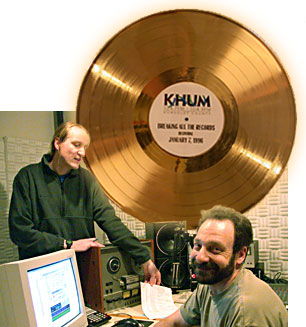
Left: Mike Dronkers and Cliff
Berkowitz of KHUM, "breaking all the records beginning January
7, 1996."
On Monday, after the county was ravaged by the
New Year's Eve storm, as the noon hour approached, KHUM deejay
and music director Mike Dronkers was at the microphone at the
station's Ferndale studio. Even when the town was cut off from
the rest of the world by flood waters, and power was out in much
of the county, the station had served as an information lifeline
offering the latest on road closures and power outages and letting
people know whether schools would be open or closed.
In between an array of musical offerings ranging
from Tom Waits and the Grateful Dead to Death Cab for Cutie,
he was fielding calls from all over Humboldt County, grilling
the PG&E representative about when the power would be back
in a dozen towns, then checking in once more with Caltrans, all
while serving as a clearinghouse for those in need of or offering
volunteer assistance. He managed to line up help for Francis
in King Salmon, who needed help wet-vac'ing her flooded home;
then there was the guy named Rod with a truck, a winch, a chain
saw and a cell phone, ready to help pull trees from someone's
driveway.
The day before Dronkers did pretty much the same
thing, but from the guest room in his Eureka home. "It was
sweet. I could do the weather while looking at the bay,"
he said. "We made a really smart investment this year. We
bought a remote device, something that served us so well at this
time when we most needed it. It allowed us to be live at a time
when local radio stations need to be local."
Sweet, yes, but KHUM also served as an information
lifeline for thousands around the county at a time when power
failures at transmission towers knocked public stations off the
air, when other commercial stations were offering canned satellite
programming with little or no local content.
It also served to demonstrate that the key to KHUM's
success lies in something more than tenacity: It has evolved
into a "community" radio station in the purest sense
of the word.
Of course all radio stations, along with most TV
stations and newspapers, try to demonstrate a bond with their
community. Berkowitz had something else on his mind when he started
KHUM and its parent company, Lost Coast Communications. He had
come to Humboldt County to escape from a life in the world of
high-power corporate radio. His goal: to resurrect a fading format,
freeform radio, known in its early days at the end of the '60s
as underground radio.
"Freeform stations were unproven and harder
to sell to the advertisers," said Berkowitz, describing
KHUM's early years. "They wanted to know what kind of person
would listen to that kind of station. Now that we've been around
10 years, we're a `heritage station.' We're one of the first
buys in the market."
The Eastlan rating book ranks KHUM No. 1 for listeners
aged 25-54 over the course of the last four years. That's the
group Berkowitz deems "our key demo" for advertisers.
The modern rock sister station KSLG is No. 1 for those 18-49.
"Modern rock is a huge musical force in this country and
there was not one station playing it here. It seemed an obvious
niche to fill.
"A lot of miracles led to getting us to where
we are," he continued. "When I came up with [the KHUM]
concept I was naïve enough not to know the downfalls. A
few years in we were lucky enough to get R.J. Blount, our general
manager and sales manager, who turned things around. Then came
Patrick [Cleary] who is a real business manager. Finally for
the first time in 10 years we're actually profitable and paying
off our enormous amounts of debt."
Cleary's initial involvement with Lost Coast Communications
was as one of a group of investors who helped get KSLG on the
air. It took about three years for Lost Coast to get the station
up and running in 2001 following a $70,000 purchase of the frequency
in the late '90s.
Then in 2003 the company "hit another rough
spot, financially," as Cleary put it. Cleary and his family
put in enough additional money to buy a controlling interest
and he took over as CEO.
Prior to his position at Lost Coast, Cleary was
general manager for North Coast Cooperative Inc. His official
KHUM bio describes him as "a recovering New York banker"
who "moved to Humboldt County to learn to play the guitar."
"There's a little bank called Chase Manhattan
where I spent a good 10 years," he said, explaining away
his banking background. During that time the radio world was
transforming. Bigger companies -- the now giant Clear Channel
conglomerate, for example -- were buying smaller stations.
"I was actually involved in selling a channel
to Clear Channel in the early '90s," said Cleary, noting
that it was one of the first to utilize a loosening of FCC rules
allowing for a "duopoly" -- one company owning more
than one station in the same market. By using the same office
space, operating and sales staff to run two or more stations
at once, media companies were able to resurrect stations that
might have failed otherwise.
Taken to the extreme, and adding in new technology
that allows for satellite transmission of radio shows to scores
of markets across the country and even around the world, the
result can be what Cleary describes as "complete homogenization."
That's something the Lost Coast stations have scrupulously tried
to avoid.
Cleary concedes that "economy of scale"
is essential to make the company "economically viable."
Said Berkowitz, "That's one thing we learned
after we put KHUM on the air. [We] survived the first few years
and became a popular station -- we were selling advertising --
but we were barely treading water. We were in so much debt we
were in real trouble. You can barely earn enough to keep on the
air with one station. It's inefficient."
Adding KSLG and tapping a new demographic helped
improve efficiency. Then in May 2005, Lost Coast added a third
station -- KWPT, aka "The Point." The purchase was
made possible by forming a partnership with Blue Lake Rancheria,
which acquired a 20 percent interest in Lost Coast by supplying
funds to purchase the station.
"It just sort of fell in our lap," said
Berkowitz. "Things were disintegrating over there and [the
owners] approached us." The station, which had moved from
smooth jazz to hip hop a few years ago, had switched formats
once again, in 2004, to a classic hits format called The Point.
"It was like adopting a pet from the shelter that already
had a name. We kept it," Berkowitz noted.
"We switched it to our own internal system.
I personally am the staff of The Point. I program the music for
it every day. By spring or summer we should be able to bring
on a regular staff. Our concept is for all the stations to be
live and local."
Another thing that could happen by spring is another
addition to the growing Lost Coast family of stations.
Starting Jan. 12, the FCC will start taking bids
on an unused Blue Lake frequency that previously went on the
block last year. (In that auction, the highest bidder was allowed
to withdraw his bid and the frequency went unsold.) The successful
bidder will be able to establish a brand new radio station.
"We are a qualified bidder," said Cleary,
explaining that Lost Coast has posted a $60,000 deposit, joining
the fray with 46 other qualified bidders, including Eureka Broadcasting,
a local company whose stations include KINS, KEKA and KWSW.
Both Cleary and Berkowitz were hesitant to describe
what kind of programming might be offered on a fourth station.
"It probably wouldn't be wise to tip our hand to the other
broadcasters," said Berkowitz, "but it will be something
that will mesh with the other stations. Again, we're not really
chomping at the bit for another one, so we're not going to go
overboard bidding."
Whatever format that might be, the trick, said
Cleary, is "to maintain a sense of community."
Berkowitz couldn't agree more, and the same can
be said for Dronkers. "The mantra at KHUM over the years
has been local, local, local," he reiterated. "That's
what makes the station shine at a time like this. We know what's
going on in the community. We have a network of people we can
call on in any emergency. Listeners know that when something
goes down, we're a resource, a place you can call -- and there's
actually someone here. It's not on syndication programming or
some network thing. Someone who's part of your community will
pick up the phone."
For his part, Berkowitz holds strong to his original
dream. "We've been able to hold true to our vision, staying
freeform and being live and local. Music's important, but the
connection to the community is even more important. We never
lose sight of that, it's our No. 1 objective: To be part of the
community."
Regarding that birthday party this Saturday at
the Bayside Grange: "We wanted to have an all local line-up,"
said Berkowitz. "We have enough pull with the record companies
to get some big name artist, but we have super-star artists locally."
In a way, the groups playing parallel the style
of the station: The Delta Nationals dig into the roots of classic
American rock, country and blues; Kulica merges folk and rock
into a jamming groove; and the consummate showman Earl Thomas
fuses blues and soul. All three are bands with deep Humboldt
connections, folks who choose to call Humboldt home.
"I think the whole thing reflects who we are,"
said Berkowitz.
TOP
COVER
STORY | IN THE NEWS | THE HUM | CALENDAR
Comments? Write
a letter!
© Copyright 2006, North Coast Journal,
Inc.
|