|

COVER
STORY | IN THE NEWS | ARTBEAT
THEATER | FOOD | THE HUM | CALENDAR
December 15, 2005

Satsumas from Orland
by BOB
DORAN
Not that anyone asked, but if you were wondering
about my absolute favorite foods, I'd have to put the satsuma
mandarin near the top of the list. I just love the little easy-to-peel
citrus fruit, the one that people sometimes mistakenly refer
to as a tangerine.
I got hooked on satsumas years ago when I was working
my way through Humboldt State flipping pancakes and washing dishes
at the Jolly Giant cafeteria. Every winter a truck would pull
up downstairs and a friendly old gentleman from Orland would
bring up 10-pound sacks to sell to the cooks who worked there.
I'm a big citrus fan, and once I tried one, I became a convert
-- I'd buy one or two sacks and bring those I didn't eat home
to the family to join the nuts and candy that filled our Christmas
stockings.
According to Wikipedia, the satsuma mandarin,
aka Citrus reticulata, originated from a mutation recorded
as early as 1429 in Japan, where the fruit is called Unshiu
Mikan. There are around 100 varieties over there, of which
about a dozen are grown in the United States. The fruit was introduced
to the states in 1876, brought over from the Satsuma Province
in Kyushu by the spouse of someone from the U.S. Embassy.
I had always enjoyed tangerines, but satsumas were
new to me. Over time I discovered them in regular grocery stores
-- I'd buy a few, a box here, a box there, but they usually didn't
have the irresistible flavor of the Orland fruit. I was never
quite sure why until today, when I talked with Vic Cook, the
Orland grower who supplies Wildberries Marketplace, where I bought
a 10-pound bag last week.
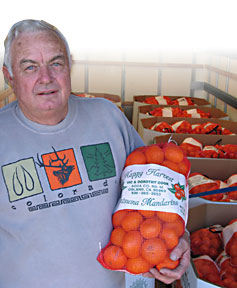
Vic, a 67-year-old retired excavation engineer,
has been growing citrus for 14 years; he has 3 1/2 acres of navel
oranges with the same amount of land devoted to satsumas.
How many mandarins are produced on that much acreage?
"It varies from year to year," said Vic, noting that
his best crop totaled just short of 85 tons.
"This year we had some bad weather. Early
on it was unseasonably warm, and we didn't get the cold weather
to toughen up the rind. Then we got a real hard rain. The wind
drove the rain right into the rind on 'em and a lot of them are
damaged beyond selling. We're going to lose a lot of the crop.
The fruit's going bad. We're having to sort real heavy and we're
having to throw out 25-30 percent."
The culls? "We feed them to cows. They're
not wasted."
Vic delivers to just three stores: Wildberries
and the Arcata and Eureka Co-ops. "And we sell a lot to
4-H Clubs, Kiwanis, different outfits in the Redding and Cottonwood
area that buy them and resell them as a fundraiser."
He noted that he was coming to Arcata Tuesday with
a truck-full, "and that'll be the last load of the year.
It's getting hard to find enough good fruit to make it worth
another trip." His truck holds 720 10-pound sacks, and my
guess is they will fly out the door, since both stores are currently
out of the bulk bags.
When I asked how far Orland is from Redding (65
miles) his response was, "You've probably never heard of
Orland." I let him know that I've known of his town for
years, because of satsumas, and mentioned the guy who brought
the fruit over in my college days.
We were talking by phone, so I couldn't see him,
but I sensed that a smile came across his face at the mention
of the old man. "That was Marvin McCoy," he told me.
"He was the one who got us started over there. Nobody knew
what a satsuma mandarin was in your area, and he went door-to-door
passing out samples. I actually took over [the Humboldt market]
from Marvin: He took me over there a few times, showed me where
the stores were. He was getting older and wanted to quit doing
it and I offered to buy his business from him. He said he'd just
give it to me. He didn't want anything for it. He passed away
about three or four years ago."
Regarding those mandarins from the other supermarkets,
Vic thinks he knows why they don't taste as good. "There
is a lot of acreage in satsumas down in the San Joaquin Valley.
They're old by the time you get them -- a lot of them are picked
real green. They're gassed with [ethylene] to color them up.
They're not tree-ripened." So that's why they're not as
sweet.
Now, I don't typically get around to doing any
cooking with satsumas -- I just eat them (and following my dad's
lead, I try to keep the peel in one piece). But when I asked
around, I did get a couple recipe ideas: Arcata Co-op produce
worker Damon Berkowitz suggests a fresh mandarin ambrosia with
shredded coconut and seedless red grapes dressed with whipped
cream. Being a Co-op type he figured there must be a vegan variation,
but couldn't think of one offhand. I'd say orange juice could
replace the cream. Sliced banana would make a fine addition,
too.
Chef Brett Shuler recommends using satsuma juice
in citrus vinaigrette to dress a green salad garnished with mandarin
segments, or using it to replace orange juice in a variation
on the custard dish known in Italy as zabaglione and as sabayon
in France.
Sounds good -- but you know what? I think I'll
just eat them as is. In fact, I'm going to have one right now.
We'll see if there are any left for Christmas. Vic tells me that
they will keep until then. "Just take them out of the bag
and put them in your fridge and I think they'll be fine."

COVER
STORY | IN THE NEWS | ARTBEAT
THEATER | FOOD | THE HUM | CALENDAR
Comments? Write a
letter!
© Copyright 2005, North Coast Journal,
Inc.
|