|

COVER
STORY | IN THE NEWS | OPINION | DIRT
TALK OF THE TABLE - | THE HUM | CALENDAR
December 8, 2005

by BOB
DORAN
In the course of my investigation into the world
of wild mushrooms a few weeks ago, I came across an Arcata business
specializing in growing tame mushrooms for the local and
market.
Mycality has its headquarters on Fickle Hill; I
met the business' owner and an assistant at the Arcata Farmers'
Market where they were selling shiitakes by the pound, along
with kits for growing your own oyster mushrooms.
The name? "Mycos is Greek for mushrooms; I
combined that with vitality for healthy living," explained
the founder of Mycality, whose name, coincidentally or not, is
Michael -- Michael Egan.
"We grow gourmet and medicinal mushrooms:
shiitakes, oyster, nameko, enokitake. I'm fiddling with a few
others: shaggy mane, maitaki ..."
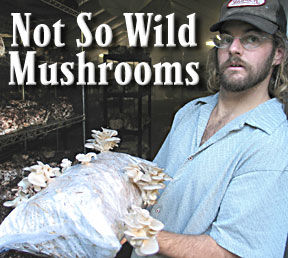
The kits he was selling at the market look for
all the world like a bread bag stuffed tight with hay. The hay-like
medium for growing the oyster mushrooms is actually rice straw.
Selling the bags for home growing is a sideline -- they are simply
the basic cultivation units for his operation, marketed in a
different way.
"They push their fruit on the outside of the
bag and you just break them off," said Egan. "Each
kit will produce four to six pounds of mushrooms over the course
of about a month, in four flushes. The shiitakes and others are
all grown in a mix of hardwood sawdust and alder chips; they're
wood decomposers. The shiitake is a non-native, it's a Japanese
strain. The oyster is native -- you'll find them at College Cove
and Prairie Creek growing in big shelves up on the alder trees,
but often times they'll be all maggoty or the timing isn't right."
In fact, when I went mushrooming with Barry, my
mushroom guide, we came across a dead alder in the woods with
a profusion of wild oyster mushrooms growing on it. Unfortunately
they were all more than 12 feet in the air, far from reach.
Another advantage Egan points out is the fact that
his mushrooms are completely clean. "As far as cultivation
goes, the cleanliness is incredible. I pasteurize the [rice]
straw, pack it into the bags then use inoculated rye grain with
the mycelia on it, a few cups per bag. In 10 days the mycelia
will run its course through the bag and I move it into the fruiting
facility."
I eventually paid a visit to his custom-built 1,200-square-foot
fruiting facility, a long building shaped like a Quonset hut
with a plastic roof. It looks like a greenhouse, but inside it's
dark and filled with a musty fog and rack after rack of bags
sprouting mushrooms, or about to.
Egan went to school at Humboldt State, graduated
with a degree in soil science, then farmed for a bit. "I
grew up in a science background. My parents were both microbiologists
-- I was sexing fruit flies in the garage when I was 9. It was
natural for me to pick up something scientific, and I was always
interested in farming.
"I fell in love with the area, didn't want
to leave. I figured out that this was something that could be
economically profitable. I realized there was a niche market
for mushrooms and nobody here was doing it, so I went for it."
Egan learned the business from Paul Stamets, who
runs Fungi Perfecti in Olympia, Wash. "He's the guru of
mushroom cultivation. He offers courses: I went up to his farm
-- he walks you through his lab and through the process. He basically
wrote the book."
Stamets literally wrote the book -- several, in
fact. The Mushroom Cultivator is considered "the
grower's Bible," which makes the voluminous follow-up, Growing
Gourmet and Medicinal Mushrooms, the growers' New Testament.
At his home on Fickle Hill, Egan set up a little
mycology lab. A room by the house that seems like a walk-in refrigerator
is actually a climate controlled sterile room always at 70 degrees.
Inside are racks filled with plastic bags full of sterilized
sawdust or straw inoculated with Fungi Perfecti mushroom culture,
all of them in varying stages of mycelium development. The back
porch holds a stainless steel drum he uses as a makeshift pasteurizer.
Talk turned to Stamets' latest book, Mycelium
Running, described by its publisher as "a manual for
the mycological rescue of the planet." Stamets links mushroom
cultivation with permaculture, ecoforestry, bioremediation and
soil enhancement, making the case "that mushroom farms can
be reinvented as healing arts centers, steering ecological evolution
for the benefit of humans living in harmony with its inhabitants."
Stamets envisions a world with "mycoforestry
and mycogardening," where we could use mycelium in companion
cultivation, creating symbiotic relationships the way wild mushrooms
do in nature. He speaks of mycoremediation -- mushrooms that
decompose toxic wastes and pollutants and other mushrooms that
act as pesticides.
Then there is the health aspect, already well known
in Asian cultures. Egan points out that shiitakes are anti-oxidants,
anti-tumor, anti-viral and anti-bacterial immune stimulators.
"They lower cholesterol and work as a sexual potentiator,
not to mention the fact that they are 37 percent protein, so
a vegetarian looking for something to eat can look no further."
Yes, he's sold on mushrooms and wants to spread
the word, but he also has a bit of business sense. The market
is hot right now, and the 150 pounds of mushrooms he's producing
every week are basically spoken for in sales to Wildberries,
Eureka Natural Foods and restaurants including Avalon, Hotel
Carter's Restaurant 301, Tomo and Wildflower Café. "The
demand is phenomenal," he notes. "I can't meet the
local needs, let alone try to develop an export market outside
of Humboldt."
He's about to see what the bankers think of his
idea for growing his growing business. In between mushroom batches
he's been working on a business plan that looks to expand Mycality
with an enlarged facility, in Arcata or nearby, where he can
ramp up to produce 2,000 pounds a month. Talking with him, you
can see his vision develop and grow just like the mushrooms in
that big wet room in the field by his house.
In the meantime, you can find his mushrooms in
the stores and fine dining facilities listed above, or if you
want to grow your own, give Michael a call at 707-834-6396 and
he'll arrange for you to buy one of those do-it-yourself oyster
mushroom kits. With the holidays coming you might want to get
two.

McIntosh Farm Country
Store is open from 9 a.m.-5 p.m. Monday through Saturday at 1264
Giuntoli Lane, Arcata, right across the street from TP Tires.
Call them at 822-0487.
COVER
STORY | IN THE NEWS | OPINION | DIRT
TALK OF THE TABLE - | THE HUM | CALENDAR
Comments? Write a
letter!
© Copyright 2005, North Coast Journal,
Inc.
|