|
 
COVER
STORY | CALENDAR
Nov. 21, 2002
PIP on way to acquiring
Sweasey building
by
ANDREW EDWARDS
 PLAYS-IN-PROGRESS
COULD BE BACK IN PLAY SOON. PLAYS-IN-PROGRESS
COULD BE BACK IN PLAY SOON.
According to the group's director,
Sue Bigelow Marsh, plans are moving ahead to purchase the old
State Theater, aka the Sweasey building, part of the Daly complex,
to turn it into a performing arts venue. The deal, financed by
Eureka developer Donald Murrish, is set to close by the middle
of next month, barring complications.
"It's just clicking right
along," Marsh said. "Unless the building falls down
I think we're okay."
Under the current deal, Murrish
would purchase the entire complex from the city of Eureka's redevelopment
agency, and then PIP would purchase the State Theater from him.
The group has been homeless
since it lost the World Premiere Theatre, which was located over
the Lost Coast Brewery in Old Town Eureka.
The new digs will be expensive,
more than $330,000 with a $100,000 down payment. Marsh said the
group has raised about a third of the down payment so far. Assuming
the rest of the money is obtained, the purchase will be well
worth it, she said.
"When you look at how [the
theater] was constructed, how it was put together, it's a really
beautiful piece of architecture; it's gorgeous," she said.
"It's ugly right now, but it has a charm."
Right now what Marsh described
as a beautiful art deco theater is hidden under the drab 1950s-era
Daly building department store.
When the theater was turned
into a store the ceiling was lowered, concealing what Marsh described
as a "phenomenal" fly system (a system of weights and
pulleys that can raise and lower lights or scenery suspended
over the stage) minus the ropes. The false floor conceals sloping
audience seating, similar to that of the Ferndale Repertory Theatre
but with an orchestra pit as well.
 Underneath
the building is a basement the same size as the theater itself,
which PIP plans to turn into a costume and set storage area and
rehearsal space that could be used by all of the local theater
companies. Underneath
the building is a basement the same size as the theater itself,
which PIP plans to turn into a costume and set storage area and
rehearsal space that could be used by all of the local theater
companies.
"[PIP] will never use [the
practice rooms] all the time, and we have no intention of doing
so," Marsh said.
PIP plans to renovate the building
in two stages. The first stage would be to get the theater itself
working in a versatile 200-seat "black box" format,
where audience seating and stage setup could be rearranged to
accommodate different types of performances, from plays to conferences.
Marsh said it would be similar
to the format of the World Premiere Theatre, only twice as big.
The front of the theater would
be turned into an art gallery/lobby that would be part of the
Arts Alive! circuit.
The second stage (no pun intended)
would be restoration of the theater to its original Vaudeville-era
glory, opening up the balcony, raising the ceiling, sinking the
orchestra pit, and cleaning up the original architecture. When
completed the theater will seat 400 to 500 people.
Marsh said that PIP had decided
to do the project in two phases to make it more affordable; the
entire cost is likely to range into the millions of dollars.
"If we tried to do it all
at once we'd have to spend four or five years rasing money, and
by that time the building would have fallen apart," Marsh
said.
If everything goes smoothly
and PIP acquires the building in mid-December as planned, it
will still be another six or seven months before the theater
is performance-ready. Marsh said the first performance is tentatively
scheduled for late June.
Meanwhile, PIP is in overdrive
trying to scare up the capital to make its dream a reality. Among
other events, the group is holding a "Night at the Speakeasy"
fund-raiser at the Wharfinger building Saturday.
Marsh said the group is seeking
money "every single way it possibly can," including
pursuing grants from both public and private foundations as well
as looking to community members for funding. Thus far they have
found the community very receptive.
"Luckily there's a wonderful
community around here with disposable cash who are also very,
very civic-minded," Marsh said. "Half of them necked
in the balcony when they were teenagers, so there's a real emotional
attachment to this theater."
Despite the long negotiations
with the city of Eureka, and several setbacks including an erroneous
press report that said the building was going back to Humboldt
State University, PIP has struggled on undaunted.
"We should never be afraid
of saying we can turn something around and do something big,"
Marsh said. "It was all worth the fight, and we've got a
long way to go."
Fish
kill study to be approved in D.C.
by
KEITH EASTHOUSE
IN A MOVE THAT COULD UNDERMINE
ITS scientific credibility, a much-anticipated federal report
on the Klamath River fish kill will be routed through Washington
D.C. for approval before it is released to the public, an agency
official said this week.
John Engbring, supervisor of
all U.S. Fish and Wildlife Service offices in the Klamath basin,
downplayed the significance of the decision to run the report
by the director of fish and wildlife, Steve Williams.
"This was an event of national
significance, so I don't know that it's that unusual," Engbring
said in a telephone interview from his Sacramento office.
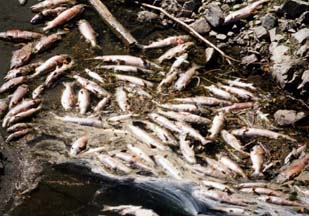 The
report, along with others, could have a significant impact on
the key question of what factor or factors caused an estimated
33,000 salmon and steelhead to die in the lower Klamath River
in September. The
report, along with others, could have a significant impact on
the key question of what factor or factors caused an estimated
33,000 salmon and steelhead to die in the lower Klamath River
in September.
A scientific determination of
that question could, in turn, affect another key issue: how much
Klamath River water should go to farmers in southern Oregon and
extreme northern California and how much should be allowed to
flow downstream.
Dave Hillemeier, fisheries biologist
with the Yurok tribe, expressed skepticism that the fish and
wildlife report would seriously tackle the question of whether
low water flows caused the die-off. "We all know what it's
going to say. It's going to say that it's inconclusive as to
what caused the fish kill."
Engbring said the report would
initially focus on determining the magnitude of the fish kill
-- not on answering the question of whether low flows caused
or contributed to the fish kill.
He said he didn't know if that
subject would even be addressed.
Troy Fletcher, executive director
of the Yurok tribe, said tribal officials were informed last
week about how the report would be handled. He said that running
it by political appointees in Washington raises "serious
concerns about this administration's ability to produce an unbiased
scientific report."
Noting that fish and wildlife
researchers produce reports on a regular basis, Fletcher added:
"How many of those reports have to be approved by the director
of fish and wildlife?"
A fish and wildlife scientist
who asked not to be identified said requiring a scientific report
of this sort to be endorsed by the director was out of the ordinary.
But the source said it was "not surprising" given the
extent to which the fish kill has become a political issue.
Tim McKay of the Northcoast
Environmental Center in Arcata agreed. "Given the current
state of politics in Washington D.C. this doesn't surprise me
in any way," McKay said.
In the wake of the fish kill,
the environmental center and other conservation organizations
filed a lawsuit in late September charging the federal Bureau
of Reclamation with violating the Endangered Species Act. Specifically,
the groups are alleging that the bureau pressured federal scientists
last spring to endorse a plan that provides insufficient protections
to coho salmon, a federal threatened species.

A protest sign
at a rally last spring for greater
protections for Klamath River fish.
While the vast majority of fish
that died in September were fall chinook, some coho also perished.
The Yurok tribe has declared
its intention to intervene in the lawsuit, arguing among other
things that the reclamation bureau violated its tribal trust
responsibilities by failing to protect the tribe's fishery.
The fish kill occurred entirely
within the boundaries of the Yurok reservation on the lower Klamath.
However, half of those fish or more were destined to pass through
the Hoopa reservation and spawn in the Trinity River, a tributary
of the Klamath.
In addition to the fish and
wildlife report, several studies are in the works regarding the
fish kill, including one by the Yuroks and one by the state Fish
and Game Department.
Both the tribe and the state
have been critical of the reclamation bureau's decision to cut
flows on the Klamath this year by 43 percent -- a move that made
available more water to the irrigators favored by the Bush administration,
but may have had disastrous results for what was shaping up to
be one of the biggest runs of fall chinook on the Klamath in
recent years.
While it remains to be seen
what the scientific reports say, the consensus at this point
is that the fish kill happened primarily because of low water
flows.
"There wasn't enough water
to stimulate the fish to move upriver, so they just remained
in the lower part of the river," explained Hillemeier, the
biologist with the Yuroks.
Hillemeirer said that given
the large number of fish in the river, the traffic jam was a
perfect breeding ground for disease.
According to Gary Stacey, a
fish and game official, the fish succumbed to a bacterial infection
known as gill rot as well as to an external parasite.
Both pathogens are normally
present in the river, but apparently conditions are generally
not as ripe for their spread as they were this year.
For example, there were low
water flows in a few years in the 1990s, but no major fish kills.
Agricultural groups have argued
that there is no proof low water contributed to the die-off and
that the fish kill may have been simply a natural phenomenon
caused by drought.
Hurwitz
escapes -- again
by GEOFF
S. FEIN
CHARLES HURWITZ, PRESIDENT AND
CEO of Maxxam Inc., the parent company of Pacific Lumber Co.,
has once again managed to evade a multi-million-dollar federal
lawsuit.
Not only that, the man who was
deeply involved in the savings and loan scandal of the 1980s
appears to be milking the legal system in a bid to force the
government to pay millions in damages for bringing litigation
against him.
Last week the Federal Deposit
Insurance Corp. (FDIC) announced it has dropped its $250 million
suit over the 1988 collapse of United Savings Association of
Texas, a Hurwitz-owned savings and loan.
In October the Office of Thrift
Supervision (OTS) settled a related case with Hurwitz for $206,000;
a far cry from the original $820 million the government had sought.
The settlement also restricts Hurwitz from any dealings with
a federally insured bank for three years.
Last year a federal judge rejected
OTS' efforts to force Hurwitz to pay $820 million in damages.
The judge recommended that all
charges against Hurwitz be dropped and the OTS not get any monetary
damages. The $206,000 that Hurwitz has agreed to pay is restitution
to the government and not damages.
In a statement released to the
media, Hurwitz said, "Maxxam and its employees have been
vindicated. However, our happiness is tempered by the reality
that we have had to spend enormous resources to defend ourselves
against two government agencies' claims that never should have
seen the light of day."
In 1988 Hurwitz was a director
and officer of United Financial group, the parent company of
United Savings Association of Texas.
Hurwitz has maintained his innocence,
arguing that the federal suits, filed nine years after the savings
and loan collapsed, were politically motivated to force him to
turn over control of ancient redwoods in the Headwaters forest.
Environmentalists had hoped
the government would accept Pacific Lumber timberlands in lieu
of payment.
Hurwitz reportedly offered a
"debt for nature" trade; however, the deal became pointless
after California and the U.S. government bought the Headwaters
forest and associated groves for $480 million in 1999.
In 2000 Hurwitz filed suit against
the FDIC and the OTS seeking to recoup the $43 million he says
he spent defending himself. Hurwitz argued that the government's
suit was supposed to be based on banking claims and not on acquisition
of redwoods.
"It's important that a
message be sent to the FDIC that it should never again behave
in a political, illegal and unethical manner," Hurwitz said
in his release.
An FDIC source said last week
that the bulk of the $43 million that Hurwitz is seeking from
the government was money he spent conducting unnecessary legal
maneuvers.
For example, Hurwitz's lawyers
filed more than a dozen motions seeking millions of pages of
documents from the FDIC. Hurwitz's lawyers also conducted dozens
of depositions with FDIC personnel, the FDIC source said.
"He was burning up money
himself," the source said.
Son arrested
for father's murder
Benjamin Woods, 17, suspected
in the beating death of his father, John Woods, 55, of Arcata,
was arrested Monday by the California Highway Patrol in Siskiyou
County.
Woods, found wandering along
a road between Weaverville and Yreka, is being held in a juvenile
facility in Siskiyou County. He is awaiting transfer to Humboldt
County.
Arcata Police had been looking
for the 17-year-old since Friday when they found John Woods dead
at his home at 1835 Roberts Way.
Police have not discussed a
possible motive or whether the 17-year-old and his father had
any history of disputes.
Benjamin Woods is a senior at
Arcata Hhgh School and a member of the school's cross country
team.
Woods' mother lives in Arcata.
His parents are divorced.
The homicide is the second of
the year for Arcata. The first took place in June when Lisa Ann
Thomas, 32, was shot and killed by former boyfriend Donald Peeler,
38, at her Sunny Brae apartment. Peeler then shot himself, dying
the next day at a hospital.
PL headed
back to court
Pacific Lumber Co. officials
will have to go to court next month to show why the company is
not in contempt of court for continuing logging operations despite
a judge's order to stop harvesting.
At a Dec. 9 hearing, Pacific
Lumber and the Environmental Protection Information Center, a
Garberville group, must go before Judge John Golden -- again
-- and explain why he should or should not suspend logging on
at least 100 timber harvest plans.
Environmentalists are suing
the company over its Sustained Yield Plan, a state-approved set
of guidelines which is supposed to govern logging on the company's
timberlands for the next century.
In August, Golden told Pacific
Lumber to cease logging; the company resisted, arguing among
other things that the order was confusing.
Not surprisingly, the company's
logging this fall has led to numerous protests by environmentalists,
including camping out in trees, in an effort to slow or stop
logging.
Two tree-sitters were arrested
this past weekend after being removed from trees by Pacific Lumber
climbers.
Board knew
of Redding M.D.
A former patient of a Redding
cardiologist suspected of performing unnecessary heart surgeries
said he alerted the Medical Board of California 10 years ago
about Dr. Chae Hyun Moon.
Felix Elizalde, president of
the Alameda County Board of Education, said Moon told him in
1992 that he faced death unless he had emergency surgery. Elizalde
got a second opinion and learned he didn't need the surgery.
Medical board officials said
they have no record of Elizalde's complaint.
Moon and Dr. Fidel Realyvasquez
Jr. are both under investigation by the FBI, IRS and the U.S.
Attorney's office for allegedly overbilling on Medicare claims
and for performing needless heart bypass surgeries. Authorities
are closely examining the medical records of 201 of the doctors'
patients, 167 of whom died.
Last week a judge blocked an
attempt by the state medical board to suspend the doctors' licenses.
Moon and Realyvasquez both work
out of Redding Medical Center. The facility handles heart patients
from across Northern California, including some from Humboldt
County.
Although Moon's and Realyvasquez's
Redding practice is under heavy scrutiny, neither doctor has
been charged with any crime.
Moon took to the Internet last
week to defend himself against the accusations made by former
patients and federal authorities.
The site contains accounts of
the FBI investigation and medical board cases, legal filings
by Moon's lawyers, press releases and five short videos of Moon
talking about himself and his cardiology practice.
A $21 billion
problem
Two months after state lawmakers
wrestled with an almost $24 billion deficit, a legislative analyst
in Sacramento said California will face a $21 billion deficit
next year.
That means that it may take
longer than anticipated for California to rebound from its current
economic slump.
Elizabeth Hill, the legislature's
nonpartisan economic adviser, said the deficit, combined with
lower-than-expected state revenues, slow personal income growth
and declines in the stock market, could lead to additional cuts
in state programs.
Just like this year, a wide
variety of programs will be on the chopping block, including
education. Additionally, lawmakers will have no choice but to
look at the possibility of raising taxes.
Leading the effort to balance
next year's budget in the Senate will be Wes Chesbro, D-Arcata.
Chesbro, elected to a second four-year term Nov. 5, was named
chair of the Senate Budget Committee last Thursday.
In September Gov. Gray Davis
signed a $98.9 billion budget. The budget was 67 days late and
and relied on cuts, borrowing and increased revenues to balance
a $23.6 billion deficit.
Dirty bomb
drill
Last Thursday Humboldt County
got what could be its first taste of 21st-century disaster preparedness,
but with a title straight out of the McCarthy era: "Operation:
Red Terror."
The exercise, which took place
at St. Joseph Hospital, simulated a "dirty bomb" attack
on a local high school.
A second exercise, held at Mad
River Hospital, was also designed to test emergency preparedness
in the event that a non-nuclear device is detonated and disperses
radioactive material.
In addition to the two hospitals,
the Eureka Police Department, the California Office of Emergency
Services and the California Emergency Medical Services Authority
all participated in the simulations.
Pat Lynch, emergency preparedness
coordinator at St. Joseph, called the disaster drill there "very
successful." At Mad River, Tina Wood, staff development
coordinator, said the drill went well "but there are a few
things to iron out."
Part of the exercise had to
do with the process victims must go through to decontaminate
their clothing.
Recycling
reprieve?
Arcata's curbside recycling
program may continue, at least for a few more months.
At its Nov. 6 meeting, the City
Council seemed to be leaning toward letting the program's contract
with Arcata Garbage Co. expire at the end of the year.
However, Environmental Services
Director Steve Tyler says the contract should be extended so
that the program can continue into next year.
The council is expected to discuss
the contract extension at its Dec. 4 meeting.
Tyler hopes to give the council
a new recycling contract in February.
The city may face a daunting
task of trying to meet the state-mandated diversion of 50 percent
of its waste from landfills if it decides to drop curbside recycling.
Recently, the city was granted
a three-year extension to cut in half the amount of waste it
sends to landfills.
Fujitsu
gift to HSU
Humboldt State University's
Quantitative Sciences Laboratory received a $30,000 gift from
Fujitsu Laboratories of America to help pay for 25 new computers
and other upgrades.
The university lab supports
mathematical research by faculty and students.
This is the second monetary
gift from Fujitsu to the university this year. In April, the
company gave $4,200 to the HSU chapter of the Society of Women
Engineers to support student research.
Fortuna
drug use on rise
Drug use among Fortuna high
school students is on the rise, despite urine testing every two
weeks of athletes and students known to have drug problems, and
daily physical checks of students suspected of using drugs.
The biggest increase has been
at East High, the district's continuation school. Fortuna High
has had a slightly smaller increase, according to Superintendent
Dennis Hanson.
Administrators and teachers
are seeing more students under the influence of marijuana.
Despite the spread of drug use,
the testing program started six years ago was described
as successful by Hanson, largely because of a decrease in repeat
offenders. Only one student has continually failed the drug tests
since they were initiated, Hanson said.
Sturgeon
suit
The Environmental Protection
Information Center is suing the National Marine Fisheries Service
for dragging its feet in declaring the green sturgeon an endangered
species.
By law, the fisheries service
was supposed to respond to the group's request to list the species
in July.
In Humboldt County, only the
Klamath River is considered viable spawning habitat for the fish,
a primitive, bottom-dwelling species that can live up to 70 years
and reach 7 feet or more in length.
Another
tree attack
Eight shore pines and four redwoods
are the latest victims of vandals who have been damaging trees
in Arcata since this past spring.
Arcata Police have no leads
in the six-month-old case.
The 12 trees, standing along
Samoa Boulevard near the traffic roundabout by Buttermilk Lane,
had their tops broken off sometime between Oct. 26 and 27. The
trees will be replaced at an estimated cost of $750.
The first report of vandalism
to Arcata trees occurred in May at Community Park. Spruce, cedar
and alder trees were vandalized in August at both Shay and Westwood
parks.
Toilet tax
tanks
Lost amid the election hoopla
was the rejection by Ferndale voters of a plan to raise the city's
business license tax to pay for maintenance of public restrooms
along Main Street.
Residents voted 224 to 181 against
increasing the fee from $48 to $90. They said the hike was too
drastic; they also questioned whether the funds would actually
go toward maintaining the bathrooms. City officials are prohibited
from permanently allocating General Fund money for a specific
use.
Ferndale spends about $10,000
annually to maintain the facilities. Earlier this year the Ferndale
City Council said it could no longer afford the cost.
City officials are dipping into
the city's reserve fund to cover the expense.
Seniors
beware
Senior citizens are the target
of a telephone scam in which callers claim to be informing seniors
of changes to their health benefits.
In reality, they're trying to
steal their money.
No one locally is known to have
been taken in by the scam; it's not even clear anyone in the
area has been contacted. But the Eureka Police Department was
recently notified of the scam and wants to get the word out.
Here's how it works: Senior
citizens are asked to give out their personal checking account
and Social Security numbers to a representative from a company
called the "Medicare planning center." Seniors are
told that the usual $95 service fee has been waived. They are
then passed on to a "supervisor" who verifies the information.
Seniors are also given a toll-free
800 number to call if they have any questions. The number is
bogus.
McKinleyville
substation
McKinleyville residents could
get a Humboldt County Sheriff's substation by the end of the
year. The substation would replace a smaller sheriff's office
currently located in the Pierson Park parking lot.
That office is staffed during
the week by deputies and volunteers. Newly elected Sheriff Gary
Philp's proposal would increase the size of the office space
and create a secure area to park sheriff vehicles.
Building a substation was a
campaign issue for Philp back in March.
The McKinleyville office was
originally built with funds made available from the Mad River
Rotary Club.
The Sheriff currently operates
substations in Hoopa and Garberville. The Hoopa substation is
staffed with a sergeant and six deputies. The Garberville site
has a sergeant, correctional officer and five deputies.
Philp will submit his proposal
to the Humboldt County Board of Supervisors before the end of
2002.
COVER
STORY | CALENDAR
Comments? E-mail the Journal: ncjour@northcoast.com
© Copyright 2002, North Coast Journal,
Inc.
|