|
 
IN
THE NEWS | CALENDAR
![Dead Men Talking: Life and Death at the Humboldt County Coroner's Office [photo of investigators and coroner pulling body from bay]](cover1121-photohed.jpg)
by GEOFF
S. FEIN
Death, the most dreaded of
all evils,
is therefore no concern to us...
-- Epicurus, Greek philosopher
(341-271 BC)
DEATH. IT IS A SUBJECT MOST
PEOPLE AVOID.
But the employees of the Humboldt
County Coroner's Office live with death every day.
The coroner's office averages
about 600 reported deaths each year; that's almost two a day.
Of those, a third will undergo an investigation. Some investigations
will require no more than collecting information from family
and friends; others will require an autopsy to determine the
cause of death.
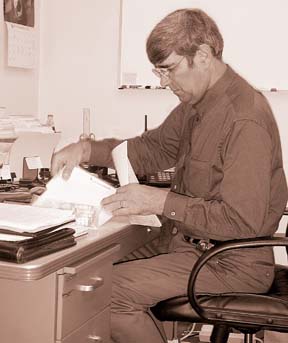
"Every county is tasked
with finding out how people die," said Frank Jager, Humboldt
County coroner. [photo
below left]
 The
investigations, the autopsies, notifying families -- all are
handled by a small dedicated team led by Jager. The
investigations, the autopsies, notifying families -- all are
handled by a small dedicated team led by Jager.
The coroner's office here is
unique among its counterparts in California. It has its own forensic
pathologist; the coroner's office is not under the authority
of the county sheriff; and the coroner is an elected official.
Any registered voter, regardless of their background, could become
county coroner. Before Jager became coroner in 1998, Glenn Sipma,
a banker, held the job for 17 years.
The coroner is also a public
administrator, overseeing the estates of those who died alone.
Jager handles about 40 to 45 of these cases per year. He's amazed
at how many people die without relatives to claim the remains.
"It's so foreign to me,"
Jager said.
Jager and his team of investigators
also have the grim task of notifying family members of a death.
Jager called that the toughest part of the job.
On Dec. 20, 1998, Deputy Coroner
Roy Horton, after visiting the scene of a fatal car accident
on Highway 101 at Miranda, had to deliver the news to the husband
that his wife, their granddaughter and the wife's brother all
died.
Horton sat in his vehicle outside
the family's house waiting for a chaplain from the Eureka Police
Department to show up. He could see the husband inside standing
by a Christmas tree.
All the time he was waiting,
Horton kept going over in his mind what he was going to say.
"I dreaded going in,"
Horton said. "It was the worst."
Death
is a job
At the coroner's office death
is a job and death comes in all forms: suicide, homicide, auto
fatalities, unexpected natural causes, unattended deaths. Each
of those deaths must be painstakingly investigated to determine
whether foul play, accident, drugs, alcohol or disease were the
culprit.
"When the phone rings,
you never know what you'll be dealing with," said Charlie
Jones, deputy coroner.
Horton, 51, Jones, 48, and Charles
Van Buskirk, 40, are the three deputy coroners, or death investigators,
who along with Jager, conduct the initial investigation and retrieve
the bodies. They have been called to retrieve skeletal remains,
decomposing remains, partial remains and charred remains. They
seldom investigate cases where the cause of death is known --
such as those due to cancer, heart disease or other terminal
illnesses.
 One
thing is certain: whether rich or poor, whether death by homicide
or suicide, every body a death investigator brings back to the
county morgue is treated equally. There's no prejudice or discriminating
against the dead. One
thing is certain: whether rich or poor, whether death by homicide
or suicide, every body a death investigator brings back to the
county morgue is treated equally. There's no prejudice or discriminating
against the dead.
"We investigate [the deaths
of] people who were wealthy and those living in dumpsters,"
Horton said.
Because the deputies often must
travel alone, day or night, into remote parts of Humboldt County,
they carry guns. They are considered law enforcement officers
under California law. They can make arrests (if it's for public
safety) and write traffic tickets, but they seldom have time,
Horton said.
By the third week of November,
the coroner's department had logged 25 suicides (there were 27
for all of last year); 25 vehicle fatalities (compared to a total
of 22 in 2001); 29 drug overdoses (there were 40 in 2001); and
13 homicides (already more than last year, when there were eight).
Jager anticipates that the number
of motor vehicle deaths and suicides will increase with the upcoming
holidays.
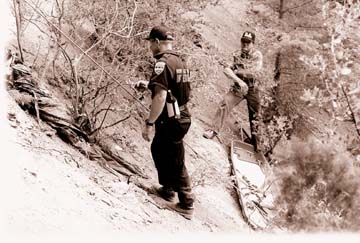
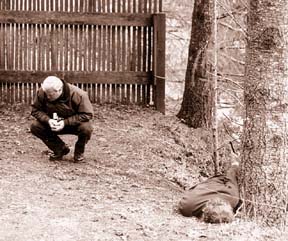
[In photo at top right:
Deputy Coroner Roy Horton retrieves a body in mountainous terrain.
Below left, Deputy Coroner Charlie Jones investigates a suicide
in Humboldt County.]
 As
of the middle of the month, 378 deaths had been reported by phone
to the coroner's department. Those calls came from hospitals,
paramedics and law enforcement. If a case requires an investigation
-- such as when there are questions about the circumstances surrounding
a death -- it's then logged onto a second list. As of last week,
the department had logged 209 deaths requiring a full investigation. As
of the middle of the month, 378 deaths had been reported by phone
to the coroner's department. Those calls came from hospitals,
paramedics and law enforcement. If a case requires an investigation
-- such as when there are questions about the circumstances surrounding
a death -- it's then logged onto a second list. As of last week,
the department had logged 209 deaths requiring a full investigation.
Somewhere out there in Humboldt
County is case number 210.
With one month left in the year,
it's certain that the coroner's office will hit 210. Last year
the office investigated 244 cases. The busiest year recently
was 1997, when 261 deaths were investigated.
The department is run on a budget
of $477,380, but it generates revenues of $307,731 through estate
sales. So the net operating cost to the county for employing
a coroner, three deputies, a secretary and a medical doctor is
$169,652 (these numbers do not include the cost for an on-call
forensic pathologist). And unlike most county offices (with the
exception of the sheriff) the coroner's office operates 24 hours
a day, seven days a week. Death never rests and never takes a
holiday.
Jager used to rely on a pathologist
from Trinity County to handle routine and natural death cases.
More complex cases and homicides were either taken to Sonoma,
Solano or Shasta counties.
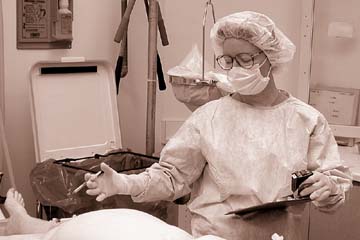
But in April, forensic pathologist
Dr. Susan Comfort [in photo
below right] was hired to perform autopsies.
It's rare for a county the size of Humboldt to have someone on
board trained in forensic pathology, the most advanced kind of
medical examiner around. Comfort is also board certified; Jager
said there are very few pathologists with national board certification.
Having Comfort means Jager can
consult with her anytime on any case that comes into his office;
she can also visit a death scene if necessary.
The
dead do tell tales
 There
is a saying, a belief, among coroners that the dead talk. Often
within a dead body are the clues to whether a person was murdered,
died at their own hand, by accident or by natural causes. That
is where Comfort comes in. There
is a saying, a belief, among coroners that the dead talk. Often
within a dead body are the clues to whether a person was murdered,
died at their own hand, by accident or by natural causes. That
is where Comfort comes in.
Comfort performs autopsies to
determine cause of death. She meticulously dissects bodies, carefully
removing the organs, looking for clues. Depending on the case,
an autopsy can take a couple of hours or all day. Some cases
are easy -- those who die from heart disease, for example. Others,
such as homicide cases, require detailed work to make certain
no clue has been missed. Tissue samples are often taken and sent
out to labs for toxicology studies. A toxicology test can determine
if the deceased was under the influence of drugs or alcohol.
"The dead speak. They tell
us the story of how they lived," she said. "If it was
a violent death, what kind of life did they lead?"
Dissecting the dead might seem
a gruesome occupation, but to Comfort it is rewarding, especially
when her findings help police solve a crime -- or help families
learn the fate of missing loved ones.
She was able to do just that
six years ago when, as the pathologist for Shasta County. She
was brought two skeletal remains that had been buried on a ranch
near Susanville, Calif., about 80 miles west of Reno. The remains
were thought to be those of two teenage girls from Sparks, Nev.,
who had been missing since the 1970s, but the remains alone did
not provide positive identification.
Comfort was able to piece together
shreds of clothing that were still stuck to the skeletons. The
clothing was distinctive to the 1970s and she was able to determine
that each girl was wearing an identical blouse and that they
had both been wearing jeans. When the families of the two Sparks'
girls saw the clothing, along with other items such as the shoes
the girls had on and a key chain with the name of a Reno mall
store on the fob, they knew their daughters had been found at
last. "It was exciting after all that time [that we were]
able to solve that," Comfort said.
Comfort's job has its disturbing
side. Conducting autopsies on children is hard to do, but necessary
to determine if a child died of natural causes, abuse or Sudden
Infant Death Syndrome.
In suicide cases not only does
Comfort perform an autopsy, but a psychological autopsy is performed
as well. The deceased person's life is examined -- investigators
will talk with family, friends and the deceased's doctors in
an effort to make sure that the death was due to suicide and
not an accident or foul play.
Comfort, 45, has been a forensic
pathologist for six years. But she didn't start out with an interest
in medicine.
"I started out my life
as a commercial artist," she said.
But she wasn't enjoying commercial
art. Comfort said it wasn't very creative. She had wanted to
be a painter. She was also good in science.
Comfort's father was an anesthesiologist
and encouraged her to pursue medicine. She eventually received
her degree from the University of New Mexico School of Medicine.
"Initially I thought I'd
go into plastic surgery," she said. "But in the first
semester I realized I didn't have the mindset to be a surgeon."
By her fourth year in medical
school Comfort settled on psychiatry.
Comfort took a forensics course
but didn't think she'd be interested in the field. Her professor,
however, thought she'd be a natural at it. Once Comfort delved
into forensics she knew it was the right field for her, she said.
"You don't have the same
hours as an obstetrician and you don't get called up in the middle
of the night," she said.
Comfort went on to do her residency
at the University of Texas Southwest Medical Center and worked
at Parkland Hospital in Dallas, the same hospital President Kennedy
was taken after he was shot.
Comfort was hired by the Maricopa
County Medical Examiner in Phoenix, Ariz. Very quickly the realities
of the job set in. Pathologists were handling a horrendous number
of cases, Comfort said.
"In Phoenix I did six autopsies
a day," she said.
The high caseload can turn an
interesting job into a depressing one. That is one reason there
is a high burnout rate among pathologists. Many quit to go into
teaching or they become expert witnesses, testifying in wrongful
death and homicide cases to avoid dealing with dead bodies, Comfort
said.
After more than two years of
performing dozens of autopsies per week, Comfort left Phoenix
for the Shasta County Coroner's office in Redding. Although the
number of autopsies she had to perform dropped, she soon found
herself handling cases from nine surrounding counties. It also
meant she could be called to testify at trials in any of those
surrounding counties.
"If I had to testify [in
court] I could be stuck some place for two to three days,"
she said.
Being away from the office for
a few days often meant that back in Shasta County bodies would
begin to pile up. As an employee of Shasta County, she was required
to be in the office for 40 hours a week, but as an independent
contractor with Humboldt County she has more freedom to pursue
outside interests.
Innocence
lost
Performing an autopsy profoundly
changes a person, Comfort said.
"You never look the same
at things after doing this," she said. "You know about
things other people can't comprehend."
Comfort's first two autopsies
left her horrified. They were a baby who drowned and a child
run over by a sport utility vehicle. She said it was the worst
thing she ever saw.
"It was very shocking to
me," she said. "I didn't know how anyone could do [pathology].
It was not a good first experience."
Over time, Comfort said she
lost her fear of death. It's an experience pathologists and death
investigators all go through.
Horton was a police sciences
major at College of the Redwoods. He eventually went to work
as a reserve officer for the Arcata Police Department. In 1995
he was hired by the county coroner. He said his first death investigation
was emotional. And it wasn't easy to leave his work at the office.
"Everyone has nightmares,"
Horton said. "People are not designed to deal with what
we see."
Horton said he is able to handle
the job because of his faith (he's a Christian) and by learning
to concentrate on the work.
"You can't relate to a
dead person. You have to focus on the investigation," he
said. "The job intrigues people to a certain point, until
they think of their own death."
Van Buskirk, who is originally
from Oregon, was a computer programming major in college. He
moved to Michigan to train to become a paramedic. His brother,
who was with the Samoa Fire Department, encouraged him to move
to Humboldt County. The department needed advanced life support
personnel. Two weeks after graduating Van Buskirk got the job.
For 19 months he commuted between his four-day-a-week paramedic
job in Eureka and a part-time job in Eugene, Ore.
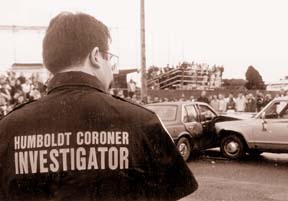
[Below left, Deputy
Coroner Charles Van Buskirk stages a drunk driving accident for
students at St. Bernard High School.]
 A
friend at the Samoa Fire Department told Van Buskirk about an
opening at the county coroner's office. Van Buskirk applied and
now, after almost 13 years, he is one of the most senior employees
in the office. A
friend at the Samoa Fire Department told Van Buskirk about an
opening at the county coroner's office. Van Buskirk applied and
now, after almost 13 years, he is one of the most senior employees
in the office.
He said the job still gets to
him on occasion. Child abuse cases, for example, make him emotional.
"Some things are hard to
put behind you," he said.
Back in 1997, Van Buskirk was
investigating a torso that was found floating in Humboldt Bay.
That investigation was difficult, he said.
"It's stunning to see in
person what people can do to each other," Van Buskirk said.
Those remains have yet to be
identified.
In 1998 Wayne Adam Ford, a truck
driver accused of killing prostitutes, turned himself in to the
Humboldt County Sheriff. He eventually led authorities to a tree
stump in Trinidad where he had placed the pair of legs that belonged
to the torso out in the bay. Ford also kept parts of other victims
in a storage locker in Arcata. (Ford was charged with one count
of murder by the district attorney's office; the case is pending
as Ford is now on trial in Riverside County for allegedly killing
three prostitutes there.)
Van Buskirk also tracks all
the "John and Jane Doe" cases -- cases where investigators
have either recovered unidentified partial remains or when someone
is reported missing and law enforcement is hoping to find information.
Van Buskirk has several thick
files of missing persons reports and information on unidentified
remains that have come in from all over the country. Some of
the cases date back to 1968. The file for cases solved is significantly
thinner simply because it pertains only to cases that have occurred
here.
"You can't be sloppy with
[missing persons] cases," Van Buskirk said.
The coroner's department gets
about two to three "Doe" cases a year, Van Buskirk
said. Every time a new case comes in, he'll go through the case
files plus all those sent to him from police and sheriff's departments
from around the country.
Jones has been around dead bodies
for most of his life. While in high school he worked at a mortuary.
He has about 20 years experience in the mortuary field. He was
a reserve deputy coroner in Corning, just south of Redding. Before
coming to the Humboldt County Coroner's Office, Jones was the
manager of Chapel of the Ferns Mortuary in Eureka.
"At the mortuary you get
the aftermath (of death)," he said. "Here you get it
up front."
Jones said he learned a long
time ago to block out death. Like Horton and Van Buskirk, Jones
is able to handle the job by not dwelling on what he does.
"Something just kicks in;
I can handle it," Jones said.
There are times when he has
been unable to leave work behind, especially if he handled a
difficult investigation.
"I'll question a thing
I did or didn't do," Jones said.
Although Jones believes his
20 years in the mortuary business gave him an advantage at the
job, he did have some adjustments to make. At the mortuary he
was the boss. He oversaw the finances. Now he is back to being
an employee. Jones also misses doing "restorative art"
-- restoring badly damaged or decomposed bodies to make them
look natural.
Horton and Van Buskirk share
a small cramped office space. Papers are stacked on the floor,
on shelves, on their desks. Jones and Jager share the other office,
using removable dividers to split Jager's office into two.
Anyone
can be coroner
Jager, 55, has been in law enforcement
since 1971, when he joined the Eureka Police Department. In 1990
he became a criminal investigator with the Humboldt County District
Attorney's office. He's been coroner since 1998 (he won a new
four-year term this past spring).
The Board of Supervisors has
toyed with the idea of going with a sheriff coroner. There are
44 counties (out of 58) in California with a sheriff-coroner
system. Jager said it is a good idea to keep the coroner an independent
office.
"You can end up with people
who don't want to be in the coroner department," he said.
"When you have grieving families you need someone to go
the extra mile. You won't get that in a sherif-coroner [system]."
Besides running the office and
conducting death investigations, Jager is also a public administrator;
he oversees administration of estate sales.
When the investigators come
across a deceased person and they can't locate any nearby family
or relatives, all of the deceased's personal property must be
secured. Guns, money, jewelry are all taken back to the coroner's
office and placed in safe keeping.
Investigators then must pore
over the deceased's mail, address book and papers to track relatives.
It can take 45 minutes or several days to learn whether someone
has family or not. If there are no relatives, then the deceased's
belongings are sold. The funds from the sale are placed in an
estate in case a relative comes forward to pay any outstanding
bills. After three years, the money goes to the state. The office
also collects a fee for handling the sale -- 4 percent of the
first $100,000. The fee was established by the state. Jager estimates
it cost about $560 to handle each sale.
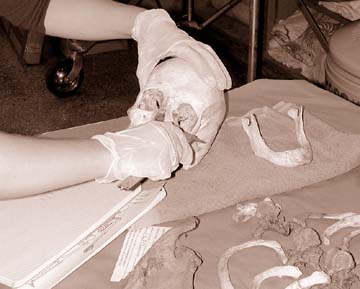
[An on-call anthropology
student examines unidentified remains found in rural Humboldt
County.]
"That's the revenue source
for the coroner's office," Jager said. "It helps offset
operating costs."
The sales can bring in between
$80,000 and $100,000 a year for the department.
Those fees come in handy. Lab
costs can add up over time. Each toxicology test costs between
$100 and $150. The county has to send samples to a lab in Fresno
because a local lab is not available. Jager estimates the department
spends upward of $25,000 per year on toxicology.
DNA analysis can cost up to
$5,000 per test. But the state will cover the cost if the DNA
test is for a homicide case.
Jager can also take advantage
of a new state missing persons lab. Remains can be sent to the
Sacramento area lab to be matched against DNA samples from across
the state.
"There are thousands of
missing persons cases in California," he said.
Earlier this year a partial
skeleton was found in the waters off Eureka. The remains are
believed to be that of a man who was swept off the North Jetty
(at the mouth of Humboldt Bay) and out to sea in January.
Because the remains did not include the skull, no dental records
match could be made. The state lab is looking at it as a test
case. Technicians should be able to extract DNA from the bones
and hopefully match it with DNA taken from hair samples provided
by the man's family, Jager said.
The technology available now
to the coroner's office allows them to do things they couldn't
do just 30 years ago, Jager said.
"We didn't have computers
back then to do DNA testing," he said. "In 30 years
law enforcement has come a long way."
IN
THE NEWS | CALENDAR
Comments? E-mail the Journal: ncjour@northcoast.com
© Copyright 2002, North Coast Journal,
Inc.
|