|
 
COVER
STORY | IN THE NEWS | PUBLISHER | OPINION
DIRT | STAGE MATTERS | TALK OF THE TABLE | THE HUM | CALENDAR
November 10, 2005
story & photos by HEIDI WALTERS
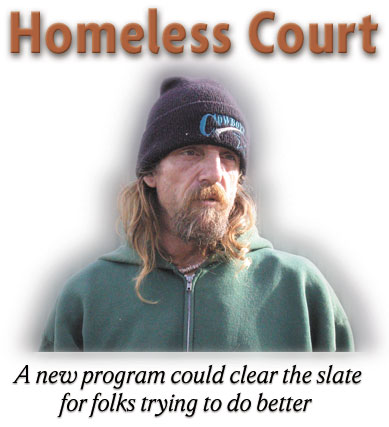
Above: After decades of working
hard labor jobs, Butch Henderson is homeless and jobless in his
home town. He recently was ticketed for riding his bicycle down
the wrong side of the street.
The 'bum'
BUTCH HENDERSON seems a bit
of a comfort magnet here at 35 W. 3rd Street in Eureka, where
a mix of homeless and working poor people are slowly gathering
this Thursday for the midday free meal provided by St. Vincent
de Paul. Henderson, dressed in a green sweatshirt, black jeans,
sneakers and a black knit cap with "Cowboys" stitched
in blue thread on it, stands alone in a puddle of pavement away
from the line of people forming against the building, talking
with Les Rastorfer, who's sitting on a bench. And as he talks,
people keep coming up to him for stuff. One young man, dressed
nattily in black, wants a cigarette. Henderson gives him one.
Another man -- a kid, really -- wants to borrow the striped,
multicolored hacky sack Henderson grips in his right hand. He
tosses it to him, following it with his eyes, then resumes talking.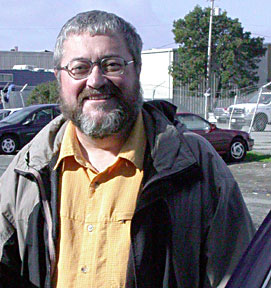
Henderson, who is homeless,
and Rastorfer, a case manager for Mobile Medical (a health-care
truck that serves the homeless population), are discussing one
of the more plaguing aspects of the already difficult life on
the streets: The steady accumulation of police citations that
adhere to homeless people for infractions that range from peeing
in public to illegal camping to, for those who don't know about
the free meals, petty thefts of food and other necessities from
convenience stores. Why, just the other day, Henderson got a
double whammy.
Right: Les Rastorfer
is a case manager with the Mobile Medical Office, which brings
health care to people living on the streets. He says a pile-up
of petty fines can block a person from getting important medical
benefits.
"That day -- the police
were here all day, and they pulled a couple of people over who
were just driving by," recalls Henderson. "I was sitting
right here. I picked my pack up and got on my bike, and the cop
was over there on his motorcycle. I was going to the [Rescue]
Mission on 2nd Street to drop my pack off -- they let people
leave their things there during the day. So, I got on my bike,
and I went across the street and was riding to the Mission, and
the cop came after me." He was ticketed twice: for riding
on the wrong side of the street, and for having an outdated post
office box number on his driver's license.
"It's a total waste of
taxpayers' dollars," says Rastorfer. "There are house
break-ins in Eureka, and the police are busting people for riding
bicycles on the wrong side of the street. He's easy prey. The
police like going around these areas where the homeless are.
It's like shooting fish in a barrel."
The kid comes back and hands
Henderson his hacky sack. He looks at it gravely.
"I've been playing for
about four years," Henderson says. "It's something
out here that gives me space, because out here, it's hard to
have privacy."
Henderson has reddish long hair
and a short beard and mustache. His light eyes are a little sad,
his face prematurely drawn with long lines of a life hard-lived.
He was born 45 years ago, on Nov. 22, in Eureka, and he's been
homeless in his home town since 2000. Like many homeless people,
he sleeps down by the bay. "Before I came out here, I always
thought bums were lazy," he says. "But everybody has
a story of one kind or another. Working people pick on us all
the time. But it's not just that people are lazy. A lot of people
are not capable of working."
His story? He worked hard, body-breaking
jobs for years, 60- to 90-hour weeks sometimes, including 17
years with Eureka Fisheries. The jobs came and went. For 10 years
he lived and worked in Phoenix, where his brother lives. One
night, his house was burgled and the invader bashed in his face.
It was a turning point, and he came back to his home town. But
he'd been declining, physically, anyway. His legs and back ache
intolerably now and he finds it hard to get up in the morning.
Once while working a night job, he says, "somebody went
like this" -- he sticks his arm out straight, pinches his
fingers together and shakes his hand like he's holding a baggie.
It was meth, he got hooked, and life just got harder.
Still, listening to Henderson,
you get a sense he's on an upward swing. He's going to physical
therapy now, he's struggling to quit meth, and he has a "significant
other" he met a year ago. "Her kids call me 'Dad.'"
She and the kids are in the M.A.C. -- the transitional-living
Multiple Assistance Center -- and she has saved up enough money
for them to rent a place together as a family. "We're filling
out applications," Henderson says.
This is where the bicycle citations
could cause trouble, if Henderson doesn't deal with them. And
that's where a new concept, for Humboldt County anyway, could
come in handy. It's called "homeless court."
The law
Everybody, at some point, has
probably committed an "infraction" or maybe even a
misdemeanor. Riding a bike on the wrong side of the street, like
Henderson did. Or forgetting to update the address on that driver's
license. Maybe, even, sitting on a bench in public after drinking
a few. And every day, hordes of people -- housed and unhoused
-- let their dogs wander off-leash in the Arcata Community Forest.
Others let their dogs sit down in the Arcata Plaza (they're supposed
to keep moving). These are all citable offenses, usually dealt
with by an appearance in court and payment of a fine.
But some infractions and misdemeanors
might stem from the condition of being homeless, says Steve Binder,
a deputy public defender in San Diego who co-founded the nation's
first homeless court, in San Diego County in 1989. "Most
of the offenses the homeless folks bring into court are public
nuisance offenses," Binder told Michael Twombly in a taped
interview earlier this year. (Twombly is a board member of the
Humboldt All Faith Partnership, which runs the nonprofit, private
Arcata Night Shelter.) "They are the result of their being
homeless. They might be 'sleeping in public' or 'drinking in
public' or 'peeing in public' -- things we do in the privacy
of our homes, they do outside because they have no other options.
Additionally, you'll find petty thefts [of food], because people
might be looking to survive. Or you'll find people doing drugs,
whether it is a way of self-medicating or just a way of surviving
on the street. We're not trying to condone that." Rather,
homeless court tries to engage a person, with the community's
help, in finding a way out of the homeless situation.
Fact is, Binder reiterated last
week, most homeless people don't deal with the tickets they get
from the police, either because they don't have the money to
pay the fines, or they're afraid of being jailed so they avoid
going to court. As the tickets and warrants for failure to appear
in court multiply, their fears increase. Often, homeless people
will just tear up these pesky "notices to appear" or
shove them into the bottom of a backpack to be forgotten. And
then the citations become red flags to prospective employers
and landlords. Also, says Rastorfer, who helps people get medical
coverage, a simple citation, ignored, can keep a person from
receiving Social Security Insurance and medical benefits. "You
can go from $900 a month and medical coverage, if you're on SSI,
to nothing," he says. "I've seen a lot of people go
through a lot of misery over something that was insignificant."
For a person with diabetes, for instance -- a common ailment
on and off the street -- loss of medical coverage can even mean
death.
But in "homeless court,"
all efforts to get one's life back together are put on the table,
and the judge views those and usually says, "case dismissed."
Homeless court, says Binder,
takes "away the traditional court sanctions of fines, public
work service and threat of custody, and, instead, people receive
credit for the positive things they're doing to get their life
back together. Those can be attending AA meetings, or training
and searching for employment. And the judge has proof of that
up front. And when the court actually recognizes what that person
has done in the program, the person actually sees that it is
valuable." That boosts self-esteem. "Because, when
you get citation after citation, and people are telling you to
move on, you feel worthless."
Binder says he recognized a
need for an alternative way of dealing with homeless people and
their citations when he was just starting out in the public defender's
office. He noticed an endless train of minor offenses: "illegal
lodging citations, sleeping under bridges, sleeping on a sidewalk,
sleeping in a doorway or in a field or a canyon. There was no
place to stay, and there were not enough beds to house the homeless
folks. The shelters were turning away folks. And some of these
people would be standing there [in court] with their worldly
belongings on their shoulders." That, and a survey of homeless
veterans who showed their biggest need was resolution of outstanding
bench warrants, spawned the homeless court, held at first in
a handball court at the county's annual Stand Down for Homeless
Veterans -- a bazaar of social and medical services. "In
the first four years, 942 homeless veterans resolved 4,895 cases."
San Diego's homeless court now is held monthly, alternating between
two homeless shelters, for all homeless people.
Homeless court is an alternative
way for a homeless person to tackle minor but niggling legal
problems without having to face a fine-wielding, jail-threatening
judge in a traditional courtroom. (Charges of major offenses,
such as assault, drug dealing or domestic violence, would remain
the purview of regular court.) For example -- and Humboldt's
legal team is still working out the details -- if someone is
busted for being drunk in public, she might agree to go to five
Alcoholics Anonymous meetings and perform community service at
one of the homeless service facilities. Or if a homeless person
is cited for stealing food, he might agree to seek out a homeless
service facility and learn about where to get free food. If he's
cited for loitering, he might agree to enroll in a job-training
course.
Humboldt County's homeless court
is tentatively scheduled to hold its first session at 3 p.m.
on Jan. 13, a Friday, at St. Vincent de Paul in Eureka, and to
meet thereafter once a month, perhaps even in other areas of
the county.
 The legal team The legal team
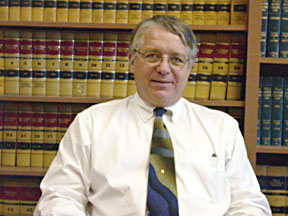
Left: Humboldt
County Judge John Feeney is looking forward to presiding in homeless
court, where defendants charged with infractions and misdemeanors
will be given credit for having completed programs aimed at bettering
their lives.
Judge Feeney, who presides in
Humboldt County Superior Court, Courtoom 8, was born and raised
in San Diego and says he has "been admiring their homeless
court from afar for years." So when Christina Allbright,
a deputy public defender in the main public defender's office,
and Tiffany St. Claire-King, an attorney in the county's Alternate
Conflict Counsel office, asked at a California judges' meeting
if any local judge would be interested in holding a homeless
court in Eureka, he was ready. In September, he went down to
San Diego to observe a homeless court. "I was impressed,"
he says. "In the traditional courtroom, the judge sits up
high and looks down on you. In the homeless court, the judge
was eye-to-eye [with the homeless defendant] and it was just
much more personal." The judge still wears a robe and is
attended by a bailiff, clerk and court reporter -- it's a real
court of law, even if the setting's relaxed, and the defendant
has the same constitutional rights as in a traditional court
setting. But, most important, nobody gets taken into custody
at homeless court.
"For the most part, the
DA and the defense attorney will work out ahead of time how the
case is going to be handled, and I'll likely call the case and
say what the disposition's going to be," says Feeney. "They'll
have, say, three months to do it, and then they come back with
proof they completed the program."
Feeney says he expects homeless
court to save the county money and time. It'll clear up old cases,
and likely keep some people from re-entering the court system.
Homeless court will be conducted by existing staff within normal
business hours, with court just being diverted once a month to
a homeless provider setting.
"The court -- we see this
as a community outreach to assist these folks," Feeney says.
He compares it to a successful pilot mental health court the
county had for four years, until state funds dried up, and to
the county's existing drug court. "Courts, in general, are
going more toward rehabilitation than the punitive, which is
good."
Feeney allows that homeless
court alone isn't going to eliminate homelessness. "Many
homeless people have substance abuse issues and mental illness,
and for those people it's more complicated," he says. "But
I think for some homeless people, they just need a helping hand.
The way I look at it, even if we only help 10 to 20 people a
year, that would be great."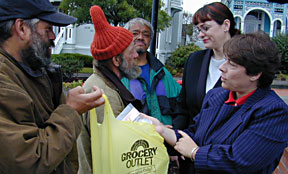
Right: Christina
Allbright (right, foreground), a Humboldt County deputy public
defender, and Tiffany St. Claire-King (right, back), an attorney
with the county's alternate conflict counsel office, talk with
homeless Eureka natives Jody Kiesner (left, foreground), Robert
Wayne Printy (middle) and Chester Bighead (back).
Allbright and St. Claire-King
likely will form the core defense team for homeless court. For
St. Claire-King, it was at a meeting earlier this year between
judges, district attorneys, public defenders and law enforcement
to talk about the regular court process that she found the impetus
to push for a homeless court here. "Several law enforcement
officers expressed frustration about writing citations for people
without addresses, and then they would just get lost and nothing
would be done," says St. Claire-King. Since she had worked
with Sacramento County's homeless court, she knew enough to start
promoting the idea. Allbright was also at that meeting where
police officers told the judges that "people are just tearing
up tickets ... and the court doesn't even issue warrants sometimes
to people they've cited" because the people don't have addresses.
"I think [homeless court] is going to make the police happy,
because they'll get to see some accountability."
The cop
It might be tempting, at this
point, to wonder if maybe the police could just lighten up on
the homeless folks. But that isn't the way it works, says Arcata
Police Captain Tom Chapman, namely because the police don't distinguish
between housed and houseless people -- that would be profiling.
As Eureka Police Captain Murl Harpham puts it, "Our job
is to write the ticket -- just enforce the law."
That said, Chapman is willing
to produce statistics, upon request, based on types of offenses
-- again, not linking them to a person's housing status. This
year, from January to date, for example, the Arcata Police Department
issued 113 tickets for illegal camping within the city limits,
and seven tickets for urinating in public. Once a citation is
issued, the police department sends a copy of the citation to
the district attorney or city attorney's office, depending on
the charge. The person cited is supposed to contact the court
within 30 days to either enter a plea or pay a fine.
Binder agrees it isn't the cops'
problem. "I don't badmouth the police," he says. "They're
caught in the middle of a social problem, and they have to answer
to the citizens."
Still, the cops seem to like
the idea of homeless court. "Conceptually, I like the idea,"
says Arcata's Chapman. "How do we fine somebody $500, or
$1,000, if they have absolutely no means to pay? It makes no
sense." Harpham says the idea is "great." "At
least something will be getting done," he says. "We
had one guy who had about 60 tickets and he'd never been to court."
Equally frustrated have been
the homeless people who do happen to make it to court, says public
defender Allbright. Homeless court will give some of these folks
"doable consequences" as opposed to punitive consequences.
"We always tell people they should pull themselves up by
their bootstraps," says Allbright. "But we forget that
some people don't have bootstraps. This is going to give them
bootstraps."
The provider
The No. 1 bootstrap dealers
will be the homeless services providers, such as St. Vincent
de Paul, Arcata Endeavor, Arcata Night Shelter, Mobile Medical,
the M.A.C. and the Eureka Rescue Mission. Providers will refer
a person to homeless court and facilitate the process with the
legal team. Michael Twombly and Susie Van Kirk are board members
of the Humboldt All Faith Partnership, which runs the private
non-profit Arcata Night Shelter (the only emergency shelter in
Arcata), and likely will be at the forefront of the new court
program. Around about when the judges, attorneys and cops were
creeping up on the idea of a homeless court, Twombly was already
a few steps ahead of them. Twombly has worked with homeless people
and the mentally ill for more than a decade, and says he'd been
reading about homeless court when, one night, something happened
that convinced him it was needed in Humboldt County.
"I was driving back to
Arcata from teaching substance abuse courses at the jail in Eureka,"
he recalls. "It was dark, it was raining, it was cold. And
I picked up this guy. He'd been working all day -- he's a painter.
I said, 'Wow, that's hard to do without a car.' And he said,
'I got in a twist with a fix-it ticket for my taillight.' He
said he didn't pay the fine, and then he got cited again for
the same taillight. He didn't have any money to fix it. Then
he was issued a warrant. So, he couldn't get his car registered.
So, then he drove an unregistered car to work, and he got three
more tickets for failure to register. He owed $1,000 by then.
So then he stopped driving. And now he was hitchhiking to work
to feed his family. And I thought, there really ought to be an
amnesty day for this guy."
Twombly called Binder to talk
to him about San Diego's homeless court, and Van Kirk wrote to
Judge Feeney. Twombly went to San Diego to observe homeless court
in action, recorded interviews with Binder and another attorney,
then came back and joined forces with the players in the traditional
court system -- and Humboldt County's homeless court was born.
Happy ending
Everyone seems excited, but
perhaps no one is looking forward to homeless court more than
the mild-mannered Judge Feeney. His face shines when he talks
about his favorite moments of being a judge. "Weddings,"
he says, "and I really enjoyed running that mental health
court. It was just so gratifying to see people turn their lives
around." Yes, gentle Feeney, who says he loves being a judge
because he gets "to do the right thing," seems just
the right kind of judge to wander down to St. Vinny's for a Friday
afternoon clean-that-slate session.
"I feel empathy for folks
who, for financial, or physical reasons, or because of drug abuse
or mental illness, are homeless," Feeney says. "They're
no different from all of us. A lot of us could be homeless --
just one bad turn. This is going to sound corny, but I think
our community is only as strong as the less advantaged in our
community."
COVER
STORY | IN THE NEWS | PUBLISHER | OPINION
DIRT | STAGE MATTERS | TALK OF THE TABLE | THE HUM | CALENDAR
Comments? Write a
letter!
© Copyright 2005, North Coast Journal,
Inc.
|