|

COVER
STORY | IN THE NEWS | OPINION
THEATER | TALK OF THE TABLE | THE HUM | CALENDAR
November 3, 2005

Reframing McKinley
by RICK
ST. CHARLES
A few years ago I wrote about
how the problem of having billions of ants in our house was easily
resolved by simply "reframing" them. Instead of seeing
them as loathsome vermin immune to every known means of extermination,
we began to view them as vast hordes of personal maids, fastidiously
cleaning up every speck of Dorito and smidge of marmalade we
spilled.
 Miraculously, it worked. Instead of tearing our
hair out, we began to smile with benign affection whenever we
came upon a writhing mass of our little servants engrossed in
their housework. The ants, sensing we were taking advantage of
them and resenting that we weren't providing health insurance,
soon vacated the premises. Miraculously, it worked. Instead of tearing our
hair out, we began to smile with benign affection whenever we
came upon a writhing mass of our little servants engrossed in
their housework. The ants, sensing we were taking advantage of
them and resenting that we weren't providing health insurance,
soon vacated the premises.
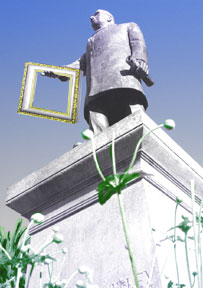
Now I see that once again the
statue of William McKinley on the Arcata Plaza is causing some
residents to squirm with indignation. They feel he left a legacy
of war, oppression and corporate greed, and should be sold, perhaps
on eBay, to some other community that appreciates these qualities
in a president. The local UPS outlet is in favor of this, because
it would cost approximately $2 billion to ship the 26-ton statue,
even more if the buyer wants two-day ground service.
I feel this is an unnecessary
expense and would like to propose a simple solution. All we have
to do is "reframe" McKinley: Pretend it's a statue
of someone else, some noble person of impeccable character who
just happens to look exactly like McKinley.
It's common knowledge that somewhere
on Earth we each have somebody who looks enough like us to be
our twin. A lot of people make a healthy living impersonating
someone famous, from Albert Einstein to Barney Fife. I myself
have a double who happens to live in Humboldt County, although
I seriously doubt he's going to make any money off it. My wife
saw him hanging around the gazebo in Old Town Eureka a few years
ago and, thinking he was me, snuck up behind him and pinched
his butt. When she explained her mistake, they both laughed about
it until he tried to kiss her, claiming she was a dead ringer
for his girlfriend. She didn't buy it.
But I digress. Let us go back
100 years to San Francisco and imagine young Armenian sculptor
Haig Patigian as he goes about fulfilling his commission to make
a statue of the recently assassinated McKinley. Ideally, Bill
would have been available to pose for Patigian, but that's not
an option. The second choice would be to work from photographs
of McKinley striking that diplomatic pose -- his right hand extended
in friendship, his left hand clutching a declaration of war on
some easily oppressed country, after which he can dish out immense
rebuilding contracts to his fat-cat cohorts. But, sadly, no photos
of this particular stance are available.
Patigian is under intense pressure.
He knows the great earthquake of 1906 is on its way and he wants
to finish the statue so UPS can ship it and he can get the hell
out of town. Returning to his studio after a crab sandwich lunch
on Fisherman's Wharf, he encounters a street performer whose
similarity to McKinley is uncanny. The man's act consists of
standing perfectly still until you put a dime in the hat at his
feet, whereupon he delivers McKinley's first State of the Union
address, in which the former president proposes that his nephew
be granted the ambassadorship to Belize. They strike a deal:
The man agrees to pose for Patigian in exchange for a year's
supply of Ghirardelli chunk-style dark chocolate.
As Patigian sculpts, they chat.
The man's name is Alphonzo Bambino. He's a vegan environmentalist
advocate of nonviolence who spends his spare time planting apple
trees, reading to blind children and organizing fundraisers for
victims of Hurricane Katrina. When his modeling job is done,
Bambino feels remorseful for negotiating all that chocolate for
himself and instead donates it to Habitat for Humanity, keeping
only enough to supply treats for the 16 multicultural orphans
he has adopted and put through med school.
Later in his life, Bambino founds
an international organization called Doctors Without Borders
and spends years as a medical missionary in Africa. After that
he devotes himself to working among the poorest of the poor in
the slums of Calcutta. "Ask not what the world can do for
you," he is fond of saying. "Ask what you can do for
the world. In the end, the love you take is equal to the love
you make. All we are saying is give peace a chance. I have a
dream."
Bambino dies when, after saving
the occupants of a retirement home from their burning building,
he re-enters the inferno in an attempt to rescue Petey, Ruby
Bugbee's parakeet. (Petey is found afterwards safely perched
in a tree with his cuttlebone tucked under a wing, saying, "What?
What?!")
So. We don't need to get rid
of the statue. It's been estimated that to do so would cost $34
million and leave behind an unsightly hole in which a knot of
plazoids would undoubtedly set up a percussion section. Instead,
let's just change the plaque on the pedestal to read, "ALPHONZO
BAMBINO -- BELOVED HUMANITARIAN." It has been calculated
that it would cost only $75,000 to $100,000 of city staff time
to figure out how to obtain an Environmental Impact Report to
allow this, plus an additional $79.95 for the plaque.
It would be well worth it. Because
the next time anti-McKinleyites gaze upon that lofty bronze visage,
they won't see the 25th president of the United States and feel
outraged. They will see Bambino and feel all warm and fuzzy.
I know I will.
Rick St. Charles has lived
in Arcata and Bayside for 20 years. His most prized possession
is a bust of Alphonzo Bambino, which he stumbled upon at a garage
sale for 25 cents. He is willing to part with it for $2.5 million.
COVER
STORY | IN THE NEWS | OPINION
THEATER | TALK OF THE TABLE | THE HUM | CALENDAR
Comments? Write a
letter!
© Copyright 2005, North Coast Journal,
Inc.
|