|
 
IN
THE NEWS | CALENDAR
by JIM HIGHT
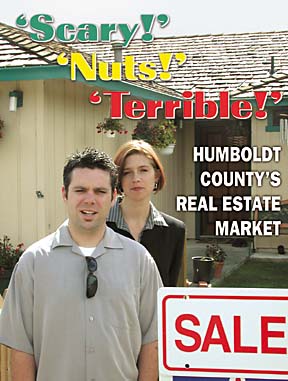
JEFF CROSS, 34, AND SEQUOYA
ANDERHOLM, 27 [in above
photo] recently began trying to
buy their first house in Eureka, where they both grew up.
With their combined salaries
-- he's head clerk at a supermarket and she's an advertising
executive -- they figured they'd be able to afford a three-bedroom
house in one of Eureka's safer neighborhoods.
But Cross and Anderholm quickly
learned how expensive and difficult it is to buy a home in Humboldt
County today.
"The market is really over-priced,"
said Anderholm, standing with Cross and their 6-year-old son
Cain outside a plain 1950s three-bedroom house listed for $170,000.
"It's inflated beyond belief,"
agreed Cross.
"It's amazing how quickly
they go," said Anderholm. "Some sell within a week,
and some sell the day they go on the market."
A
price spike
"Amazing" is something
a lot of people are saying about Humboldt County's real estate
market. Other descriptions include "nuts," "terrible,"
"scary," "crazy," and "mind-blowing."
For most of the 1990s, home
prices in Humboldt County poked along at a slow pace, with an
average annual increase in the median price of about 2 percent.
The median-priced house that sold for $110,000 in 1992 had appreciated
to $129,000 by 2000, according to data from the Humboldt County
Association of Realtors. (Median is the price in the middle,
where half the homes sold for more and half for less.)
But in 2001, housing values
rose 8.5 percent. And in just the first nine months of 2002,
the median price of houses sold has shot up another 16 percent
to $162,300.
House prices have increased
even more in some parts of the county. The North Bay region that
includes Arcata, McKinleyville and Trinidad has seen median home
prices go up to $180,000, according to the Realtors' association
data.
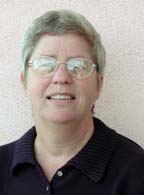 "It's
terrible news for local people," said Sue Forbes, [photo at left] a
broker and owner of Forbes Associates in McKinleyville. "If
you're not already in a home right now and riding that wave of
appreciation, it makes it very difficult [to buy a house]. "It's
terrible news for local people," said Sue Forbes, [photo at left] a
broker and owner of Forbes Associates in McKinleyville. "If
you're not already in a home right now and riding that wave of
appreciation, it makes it very difficult [to buy a house].
"We don't have the jobs
or the industry or the income [levels] here for somebody who's
just starting out to buy a $180,000 house," said Forbes.
As recently as 1998, buyers
in Arcata could purchase a modest three-bedroom tract house --
most likely one built in the 1950s by the Pierson or Stromberg
families -- for $100,000 to $115,000. Today, those homes are
listed for $175,000 to $200,000.
In Fortuna and much of the Eel
River Valley, homes listed for under $200,000 are rare. "If
I could find a house for $160,000, I'd sell it in a day,"
said Debi August, a Realtor and Fortuna City Council member.
"I've been a real estate agent and broker for 30 years,
and I've never seen anything like this happen here. I've never
seen a house increase in value $55,000 in four months.
"It's kind of scary,"
she added. "I worry about the young people getting married
and looking for their first house."
In Southern Humboldt, Realtor
Vern Bonham says the least expensive house to sell recently in
the Garberville and Redway area went for $295,000.
"We have a house [in Redway]
listed for $750,000," he said. "We've got another couple
houses listed for $450,000 and we [recently] sold one for $410,000.
"Three or four years ago
if you'd [mentioned] these prices, somebody would have run you
out of town," said Bonham.
The
Bay Area effect
"I had a doctor buy a homestead
in Mattole River. He paid $600,000 for that old homestead, flat
cash, thank you very much," said Bonham. "I thought
the price should have been probably $385,000. Sometimes you just
shut up.
"In the past the market
was driven by the amount of dope that was grown," said Bonham.
"Now it's just people out of the city who sold a home down
there for $700,000 to $800,000."
Realtors in other parts of the
county echo Bonham's assessment. New residents are moving into
the county with lots of cash to buy a home -- and driving values
way, way up.
"People from the Bay Area
are selling their homes then coming up here and buying a house
for cash and living without any house payments," said one
Realtor.
Some real estate agents trace
the increased migration to the Sept. 11, 2001, terrorist attacks,
when many city dwellers found a new motivation to move away from
populous areas. Others see an ongoing trend that has accelerated.
"We've seen a lot of people
coming in from outside the area for the last four or five years,
but we've really seen a lot of it since last year at this time,"
said Forbes. "People seem to be accelerating their retirement
plans. [Some are moving here] to go back to school."
Another trend driving the market
is a new surge in real estate investing in the wake of collapsing
stock values. "[Investors] think real estate is a better
investment now than the stock market," said John Fessler,
a loan officer with Prime Rate Mortgage in Arcata. "That
really pushes prices and puts pressure on the young couple or
other entry-level buyers trying to purchase a house for their
own personal residence."
Still
cheap for California
Even after the appreciation
of the last two years, Humboldt County real estate still looks
like a bargain to investors and newcomers who've owned property
elsewhere.
"One of my clients from
San Francisco bought a house here sight unseen," said one
Realtor. "`Where else can you find real estate that cheap?'
she said."
"In Humboldt County, we
haven't seen the spectacular appreciation as in the Bay Area,
Central Coast, Southern California and San Diego," said
Fessler. "In the Bay Area, a 1,100-square-foot bungalow
[might sell for] $750,000."
But the fact that local housing
values are still less than in the Bay Area and most of California
-- the statewide median price is about $325,000 -- is little
comfort to local people who are watching the cost of a Humboldt
County house escalate beyond their grasp, perhaps permanently.
Ironically, the current low
interest rates for mortgages could make home ownership more affordable
for first-time home buyers. But the rise in home prices has far
outpaced the potential savings offered by declining interest
rates.
Consider the gap between the
home-buying power of a family earning the median household income
-- $31,226 -- and the median home price -- $162,000.
With a 5 percent ($8,100) down
payment and a 30-year mortgage at 6 percent interest, the monthly
payments for a $162,000 home (with taxes and insurance) would
be about $1,250, according to Fessler. To qualify for such a
mortgage, a family with moderate debt (car payments, credit card
balances, etc.) would need to earn about $46,000 per year.
A
seller's market
Not only are homes more expensive,
they're also harder to find.
Between the newcomers, the investors,
renters trying to buy their first house and homeowners looking
to move up to a larger one, there is an enormous demand for homes
in Humboldt County.
But there are not a lot of homes
available for sale. Real estate agents have more buyers than
homes available, according to many sources. "The supply
of homes on the market is the lowest I've seen," said Bob
Lawton, a broker and owner of Humboldt Mortgage Company.
With demand exceeding supply,
competition among buyers has become intense. "Good houses
sell within hours or days of going on the market," said
one real estate agent. "Sellers are choosing from a range
of offers, many of which come in above the asking price.
"Buyers who have lost out
on two or three houses in a row become more desperate,"
she continued. "They jump at the next opportunity. In some
cases, people are offering $10,000 to $20,000 more than the asking
price."
With strong demand, high prices
and short supply, the laws of economics should be leading developers
to construct a lot more housing. That doesn't seem to be happening.
The number of annual housing
starts -- measured by building permits issued for new single-family
homes -- has been on a downward trend since 1990, according to
county records.
In the late 1980s and early
1990s, housing starts averaged 380 per year. From 1994 through
2001, the annual average was 250. (This doesn't include the seven
incorporated cities -- Arcata, Blue Lake, Eureka, Ferndale, Fortuna,
Rio Dell and Trinidad; but it does include McKinleyville, Cutten
and other fast-growing areas.)
County figures for the first
eight months of 2002 show that housing starts for this year will
probably come to about 250.
"We haven't seen a whole
lot of new subdivisions coming into our office despite the fact
that housing prices have gone up," said Michael Richardson,
senior planner for Humboldt County Community Development Services.
Buildable
land scarce
Why the market demand isn't
leading to a greater supply of housing is a central question
that county planners will explore in the next year as they update
the county housing plan, known as the "housing element."
One likely answer goes to the
heart of what defines Humboldt County -- an abundance of natural-resource
and agricultural lands.
Developers say that between
protected wetlands, nature preserves, and land zoned for agriculture
or timber production, there is very little land available for
new homes. As a result, land prices have soared.
North Coast Home Builders, an
association of developers, advocates rezoning more agricultural
land for development. This would not only allow more housing
to be built, it would also ease the price increases, they say.
 "The
first cost of building is the raw land," said Bob Higgons,
director of the group. [photo
at right] "If that remains
in limited or short supply, its cost goes up. If no more agricultural
land is going to be considered for residential use, the trade-off
is higher cost for housing." "The
first cost of building is the raw land," said Bob Higgons,
director of the group. [photo
at right] "If that remains
in limited or short supply, its cost goes up. If no more agricultural
land is going to be considered for residential use, the trade-off
is higher cost for housing."
But many citizens oppose converting
agricultural lands. Farms and pastures around North Coast towns
are cherished by residents as open space "greenbelts."
On top of the open space concerns,
land conservation advocates -- including the Humboldt County
Farm Bureau -- point to food security issues: as global population
soars and farmland diminishes, every square yard of productive
agricultural land becomes more important, they say.
Some affordable-housing specialists,
however, echo the builders' group's concerns about the short
supply of land for building.
"You want to preserve the
character of the community and the greenspace, but on the other
hand when you limit development options too much, then the cost
[of land and new houses] goes up," said Kermit Thobaben,
director of planning and programs for Redwood Community Action
Agency, a Eureka nonprofit agency with several housing programs.
"When elected officials
make a decision [on the new general plan's zoning designations
for agricultural land], they're going to have to weigh both sides
of the issue," said Thobaben.
But zoning more fields and farms
for development may not help first-time home buyers. While land
values may not increase as quickly, it's unlikely that more supply
will bring current land values down. "Will we see a return
to the $125,000 entry-level new home? I don't think so because
the [current] cost of raw land will not allow it," said
Higgons.
 In
addition to land, developers' other costs have increased sharply,
particularly insurance to cover accidents and injuries during
construction. "We're looking at costs of $5,000 to $10,000
[per house] just for insurance," said McKinleyville developer
Mark Rynearson. [photo
at left] In
addition to land, developers' other costs have increased sharply,
particularly insurance to cover accidents and injuries during
construction. "We're looking at costs of $5,000 to $10,000
[per house] just for insurance," said McKinleyville developer
Mark Rynearson. [photo
at left]
Fees levied by local governments
also drive up building costs, and so do conditions imposed upon
builders, according to Rynearson and Higgons. For example, in
McKinleyville builders of new subdivisions must set aside land
for storm water retention basins because of water quality problems
in local creeks.
But the sales prices of new
houses are also determined by the types and sizes of houses that
are built.
Developers build for the market,
and except for first-time home buyers, most people in the market
for a home in Humboldt County -- and elsewhere in California
-- want a roomy house, 1,400 square feet and up, with "all
the bells and whistles," as a recent ad for a new $269,000
home in Cutten proclaims. And they want the standard 60 x 100
lot -- if not a larger one.
Thinking
small
To create more affordable new
housing, advocates for first-time home buyers want county and
city zoning codes changed to encourage developers to build smaller
houses and denser subdivisions.
"Land is so expensive that
to create affordable homes we have to build more units on less
land," said Kay Escarda, president of Humboldt Bay Housing
Development Corp. (HBHDC), a non-profit organization.
Escarda served on a county advisory
group -- the Community Advisory Committee on the Housing Element
-- that proposed several ideas for affordable housing in 1998,
before it disbanded. Only one of its proposals was adopted by
the county board of supervisors: allowing construction of second
homes -- commonly called "mother-in-law" units -- on
standard size lots. "That was a good step in the direction
of getting affordable housing," said McKinleyville Realtor
Forbes.
With the county housing element
being updated -- and the soaring cost of homes creating new urgency
-- Escarda and others hope the county will take a second look
at some of the group's other proposals.
One idea is a "density
bonus" that allows developers to build more houses per acre
than current zoning allows if they ensure that a percentage of
the homes will be priced affordably.
Another is allowing developers
to create some half-size lots in new subdivisions -- 3,000 square
feet instead of the standard 6,000 -- with homes of 700 to 1,000
square feet instead of the usual 1,400 and up.
"The idea is to create
more rungs at the bottom of the ladder so young people can get
access to the equity chain," said Dan Taranto, who also
served on the advisory group.
For the most part, these zoning
changes would allow and encourage developers to build some smaller,
cheaper homes. But mandatory policies are also under consideration.
Arcata put an "inclusionary
zoning" policy in its recently adopted general plan and
it is now fine-tuning the details. "The city will set certain
percentages of units that need to be affordable in the land use
code update which is now underway," said Elizabeth Conner,
director of HBHDC and an Arcata planning commissioner who supports
inclusionary zoning.
Without such policies, Conner
says, "Arcata will continue to become a community where
only higher-income people can afford to buy a home."
The home builders group has
spoken out against Arcata's inclusionary zoning policy, saying
it will discourage developers from building anything in town.
Conner, who's running for city
council this fall, believes that the Arcata market is lucrative
enough for developers to make a profit on a mix of upscale and
affordable houses. "We can assist developers with incentives
and trade-offs like density and setback bonuses to make sure
it's financially workable for them, but we do need to require
it," she said.
On the voluntary measures, Higgons
and Rynearson give mixed reviews. "There are some builders
who would choose to go into the smaller-house market if a reasonable
profit is there," said Higgons.
But Rynearson fears getting
stuck with houses nobody wants. "If I had 800-square-foot,
three-bedroom, one-bath houses today, I could sell them. But
in a normal market, I'd have trouble," he said.
"The market here changes.
It goes down just as rapidly as it goes up," said Rynearson.
"This housing shortage has only come about in the last
24 months. Before that there were tons of houses [for sale] and
[fewer buyers]."
Rynearson also notes that "higher-density
subdivisions are not real popular [with neighbors]. If I go next
to your house [and propose] cutting down all the trees and building
a high density subdivision are you going to be at the [planning
commission] meeting?"
Escarda acknowledges "there
is sometimes resistance" to high-density subdivisions. "People
in large houses on large properties don't want little ones next
to them," she said.
"People with a small home
tend to keep it up just as well as owners of large homes,"
she said. "[But] sometimes the public doesn't understand
that. It's something new."
"If all you're offering
in a community is expensive, big houses, then the people who
could buy the smaller homes don't have any opportunities,"
she said. "Because of the market demand and the higher profits
the developers make on expensive homes, the higher-priced homes
will always be available. The need is to have something available
for folks who can't afford the 2,500-square-foot homes."
Condos
coming?
The dense-development approach
favored by affordability advocates and the logic of the marketplace
may work together to see a new type of housing come to the North
Coast: condominiums.
Buyers of condos -- both the
attached "townhouse" style and the apartment style
-- own their dwelling unit and a share of the common land and
buildings in a development. Cheaper to build and easier to site
in congested urban and suburban settings, condos have been popular
for the last 30 years. But only a few condo buildings exist in
Humboldt County.
"People here like to have
space and a garden and not be living with a common wall between
themselves and their neighbor," said Forbes. But she and
others think that may be changing.
"As all of us baby-boomers
get older, I think there is going to be a good market for [condos],"
she said. "I think you'll find some of these being constructed.
[They] allow you to have greater density than what you could
have in a subdivision."
"We're looking at building
condos, for young people and seniors in particular," said
Conner of HBHDC. "They might be mixed-income projects, with
some low-income units and some market-rate units."
Condo development could also
dovetail with the "smartgrowth" approach to development
advocated by many on the North Coast.
Smartgrowth -- also known as
"livable communities" -- aims to concentrate new development
in already built town centers and neighborhoods, while preserving
surrounding farm land.
Smartgrowth also calls for a
mix of uses -- housing, shops, services, employers -- so land
is used efficiently, downtowns aren't abandoned at night and
residents drive less.
 "We
would love to see condos built above commercial structures in
the downtown, where we'd like to see mixed uses," said Larry
Oetker, deputy director of redevelopment for Arcata. [photo at right] "We
would love to see condos built above commercial structures in
the downtown, where we'd like to see mixed uses," said Larry
Oetker, deputy director of redevelopment for Arcata. [photo at right]
Downtown areas of Eureka and
other North Coast towns might also be viable for condo development,
according to several sources in the real estate business.
An increase in condo development,
however, might lead to renters being evicted as apartment owners
decide to convert their buildings to condos. But city policies
can limit this. Arcata's zoning code limits condo conversions
to one building per year. (The limit applies only to existing
apartment buildings, not to new condominium construction.) "We
don't want to see a massive conversion of condos displacing renters,"
said Oetker.
A
bidding war
While condos may appeal to singles
and retired or childless couples, most families with kids are
still looking for the detached house with a private yard. And
for the time being, first-time home buyers like Cross and Anderholm
can only shop from the small stock of older houses.
In early September the couple
made an offer on a $145,000 house. "It's a three-bedroom,
very well maintained," said Anderholm. "It has style
and charm and it's in an OK neighborhood. It's not our ideal
home. We won't spend the rest of our lives in it.
"We'll do some modifications,"
said Anderholm, who grew up in a family of building contractors.
"And we'll probably sell when the prices jump again."
But even though Anderholm and
Cross made their offer the same day the house was listed, they
were told the seller was waiting for more offers. "They
got six offers in all, and they asked us all to resubmit bids
[without regard for] the appraisal value," said Anderholm.
At the Journal's deadline,
they were preparing a modest counter-offer, but weren't very
hopeful. "It's already high in our price range," said
Anderholm.
So it's back to searching for
the elusive affordable house, a depressing prospect to the couple.
"We've looked at several houses, and when we see stuff in
our price range, we think, `How do people live in this?'"
said Anderholm.
"It's really hard not to
be able to afford a house in the place where you grew up."
Building affordable homes
PROGRAMS RUN BY THE CITIES OF
ARCATA AND EUREKA, THE U.S. Department of Agriculture, the Humboldt
County Housing Authority and Redwood Community Action Agency
have helped hundreds of first-time home buyers purchase a house
in Humboldt County.
But today's prices are out of
reach for low-income buyers even with the programs' financial
aid. And the seller's market puts subsidized buyers at a further
disadvantage.
"In our program, you cannot
pay more for a house than the appraised value. That's a federal
requirement," said Larry Oetker, deputy director of redevelopment
for Arcata. "In this market, almost all Arcata homes sell
for higher than their appraised value. That eliminates our first-time
home buyers."
New houses now being planned
or constructed in Humboldt County won't help the situation because
developers are building almost exclusively for people in the
market for a $200,000-plus home.
But three nonprofit agencies
are working to build new homes within the price range of low-income
first-time buyers.
"Sweat
equity"
Two groups use the self-help
approach that engages buyers in contributing labor and building
"sweat equity" to make up for the cash they lack. Humboldt
Habitat for Humanity, an affiliate of an international group
based in Americus, Ga., has built six homes here.
With a federal grant in hand,
Humboldt Habitat has set a goal of building nine more homes within
the next two years on a McKinleyville site. "To meet the
pressing need, [Habitat is] going from [building] one house at
a time to building an entire subdivision," said Jack Surmani,
executive director. (See "Building a Village," Journal
cover story Aug. 17, 2000.)
In addition to the labor of
home buyers, Habitat relies on donations of materials and services
from local businesses, and the group is knocking on more doors
to generate support for its expanded efforts.
The other self-help housing
program is jointly run by the local office of the agriculture
department and Rural Communities Housing Development Corp., based
in Ukiah. The two entities are nearing completion of a 10-home
project on Thiel Street in McKinleyville and are preparing to
break ground on another subdivision of 13 homes nearby.
Buyers are required to work
40 hours a week for a year under the supervision of an on-site
foreman. "It's like a full-time second job," said Kevin
Jennings, construction manager.
But family members can help
out, with their hours counting toward the weekly requirement.
"I couldn't afford to give my kids money, but I can give
them my labor instead," said one man who was landscaping
on a recent weekday evening.
A
land trust
 The city of
Arcata and Humboldt Bay Housing Development Corp. (HBHDC) --
a nonprofit that builds and manages apartments for low-income
people -- are working together on a new approach to building
affordable homes: a Community Land Trust. The city of
Arcata and Humboldt Bay Housing Development Corp. (HBHDC) --
a nonprofit that builds and manages apartments for low-income
people -- are working together on a new approach to building
affordable homes: a Community Land Trust.
With a $351,000 loan from the
city's redevelopment agency, HBHDC recently bought nine parcels
in the subdivision known as Windsong off Janes Road in west Arcata.
Using federal funds, it will build houses on the lots,
then sell them for about $140,000 to people on the first-time
home buyer program's waiting list. The city will chip in subsidies
of up to $48,000 in low-interest loans and down payment grants,
making a $140,000 home affordable to low-income people (To qualify,
a family of three, for example, must have a yearly income below
$28,200; a family of four must make less than $31,350.)
But the land on which the houses
are built will remain in the hands of the Community Land Trust.
Buyers will sign a complex 99-year "ground lease" that
lets them accrue some equity appreciation -- plus the value of
home improvements they make -- but limits how much they can resell
the home for.
"When a buyer wants to
sell, they can make a modest amount of money on the property,
but they will not make a huge profit," said Oetker.
"By land-trusting these
houses that are built with public dollars, we protect the public's
investment and make sure these homes stay affordable over the
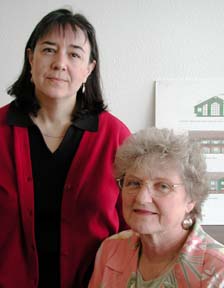
long term," said Elizabeth Conner, director of HBHDC. [in above photo, on the left] "They will remain as part of the affordable
housing stock when they go on the market in the future."
The organization intends to
develop 13 more houses through the land trust within two years
and would like to see the program go county-wide. "We need
to work with cities and counties to put buildable land into the
Community Land Trust now," said Kay Escarda, president of
HBHDC's board of directors. [in
above photo, on the right]
The land trust will be a community-based
organization with an elected board of directors. HBHDC is currently
developing the legal structure for the trust and hopes to have
it up and running by next summer.
-- Jim Hight
Jim Hight is a former Journal staff writer. He is also the husband
of Elizabeth Conner, one of the sources quoted in this story.
IN
THE NEWS | CALENDAR
Comments? E-mail the Journal: ncjour@northcoast.com
© Copyright 2002, North Coast Journal,
Inc.
|