 
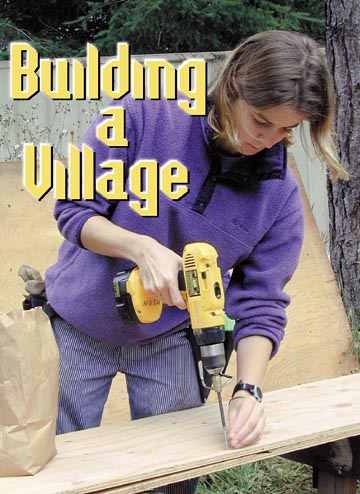
by BOB DORAN
AN UNUSUAL SUBDIVISION IS TAKING SHAPE
in McKinleyville -- a cluster of homes built for the most part by volunteer
labor. The first of nine houses is near completion and a family is ready
to move in. The down payment on the three-bedroom home is paid in full --
not with cash, with sweat equity.
The home on A Street is part
of something called Habitat Village, a development being built by Humboldt
Habitat for Humanity, an affiliate of Habitat for Humanity International.
On a Saturday morning a group
of volunteers gathers to help move the project forward. Work on the house
is just about complete so the crew is small. There's Megan Cooney, a college
student, retiree Harold Hallsten, father-and-son team Tom and Matt De Cesar.
Joe Rhodes shows up every weekend. He is working on his own home; at least
it will be his when it's done.
![[photo of Ross Nash and Tom DeCesar]](cover0817-nash.jpeg) Ross Nash shows Tom De Cesar a drill bit used in plumbing installation.
Ross Nash shows Tom De Cesar a drill bit used in plumbing installation.
When crew leader Ross Nash arrives
with his truck full of tools the group splits into teams. Some head inside
to finish plumbing work on one of the bathrooms, the rest are put to work
building shelves for the tool storage unit that will move from site to site
as eight more homes are built.
"I'm a builder by trade,
a general contractor," said Nash who serves as president of the local
Habitat for Humanity affiliate. "I try to build houses that we can
take pride in. It's not just that we're doing something good, we want to
do it the best way we can."
During the week Nash renovates
houses. He works on all sorts of projects and has done a lot of jobs for
the Redwood Community Action Agency and the Eureka Redevelopment Agency,
organizations that help improve housing conditions for low income families.
Nash said he was working on
a woman's house when she told him about Habitat and asked if he'd be interested
in joining.
"I'd heard of them -- former
President Jimmy Carter -- that's the big name. I knew what they did, but
I had never given it a second thought. She asked if I'd come on board.
"I thought about it and
realized, this is something I was meant to do. Building homes is what I
do every day. It's what I have a talent for, so I've fallen into a leadership
role and it's very rewarding.
"You have an opportunity
to make things better for someone else and I really enjoy it. This may sound
corny or philosophical, but I think it's everybody's right to have decent
housing to live in. And not everyone has a house available, often because
of circumstances beyond their control."
Megan Cooney, who attends College
of the Redwoods, joined Habitat recently.
"I'd been hearing about
the organization for years and decided to see what it was all about. I'm
an engineering major so I thought it would be good to learn about how to
build a house. Everyone here has a lot of experience and they teach you
for free."
![[photo of volunteer workcrew]](cover0817-work.jpeg) Volunteer crew -- Megan Cooney, Harold Hallsten and Volunteer crew -- Megan Cooney, Harold Hallsten and
Humboldt Habitat Executive Director John Diskin --
spending a Saturday morning on the site.
Nash says he is happy to provide
instruction to those who are "in it for the long haul. We try to teach
people how to do things right so that as we build other houses they have
the knowledge, that way we don't have to reinvent the wheel every time we
start over."
What has Cooney learned?
"I learned that sometimes
it's best to start at the bottom," she said. "A lot of people
come out thinking they're going to be raising the walls, but it's just as
important to sand the baseboards or set nails and put spackle over them.
Those things don't seem as exciting but they still have to be done. Someone
has to do it and it could be you. That's how you learn."
Most weekends the crews are
made up of members of Humboldt Habitat for Humanity but on occasion the
numbers grow as other volunteers join in.
"There are days when we
have 20 or 30 people out here. Groups call up who want to participate en
masse," said Nash. "We've had youth groups, church groups, student
groups -- just killer workers. Nobody can match their spirit. It's just
great to have their energy channeled in a positive way like this. They're
not out hangin', not out chillin', they're working.
"And they work hard. They're
in the ditches getting dirty, hauling trash and loving every minute of it.
We all have lunch together and this camaraderie just happens, a sense that
everyone is all working towards a common goal. It's a great feeling."
According to John Duskin, new
executive director of Habitat for Humanity of Humboldt, the local affiliate
of Habitat International got its start in 1989 and built its first house
the next year.
"They started with major
rehabilitation projects, older homes with people on fixed incomes who could
afford to live in a house but had no way to keep it up, people whose houses
needed new foundations or insulation or had leaking roofs, or the bathroom
floor was falling through.
"They did maybe a dozen
major projects, then about four years ago they bought this piece of property
on A Street in McKinleyville from Red and Irene Adams."
In 1990 the Adams split a portion
off the parcel and sold it to Habitat. After living as neighbors with a
Habitat family, they decided to sell the group the rest of the land, a little
less than two acres.
The remaining property was appraised
at $220,000 but Adams sold it for just $120,000. Six Rivers Bank came up
with a loan that covered most of the purchase.
Spencer Engineering took on
the task of designing a subdivision. Initially the plan was to run a short
road into the lot and divide it into four pieces. But when "planned
unit development" options were added to the county general plan they
decided to go that way. The final plan, which has been tentatively approved,
calls for nine homes built around a central common area.
The first house is just about
finished. All of the interior work is done. Outside the only thing that
remains unfinished is the front porch steps. When complete the house will
be home for the Rhodes -- Joe, his wife Julie and their two sons, Joey and
Jonny.
When the family applied for
a Habitat home five years ago they were turned down. They tried again and
were approved for the A Street house two years ago.
"There's a screening process
and it's a tough responsibility deciding who to pick," said Nash. "We
open an application period for 60-90 days and will usually get 40-50 applicants.
The family selection committee and the family nurturing committee narrow
the list to three to five and present them to the board to make the decision.
"To be selected, families
need to fit into a specific income bracket. They need to earn enough to
pay back the mortgage, but they can't earn too much so that they exceed
the low income level."
The 1,190-square-foot home is
a major step up for the family of four. They currently reside in an apartment
in McKinleyville that's about half that size. Julie says she is ready to
stretch out a little bit.
Jonny is 5 and about to enter
kindergarten at Dow's Prairie School. Big brother Joey will be a third grader.
Right now they share a bedroom and sleep in bunk beds. In the new house
each will have his own room.
"The kids can't wait to
have their own rooms," said Julie. "And I'll never have to make
up bunk beds again. No more cracking my head when I'm making the bottom
or climbing a ladder to make the top.
"The kitchen is what I'm
waiting for. The kitchen is just awesome. I'll be able to put a large pizza
in the oven without having the sides touching and burning. And the cabinets
are beautiful. I can't believe someone donated them."
![[photo of Rhodes family]](cover0817-family.jpeg) The Rhodes famliy in their new kitchen. The Rhodes famliy in their new kitchen.
Besides giving them more room,
the new home is a good deal financially. "We're paying $395 for a two-bedroom
apartment and my house payment, when all the insurance and taxes are included
is going to be $390. And the money isn't going to someone else, we're buying
a place."
"When you get the house,
you get it on a 20-year no-interest loan with no down payment," said
Joe. "The partner family puts in 500 hours of sweat equity. That's
your down payment."
Duskin said that the Rhodes
family has actually put more "sweat" into the organization than
they had to. "Julie and Joe each put 500 hours in and the two kids
put in another 500 hours. So altogether they have exceeded the requirement
by several times.
"A few weeks ago we had
about 20 Humboldt State University student volunteers from the athletic
department out at the house working. We were sitting around eating lunch
and Joey Rhodes says, `You know I put in my 500 hours so now every hour
I put in I'm a Habitat volunteer helping someone else get their house. We've
got our house and I want to help the next person else get theirs.'"
Habitat sets the mortgage value
for the house at $69 per square foot, far below what a comparable home might
cost.
"The family that gets the
home is actually buying the home from us," said Duskin. "If someone
donates material or labor to the project, the donation is not really made
to the family, so the value of the donation is factored into the price of
the house."
The $69 figure is somewhat arbitrary
since the building cost for each project varies according to what is donated.
Volunteer labor helps keeps the cost down, but generous contributions from
area businesses are just as important.
"We've been starting to
cost out the house now that it's done," said Nash. "We figured
we've only spent about $150 on the kitchen and it's a nice new kitchen.
Whirlpool donated the refrigerator and the range. Thrifty Supply (Eureka)
donated the sink and faucet. I got a good deal on the counter tops from
Humboldt Counter Tops.
"The cabinets are beautiful
-- custom made for an extra tall couple who sold their house to a short
couple. We have some volunteers who do cabinet work, they cut them down
and modified the layout to make them fit. It's not perfect, but there's
probably $6,000 worth of cabinets in there.
"The majority of the flooring
was donated by Eureka Floor. It's remnants and ends of rolls. The homeowners
picked what they wanted and Eureka Floor donated the labor to install it.
We floored the whole house for $160, a job that for a house that size might
normally run around $4,000."
As soon as the porch is done
and the building inspections complete, the Rhodes family will move in. Habitat
usually holds a deed ceremony when a family takes residence, but this house
is different because this is the first house completed in the "village."
Technically the Rhodes' lot
is still part of the larger subdivision and while the plan has tentative
approval, the lot split won't take place until the final map is approved.
In the meantime Joe and Julie will technically rent the house from Habitat.
With the first home done, the
organization is shifting its attention to work on the rest of the village.
In July the original Adams home was burned by the Arcata Fire Department
to make way for a new road and underground power lines.
![[photo of fire]](cover0817-fire.jpeg) Arcata
fire crew supervises the burning of the old Adams house, making way for
Habitat Village. Arcata
fire crew supervises the burning of the old Adams house, making way for
Habitat Village.
Two more families have been
chosen to become the next villagers. Work will begin on at least one more
house and maybe two as soon as the infrastructure is in place.
Usually Habitat affiliates build
one home at a time. Multiple home projects are not uncommon back East, but
this is the first in Northern California and certainly the first under a
planned unit development higher density provision.
"It's very rare for Habitat
and for anyone to have an opportunity not just to build a house, but to
build a neighborhood," said Nash. "This is a great vision we have
and it's getting closer to reality every single day. It's absolutely thrilling
to be able to provide a neighborhood and watch these families and these
kids thrive."
IN THE NEWS | CALENDAR | EDITORIAL
Comments? E-mail the Journal: ncjour@northcoast.com
© Copyright 2000, North Coast Journal, Inc. |