COVER
STORY | IN THE NEWS | PUBLISHER
PREVIEW | THE HUM | CALENDAR
September 29, 2005

SCOPAC TALKS BREAK DOWN:
Back in June, the Maxxam Corp. parent company
of the Pacific Lumber Co. announced that it was opening negotiations
with the people and institutions it owes $750 million. The aim
was to restructure the debt of the cash-strapped Maxxam subsidiary
Scotia Pacific (Scopac), which holds title to the bulk of Maxxam
lands in Humboldt County and carries the debt in the form of
bonds secured against its timber holdings. As the deal currently
stands, Scopac must meet interest payments of around $54 million
annually to the owners of the timber notes; recently, it has
been struggling to make the payments. Maxxam had hoped that a
deal could be struck that would reduce that burden. But on Friday,
the company announced that it was withdrawing from talks with
the noteholders. In a statement filed with the Securities and
Exchange Commission, the company said that "insufficient
progress" had been made, and that it had recently been advised
that the group with which it had been negotiating represented
less than 15 percent of a noteholders. On Tuesday morning, an
attorney for the group fired back, issuing a press release that
blasted the company and laid out the position that Scopac should
be a stand-alone company, with an independent board of directors
and the ability to sell its timber on the open market. "Scopac's
decision to end the discussions is disappointing," said
Evan D. Flaschen, attorney for the noteholders, in a press release.
"In the noteholders' view, it reinforces our belief that
we need to create a new Scopac that is independent of Palco's
influence. Scopac's redwood forests are an important resource
and the noteholders intend to pursue a more responsible timber
harvesting and reforestation program that is sustainable over
the long term." In addition, Flaschen stated that contrary
to the company's claims, his clients owned over 80 percent of
the Scopac timber notes. In a follow-up interview, Flaschen who
works with the Hartford, Conn.-based firm Bingham, McCutchen
LLP said that while it wasn't the only sticking point in the
negotiations, the noteholders' demand that Scopac divorce itself
from Palco was a biggie. He said that his clients were committed
to reinventing the company's relationships with regulatory agencies,
environmental groups and the general public. "Whatever historical
baggage there may be with Palco, we want people to recognize
that Scopac should be independent and should be judged fresh,"
he said. "We're here to work with people, and in order to
do that we need to be independent." Any number of things
could happen now, Flaschen said: Scopac could declare bankruptcy,
the noteholders could foreclose or Maxxam could come back to
the table. "The ball is really in Scopac's court. Are they
interested in reaching an agreement, or do they want this to
be an adversarial process?"
HOOPA SCHOOL NEARS CRISIS:
Earlier this month, the California Department
of Education released its 2005 list of schools throughout the
state that failed to meet goals set by the federal No Child Left
Behind Act. Such schools are designated as "Program Improvement"
schools, and are subject to ever-increasing penalties the longer
they remain on the list. With the release of the list, Humboldt
County got quite a bit of good news: Both Hoopa High and Fortuna
Middle School had met the goals, and were therefore removed from
potential punishment under No Child Left Behind. But the news
wasn't so good for Hoopa Elementary, which entered into its fourth
year in Program Improvement by failing to meet federal standards
for student proficiency in English and mathematics. Year Four
of Program Improvement is a serious one: It mandates the school
district to devise a plan to radically revise a school if it
fails to meet federal standards this year. The revision can take
several forms, including replacing almost the entire school staff,
turning the school over to a private management company or the
state, or reopening as a charter school. Janet Frost of the Humboldt
County Office of Education said that her organization was working
with Hoopa Elementary to stave off that outcome. "We have
support staff that are working with the elementary school staff,
and we'll continue to do so," she said. "We want to
provide them as much assistance as feasibly possible. We have
every hope and expectation that they'll get out of it next year.
Hoopa Elementary Principal Jennifer Lane and Laura Lee George,
acting superintendent of the Klamath-Trinity Joint Unified School
District, could not be reached for comment. In addition to Hoopa
Elementary, two smaller Humboldt County schools are on the 2005-06
Program Improvement list: Pacific View Charter School, a high
school program based out of the Loleta Union Elementary School
District, and Northern Humboldt Community Day School. The former
is in its second year of Program Improvement, the latter the
first. In addition, the entire Mattole Unified School District
was placed on the list because its charter school failed to make
the grade.
BIG GRANT FOR TEACHING HISTORY:
The Northern Humboldt Union High
School District received a $974,000 federal grant last week for
its Northwestern California Teaching American History Program.
The grant will fund advanced US History instruction for 105 local
elementary school teachers over the next three years. Northern
Humboldt will act as the lead agency in partnership with the
Humboldt and Del Norte County Offices of Education, the Humboldt
State Geography Department, the Gilder Lehrman Institute of American
History in New York, the White House Historical Association,
the Humboldt Bay Maritime Museum, the Clark Historical Museum,
the Humboldt County Historical Society and Blue Ox Millworks.
During the school year each group will meet five weeknights and
five Saturdays per semester and will read 14 significant books
by leading American historians. Teachers will be able to meet
or teleconference with some of the authors, and will also have
the opportunity to travel to regional and national history conferences
and participate in a two-week summer trip to historical sites
such as Boston, Plymouth Plantation, New York, Constitution Hall,
Gettysburg, Washington D.C. and the White House. Through classwork
and travel study teachers can earn up to 15 university credits
and count class and travel study time to meet the No Child Left
Behind standards for "highly qualified" instructors.
Each participant will receive a $1,000 stipend, which can be
used to defray the cost of their books, units and other materials.
Fifteen positions are still available. The group holds its first
meeting Oct. 20 at Arcata High School. Interested teachers and
administrators contact Jack Bareilles, the program director at
McKinleyville High (839-6492 or via e-mail: jbareilles@nohum.k12.ca.us).
SEX OFFENDER SWEEP: U.S. Marshals and area law enforcement led a sweep
earlier this month that nabbed 10 sex offenders for parole violations
and for not complying with Megan's Law, which requires convicted
offenders to register with the state. Among the 300-plus Humboldt
County sex offenders who were targeted during the sweep, 20 are
still under investigation, 17 have charges pending, 11 were told
to update their registration information and seven were dead.
A database of California sex registrants can be viewed at www.meganslaw.ca.gov.
The site is updated daily by the state Department of Justice.
FOREVER IN DEBT: Gov. Schwarzenegger wants the City of Eureka to
pay and pay and pay. And pay some more. That, at least, is what
one might be tempted to surmise following the governor's veto
last Thursday of a bill submitted by Sen. Wes Chesbro (D-Arcata)
that asked the state to finally release Eureka from its indebtedness
for a loan made in 1970. Back in the 1970s, the city of Eureka
was embroiled in litigation with Humboldt Bay private landowners
over tideland boundaries: The private landowners figured their
property extended into the tidelands, said Chesbro legislative
aide Bob Fredenburg, but the city said, "No, that's our
land," arguing that the city was granted jurisdiction over
the state tidelands by virtue of public trust doctrine. City
jurisdiction was intended to protect the tidelands from private
encroachment and facilitate city redevelopment. The city prevailed,
but incurred hefty legal fees. The state, glad to have the city
fight what was partly its battle, agreed to loan Eureka $750,000.
The deal was that the city could pay back the state with 15 percent
of yearly revenues from the Humboldt Bay Enterprise Fund. That
has amounted to an average $45,000 payment each year, and to
date the city has paid the state $873,000 for the $750,000 loan.
The problem, said Fredenburg, is the payment plan never specified
an end date. "We assumed it was just an oversight,"
he said. Senate Bill 742 sought to have payments end by June
30, 2005. The city made the case that the money going to the
state would be better kept in the enterprise fund and used to
fulfill the city's 1993 Eureka Waterfront Revitalization Plan,
which aims to combine public and private projects to enhance
tourism, recreation and commercial endeavors and thereby uphold
the public trust which, after all, is what the state and city
both sought to preserve in the first place. "But the Governor
apparently thought [the city] should just keep paying it forever,"
said Fredenburg.
SAWMILL CLASS ACT: Mild-mannered Eureka attorney Bill Bertain has
added a "bully" to his team in his class action lawsuit
against Eel River Sawmills, Inc. Bertain has gained the support
of two firms, actually, including the firm Cotchett, Pitre, Simon
& McCarthy, of Burlingame, whose attorney Joe Cotchett was
written up in the 2005 Northern California Super Lawyers
as "The man who bullies the bullies" and "wages
war on corporate bad guys" with repeated success. Bruce
Simon's the man helping Bertain from the Cotchett firm. Bertain
filed the original lawsuit (it's in its fourth amended complaint
now) in 2001, on behalf of about 400 employees of the Eel River
Sawmills (which has since closed). The suit claims that mill
trustees Dennis Scott and Eugene Lucas, among others, failed
to uphold a promise made to the employees by Eel River Sawmills
founder Mel McLean. McLean and his wife, Grace, founded Eel River
Sawmills in the 1950s. Plaintiffs claim the McCleans promised
that when they died, the employees would gain majority ownership
of the business. They set up an employee stock ownership plan
in 1989 to facilitate the transfer. Grace died in 1989, and Mel
died in 1999. "Dennis Scott also promised, two weeks later
after Mel's death, that the employees would have majority ownership,"
said Bertain. "And the employees relied on that promise."
But the ownership transfer didn't happen, and Bertain sued, alleging
among other things that Lucas and Scott received $600,000 each
from the sawmill trust "to the detriment of plaintiffs."
Judge Lloyd Von der Mehden of Santa Rosa recently overruled the
defense's arguments that Bertain's case isn't supportable by
law, and a trial has been set for March 2006. "The class
action has been certified and the notice has gone out to newspapers
and the employees," Bertain said.
WHERE'S MY LIBIDO?: Doctors at the Full Circle Center for Integrative
Medicine, a practice that specializes in women's health, were
hearing the same stories from their middle-aged and menopausal
clients. Their sex drive just wasn't what is used to be a depressing
realization that lots of women often remain mum about. That's
why doctors from the clinic and other local authorities on women's
sexual health decided to put together a workshop to open up dialogue
on aging and libido. "Our providers have noticed a near-epidemic
of people frustrated with a diminishment in [our clients'] sensual
lives," said Lisa Keller, M.D. with Full Circle and a presenter
at the upcoming workshop. "We are excited to bring to this
conference a wide-ranging set of perspectives for helping women
reclaim their natural healing sensuality." Among other things,
the seminar will deal with medical and psychological issues affecting
sexuality in women, menopause and hormonal influences on vibrancy,
prayer and communication, herbs for libido and pleasure and solutions
to sexual dysfunction. The workshop takes place Oct. 8, 9:30
a.m.-4:30 p.m., at the Humboldt Unitarian Universalist Fellowship,
Bayside. $60 in advance/$75 at the door. Call 826-2222 ext. 311
for details.
PLAZAPALOOZA: Back in the 1800s, fuzzy-coated cows loafed on
the lovely Arcata Plaza, cropping the grass and generally measuring
the day in bovine leisureliness. Today, it's those kids with
their fuzzy dreadlocks partaking of the grass and marking off
the hours with youthful un-ambition. At least, that's how it
appears, although not everything is always as it seems. That's
why we've got study sessions, to get to the heart of matters
and to sort out issues that arise in public spaces like the Arcata
Plaza. On Monday, Oct. 3, the city of Arcata will host a study
session at 7 p.m. in the city council chambers to discuss "Daytime
Plaza" issues. (A previous session apparently hashed out
the "Nighttime Plaza" issues.) Those giving presentations
on their roles in managing or keeping up the plaza include folks
from city parks and rec, the police department and HSU. Be there
or be square!
CORRECTION: A painting illustrating last week's arts column,
"Health and Well Being," was incorrectly attributed
to Julian Lang. The painting is, in fact, by Lyn Risling, the
subject of the column. The Journal regrets the error.
TOP
Clam Beach idyll
(with traffic)
Story and photos by HEIDI WALTERS
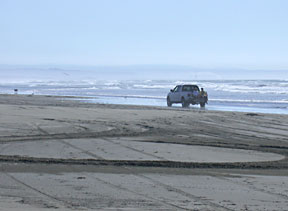
I was dozing at Clam Beach one
Saturday afternoon, on a sandy rise just above the waveslope
the area last wetted by high tide, and the only place vehicles
are allowed to drive at Clam Beach County Park. A revving whine
and a rumble awakened me, and I sat up to see a blue pickup careening
just yards away, leaning into the first swoop of a donut. The
truck completed the circle, its driver punched the gas pedal
to keep from floundering and zoomed in front of me, where he
slammed the truck into another tippy donut. He lurched forward,
did it again and sped on. After the truck bounced over two low
dunes, I saw two people sit up in a hollow between the dunes
where they'd been sunbathing. The truck had passed within a couple
of feet of them.
At that moment, I felt like
one of those people whom beach-access activist Dennis Mayo rants
about, the ones who hate vehicles, period, and want them banished
from the beach forever. I mean, if the drivers can't behave .
And it made me feel a part of the volatile discussion about Clam
Beach and vehicle access. A draft county management plan for
Clam Beach, among other things, proposes closing the beach to
vehicles (with exceptions for fishing) from March 1 to Sept.
30 to protect the threatened western snowy plover during breeding
season. The issue, debated nastily in public, has extended to
questions of public safety. On the day the blue truck almost
made me the jelly in its donut, I was firmly of the ban-vehicles-from-the-beach
persuasion.
Other days, I've had trouble
condemning beach drivers. Personally, I'm not fond of sharing
that lovely space with cars. But there've been times when a truck
has trundled by slowly in the sparkling surf with a tailgate
full of laughing kids and I've found it hard to, you know, hate.
One day in July, I walked down-bluff from the Hammond Trail,
waded through the errant Mad River and crossed the dunes to the
ocean. Along the shore two boys on foot were surf fishing. So
far they had four red-tailed perch and two big crabs. A guy who'd
driven over from the Clam Beach entry point was starting to fish
nearby. I asked him what he was after, and he said, "I don't
know what they're called, but they're really small and fun to
catch. I throw `em back." Now, who am I to condemn a man
who drives out and flings a fishing line at the sea on weekends
to unwind?
Another day, I returned from
the beach to the parking lot to find a pickup mired in the deep
crossing, water close to pouring in the bed, hood up and two
men tinkering. I thought about the grime and oil smuttering off
the truck's underside into the water. I did not feel car-friendly.
This past Sunday one of those
rare, all-day sunfests I walked north from the southernmost Clam
Beach parking lot to Moonstone Beach, keeping close to the shore's
bric-a-brac edge where the waves tickled and ravens and gulls
pecked at the froth. Once, a mound of sand heaved after a wave
departed and I found a crab hunkered down in vain hope of avoiding
the predictable end discovery by a gull, flipped over by a beak
and then pecked to death, despite wriggling its legs in protest.
Mostly I saw the remains: Those bright orange shells with their
goat's head pattern staring back accusingly, empty of meat, amid
broken sand dollars, clam shells, kelp fronds and other shoreline
detritus. Bird tracks crisscrossed truck and people tracks, and
a swath of chunky divots made by the hooves of horses ran over
them all. An unleashed black dog came racing along the foredunes,
chasing plovers, followed by a jogging man in a yellow shirt.
Five trucks and one horse passed
me along the way. One truck sped recklessly through the waves,
another drove fast along the top of the wet slope, passing close
by a small boy in a gray shirt who'd dug himself into a hole.
The other drivers, model citizens, veered slowly around pedestrians.
The horse, ridden by a yellow-locked man in a caramel-colored
canvas jacket, galloped at waves' edge and then slowed when it
passed people on foot. Later I came upon the horse and rider
again, turning tight circles by the waves.
The scene at Moonstone was like
one of those corny, bright paintings of a town in perpetual carnival.
People swarmed the sand and water. All the big 4-by double-cabs
that had passed me were parked there. A couple of muddied renegades
were parked over on the Moonstone Beach side, which is off-limits
to vehicles. Two equestrians cantered about. Climbers dangled
off the shore-side rocks. Surfers bobbled in the ocean or napped
in the sun, while kids scooted around on those little sand slider
boards. Two kites soared, and here came the yellow shirt and
his black dog again. The dog stopped, sat, and stared for a long
time up at one of the kites, then dashed after its person. I
walked over to one of the parked trucks from which several surfers
and friends had exited. One of them, Rachel, said they'd come
here because the wind was shaping the waves just right. It was
easier to drive on the beach, she said, and Moonstone's parking
lot "is always full." What would she do if beach driving
was prohibited part of the year? "I guess we'd just walk
in," she said.
A couple with their well-mannered
dog "we pick up after her," assured the woman offered
mixed observations. "We're in the middle," said the
man. They have friends who drive here. "It's too bad they
made trucks like this in the first place," he said, nodding
at the gigantic rigs gathered at the Little River's mouth. "But
if they're courteous, it's OK. What would make sense to me is
if they made the speed limit 5 mph." The woman said, "I
wouldn't mind if they closed it to vehicles."
Walking back south, I passed
a woman carrying a ratty tennis racquet accompanied by a dog
mouthing a green tennis ball. I posed the vehicle-on-the-beach
question to her. She said, "I think there's a way for everyone
to share the beach." After a pause, she added, "I wish
there were fewer cars, or that they went slower." --
TOP
Nine Questions for
Mel Berti
Story and photo by
HELEN SANDERSON
The City of Fortuna has gone
through some major transitions lately, chief among them the death
of Mayor Tom Cooke and the closures of the Pacific Lumber's Fortuna
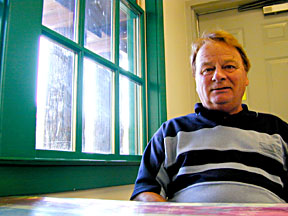
Mill and Humboldt Printing. Longtime Fortuna councilmember and
lifetime Fortuna resident Mel Berti, 66, who's been a butcher
at Hoby's Market in Scotia for 30 years, took a break from his
work to reflect on the years spent on the council and to mull
over the changes ahead.
How does Fortuna distinguish
itself from other cities in Humboldt County?
 Fortuna
works together. If you want the lights changed over at the ball
field, you call up the fire department and they bring the big
ladder and change the lights. If you want new dirt on the football
field or baseball field, you have 20 people down there with rakes
and shovels; you've got construction guys who bring down their
equipment. In bigger cities it's not like that. We've got a good
fire department, a good police department. We keep our town clean. Fortuna
works together. If you want the lights changed over at the ball
field, you call up the fire department and they bring the big
ladder and change the lights. If you want new dirt on the football
field or baseball field, you have 20 people down there with rakes
and shovels; you've got construction guys who bring down their
equipment. In bigger cities it's not like that. We've got a good
fire department, a good police department. We keep our town clean.
Right: Mel Berti
How long have you been on
the council?
I'm on my 22nd year. I've been
mayor twice, and now I'm the vice mayor.
Do you think you'll run again?
I will have to wait and see,
but probably not. By then I'll have 24 years I still have two
and a half years left. There'll come the time when I'll want
the freedom to not have to go to a meeting every night so I can
go out and enjoy myself.
In what ways are you missing
Tom Cooke?
The knowledge he carried through
the state was huge. If there was something we needed he could
go through the state to get it, because he was recognized by
everybody every committee he got on he was either vice chair
or chair. It showed what a great work ethic he had. Personally,
I lost a real good friend. We'd been working together 22 years.
You've called Palco "Humboldt's
Rock of Gibraltar." Do you still feel that way now that
things are shaky for the company?
See, what's made it shaky, what's
put the crack in there, is the environmentalists. PL's got the
lumber, they've got the trees but now they can't cut it. So what
that does is soon you start cutting people out of jobs. And what
happens here [at Hoby's] is, like lunch hour, we used to have
60 to 70 people in here, now maybe we get 20. We've had to cut
employees because we're not doing the same volume. And that happens
all the way from here to Fortuna.
Will a big box store change
the character of the town?
Some people want to put a picket
fence around Fortuna. But we have people who are tired of going
to Redding, or Santa Rosa, or Crescent City to shop, so we lose
a lot of revenue. If we don't get those box stores, McKinleyville
will. People will just drive from Fortuna to McKinleyville. We're
gonna lose more money and jobs. When the Bayshore Mall opened
[in Eureka] we had to shut down 13 businesses. The same thing
can happen again.
What's the mood been like
around Fortuna lately?
The people are kind of down.
We lost the mill, we lost Humboldt Printing a couple hundred
jobs. It's kind of a negative. That's the trouble with all these
environmentalists whacking away at PL, all they've done is cost
us jobs. They have not done one damn thing to get us jobs in
Fortuna.
But then, their mission isn't
about jobs it's about saving the environment, right?
Their mission is that they want
to shut PL down and then they'll be happy. You know, PL has the
strictest logging plan in the state. What bothers me is that
the playing field isn't level. You've got this water quality
board you don't need those people. They're just eating at the
public trough. You can eliminate it, cut out this bureaucratic
crap, get rid of them, save the money and put it where you need
it. If the water quality board was gone you wouldn't miss them.
But [environmentalists] don't care how many jobs they cost an
area, just as long as it suits their cause. It's just like [DA
Paul] Gallegos and Timothy Stoen their main thing was the lawsuit
against PL. The sad thing is that they're using my tax dollars
to take jobs from me making a living. Why should that make me
happy?
Didn't you support Gallegos
the first time around?
The first time, yeah. He covered
up what his agenda was. I thought that he was fresh blood coming
in with new ideas, who wanted to prosecute people. I know a lot
of other PL people who voted for him, too. If he had said, "The
first thing I'm gonna do is put a lawsuit against PL and we're
gonna use the county's money to do it," how many votes do
you think he would of gotten? He wasn't truthful in his campaign.
But I'll tell you this: They've got a machine as far as campaigns
go, with [Richard] Salzman. Every candidate they helped has won
every election since Gallegos got elected. Now I think there
is a chink in the armor. I can't tell you which way it will go,
but if he [Gallegos] loses, then the other people who were elected
the same way might not get reelected. The upcoming DA election
will show you which way the county is going politically. If Gallegos
loses there will be a shift. I've seen this coming.
TOP
COVER
STORY | IN THE NEWS | PUBLISHER
PREVIEW | THE HUM | CALENDAR
Comments? Write a
letter!
© Copyright 2005, North Coast Journal,
Inc.
|