|

COVER STORY | IN THE NEWS | STAGE MATTERS | OFF THE PAVEMENT
TALK OF THE
TABLE | THE HUM | CALENDAR
September 28, 2006

The Ladies Who Act
by WILLIAM
S. KOWINSKI
In beginning their
season with The Ladies of the Camellias, North Coast Rep
demonstrates respect for North Coast audiences, repaid with an
entertaining evening in which the audience will also learn some
theatre and social history.
This play by the contemporary Los Angeles director
Lillian Groag is billed as a farce, among the most satisfying
theatrical forms when it works. However, it is also one of the
most difficult to write and direct. The pleasures for participants
as well as audience of creating waves of riotous laughter, each
new one "topping" the last, has been too tempting for
many playwrights to resist. (If not for his untimely illness
and death, August Wilson's next play sounded like it was going
to be a farce.) Some contemporary playwrights have successfully
created classic farce (Joe Orton comes to mind)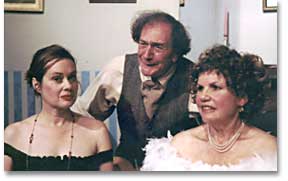 but many have failed. Others have upped the ante by using farcical
elements in more politically and socially ambitious plays --
Tom Stoppard, for instance. Then there are the influences on
writers as well as audiences of the movie hybrids: the Marx Brothers
films, slapstick and screwball comedies.
but many have failed. Others have upped the ante by using farcical
elements in more politically and socially ambitious plays --
Tom Stoppard, for instance. Then there are the influences on
writers as well as audiences of the movie hybrids: the Marx Brothers
films, slapstick and screwball comedies.
Right: La3: Gloria Montgomery as Eleonora Duse,
Bob Wells as Benoit, Michele Shoshani as Sarah Bernhardt.
We have one contemporary play about the theatre
that is as close to classic farce as modern ironic drama gets
-- Michael Frayn's Noises Off (the movie version, with
such luminaries as Carol Burnett, Michael Caine and Christopher
Reeve, also demonstrates the difficulty of translating stage
farce to screen.) The play at NCRT is stylistically more complex,
and its content is more ambitious.
The Ladies of the Camellias is set in late
19th century Paris, when new approaches from Germany, Russia
and England were about to create the modern theatre that is the
operational basis for the dramatic arts of our time. Two formidable
actresses towards the end of the age of star-driven drama, Italian
diva Eleanora Duse and the French legend Sarah Bernhardt were
each to appear in the same romance, The Lady of the Camellias
by Alexander Dumas (which is also the basis of the famous Greta
Garbo film, Camille.) Meanwhile, a production of Rostand's
Cyrano de Bergerac is opening down the street. This was
also an era of social and political turmoil that would eventually
lead to World War I and the Communist revolution in Russia. All
of these elements bear on the action onstage.
That history is the substance of this play, surrounded
by a variety of verbal as well as physical comedy, from droll
Wildean witticisms ("A cynic is a romantic sulking")
to acerbic Noel Cowardly observations (about audiences entertained
by a socially-conscious play, who then "go off and vote
for the wrong people"). Much of the humor is about theatre,
and much of that is based on affectionate clichés about
the excesses and vanities of actors, though there are some theatrical
in-jokes of the kind that added bonus zest to Shakespeare
in Love.
Is theatre a playground for the rich, or are actors
as socially outcast as anarchists? The roles of art and politics,
of thought and feeling, form one of this play's themes with contemporary
resonance.
Both Michele Shoshani (a veteran Bay Area performer
new to the North Coast) as Sarah Bernhardt and Gloria Montgomery
(fresh from her triumph in NCRT's Broadway Bound) as Duse
effectively play these actresses as practical and intelligent,
in charge of their legends and aware of the utility of their
frivolities. Thanks in part to excellent costuming, Shoshani
even looks French, and Montgomery has that Italian glow.
The male partners (onstage and sometimes off) of
these grand actresses were necessary but definitely inferior
appurtenances, and Hans Crynock and David Hamilton milk those
roles for all their obvious and subtle comedy, and even more
subtle pathos. Crynock excels at small hilarious gestures and
body language, while Hamilton brings an air of eager earnestness
with a touch of sadness that gives his physical comedy another
dimension.
As a play, The Ladies of the Camellias has
problems. A good farce is like a wind-up toy: The first act winds
it up, and it runs amuck in the second. But this play is so long
and tries to do so much (perhaps too much) that it forces a single
hysterical speed from the beginning. Fortunately, Lonnie Blankenchip
as Alexander Dumas arrives in time to admirably slow it down
and anchor it for the audience. After a frenetic and excessive
start (at least I find the miming of the lines more annoying
than funny), both the gifted Theresa Ireland and the skillful
Bob Wells have their moments. Nobody could make the two syllables
of "password" funnier than Wells does.
Without Nathan Pierce's solid performance as the
anarchist "Ivan," this play with a large cast of differentiated
characters and more than the usual amount of information to absorb,
would have been unintelligible. Edward Olson provides a bracing
turn -- I won't give away his surprise, but it enacts (and mocks)
the classic farce mechanism of the deus ex machina, the
sudden solution dropping from the sky.
A handsome set (framed by evocative, Beardsley-style
posters) and the other elements of presentation support an audience-pleasing
production. There were opening weekend problems of lines and
timing that the actors should overcome as the run goes on. Director
Carol Escobar had to deal with a play that sprawls in time and
stage space, but is too interconnected to cut (and the playwright
might react as the Blankenchip's Dumas does to the idea of cutting
text: as if it were a knife wound). But a tighter play would
have encouraged more differentiated and effective pacing and
focus. Still, the opening Saturday night audience followed the
action and had a good time, and subsequent audiences should,
too.
The Ladies of the Camellias runs through Saturday,
Oct. 14, at the North Coast Repertory Theatre (300 Fifth St.,
Eureka). Performances Thursdays, Fridays and Saturdays beginning
at 8 p.m., with a matinee Sunday, Oct. 8, at 2 p.m. Tickets are
$12 adults, $10 students and seniors.

COVER STORY | IN
THE NEWS | STAGE
MATTERS | OFF
THE PAVEMENT
TALK OF THE
TABLE | THE HUM | CALENDAR
Comments? Write
a letter!
© Copyright 2006, North Coast Journal,
Inc.
|