|
 

by BOB DORAN
You may not know Larry Ulrich's
name, but chances are you've seen the world through his eyes.
His images of the redwoods, North Coast coastlines and other
landscapes show up everywhere -- on calendars and magazine covers,
in advertisements, on posters for Humboldt State University and
in Sierra Club publications. His vistas even show up as screen
savers and refrigerator magnets. Stop by the Redwood National
Park Visitor Center and you'll find his photos of the redwoods
emblazoned on coffee mugs, bookmarks and picture puzzles.
The
Ulrich Trinidad home, nestled in the redwoods at the end of a
road, is also headquarters for Larry Ulrich Stock Photography
Inc., a company that markets Ulrich's images worldwide and represents
nine other photographers.
Need a photo of the Golden Gate
Bridge, a lighthouse or a rustic covered bridge? Ulrich has dozens.
Maybe you're putting together a tourist brochure on the Monterey
area. Call an 800 number and a van will deliver 100 images to
your office the next day. (It happened during our visit.) You
want a Bavarian castle, a tropical island or Mount Everest? No
problem. Ulrich has just the shot somewhere among the 64,000
transparencies in a fireproof vault. (Marguerite Powers is shown in the vault in photo
below at left )
![[photo of vault]](cover0906-vault.jpg) If you've lived in Humboldt County for
a long time, you might even have one of Ulrich's original prints
on your wall. He got his start selling his photos of trees, flowers
and beaches at craft fairs. If you've lived in Humboldt County for
a long time, you might even have one of Ulrich's original prints
on your wall. He got his start selling his photos of trees, flowers
and beaches at craft fairs.
Ulrich's
entry into photography was almost accidental. At the end of the
1960s he had joined the Air Force Reserve and was spending his
weekends at Travis Air Force Base in a radar shop alongside four
photo fanatics.
"Photography was all they
would talk about in the shop. They'd bring in their cameras and
their pictures. And I got interested."
When a coworker at his weekday
job went to Japan, Ulrich was offered an opportunity: high-end
photo gear at low prices. He turned to his radar buddies for
advice.
"They made me a list --
two bodies, four lenses, tripods, filters. I gave the guy 500
bucks and I had everything I needed to be a professional,"
he said. "And I had never shot a picture in my life."
From the beginning his focus
was on shooting nature.
"The first time I shot
a roll of color film it was in Humboldt County," he recalled.
"I came up here to visit friends and the first pictures
I shot were in the redwood forest. In fact, the first exposure
on the roll was something I later ended up selling. I loved photographing
the rain and the wetness, the saturated colors. That became my
focus."
![[photo of redwood grove]](cover0906-fernspath.jpg) Trail into the woods at Ladybird
Johnson Grove in Redwood National Park Trail into the woods at Ladybird
Johnson Grove in Redwood National Park
In June 1971
he quit his job in the Bay Area and took off on a long trek.
"I walked through the Sierra Nevada Mountains for two weeks
and hiked the John Muir Trail. I wanted to shoot pictures of
nature and just get away from it all."
On the trail he met up with
an old friend from high school, Paul Barron. By the end of the
trip they had decided on a plan: to move up to Humboldt County
and start a business. Their product was driftwood.
"Larry would go down to
the beach with a backpack and fill it up with wood, then sell
it to tourists," said Donna, his wife and business partner
who met him around that time.
"I developed a clientele,"
said Larry. "I had all these nurserymen and people who made
candles. And I'd go to flea markets in the Bay Area with a trunk
full of driftwood and set it all out. At the same time I would
set out a portfolio of matted prints."
Donna was impressed by his photography.
She was attending San Jose State University and talked him into
getting a bunch of prints together for a campus craft fair. It
was fun and they made some money. "So we started selling
prints at all kinds of craft shows, then on the street."
Donna was an ideal partner.
She liked traveling, loved the woods and didn't mind being Larry's
assistant, handling the film and "making sure he didn't
drop the lenses in the creek." And she didn't hesitate when
it came to spending dawn to dusk on a city sidewalk selling prints
to strangers.
With the print business they
moved into production mode. They found a lab that would do 8
by 10 color prints for $1 apiece. A friend let them use a mounting
press and suggested a source for frames in quantity.
![[photo of Larry and Donna]](cover0906-larrydonna.jpg) Larry
and Donna at a craft fair in the '70s. Larry
and Donna at a craft fair in the '70s.
The photos gained in importance,
but they weren't ready to abandon the driftwood. Barron had picked
up a catchy new technique from another street vendor.
"This guy would make little
bird sculptures from the driftwood using cones from digger pines.
The Christmas of '72 we set up this whole production line down
in Hayward. We were making $700-$800 a day off these things we
called `sturdy birdies.' One of us would set up on the street
in San Francisco and the other in Berkeley."
Before the holidays were over
they had cleared over $12,000. Part of the money was reinvested
in the photo business.
"Paul had taken a big load
of driftwood down to L.A. and while he was there he found this
guy who sold us like 5,000 feet of picture frame molding and
a machine to cut the frames. I went out and bought a used photo
processing system, a basket processor where I could do 30 prints
at a time. I set up a lab and we went into production."
Within
a couple of years they were selling 3,000 to 4,000 prints a year
-- all produced for under $4 a piece.
"We wanted to sell them
cheap," said Donna. "We figured people deserved to
have art on their walls. We called them `People's Prints.' The
other artists and photographers would come down and have $100
or $200 price tags on their pictures. They'd get mad at us for
selling so cheap."
While they were learning how
to create a low-cost product, they also had to figure out what
sort of pictures the public was interested in buying.
"The public was a great
teacher," said Larry. "When I first started selling
stuff, I printed up the things I liked. We'd put 25 pictures
out and some of them would never sell. We learned from that what
people's tastes were."
![[photo of oak silhouette against sunset]](cover0906-drycreek.jpg) Valley oaks on a Dry Creek Valley ridgetop
hear Healdsburg. Valley oaks on a Dry Creek Valley ridgetop
hear Healdsburg.
While his arty close-up of a
"sneeze weed" plant sat on the shelf, the landscapes
sold like hotcakes, particularly shots of the redwood forest.
"The first couple of years
I was in business I had one picture that made up 50 percent of
my sales. It was a picture taken up in Prairie Creek; I called
it `The Rainforest.' It had this ethereal, magical kind of quality.
With that one I would stack them up in the booth and I'd sell
four or five every day. That's what got me so excited about being
a redwoods photographer. Pictures of the redwoods sold so easily,
especially good ones.
"The public likes elements
that grab them, things they can relate to like rainbows and sailboats.
And they like nostalgia. I had a shot of a fire hydrant in a
ghost town, I'd sell those to firemen. And people like recognizable
scenes. They want to look at a picture and think, `Oh, I've been
there,' or maybe they feel like they want to be there."
Selling on the street was lucrative,
but there were parts about it they didn't like.
"The buses would go by,"
said Donna.
"The dirt," Larry
adds.
The transition out of print
sales began in the early 1980s. They did several major crafts
shows and harvest festivals up and down the West Coast ("indoors
and lots cleaner"), then decided to do a redwoods calendar.
Their first attempt was a bust.
The calendars were delivered two months late and many were not
saleable.
"Some were printed wrong,
some had missing pages. We had to hire someone to sort through
all 8,000 of them."
But they were still ready to
escape from the hard work of street vending and exposure to chemicals
that came with printing hundreds of photos.
"I began to understand
the concept of stock photography more clearly," Larry said.
"After the disaster of the first calendar, I met a guy locally
and we formed a partnership, Semper Virens Press. We decided
to print a redwoods calendar ourselves with printing done by
one of the major printers in the world in Japan." And it
was a successful venture.
![[photo of Golden Gate bridge]](cover0906-goldengate.jpg) Golden Gate Bridge from Baker Beach Golden Gate Bridge from Baker Beach
"From that we decided to
start producing note cards and calendars that included other
people's work," said Larry. "We started buying photographs
from other photographers. Though that I was meeting some of the
big names in the industry -- David Muench, Bob Clemenz, Jeff
Gnass, primarily landscape and wildlife photographers. Most were
large format [4-by-5] shooters like myself.
"Donna and I had a five-year
goal, to get out of the print business and get into licensing
our work." Following the advice of their new friends, they
made their goal with a year to spare.
When they put some energy into
selling their stock of images they had an advantage. "We
had been shooting photographs for years and we had a lot of images
no one had ever seen. Whenever we sent out a portfolio to a publisher
we'd sell at least something."
They began with companies that
produced calendars and note cards and the occasional ad agency
or magazine.
"We started establishing
a relationship with environmental magazines -- Sierra Magazine,
National Parks and Conservation -- and with a lot of natural
history associations who were producing books and publications
for their own bookstores and for the national parks."
As they developed a pool of
clients they would get want lists.
"We'd call and say `We're
going away for a month; will you need anything while we're gone?'
They'd say, `We're doing a rainbow calendar or a Rocky Mountain
calendar' or maybe an Oregon engagement calendar. They would
tell us what subjects they were looking for," Larry said.
"And from those want lists
we figured out where we should be going," added Donna. "At
the time we weren't going any further east than the Mississippi.
We didn't travel too far in the beginning."
"We knew these companies
were going to do these calendars year after year," Larry
continued. "We planned our trips based on what we didn't
have in our files. So our clients taught us what we needed to
shoot."
![[photo of Bavarian castle]](cover0906-neuschwanstein.jpg) Neuschwanstein Castle in Germany
built by mad King Ludwig II of Bavaria Neuschwanstein Castle in Germany
built by mad King Ludwig II of Bavaria
After
establishing a solid base for Larry Ulrich Stock Photography
Inc., they moved into the business of representing other photographers
beginning with a Humboldt County photographer.
"It really started with
Ron LeValley. I ran into him on the Plaza one day and he said,
`Larry, you know I'd really like to start selling my work. Could
you give me an hour of your time to look at my work and see if
you can give me some suggestions.'
"I had known Ron for a
long time. I knew he ran a tour company, Biological Journeys,
and I knew he shot pictures. But I had never really seen his
work. He showed me a lot of bird pictures -- he's a fanatic birder
-- and he showed me whale pictures and stuff from Australia,
koala bears and other wildlife. I said, `Well I've never done
this, but if you want I can take a couple of hundred of your
best pictures and try and sell them for you.' We came up with
a contract and I duped a bunch of his slides and started marketing
his work."
The Ulrich stable of talent
soon expanded, first with the addition of the Blacklocks, a family
of photographers from Minnesota who had a large catalogue of
photos of the Great Lakes. One by one they added new photographers,
mostly those who had a body of work that covered a unique subject
or a geographic area where Larry and Donna had not photographed.
"I found there were a lot
of great photographers who didn't know how to market their work,"
said Larry.
"And they didn't want to
be business people," Donna added. "William Neil is
a guy from the Yosemite area. He is really good and was doing
lots of posters and books, but his stock photography was suffering
because he wasn't into doing it."
"A lot of them didn't want
to be bothered with the idea of having employees," said
Larry. "Once you get serious about stock photography, you
have to have someone at the phone every day. Clients don't want
to get an answering machine when you're out in the field. When
they call the office, they want stuff on their desk the next
day."
That's where Marguerite Powers
comes in. She runs the stock photography office and she knows
the catalogue inside out. Clients can get a glimpse of what they
have to offer at www.larryulrich.com,
but they will only find a small portion of the thousands of images
the company has on file.
While this interview was in
progress, a call came in from someone producing a brochure on
Monterey. Powers knew what questions to ask and right where to
look for the images.
Ulrich Inc. is not as large
as some stock companies. Powers describes the business as "a
boutique" compared to the giants in the industry. She says
what makes the business work is an ability to offer a higher
level of service. That, and a collection of great images.
![[photo of redwood snag silhouette against rainbow sky]](cover0906-snag.jpg) The
redwood snag on Highway 101 north of Trinidad The
redwood snag on Highway 101 north of Trinidad
The
cream of Ulrich's images of the North Coast are gathered in a
new book, a dream project years in the making. This weekend Larry
and Donna celebrate the publication of Beyond the Golden Gate:
California's North Coast.
In 1987 Larry approached a publisher
with the idea of doing a photo book on the North Coast. He wanted
to call it Behind the Redwood Curtain.
"They told me it would
never sell, but asked, `Do you want to do a book on the whole
coast of California?'"
The result was the book, California
Coast ("quite a challenge not being a Southern California
boy"), and it was successful, especially in Southern California.
Ulrich went on to produce or contribute to a number of other
books, including the popular, Big Sur to Big Basin: California's
Dramatic Central Coast, by Chronicle Books, which focused
on a specific portion of the shoreline. But Larry said, "In
my heart this new book was always the one I wanted to do."
Its genesis came on one of the
Ulrichs' trips photographing southwestern deserts and canyons.
Larry and Donna were camping with a writer friend and Larry proposed
an idea for a book of flower photos, but had no publisher.
The friend suggested Jane Freeburg,
who runs the Santa Barbara-based Companion Press. A call from
a phone booth in Gila Bend, Ariz. was the first step toward a
new series of books that began with Wildflowers of California.
Wildflowers of the Pacific Northwest and Wildflowers
of the Plateau and Canyon Country followed and finally Freeburg
warmed to Larry's old idea for a book on the North Coast.
Larry and Donna had a fine time
sorting through thousands of pictures and came up with a "big
ol' pile of ideas" for each page. They had a lot to choose
from, having spent nearly 30 years looking for "quintessential
images" of the place they call home.
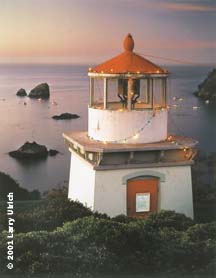 One of the firm's most popular stock
images: the Trinidad Memorial Lighthouse. One of the firm's most popular stock
images: the Trinidad Memorial Lighthouse.
They enlisted Fortuna-based
writer Roy Parvin (profiled Sept. 21, 2000 in a Journal
story, "A Writer's Road") to compose an introductory
essay after reading a piece he wrote for a Montana magazine,
Northern Lights. Parvin crafted a loving paean to the
coast and the woods based on his observations as he explored
by car, on foot and in a canoe. His insights are a perfect compliment
to the Ulrichs' vision of the region.
What do Larry and Donna look
for when they are in the field? Sometimes it's the tranquility
of a landscape, sometimes it's that perfect combination of view
and foliage, but most often it's the light.
"If you look at my work,
the most important thing is the light. The subject is often secondary.
It has to have rich colors, it has to be saturated, there has
to be a smoothness."
In the late '70s, when the Ulrichs
were perfecting their technique with the large format 4-by-5
camera, they were the subject of a student film by Phil Wright,
the same friend who had taken Larry on his first photo trip into
the redwoods. The film was called Inner Light.
"That's what I always said
about redwoods. It was the reason I photographed them on wet
days. The light would come down and reflect off of all the wet
surfaces, reflecting back into the shadows, creating an inner
light."
Lately the Ulrichs have found
they are taking a lot fewer pictures, partly because it has been
so dry lately, but also because they have covered so much territory
over the course of nearly three decades. With shots of most of
the United States in their files, they have begun taking international
trips.
"You really have to look
at the collective photographic mind when you go out and shoot,"
said Larry. "You have to look at what you've done and at
what others have done. Then you have to go beyond your own creativity
and hopefully beyond your competition's creativity. We have to
keep taking it one step further. In our shared vision when we
travel we are always trying to go that extra step."
IN
THE NEWS | IN THE GARDEN | CALENDAR
Comments? E-mail the Journal: ncjour@northcoast.com
© Copyright 2001, North Coast Journal,
Inc.
|