|

COVER STORY | IN
THE NEWS | ARTBEAT | OFF THE PAVEMENT
TALK OF THE
TABLE | THE HUM | CALENDAR
August 31, 2006
Lunch with Chef Ann
story and photos by BOB DORAN
She wasn't hard to
find, although the description from one of the Organic Planet
Festival volunteers didn't help much. "She's kinda short
with dark, wavy hair," he'd told me, not mentioning the
salient fact: Ann Cooper, aka Chef Ann, was the only one at the
festival wearing a chef coat -- to be exact, a dazzlingly white
one, with her name embroidered on it.
I trailed the so-called "Renegade Lunch Lady"
backstage into the "performers and presenters only"
area, striding purposely past a guard who ignored my lack of
a "Very Organic Person" laminate. I had a good reason:
I had promised O-Planet Fest 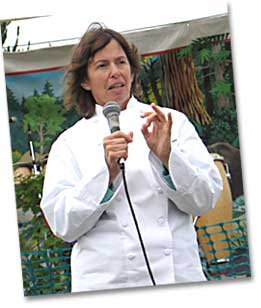 organizer
Matt Lang I'd give Chef Ann a ride to the airport. With the sweet
steel drums of Pan Dulce playing in the background I introduced
myself, and we made arrangements to reconnoiter after her keynote
talk. organizer
Matt Lang I'd give Chef Ann a ride to the airport. With the sweet
steel drums of Pan Dulce playing in the background I introduced
myself, and we made arrangements to reconnoiter after her keynote
talk.
Chef Ann's rabble-rousing speech offered an introduction
to issues she lays out in her latest book, Lunch Lessons:
Changing the Way We Feed Our Children. Essentially, she'd
like to see a revolution in school food services. The reason
is simple.
"The Center for Disease Control has said two
important things recently. One: Among 6-year-old kids -- the
ones starting 1st grade this week -- one out of three Caucasians
and one of two Hispanics and African Americans will have diabetes
in their lifetime, the majority of them by the time they're 18.
"And two: The CDC went further to say that
the generation starting school today is the first who will die
younger than their parents -- because of the food supply. How
can we not make this a huge issue? We're talking about killing
our offspring. What is there not to get about this?"
She wants to sue the U.S. Dept. of Agriculture,
who she holds partially responsible for the epidemic of childhood
obesity facing our nation, and she'd like to see school lunches
become an issue in the next presidential race. And yes, she also
wants you to buy her Harper Collins book, which officially hits
bookstores Sept. 5.
She touched briefly on her progression from upscale
restaurant chef to "queen of the cafeteria." Her career
evolution was a topic of conversation later, but not until after
we'd had lunch.
Since the festival was all about organic alternatives,
we had plenty of good food to choose from. We began with generous
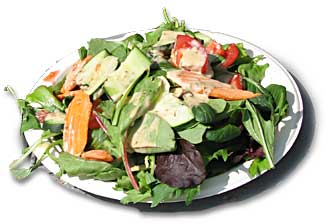
portions of Eureka Natural Foods' "world's largest organic
salad," with spring mix from Gourmet Vegpac, Coke Farms
baby spinach, slices of Bunny Luv carrots and local cucumbers
(from a farmer who prefers anonymity) and juicy, sweet tomatoes
from Norman Coates' Gem of the River Farm. I should mention that
Ann asked for a reduced portion after seeing how high they piled
the sugar cane plate the woman ahead of us was carrying. She
had hers dressed with Annie's Natural Green Goddess; I went with
the Follow Your Heart Caesar.
Next stop, the Eel River Organic Beef booth, where
Clint Victorine and his dad were flipping burgers. We chatted
with Clint about what it takes to break into the organic beef
market (a topic for another column) and somewhere along the line
he mentioned he'd been selling hamburger to a school in the Bronx.
"What school?" Ann wondered, and in a six degree of
separation moment it came out that Clint was dealing with a charter
school in Harlem where Ann had instituted an organic food service
program.
Another small world instance happened at one of
the organic wine booths. As we tasted some fine reds from Parducci
and Frey, she learned that her friend Andrew Dolan, formerly
with Fetzer, purchased Parducci, which was recently certified
organic.
Noting that she "doesn't usually have wine
with lunch," Ann decided since she was "sort of on
vacation" she could sample some from Coates Vineyards. The
abovementioned Norman and his partner, Robin, poured us samples
of a few more good organic reds and sliced open an amazingly
sweet Doubloon melon.
With reggae by Clinton Fearon and his band pumping
from the stage, we headed for a quiet bench along the bay to
about talk food. Chef Ann's culinary career began when she was
around 18, after she left her home south of Boston.
"I'd been thrown out of high school for behaving
badly" she began. "I decided my avocation was going
to be ski bum, so I hitchhiked out to Telluride, Colorado. I
talked my way into an assistant breakfast cook position and started
cooking. I fell in love with food, with working with food and
the sensibility of food. That's how I started. I've never had
another job in my life, never had a job that wasn't food-related."
Getting more serious, she'd returned to the East
Coast to study at the Culinary Institute of America, graduating
in 1979. CIA diploma in hand, she landed a series of jobs, first
on cruise ships, then as executive chef at one place after another:
the Grand Junction in Colorado, Gladstone's, the Radisson Hotel
chain in Virginia, the Telluride Ski Resort.
By the early '90s, she was at the Putney Inn in
Vermont. That's when she discovered "sustainable cuisine."
While working on her first book, A Woman's Place Is in the
Kitchen: The Evolution of Woman Chefs, she met chefs like
Alice Waters, Nora Pouillon and Odessa Piper. "These were
women who were really passionate about these issues. I, frankly,
had come up through the French chef mentality. When you went
to CIA, especially in the early years, it was all European chefs,
so there wasn't that sustainability model. You'd always import
everything because it's 'better.' I was intrigued that all these
women were into this sustainable organic stuff, really thinking
of food in a way I hadn't learned about."
 She
became a member of Chefs Collaborative, "a group of chefs
dedicated to educating other chefs and the public at large about
sustainable food issues." Even though she'd worked in the
food business for years she realized she had a lot to learn. She
became a member of Chefs Collaborative, "a group of chefs
dedicated to educating other chefs and the public at large about
sustainable food issues." Even though she'd worked in the
food business for years she realized she had a lot to learn.
She started instituting changes in the restaurant,
overcoming resistance of owners, waiters and customers. She wrote
another book, Bitter Harvest, touching on "what's
going on with our food supply and why food makes us sick and
why it's a 'follow the money' story."
Another epiphany came with a visit from her nieces.
"We were deciding what to do and I said, 'Let's go pick
strawberries.' My little niece said, 'But, I can't reach, Auntie
Ann.' I thought, well, if my nieces don't even know that strawberries
grow on the ground, that they think they grow on a bush or a
tree or something, what do they know?"
Turning her attention to children, she left the
Putney and took a job running the food service program for the
Ross School, a small upscale private academy in East Hampton,
New York, converting their lunchroom to a model program using
"regional, organic, seasonal, sustainable" foods.
The next step was replicating the Ross model at
a place that didn't have its money-is-no-object environment:
The Promise Academy, a charter school in Harlem. Then, last October,
she became Nutrition Services Director for the Berkeley Unified
School District.
Chef Ann insisted to me that teaching kids about
good food "has to be part and parcel of an education program.
And all the stakeholders have to participate: the administration
of the school, the food services people, the educators, the children
and their parents. You have to teach everybody. You need an educational
component and you need social marketing and community outreach
to teach parents that letting kids eat Pop Tarts, potato chips
and Coke for breakfast is really bad for them."
While changing bad food habits is a struggle, she
said, it's getting easier.
"Look at the phenomenal growth of a chain
like Whole Foods, or [the fact] that Safeway has an organic label.
This is a huge paradigm shift. Now people buy that stuff for
all kinds of different reasons, but basically because they think
they're eating healthier and feeding their kids healthier.
"People are thinking more about what they
put in their bodies, but unfortunately it's still tied to demographics,
to income and education. I think healthy food should be a right
of everyone, every child, every adult, everybody. And we certainly
are not there yet -- we have a long way to go."
For more on Chef Ann's new book and her work, go to www.chefann.com.

your
Talk of the Table comments, recipes and ideas to Bob Doran.
COVER STORY | IN
THE NEWS | ARTBEAT | OFF THE PAVEMENT
TALK OF THE
TABLE | THE HUM | CALENDAR
Comments? Write a
letter!
© Copyright 2006, North Coast Journal,
Inc.
|