|

COVER STORY | IN
THE NEWS | ARTBEAT
TALK OF THE
TABLE | THE HUM | CALENDAR
August 3, 2006
I went to the Farmers' Market Saturday looking
for Julie Steiner of Hilltop Farm. I'd met her a few weeks back
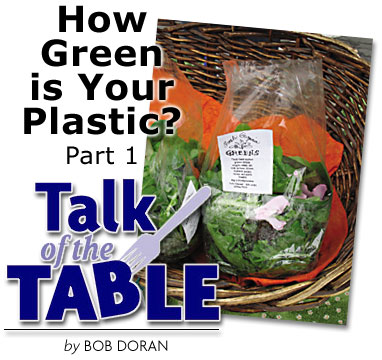
and chatted briefly about the biodegradable bags she uses for
her organic greens, a medley that includes several lettuces,
arugula, cress, kale, mustard greens, a couple of greens I've
never heard of, and for color (and I assume, marketing) a sprinkle
of edible flowers petals.
I never found Julie, but at the first booth I came
to, right on the corner, I found Karina Green of Jacobs Greens
under a blue Campari umbrella selling bags just like Julie's
— loosely stuffed with the freshest greens possible (with
flower petals) — alongside bunches of just-harvested radishes
("not too hot" she told one customer), and arugula
(which sold out quickly). Unlike Julie, who uses twist ties,
she closes her bags and bundles her radishes with biodegradable
hemp twine.
Karina was just a bit leery about being in the
paper. "I don't want to be the organic farming guru or anything,"
she told me. She grows her produce out on West End Road and started
selling at the Arcata market in 1989 "when it was really
small."
She was happy to explain why she uses cellulose
bags, which it turns out are not something new, but an old school
plastic technology making a comeback. "The produce keeps
better in them," she said , noting that "they breathe
like skin," so one could conceivably use them to store greens
in the fridge for a couple of weeks (if you didn't get around
to eating them) and they still wouldn't turn "black and
slimy" like lettuce stored in modern petrochemical-derived
plastic bags.
Then there's the do-the-right-thing aspect, which
is something I'd been thinking about since I finally went to
see the Al Gore lecture/movie, An Inconvenient Truth,
last week. Karina says she goes out of her way to avoid using
excessive fossil fuels. She admits it would be easier to get
her goods to market with a small truck, but she's sticking with
her more efficient small car and says she thinks hard about "what's
the long term cost of things."
To get specific, the "greener" bags cost
her about 15 cents each, in part because she buys them by mail
order 500 at a time from a firm in Portland, Ore., and pays for
shipping. She wonders why the North Coast Growers Association
doesn't arrange for some sort of group buy that might bring shipping
costs down. (The NCGA runs most of the local farmers' markets.)
"I'd like to plant a seed," she says, thinking out
loud about a possible cooperative venture (and not realizing
she's using a self-referential metaphor).
I take the seed with me and several conversations
later I make it to the next corner of the Plaza and put the idea
to market manager T Griffin. She tells me the farmers have tried
cooperative buying groups before, but for things like soil amendments,
never for bags. "And bags are something everyone here uses,"
she says as she turns the idea over in her mind. A light bulb
flashes on over her head and she digs out a copy of the NCGA
News, a one-page newsletter distributed to the farmers. "We
just added free classified ads. We could see who's interested
that way." I pick up a couple of copies, one for me, another
for Karina and slowly make my way around the rest of the market.
I talked briefly with Andy Zierer of Flora Organica;
he uses cellulose wrappers (and paper) for his flowers, but would
love to see something other than petro-plastic for the containers
he uses for potted plants and six-pack starts. That led us to
discuss[ion of] a newer and much more controversial type of biodegradable
plastic, the kind made from corn and potatoes that's used for,
among other things, plastic forks and cups. Those of you attending
Reggae on the River this weekend will find that the plasticware
there is made from this arguably "greener" plastic,
but that's the second part of this story, which will have to
wait a week or two for me to do a bit more reporting.
I returned to Karina's stand, relayed T's suggestion
about the want ads and we resumed our conversation, which somehow
veered into discussion of eating things straight from the garden,
specifically parsley.
While it has nothing to do with plastics of any
sort, I'll throw in a parsley-related recipe I told Karina about.
It's something I learned years ago from Joyce Goldstein's book
The Mediterranean Kitchen. I met Joyce once at her San
Francisco restaurant, Square One, and told her I'd stolen her
recipe for the menu at the place I was running. She laughed and
told me no problem, since she stole the recipe too.
For Salsa Verde (not the Mexican kind, Italian)
combine a full cup of fresh parsley (preferably flat leaf), 1/4
cup of capers, 6-8 cloves of garlic, 1/4-1/3 cup lemon juice
and 2 tablespoons of anchovy, chopping all in a food processor
(or hand chopping very fine) with about a cup of good olive oil.
I served it as a sauce for grilled halibut, but it's just as
good on chicken or steak, grilled vegetables, or even a slice
of bread for that matter.
Returning to the subject at hand, Karina expounded,
beginning to sound a bit like a guru. "These bags keep things
freshest of anything I've found. It's best to eat things right
from the ground, but for now cellulose bags will have to do.
The ideal would be no more packaging. We'd stay home and grow
our own. That's the native in me saying `stay where you are,
and do what you need to do together.' Right now the food producer
is isolated from the community. If people could put aside an
hour a day to produce their own food we wouldn't need packaging.
That would be the next step."
It's a big step, not one I'm going to take
today, but it can't hurt to dream.

your
Talk of the Table comments, recipes and ideas to Bob Doran.
COVER STORY | IN
THE NEWS | ARTBEAT
TALK OF THE
TABLE | THE HUM | CALENDAR
Comments? Write a
letter!
© Copyright 2006, North Coast Journal,
Inc.
|