|

COVER STORY | IN
THE NEWS | FROM
THE PUBLISHER | DIRT
TALK OF THE TABLE | THE HUM | CALENDAR
July 20, 2006
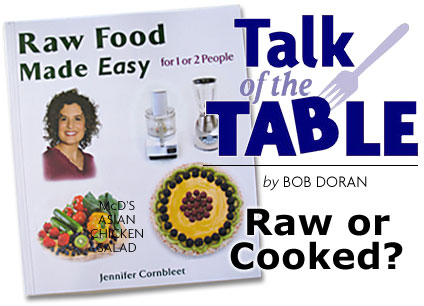
I'll admit it. I'm the defensive sort, and I have
argumentative tendencies. (Just ask my family or my co-workers.)
So maybe I was heading on a collision course when I decided to
track down and interview Jennifer Cornbleet, the author of Raw
Food Made Easy. Since Ms. Cornbleet is coming to the Arcata
Co-op Saturday afternoon to demonstrate a raw food recipe and
talk about the subject, all it took was a call to the store to
get her phone number. And after a quick bicycle ride, I had a
borrowed copy of her book.
Why would the idea of raw food make me defensive?
In part because I'm still an unrepentant omnivore and much of
my diet is far from raw (and no, sashimi and steak tartare are
not part of the raw food diet), but also because I spent over
25 years in the food business as a cook of one sort or another,
so I've done more than my share of cooking. Was I doing damage
to the food I prepared, and maybe even to the customers who consumed
it when I labored over a hot stove? I didn't see it that way,
but true believers in raw food theory might.
I may have put the author and self-described "raw
food chef" in an awkward position. She is not exactly a
true believer, certainly not a proselytizer and freely admits
that she's not trained in nutrition science. She's just someone
who finds eating raw food works for her, so she wants to encourage
the practice by offering recipes that make it easier and even
exciting.
When I called Cornbleet at her home in Chicago
I began with a leading question: Is it better to eat food raw?
"There are a lot of nutritional benefits to
eating raw foods," she began, then stopped to clarify. "First
let me say what I mean by raw foods. Raw food means foods that
are not processed, so it's not just food that's not heated, it's
also food that's not processed in any way that will damage the
nutritional value. The main things you eat with a raw food diet
are fresh fruits and vegetables — particularly green, leafy
vegetables — and natural fats like avocados, nuts and seeds
and olives."
So far so good. I eat plenty of fruit, almost always
raw, and a fair share of greens. I love olives, and a spicy bowl
of guacamole is one of my favorite things, although the tortilla
chips I use to scoop it up would not pass muster.
Cornbleet continued by detailing the nutritional
benefits of a raw food diet: "You're getting more vitamins,
more phytonutrients, you're getting enzymes, getting the good
fats — monounsaturated and polyunsaturated good fats —
and you're getting a lot of water. It's an alkalizing and cleansing
diet, which is good for your immune system. It's also good for
your digestion: Because of the high fiber, the food doesn't stay
very long in your digestive tract and you are able to assimilate
more nutrients than you can from cooked and processed foods."
While cooking is the main way food is processed,
she noted there are also "things like white flour and white
sugar where part of the food is stripped away or refined."
Exactly how does cooking damage food? "Well,
you lose the enzymes whenever you heat food. You also lose a
lot of the vitamin content and you also turn good fats into bad
fats. When you heat oils or refine them, you lose the essential
fatty acids, and the bad fats can [cause] clogging in your arteries
and digestive system."
Here's where I got defensive, contending that the
point when our ancient ancestors tamed fire is typically considered
a major evolutionary advance, perhaps the first step toward civilization
— for better or worse.
"Sure, cooking was a huge invention in terms
of all the cuisines that developed out of it and all that, but
there are a lot more chronic diseases now in humans than animals
have," she countered, "so in that sense you could say
health-wise the evolution of what we've done to food is not for
the best, and a lot of the changes we've made in this century
in terms of food technology have not been positive."
I wasn't about to jump to the defense of our modern
over-processing food biz, but I still had to speak up for the
proper application of fire. There's obviously more to it than
"all the cuisines that developed."
"There are some benefits to cooking certain
kinds of foods," she conceded. "If you cook food that
has bacteria or is contaminated, it's going to get rid of that.
The ideal would be to prepare food that hasn't been contaminated
in the first place. [Cooking] also breaks down the fiber in certain
tougher vegetables that people might have trouble digesting,
like broccoli or that kind of thing, but once you adapt to eating
more raw foods, the fiber is actually good, and you don't have
trouble digesting it. And if you're eating pure organic food
that isn't contaminated with bacteria or parasites, you don't
need to cook it to get rid of that."
Cornbleet argues that the loss of vitamins in cooking
is not debatable. "It's totally mainstream accepted science,"
she said. 'And you lose most of the phytonutrients, which nutritionists
and scientists are discovering are very important for the immune
system." She hesitated a bit on the subject of enzymes,
calling it "a controversial topic in nutrition," and
I did not inject my thoughts on phytonutrients, another topic
that's a subject of debate in the nutrition science world.
"What isn't controversial is that enzymes
are destroyed at temperatures above 118 degrees," she continued.
"What is controversial is how much we really need enzymes
in our diet. There's evidence on both sides, and the jury's still
out on that."
I was slightly relieved to hear Cornbleet say that
she does not maintain a totally strict raw diet herself. "I
eat about 90 percent raw foods, but I like to be flexible on
social occasions and go out to eat and all that — but when
I'm at home I eat a raw diet."
Why did she decide to go the raw route? "I
loved to cook my entire life, my father was an excellent cook.
And I'd always had an interest in health and nutrition. I was
a vegetarian for a while in my teens and got interested in different
diets. When I was in my early 20s I met a yoga instructor who
followed a raw diet and was an example of how to live healthy.
Because of his example I decided to give it a try.
"I didn't have any major health problems the
way some people do, but a lot of things I had come to expect
as being normal just drastically changed after just a month of
eating an only raw diet: I lost 10 pounds, my skin went from
broken out to completely clear, allergies went away, digestive
problems went away, I was sleeping better and had more energy.
So from that experience, I saw it could make a huge difference
in my health."
That said, she went on to reiterate, "I'm
not trying to prove anything or change anybody's diet. I'm a
chef. I love tasty food. If there's one thing that everybody
agrees on, it's that we need to get more unprocessed fruits and
vegetables in our diet. Everyone knows the pleasure of eating
fresh fruit, a crispy salad, a handful of nuts. What I'm trying
to do with my book is show you how you can take those foods you
already enjoy and expand your portions into more creative delicious
meals using fresh fruits and vegetables."
At her 2:30 p.m. workshop at the Arcata Co-op Saturday,
July 22, Cornbleet will demonstrate a recipe from Raw Food
Made Easy, a five-minute Flourless Chocolate Cake, which
she promises is "a decadent wonderful dessert, good enough
to bring to a party."
Raw decadence? I think I could get into that. But
I'm not about to give up cooking. What would I do with my new
grill?

your
Talk of the Table comments, recipes and ideas to Bob Doran.
COVER STORY | IN
THE NEWS | FROM
THE PUBLISHER | DIRT
TALK OF THE TABLE | THE HUM | CALENDAR
Comments? Write a
letter!
© Copyright 2006, North Coast Journal,
Inc.
|