|
 
COVER
STORY | GARDEN | SUMMER FESTIVALS GUIDE | CALENDAR
June 13, 2002
Cherney
and Bari prevail
After 17 days of deliberation,
the verdict is in: Darryl Cherney and the estate of Judi Bari
have been awarded $4.4 million in their long-running legal battle
against the Federal Bureau of Investigation and the Oakland Police
Department.
The jury, in a verdict announced
Tuesday, found three FBI agents and three Oakland police officers
guilty of violating the civil rights of Bari and Cheney, who
were arrested and charged with illegally transporting an explosive
device hours after a pipe bomb exploded in Bari's car as she
was driving through Oakland in May 1990.
The law enforcement officers
were found guilty of false arrest, conducting improper searches
of the activists' homes and of slandering Earth First! in the
press.
Cherney could not be reached
for comment. But one of his lawyers, Ben Rosenfield, called the
verdict "a resounding victory."
During the well-publicized trial
at a federal courthouse in Oakland, attorneys representing the
investigators tried to show that law enforcement authorities
had good reason to be suspicious of Cherney and Bari because
of their association with Earth First!, which at the time had
a reputation for sabotage.
The activists' attorneys, in
contrast, portrayed Cherney and Bari as non-violent and said
they had renounced "tree-spiking," the practice of
driving long nails into trees so that they can shatter a chainsaw.
In one of the trial's more memorable
moments, Cherney, a folk singer, broke into song on the witness
stand, at one point serenading the jury with a tune entitled
"Spike a Tree for Jesus."
Cherney and Bari were arrested
within hours of the explosion in Bari's car, but after six weeks
Alameda County prosecutors decided not to mount a case and the
charges were dropped. Ten months after that, Bari and Cherney
filed a federal lawsuit alleging that the FBI and the Oakland
police had falsely accused them. After years of delay -- due
mainly to FBI attempts to have the case thrown out -- the lawsuit
finally got a hearing this spring.
The suit did not pertain to
the enduring mystery of who planted the bomb, which shattered
Bari's pelvis. Bari died of cancer in 1997.
Priests
to be fingerprinted
by
MEGHAN VOGEL FULMER
In the wake of the nationwide
sexual abuse scandal within the Catholic church, the Santa Rosa
diocese has decided that it will begin fingerprinting priests
and other church employees to make it easier to determine if
one of them is a sex offender.
All church employees involved
with children and youth will be fingerprinted, and prospective
employees and church volunteers will be required to fill out
a background check, according to an announcement in late May.
The fingerprints will be sent to the State Department of Justice
for a criminal records check.
Essentially, church officials
will be treated much like public school teachers in California
and some sports coaches, who must also be fingerprinted.
Earlier this week, the U.S.
Conference of Catholic Bishops, meeting in Dallas, released a
draft policy regarding the handling of sexual misconduct. The
proposal calls for requiring every diocese to report all accusations
of sexual misconduct to secular authorities. It also affirms
the power of bishops to remove accused priests from public ministry
or to defrock them. The 285 bishops gathered in Dallas are also
expected to issue a formal church apology for abusive priests.
In recent months, the Santa
Rosa Diocese, which includes the North Coast north to the Oregon
border, has established an in-house panel, called the Sensitive
Issues Committee, that will be charged with conducting an immediate
and thorough investigation of an alleged sexual crime. Overturning
the church's longstanding secrecy in the handling of sexual abuse
cases, the diocese is also encouraging the public to report all
sexual abuse allegations against clergy directly to the police.
The committee is currently investigating
the Rev. Anthony Ross, accused by a Joliet, Ill., man of molestation
in 1981 when the man was a teenager.
The Santa Rosa Diocese, which
governs Catholic churches along the North Coast, has been rocked
by its share of abuse allegations, not to mention lawsuits and
criminal investigations. Beginning in 1994, it was revealed that
priests had been molesting children from Eureka to Santa Rosa
for more than 20 years. To settle sex abuse victims' claims the
diocese has paid out $7.4 million over the past eight years.
Santa Rosa's last three bishops,
and current bishop Daniel Walsh, have all been implicated in
covering up cases of abuse. Walsh is a target in a civil lawsuit
claiming he overlooked a priest's sexual abuse of nine teenagers
in Nevada before becoming bishop of the diocese.
Bishop Mark Hurley, who ran
the Santa Rosa diocese from 1969 to 1987, recently told The
Press-Democrat, Santa Rosa's newspaper, that he never went
to the police when informed of suspected molestations. He also
said he destroyed all confidential personnel records before retiring.
Although repeatedly warned about
the sexual misconduct of the Rev. Don Kimball, a Santa Rosa priest,
Bishop John Steinbock, in charge of the diocese from 1987 to
1991, concluded Kimball was "not any present danger to God's
people," and allowed him to continue with youth ministry.
Kimball was sentenced last week to seven years in prison for
molesting a 13-year-old girl in 1981. According to the Press
Democrat report, Kimball had admitted to Steinbock that he
had had sexual contact with six young girls, three in Santa Rosa
and three in Eureka.
During Patrick Ziemann's seven-year
tenure as bishop from 1992 to 1999, he removed three priests
accused of sexual misconduct, including the Rev. Gary Timmons
of St. Bernard's parish in Eureka. Timmons was convicted in 1994
of molesting young boys at Camp St. Michael, founded on the Eel
River in northern Mendocino by Timmons in 1964.
Ziemann loaned Timmons $40,000
for legal defense, and was later embroiled in his own scandal
after a complaint was lodged against him by a Ukiah priest alleging
sexual abuse. In response to Timmons' case, the California legislature
passed a law to become one of nineteen states that include clergy
members on a list of professionals who must report child abuse.
Another sexual scandal involving
Humboldt County clergy was revealed in 1995. The Rev. John Rogers,
who was chaplain of the Newman Center at Humboldt State University,
had been accused of molesting a boy at the St. Bernard Church
rectory in 1976. The alleged victim said he first complained
in 1989 and again in 1995 when he became aware that Rodgers was
still working around children. Rogers was reassigned by the church
to Belgium where he committed suicide.
LOOKING
BACK: See story from Feb. 1996: "The
Accusers of Father Timmons"
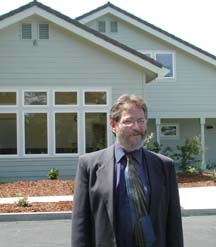 Community
Center opens Community
Center opens
Five hundred community members
showed up Saturday to celebrate the grand opening of the Humboldt
Area Foundation's new building off Indianola Road. According
to HAF Executive Director Peter Pennekamp, the new 6,400-square-foot
community center offers an expanded Rooney Resource Library with
information about non profits and grant writing and two new meeting
rooms: a conference room that holds up to 65 people and a board
room/training room that seats 25. [Pennekamp
in front of new building at right]
"The rooms are available
for any group in the community doing public-benefit work,"
said Pennekamp, "and that's not just non-profits. Anyone
doing anything that improves the quality of life on the North
Coast is welcome."
To learn more about the foundation's
work go to www.hafoundation.org.
For information about using the facility, call Karen Meynell
at 442-2993 Ext. 307.
Chesbro
silent on bullet tax
Although Sen. Wesley Chesbro
voted on every other bill that came before the Health and Human
Services Committee last week, he abstained from voting on a controversial
proposal to place a 5-cent tax on every bullet sold in California.
The bullet tax has garnered
wide support from his fellow Democrats, but Chesbro's non-vote
has nothing to do with the validity of the bullet tax, according
to a spokesman for his office. Chesbro is postponing deliberation
on any new tax measures until after the state's budget crisis
can be addressed.
Chesbro also refrained recently
from voting on two other tax measures -- a soda tax of 21-cents
per gallon on bottled soft drinks that would be used to offset
the economic costs of obesity, and the Petroleum Pollution Cleanup
Act, which would levy a 30-cent tax on each barrel of refined
petroleum to be used to tackle water and air pollution. Both
bills failed to meet legislative deadlines and are being reworked
in committees.
The author of the bullet tax,
Sen. Don Perata of Oakland, said the tax would raise around $21
million a year to partially cover uninsured gunshot wound victims
who end up in the state's emergency rooms. The estimated total
cost of covering such victims is around $400 million a year,
according to Bill Durston, a member of the California Chapter
of the American College of Emergency Room Physicians.
Chesbro has supported gun-control
bills in the past, including a bill last year requiring handgun
buyers to pass a written test and to apply for a permit from
local law enforcement. Opponents of the bullet tax say that the
bill would unfairly penalize hunters and sportsmen, and it is
opposed by most Republicans.
Boxer, Feinstein
back Berg
Patty Berg, a resident of Eureka
for the past 30 years and a candidate for the state Assembly's
1st District, announced June 10 that U.S. Sens. Barbara Boxer
and Dianne Feinstein have endorsed her. Congressman Mike Thompson
and state Sen. Wesley Chesbro are honorary co-chairs of Berg's
campaign.
"I am confident Patty will
be a powerful and effective representative for the North Coast,"
stated Boxer in a news release.
Berg faces Republican Rob Brown
and Green Party Doug Thron.
Coast Guard
ships arrive
In conjunction with the Third
Annual Coast Guard City Celebration of Eureka, five Coast Guard
vessels will be open for tours this Saturday from 10 a.m. to
4 p.m.
Alex Haley, a 282-foot cutter, will arrive in Humboldt Bay
Thursday and will be docked at 990 W. Waterfront Drive. A buoy
tender, Aspen, also arrives Thursday and will be stationed
at the Commercial Street Dock.
The Bonnie Gool Dock at the
Adorni Center will dock two local ships, Eureka's Barracuda
and Crescent City's Dorado. Making her maiden voyage from
Port Angeles, Wash., Wahoo docks at the Woodley Island
Marina.
McLimited
in Arcata
Fans of fast food will have
to look outside of Arcata for more options.
The Arcata City Council finalized
an ordinance limiting the number of chain restaurants in the
area to nine last week. The new law amends the city's Land Use
and Development Guide and takes effect July 5.
The ordinance limits chain eateries,
allowing them into the city only to replace an existing "formula"
restaurant, defined as having standardized food, ingredients,
décor and uniforms shared by at least 11 other restaurants
of the same name.
Passing by a 3-2 vote, the new
law was opposed by Councilmembers Michael Machi and Robert Noble.
Machi dissented on the grounds that he is not convinced of the
harm these corporations would bring to Arcata, and Noble contended
that the ordinance is not a proper means of limiting corporate
power.
The proposal stems from the
Committee on Democracy and Corporations, established in 1998
by voter-approved Measure F, which curtails the influence of
corporations in Arcata. Committee Chairman Paul Cienfuegos said
he hopes Arcata's cap on these types of restaurants will set
an example for other cities to follow.
Chain eateries in the area currently
include Subway in Northtown, Denny's on Janes Road and Carl's
Jr., McDonalds, Round Table and Papa John's in Valley West.
Cross-reporting
abuse
The Senate Public Safety Committee
approved a bill that would establish an optional cross-referencing
system between animal control and social workers last week.
Initiated by Assemblywoman Virginia
Strom-Martin, the bill would authorize and train county child
and adult protective service workers to report suspected animal
abuse or neglect. Studies have shown that the same dynamics of
animal abuse often affect other vulnerable members of the household,
including children and the elderly.
Although the bill originally
called for mandatory cross reporting of suspected animal abuse
between all agencies, special training on how to identify animal
neglect and abuse would be too much of a strain on the state's
already limited budget. If the bill passes, reporting suspected
animal abuse would be encouraged.
Hospital:
Condition critical
Jerold Phelps Community Hospital
and adjoining Southern Humboldt Community Clinic, suffering from
years of undercompensation from insurance companies and Medi-Cal
reimbursements, are in danger of closing if voters don't approve
Measure V, a property tax initiative, on June 25.
Measure V would add $75 to the
annual per-parcel tax paid by landowners in the southern Humboldt
area. The initiative would amount to $6.25 per parcel per month,
enough to guarantee the hospital $800,000 a year for operating
expenses.
Currently the hospital is losing
more than $30,000 a month. A significant contributing factor
is Medi-Cal paying less than 30 cents on the dollar for services
received. In January 1999 the hospital went into bankruptcy but
had a debt repayment plan approved last June.
The high cost of health care
and low reimbursement rates have hit rural hospitals throughout
California especially hard. Many rural communities rely on Medi-Cal
and don't have a large enough patient base to help defray the
costs of necessary hospital departments such as a lab.
If the measure fails and the
hospital closes an economic ripple effect would be felt throughout
the entire community from loss of jobs and diminished property
values. In life-threatening emergencies the nearest emergency
room would be at least 40 minutes away.
Watch your
purse
The Eureka Police Department
received four reports of purses stolen from shopping carts over
the weekend. The purses were lifted from unattended grocery carts
at Canned Foods and Winco in Eureka.
Farm bill's
dairy impact
Within the recently passed $200
billion federal farm bill were some short-term gains for dairy
farmers, however local producers are concerned about its long-term
ramifications. The bill sets money aside for farming, conservation
programs and disaster payments.
With more government money bolstering
dairy production, producers are more likely to expand their herds.
As herds increase and milk production rises, the price of milk
will eventually fall. Although good for consumers, the decreased
milk prices would be detrimental for dairy farmers already competing
in a tight market.
Mike Brown, general manager
of the National All-Jersey Inc., discussed the bill last month
with a gathering of dairy producers and processors in Ferndale.
He speculated that in 2006 when the farm bill ends, the market
will be flooded with milk and inexpensive herds for sale.
"This is a program that
just makes government a bigger part of agriculture," said
Brown.
Clothing
company in the news
Blue Canoe Bodywear of Garberville
will have a fashion spread in Women's Health & Fitness
magazine's June/July issue.
The company, owned by Laurie
Dunlop, specializes in healthy bodywear made from organic cotton.
For its double-page "Fashion Trends" spread, Blue Canoe
employed local art director Carolyn Lamont, photographer Arleen
Olson and models, Gaea Woods and Mia Ribish.
COVER
STORY | GARDEN | SUMMER FESTIVALS GUIDE | CALENDAR
Comments? E-mail the Journal: ncjour@northcoast.com
© Copyright 2002, North Coast Journal,
Inc.
|