|

COVER STORY | IN
THE NEWS | DIRT
| STAGE MATTERS
TALK OF THE TABLE | THE HUM | CALENDAR
June 8, 2006

Chicago at NCRT and
Bard Trek II
by WILLIAM S. KOWINSKI
 In
a few months the musical Chicago will celebrate its 10th consecutive
year on Broadway. With songs by John Kander and Fred Ebb (who wrote
"New York, New York" and the songs for Cabaret), it
won an Oscar as Best Picture of 2002. It is based on a straight play
about two actual 1924 Chicago murder cases written by a reporter caricatured
as "Mary Sunshine" in the musical version. But its theme,
the criminal justice system as show business, came from famed choreographer
and filmmaker Bob Fosse, who wrote and staged the first musical production
in 1975. In
a few months the musical Chicago will celebrate its 10th consecutive
year on Broadway. With songs by John Kander and Fred Ebb (who wrote
"New York, New York" and the songs for Cabaret), it
won an Oscar as Best Picture of 2002. It is based on a straight play
about two actual 1924 Chicago murder cases written by a reporter caricatured
as "Mary Sunshine" in the musical version. But its theme,
the criminal justice system as show business, came from famed choreographer
and filmmaker Bob Fosse, who wrote and staged the first musical production
in 1975.
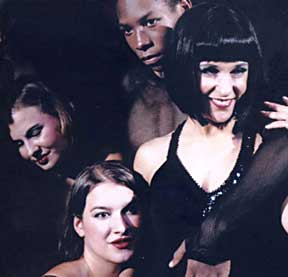
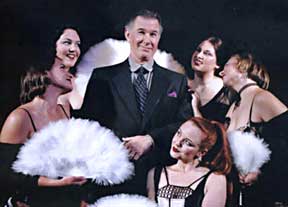
Left and below: scenes from Chicago.
I'm guessing that we're seeing his experience with
his 1975 Chicago in his brilliant 1979 film, All That Jazz.
You can certainly see Fosse's combination of trenchant observation
and bombastic cynicism as well as his style of choreography very clearly
in the movie of Chicago, but I was turned off by its excesses,
including the mechanically speeded-up dancing. The play is structured
as a series of vaudeville acts, but the movie transforms them into extravagant
dream sequences, a technique I feel was done a lot more effectively
in Pennies From Heaven (1981).
For me, Chicago works much better on a smaller scale,
such as the current North Coast Repertory Theatre production, directed
by Xande Zublin-Meyer. There's a much stronger sense of the vaudeville
period that's present in the music, and if this version and how it's
performed in Eureka lacks some of the cynical edge, it also doesn't
hit you over the head with it repeatedly. The satire is still there,
and since the idea (crime and show biz) is no longer novel, the audience
seemed to get it from the songs and dialogue.
 The
story concerns the fall and rise of Roxie Hart, a wannabe vaudeville
performer who kills her partner in an extramarital affair, and Velma
Kelly, a star in a sister act who kills her other half. Kimberly Hodel
is a fetching, brassy Roxie, with a 1920s flapper look. Especially in
one gyrating number in a shimmering gown, she's Betty Boop brought to
life. Jolene Hayes brings a strong voice and a hint of vulnerability
to Velma. With her vocals and acting clarity, Dianne Zuleger as prison
Matron Mama Morton keeps the story moving, as does Daniel Scott Marcus
as the seedy Master of Ceremonies. The
story concerns the fall and rise of Roxie Hart, a wannabe vaudeville
performer who kills her partner in an extramarital affair, and Velma
Kelly, a star in a sister act who kills her other half. Kimberly Hodel
is a fetching, brassy Roxie, with a 1920s flapper look. Especially in
one gyrating number in a shimmering gown, she's Betty Boop brought to
life. Jolene Hayes brings a strong voice and a hint of vulnerability
to Velma. With her vocals and acting clarity, Dianne Zuleger as prison
Matron Mama Morton keeps the story moving, as does Daniel Scott Marcus
as the seedy Master of Ceremonies.
After a few establishing set pieces, the show really
comes alive with the entrance of Brad Curtis as Billy Flynn,
the lovable hypocrite defense attorney. Curtis has a Broadway
voice and presence, and the energy of this show seems to jump
into high gear whenever he's on stage. But the show-stealer has
to be Jamie Obeso's song as Mary Sunshine. It's as if Alfalfa
from the Our Gang comedies grew up to become a female
impersonator.
All the actors bring something special to their roles, and
not just the principal ones. The choreography by Rebecca Rubenstein
gives us less Fosse and more vaudeville, which works for me. Dianna
Thiel's costumes are especially imaginative. There's a live band behind
the performers, there are lots of songs, and the stage is often filled
with a large, hard-working and committed cast. When I saw it on opening
night-plus-one the pace was a little tentative, and some singing and
band music was off, but that's likely to get smoother. There's dialogue
concerning religion and sex that might offend some people. But this
looks like a crowd-pleaser: It's on stage at NCRT through July 1. Reservations
are recommended.

Last week I wrote about this season's plays at
the Oregon Shakespeare Festival (and misidentified an actor:
It's Christopher Duval playing Aytolycus in The Winter's Tale.)
That column was primarily for North Coasters who've already been
to OSF. In my remaining space today, I'll try to give more of
a sense of the place for those who haven't yet been to Ashland.
Building on Ashland's early 20th century success
with Chautauqua circuit performances, OSF grew in fits and starts
since 1935 to become one of the major regional theatres in North
America. In three superbly designed theatres (by Richard L. Hay,
who still designs shows in them), OSF produces 11 plays, contemporary
as well as Shakespeare, and other classics over its eight-and-a-half
month season. It sells some 380,000 tickets for 776 performances,
employing about 100 performers, and 450 others. Its yearly mission,
in the words of resident actor-teacher David Eric Thompson, is
to "tell 11 stories with as much passion and energy and
technical bravura as we can."
So today the industry of Ashland is theatre, and
not just at OSF. On my visit, Wendy Wasserstein's American
Daughter was at the Camelot Theatre Company, Oregon Cabaret
Theatre was doing Tick, Tick, Boom! (a musical by Rent
author Jonathan Larsen) and Southern Oregon University was mounting
Ibsen's Ghosts, to be followed by A Funny Thing Happened
on the Way to the Forum. Ashland Children's Theatre was
preparing its annual Incredible Theatre Camp.
Shops, restaurants, white-water rafting —
there's plenty more to do, but it all revolves around OSF. The
Festival offers theatre tours (many in our group had taken one
before), talks, related concerts and other events. A visitor's
center has vintage costumes on display, and a gift store features
theatrical masks and Oscar Wilde action figures. OSF proves that
in the TV and movie age, people are still fascinated with live
theatre.
Theatre in Ashland fulfills many hopes, and demolishes many
excuses. It's not New York or any large city, or even near one. Yet
people travel hundreds of miles to see Shakespeare done with high artistry,
clarity and style. Other classics and contemporary plays are likewise
performed to fully engaged and responsive audiences of young and old,
who typically see two plays a day, with actors as well as audiences
as fully committed in matinees as in evening performances. It can be
done, and the proof is living.
COVER STORY | IN
THE NEWS | DIRT
| STAGE MATTERS
TALK OF THE TABLE | THE HUM | CALENDAR
Comments? Write a letter!
© Copyright 2006, North Coast Journal, Inc. |