|
 
IN
THE NEWS | GARDEN | GOOD NEWS | CALENDAR
by JIM HIGHT
With MEMORIAL DAY JUST A FEW
away, North Coast business owners are looking forward to the
seasonal jump in sales that arrives with the tourist season.
Gary Cortopassi, owner of Harbor
Lanes in Eureka, makes a point of welcoming tourists. "Whenever
we see a strange face, we introduce ourselves and ask where they're
from," said Cortopassi. He estimates that about 500 tourists
visit his bowling alley annually, spending $10 to $15 each.
According to the California
Tourism Division, Cortopassi could do a lot better with the tourist
trade. The agency says that visitors to Humboldt County spend
more than $50 million annually on recreation, which includes
bowling.
"How much?" Cortopassi
asked when told of the estimate. "Fifty million? Come on.
I want to know what those guys have been smoking."
Cortopassi's incredulity is
well-founded.
By comparing the Tourism Division's
estimates with data from state and local agencies -- and applying
the insights of local business owners -- a North Coast Journal
investigation reveals that the state is overestimating travelers'
spending by as much as 500 percent.
At least one local business
leader has doubted the state's numbers for some time. "This
has concerned me," said Charlotte McDonald, director of
the Old Town/Downtown business group Eureka Main Street. "There's
definitely a value to tourism, but I think it's been weighted
way too highly" by the state.
But in most quarters, the numbers
seem to have been accepted as gospel since they were first generated
in the late 1980s. They've been reported annually by the Humboldt
County Convention and Visitors Bureau, cited in countless media
reports and published in economic profiles of the county.
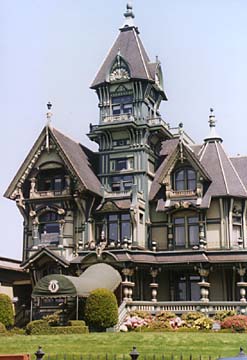
[below left, Carson
Mansion in Eureka]
DOES
IT MATTER?
 So
what? Why should we care if the state gives our tourism economy
some extra weight? So
what? Why should we care if the state gives our tourism economy
some extra weight?
While many government statistics
have little impact on our lives, these numbers matter to anyone
who cares about Humboldt County's future. If they are indeed
as inflated as this investigation indicates, then they create
a false sense of optimism about the potential for tourism to
compensate for declining natural-resource industries.
They also offer a profoundly
inaccurate yardstick for local governments and agencies to measure
tourism's impacts in sales taxes and other factors. And they
can mislead people who are starting a new business or deciding
whether to pursue a career in a visitor-serving field.
"Tourism is an important
component of Humboldt County's economic development; consequently
it is important that we have the right numbers from which we
can gauge how well we're performing in attracting tourists and
producing income for local residents," said Steven Hackett,
professor of economics at Humboldt State University.
Don Leonard, head of the Convention
and Visitors Bureau, said the state "made a substantial
downward adjustment" a few years ago in the way it estimated
tourist spending, and that he felt the current data was accurate.
"I have a lot of reason to believe these figures,"
he said.
Of course, the bureau is in
the business of promoting tourism; Leonard is hardly an unbiased
observer. On the other hand, Leonard has every reason to trust
the figures since they come from what should be a reliable source.
But the Journal's investigation
shows that there is an enormous gap between the state's estimates
and the reality of Humboldt County's tourism economy.
OUT
OF WHACK
The spending figures heard most
often are the estimates for total visitor spending, most recently:
$271 million in 1999; $285 million in 2000; and $291 million
in 2001.
Such big numbers are hard to
argue with. Who's to say tourists don't spend money in such sums?
There are, after all, hundreds of thousands of travelers coming
through the county annually, patronizing hundreds of establishments
from antique shops to the zoo.
But when the estimates for total
spending are broken into their parts -- spending by type of business
-- questions immediately come up.
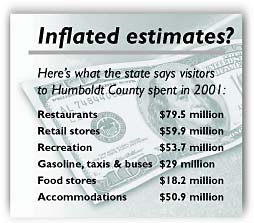
The Tourism Division says that
visitors to Humboldt County consumed $80 million worth of food
and drink in restaurants in 2001.
But the state Board of Equalization
(BOE) -- the agency that collects sales taxes -- reported that
Humboldt County's 335 restaurants took in just over $105 million
in that year. Adding 15 percent for tips (not subject to sales
tax), total spending in restaurants came to about $120 million.
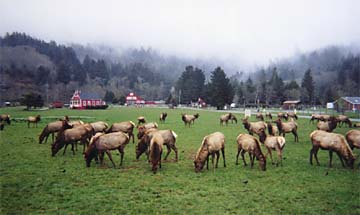 [Right:
Roosevelt Elk near [Right:
Roosevelt Elk near
Redwood Park on Highway 101]
It does not take a keen observer
of the local restaurant scene to know that tourists do not account
for eight of 12 dining customers in the county -- not even in
August.
Restaurant owners in Old Town
who were interviewed for this story estimated their annual revenue
from tourists at five to 10 percent of the total. Old Town draws
more tourists than most of the county's commercial districts,
but even if one attributes 10 percent of county-wide restaurant
sales in 2001 to tourists, they would have spent $12 million
-- not even close to $80 million.
Sales tax reports also challenge
the state's estimate of what visitors spent in 2001 on souvenirs,
gifts, artwork, camping gear and other non-food items: $60 million.
According to BOE reports, sales
of jewelry, sporting goods, novelties, art, gifts, books, musical
instruments, cameras and many other goods sold in "specialty
retail" shops came to $107 million in 2001.
Could tourists have been responsible
for more than half of specialty retail sales? In areas where
summer tourist traffic is heavy in relation to the year-round
population, perhaps.
In Ferndale, one Main Street
retailer, Barbara Garbutt of Itsy Bitsy Quilt Shop, estimated
her tourist trade at 30 to 40 percent; Chris Boynton of Abraxas,
which sells jewelry, hats and accessories, figured visitors account
for at least half of her business.
But in most of the county, visitors
probably accounted for a much lower percentage of specialty-good
shoppers. The owners of two outdoor gear shops in Arcata -- Larry
Buwalda of Adventure's Edge and Vince Smith of Life Cycle --
said their sales to tourists amount to less than 5 percent annually.
(They both reach out to tourists with ads in the annual Humboldt
Visitor magazine.)
Stretching the imagination to
assume that tourists bought 10 percent of the goods sold by specialty
retail shops in Humboldt County in 2001, that would mean they
spent $10.7 million -- not $60 million.
For goods and services that
aren't subject to sales tax, such as recreation and groceries,
there is no tally of business revenues to compare the state's
figures to.
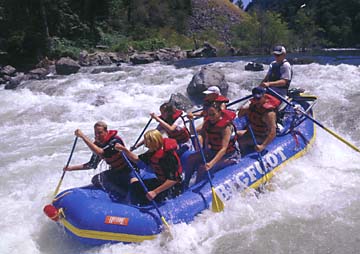
[Below left: Rafting
on the Trinity River]
 But
Cortopassi isn't the only business owner to question DRA's estimate
of recreation spending -- $54 million in 2001. "I've always
scratched my head over those numbers," said Marc Rowley,
owner of Bigfoot Rafting. But
Cortopassi isn't the only business owner to question DRA's estimate
of recreation spending -- $54 million in 2001. "I've always
scratched my head over those numbers," said Marc Rowley,
owner of Bigfoot Rafting.
Observers of the local recreation
industry believe that river trips are the largest fee-based activity
in the county. (While much of the river action happens in Trinity
County, most of the companies are based in Humboldt.)
Rowley estimates that Bigfoot
and all the other river-guiding outfits working the Trinity River
make a combined total of about $1 million per year in gross revenue--
some portion of which comes from locals. "Eighty percent,
plus, of [Bigfoot Rafting's] business is from the classic traveling
tourist, [but] I'd say we're the highest in the industry,"
he said. "A lot of the other companies really go after the
locals."
The North Coast's signature
form of recreation -- gazing at and strolling among the redwoods
-- is available free or at very low cost. The national and state
parks collected about $800,000 in parking and day-use fees in
2001, according to state reports.
Like river rafting, a chunk
of the park fees were paid by North Coast residents. But even
attributing all of the estimated $1.8 million spent on river
trips and park visits to tourists, that would leave another $52
million to account for.
Many travelers golf, and Don
Harling of Beau Pre Golf Course estimates that tourists spend
about $50,000 a year at his McKinleyville course. But even if
the handful of other local courses took in twice that amount
from visitors in 2001, that would still mean the state's $54
million estimate was way, way out of bounds.
There are no amusement parks
or large commercial attractions here -- the closest thing, Trees
of Mystery, is across the county line in Del Norte -- so it seems
unlikely that visitors spend even $5 million a year on recreation,
let alone $54 million.
A
FAULTY MODEL
How could the state's figures
be so far off?
The answer lies in something
called the Regional Travel Impact Model (RTIM) developed by Dean
Runyan Associates (DRA), a Portland, Ore., consulting firm that
is retained by California's Tourism Division to make county-by-county
and state-wide estimates of how much tourists spend annually.
DRA performs similar services for Oregon, Washington and four
other western states.
DRA used surveys of travelers
to develop RTIM as a predictor of what travelers spend. The key
criteria is what type of lodging they use. For example, a person
staying in a public campground will tend to spend less in restaurants
and shops than someone staying in a motel or B&B.
DRA estimates how many people
visited each California county annually -- and what kind of establishment,
including private homes, they stayed in -- based on national
surveys conducted by D. K. Shifflet & Associates of Falls
Church, Va.
In reviewing material on DRA's
website (www.deanrunyan.com) and interviewing company President
Dean Runyan and his California Project Manager Bill Klein, it
appears that RTIM runs afoul of the facts on the ground in Humboldt
County in several important ways.
BIG
SPENDERS
DRA assumes that visitors spend
the same kind of money dining, shopping and amusing themselves
here as they do in Napa, San Francisco, Monterey, Santa Barbara,
Los Angeles, San Diego and other California destination areas.
Runyan denied this, saying that
DRA discounts its visitor spending estimates for rural areas.
"People spend more in San Francisco than they do in Humboldt
County," he said. But DRA's estimates clearly show visitors
spending in virtually the same amounts and patterns here as they
do statewide.
Motel owners and tourism specialists
in Humboldt County have said for years that the North Coast's
tourism economy struggles because most visitors spend just one
night and head on down the road.
Those who come for the music
festivals or Godwit Days spend more time and money, but they
are not typical. There are probably far more travelers leaving
town with just a tank of gas and a quick breakfast than there
are those who stick around and spend several hundred dollars
a day in shops, restaurants and elsewhere.
But in DRA's model, the average
North Coast tourist is a very big spender.
DAY-TRIPPERS
DRA's model finds many travelers
visiting Humboldt County without spending the night. Day-trippers,
the company estimated, spent $67 million on gas, food, restaurants,
shopping and recreation here in 2001.
With the closest metropolitan
area -- Redding -- a three-hour drive away, it seems highly improbable
that large numbers of free spending day-trippers come to Humboldt
County.
SHOPPING
SPREES
"These days ... people
travel in part to do retail," Runyan told me, in defense
of his estimate that tourists spent $60 million shopping here
in 2001. "[In Portland] people come from Washington to make
major purchases because there's no sales tax in Oregon.
"The same thing will happen
in Spokane [Washington]," he said. "Rural visitors
will come in and they're not buying stuff in gift shops. They're
going to WalMart and loading up ... They're buying washing machines,
tires for their cars."
It goes without saying that
Runyan is not very familiar with Humboldt County, where there
is no WalMart, and where some residents leave the county to make
major purchases because of the relatively narrow selection of
large retailers.
In studying the local retail
scene, Bay Area Economics estimated in 1999 that Humboldt County
residents spend more than $50 million per year outside the county
on clothing, furniture, appliances, cars and tires. It is difficult
to imagine visitors traveling to Humboldt County to make large
purchases of things that are more available where they live.
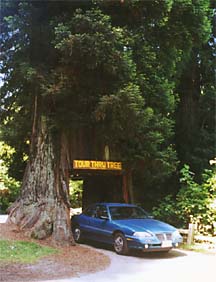
[Below right:
South of Klamath along Highway 101]
 MYSTERY LODGING
DOLLARS MYSTERY LODGING
DOLLARS
What travelers spent on accommodations
should be easy to get right because private campgrounds and lodging
establishments report their gross incomes when they pay transient
occupancy taxes (TOT). In 2001, they brought in about $32 million.
Some motel and campground owners
don't report all their income, but DRA figures that any under-reporting
is offset by reported revenue for business travelers and truckers.
"We just assume that neither of those numbers is very large
and they compensate for each other," said Runyan.
Adding $4 million for untaxed
RV parks in county jurisdiction (a rough estimate based on the
number of campgrounds) and $1 million for camping in state and
national parks (as reported by state parks), total accommodations
spending came to about $37 million for 2001.
DRA estimated $51 million. Where
did the extra $14 million come from?
DRA California Project Manager
Bill Klein estimated that rented vacation homes brought in $10
million in 2001. While the rent payments would have been subject
to TOT (unless visitors stayed over 30 days), Klein implied that
most rental owners would dodge the tax man.
But it seems very unlikely that
there is a $10 million untaxed market for vacation rentals here.
According to several sources, rental homes are actually quite
rare.
In Trinidad, where there seem
to be more rentals than in any other area of the county, Curtis
Clark of the Abalone Cove Rental outfit estimated, "There
are probably fewer than 20 individual rental units [around Trinidad].
It's an extremely small market." (And, by the way, Clark
does pay his TOT.)
Clark and other sources reported
that some homeowners in the county rent their own houses when
they leave on vacations.
But even if 1,000 homeowners
brought in $2,000 each renting their homes in 2001 (and didn't
pay any TOT), that would add $2 million and bring accommodations
spending to $39 million -- still $12 million short of DRA's figure.
This is no minor point, because
DRA's travel impact model multiplies the non-existent $12 million
into $30 or $40 million in non-existent sales of rafting trips,
T-shirts, beer, groceries, gas and bowling games.
The harshest reality confronted
in downsizing DRA's estimate of the local tourism economy is
employment. Visitor spending, DRA says, supports about 6,000
jobs here -- nearly 10 percent of total employment. That should
be good news for any unemployed job-hunter. But most of those
6,000 jobs seem to be as mythical as DRA's visitor-spending estimates.
For 2001, DRA attributed 2,780
jobs in restaurants to visitor spending, but the Employment Development
Department (EDD) reported that restaurants employed about 3,900
people in the summer of 2001. Even if tourist dollars supported
10 percent of local restaurants' payrolls -- a doubtful prospect
-- that would mean just 390 jobs.
DRA estimated that 960 workers
in the recreation field owed their salaries to visitor spending
in 2001. But EDD data shows that only 600 to 800 people were
employed in "amusement and recreation" in 2001. We
can only speculate how many of those positions were supported
by tourist dollars.
DRA's estimate for lodging and
campground employment seems to be fairly accurate. It estimated
1,150 jobs, while EDD reported 900 to 1,000. Add in the many
self-employed business owners -- who don't show up in EDD figures
-- and DRA's estimate looks reasonable.
But in measuring tourism's broader
economic impact, it should be noted that most motels and RV parks
pay relatively low wages: the average annual salary is about
$11,500, according to EDD.
TOURISM
STILL IMPORTANT
Making an accurate estimate
of total visitor spending is beyond the scope of this story.
But even downsized, hypothetically,
to a $50 million industry supporting 1,500 jobs, tourism should
still rank as an important industry. Many of DRA's mistakes reflect
the errors committed by other out-of-town consultants who have
made unrealistic projections about our economy because they didn't
grasp just how small and slow-growing it is compared to most
of California.
And because tourism brings in
money from outside the area, it makes sense that the county prioritized
it as one of the base industries in its economic-development
strategy.
"When we do get tourists'
dollars, they always look a little greener because they're out-of-the-area
dollars," said Larry Buwalda of Adventure's Edge.
Tourism does seem to be growing.
According to an analysis of TOT data by Humboldt State University's
Index of Economic Activity in Humboldt County, spending on accommodations
in Humboldt County has increased more than 30 percent in the
last five years (before inflation).
In the year after September
11, 2001, lodging and campground occupancy here increased more
than in the previous two years. If this pattern holds true, travelers'
fears and uncertainties about air travel in the wake of war and
terrorism may steer more of them than ever to the North Coast.
And when the tourists come,
they'll be bringing lots of those "greener" dollars
-- but not in the hundreds of millions estimated by DRA.
Jim Hight is a frequent contributor
to the Journal. His last cover story was on the North Coast real
estate market (Oct. 10, 2002).
Figures off-base
elsewhere, too
THE JOURNAL'S INVESTIGATION
REVEALED significant exaggerations in visitor-spending estimates
for Humboldt County, but the estimates for neighboring Del Norte
and Mendocino counties may be even further off base.
The state Tourism Division and
its consultant, Dean Runyan Associates (DRA), estimated that
travelers spent $28 million dining and drinking in Del Norte
County restaurants in 2001. But the state Board of Equalization
(BOE) -- the agency that collects sales taxes -- reported that
the county's 61 restaurants brought in a total of just $17.5
million for the year.
In Mendocino County, DRA estimated
visitors spent $93 million in restaurants in 2001, more than
the total sales reported by the BOE: $85 million.
While one can argue about how
important visitors are to the restaurant business, their patronage
certainly could not exceed the total.
When asked about these obvious
errors, DRA Project Manager Bill Klein said that "the BOE
numbers you cite do not include restaurants in hotels, casinos,
etc."
Klein is correct about tribal
casinos, but food and drink sales by hotel restaurants and room
service are reported along with other eating and drinking places,
according to a BOE spokesperson.
Because DRA uses its own model
of visitor spending patterns -- and conducts no local surveys
-- the firm's estimates of what visitors spent on recreation,
gas, food and other services in Del Norte and Mendocino counties
may be as inflated as the restaurant spending estimate.
DRA's mistakes in Mendocino,
Humboldt and Del Norte counties seem to arise from its assumption
that visitors spend the same kind of money in rural areas as
they do in areas with boutique shopping, amusement parks and
high-dollar attractions.
But independent economic analyses
by the San Diego County Convention and Visitors Bureau show that
DRA's estimates may be erroneous for the entire state. While
DRA estimated travelers to San Diego spent $8.5 billion in 2001,
the SCCVB's study showed just $5.1 billion.
The SCCVB study conducted by
CIC research established typical visitor spending patterns in
San Diego based on surveys of 3,300 actual visitors. DRA's estimates
were developed without the benefit of any local surveys.
-- reported by Jim Hight
IN
THE NEWS | GARDEN | GOOD NEWS | CALENDAR
Comments?
© Copyright 2003, North Coast Journal,
Inc.
|