|

COVER STORY | IN
THE NEWS | FROM THE PUBLISHER | DIRT
| STAGE MATTERS
TALK OF THE TABLE | THE HUM | CALENDAR
April 13, 2006
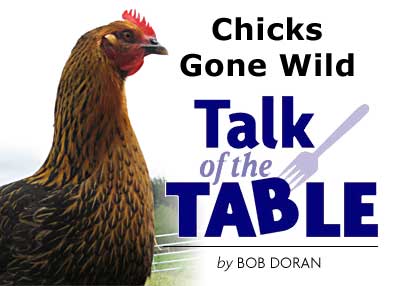
Let's get this straight from the start: Sarah Brunner
and Shail Pec Crouse, the owners/operators of Wild Chick Farm,
are women, not chicks. The "wild" chicks in the name
of their operation on Old Arcata Road are laying hens, and not
exactly your typical hens -- these are pasture-ranged, organic
chicks. They're not truly wild, but closer to nature than most
chickens you'll find on American farms.
When there was a break in the rain this last Sunday
afternoon, Sarah and Shail took a few minutes to meet me at the
farm, gather some eggs and introduce me to their flock: 120 hens
and three roosters strong. They'd spent the morning hard at work
on their business plan, getting ready for the final phase of
the soon-to-end Economic Fuel contest. If theirs is deemed the
best plan, they could get $25,000 in start-up capital to take
them to the next stage in their nascent business.
Besides putting the final polish on the plan, Sarah
had been fine-tuning the "elevator pitch" she'll deliver
at this Thursday's E. Fuel workshop, a speech describing the
business short enough to spin out in the course of an elevator
ride.
Asked for a rehearsal, she began, "We're starting
the first organic, pasture-ranged chicken farm in Humboldt County
for chicken products, including meat and eggs. We'll be directing
our marketing directly to consumers. We're already selling at
the Farmers' Market -- and we'll be selling our products on-site,
on our farm."
The wild idea for the chicken biz grew out of discussions
around revised planning for a Danco-built co-housing project
in the Arcata Bottom, one involving shares in a Community Supported
Agriculture (CSA) farm sold along with houses. Sarah served on
an advisory committee for the planned community. "We were
looking at the unmet needs in Humboldt County for agriculture,"
she recalled. "One was chicken meat. We don't have any local
producers of organic chicken."
Enter Shail, who shares Sarah's love for birds
and passion for sustainable agriculture. A plan was hatched,
for the most part drawing on Joel Salatin's book Pasture Poultry
Profits, a practical guide to raising chickens in what might
be termed a neo-old-fashioned way, at least as opposed to most
modern egg production.
While Sarah says, "We're trying to bring back
the old fashioned way of doing things," Shail points out
that the system they'll implement come summer is far from the
way things were done in the past, when chickens typically ranged
from a main barn. "We'll have [portable] coops out in the
pasture, moving around so they're always on fresh pasture. There's
no buildup of manure, which keeps the land and the chickens healthier
-- and you don't have to deal with a bunch of poop."
"It started as an experiment to see if we
could do it: If we could raise our own flock and bring them to
laying age," says Sarah, noting that the experiment has
not been without problems. They've lost 50 chickens, in part
to predators -- raccoons, skunks and weasels -- while others
drowned in a surprise winter flood.
On cue, the loudest rooster butts in, and Sarah
tries to shush him with a serious: "Excuse me!" before
explaining that their first phase was getting eggs to market.
"Eventually we'd like to go into meat as our main product.
That's our business plan. But laying hens are easier to manage,
and [eggs are] an easier product to bring to market."
It doesn't look like they'll have trouble finding
buyers for their high-end designer eggs. Up until last weekend
they'd sold all they raised to friends and word-of-mouth customers.
The supply they brought to Saturday's Farmers' Market did not
last through the day, even at $6 a dozen.
The half dozen I took home were packed in a carton
marked "Old Fashioned Organic" from Judy's Family Farm,
which according to Shail, is one of the most popular "cage
free" brands, along with Uncle Eddy's. Both Judy's and Eddy's
eggs come from Steve and Judy Mahrt's Petaluma Farms in Sonoma
County.
"Their marketing has been good," notes
Sarah. "A lot of people assume they're the best eggs because
they think the chickens are happy and healthy, living outdoors
and running around. They're actually not."
The vast majority of eggs you find in your supermarket,
around 95 percent, come from high-volume egg factories using
what are called "battery cages," with up to 10 birds
stuffed into each cage leaving no room to spread their wings
or even move around. The birds live in these cages all their
lives, never touching solid ground. Complaints from animal rights
activists have led socially conscious food businesses like Whole
Foods and Trader Joe's to switch to "cage-free" eggs
and "free-range" meat.
Shail, the researcher in the team, sees "cage-free"
as an improvement, but not much. "Basically `cage-free'
and `free-range' chickens are still grown in warehouses,"
she explained. "They're not in cages, but they're crowded
on a dirt floor in a big building. If they call them `organic'
they have to have access to the outside, but it's usually a very
small area that can't hold all the birds at once. There's no
grass, no greens at all. The chickens are de-beaked because they're
overcrowded and if they had beaks they'd kill and eat each other.
It's pretty ugly."
There are no such operations in Humboldt, nor are
there chicken factories. "There are only a handful of small
time egg farmers who go to Farmers' Market with a few eggs. That's
it," Sarah notes. "And there's no local chicken meat
at all, let alone pastured organic."
Reviving local meat production -- and moving on
to the next stage of their business plan -- will not be as easy
as gathering eggs.
"We need more infrastructure -- a processing
facility certified either by the county or the state. There's
only one commercial meat processor in Humboldt, Redwood Meat
Co., and they don't do chickens." So, phase two is to get
capital for a mobile meat processing operation.
"We plan on doing all of the processing ourselves.
All of the evisceration and cleaning will be done by hand,"
says Sarah, and I'll admit, with her gentle demeanor, it was
hard for me to imagine her eviscerating anything. "There
won't be any mechanized equipment other than a scalder, which
you have to use, and a simple plucker, which is what most small-scale
farmers use. We'll do the slaughtering the most humane way, which
also reduces shock and adrenaline in the body so that the meat
tastes better."
"Humboldt County was once a major poultry
producer back before World War II, but the industry died up here,"
says Shail. "Poultry used to be commonplace on every family
farm until it went industrial. We want to bring it back -- and
do it right."

Wild Chick Farm invites the public to Humboldt's
first ever Pasture Ranged Easter Egg Hunt on Easter Sunday, April
16, at their operation on Kokte Ranch, at 2182 Old Arcata Rd.
-- about a quarter mile past the Bayside Grange. Stop by their
booth at the Arcata Farmers' Market Saturday or call 826-1450
for further details including start time.
COVER STORY | IN
THE NEWS | FROM THE PUBLISHER | DIRT
| STAGE MATTERS
TALK OF THE TABLE | THE HUM | CALENDAR
Comments? Write a
letter!
© Copyright 2006, North Coast Journal,
Inc.
|