 
COVER STORY | IN
THE NEWS | STAGE
MATTERS
TALK OF THE TABLE | THE HUM | CALENDAR
March 16, 2006

ST. JOE FINANCES GRIM: St. Joseph Hospital
in Eureka announced last Tuesday at a press conference that its
coffers are empty and it must lay off the equivalent of 90 to
110 full-time workers by May. The hospital outlined the predicament
in a bulleted fact sheet for the media entitled "Urgency
of SJE's Financial Situation," wherein the layoffs were
deemed "regrettable but absolutely necessary."
The memo states that the Catholic nonprofit hospital
has no cash on hand and is currently living off a $10 million
line of credit extended by its parent, St. Joseph Health System.
In the last two months, $4 million has been spent, and the line
of credit is expected to run out within six to eight months,
at which point St. Joseph's will not be able to make payroll
without additional funding. "At the current run rate, an
annual improvement of $12.5 million will be required," to
achieve a
4 percent operating margin and subsequently ensure
St. Joseph's financial success, the memo reads. The fact sheet
also states that 41.6 percent of the hospital's operating expenses
go toward salary, wages and benefits and that "staffing
productivity" has been declining at both the Eureka hospital
and at Fortuna's Redwood Memorial Hospital, which is also owned
by St. Joseph Health System.
Employee/administration forums were held at St.
Joseph last week and were scheduled for Redwood Memorial this
week. The memo ends on a mildly optimistic note: "We are
all responsible to the citizens of Humboldt County to ensure
that they continue to have access to efficient, high-quality
health care services."
How that will be achievable after drastically reducing
the hospital's workforce remains unclear. Pamela Haynes, an emergency
room nurse at St. Joe's since 1997, said she is hopeful that
her employer will make the "safest cut possible so as not
to impact patient care greatly." She said the administration
has been "absolutely civil" and straightforward regarding
the hospital's financial predicament. Still, Haynes, who works
an average of 24 hours a week, wonders how many jobs will actually
be terminated when those FTEs ("full-time equivalents")
are tallied. For instance, Haynes and another part-time nurse
could add up to one full-time position, but two people would
be laid off. Kathryn Donahue, another St. Joe's nurse, voiced
the same concern: "It could add up to 180.5 [workers]. No
one knows, they gave us no specifics."
FISHING OPTIONS: The Pacific Fishery Management
Council last week was talking about the potential for a ban on
commercial and sport salmon fishing on the West Coast this season,
from Oregon's northern border to south of Carmel. And if not
a ban, the season would at least be severely restricted.
The talk of a ban or a restricted season came after
news of low returns of spawning Chinook in the Klamath River
for the third year in a row. Last year the fishing season was
curtailed to protect the Chinook, who mingle in the ocean with
other salmon. It placed hardship on fishermen up and down the
coast. The federally listed Coho salmon also is at risk on the
Klamath.
The council will make a final recommendation in
April to the National Marine Fisheries Service, which will make
the final decision.
PROBLEM GAMBLING: March 6 through March
12 was National Problem Gambling Week, and by now you've been
exposed to the ads on TV, in print, on radio. "When gambling
is more than game, no one wins," says the one placed by
Blue Lake Casino on the back of this paper. It ends with an 800
number that leads you to the private, non-profit California Council
on Problem Gaming. So we phoned the council up to ask, "How
many people respond to this sort of cry of proffered help?"
The switchboard operator sent us to the council's
executive director Bruce Roberts, who had just finished compiling
the stats for 2005. "Last year, we screened 18,470 calls
in all of California," Roberts said. "And of those
we counseled 3,868." He said 73.4 percent of the calls were
from problem gamblers -- "preoccupation with gambling, gambling
to escape, trying to cover up gambling," reads the ad --
and 9.6 percent came from the spouse of a problem gambler; 3.3.
percent came from children of gamblers; 3.6 percent from parents;
4 percent from friends; and 2.6 percent from siblings. "The
rest were miscellaneous," said Roberts. And, he added, 4.7
of the calls came from the 707 area code. Mom, was that you?
Seriously -- Roberts said calls do rise dramatically
during the national awareness week, and stay high for a period
of about three months. But his council gets calls all year round.
He had other stats, as well: "Women gamble almost as much
as men these days," he said. "They love machine gambling."
He said problem gambling doubles within 50 mile of a gambling
establishment. With poker's meteoric rise in popularity, problem
gambling also is "reaching epidemic proportions" among
young people, he said.
It's a serious addiction -- wrecking lives, pocketbooks
and relationships just like any other addiction. That's why,
on Roberts' group's hotline anyway, counseling is offered in
150 different languages, any time of day. The council is funded
by donations from the corporate gambling industry. The state
also has problem gambling counseling programs.
ANOTHER PEACE RALLY: Seems like they happen
every month or so these days, but this is the big one: The annual,
nationwide Communities for Peace Rally that's been happening
since before the commencement of hostilities in Iraq in 2003.
As always, the Humboldt County version of the march leaves the
Eureka Muni building (1120 F St.) Saturday at 11:30 p.m., then
proceeds to the Old Town Gazebo, where speeches from Nation
columnist Alexander Cockburn and other will address the costs
and consequences of the Iraq war. "We know that the majority
of people in the country want this war to end as soon as possible,"
said Ellen Taylor, one of the event's organizers. "Who knows
how much good rallies do, but we'd like to see lots and lots
of people out there.
TOP
What's up with this crazy weather?
story and photo by HEIDI WALTERS
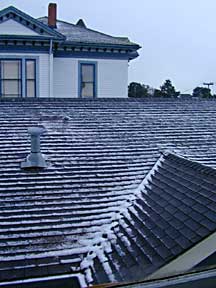
A cold front from Canada barged into Humboldt County
late last week, bringing rain as well as bouts of hail and snow
that piled haphazardly onto rooftops and streets of sea-level
towns.
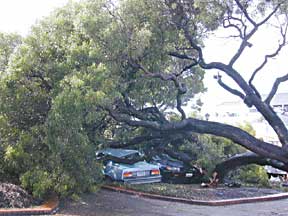 Amid
the intermittent ice-peltings, sometime in the early morning
of Friday in Eureka, a graceful old black acacia with a full
canopy of minnow-sized dark-green leaves toppled onto two empty
cars in a parking lot just south of Has Beans coffee house on
2nd Street [left]. The cars were crushed and the sidewalk
ruptured by the tree's wrenched-up roots. And, judging by its
faint tilt south and the buckled sidewalk encasing it, another
acacia a few yards away had budged closer toward oblivion in
the morning's wind. By mid-morning, city crews were sawing up
the downed acacia limb by limb. And by Tuesday, they were readying
their saws to remove the leaning tree, whose tilt hinted at a
crushing blow to a nearby house if left to the next storm's devices. Amid
the intermittent ice-peltings, sometime in the early morning
of Friday in Eureka, a graceful old black acacia with a full
canopy of minnow-sized dark-green leaves toppled onto two empty
cars in a parking lot just south of Has Beans coffee house on
2nd Street [left]. The cars were crushed and the sidewalk
ruptured by the tree's wrenched-up roots. And, judging by its
faint tilt south and the buckled sidewalk encasing it, another
acacia a few yards away had budged closer toward oblivion in
the morning's wind. By mid-morning, city crews were sawing up
the downed acacia limb by limb. And by Tuesday, they were readying
their saws to remove the leaning tree, whose tilt hinted at a
crushing blow to a nearby house if left to the next storm's devices.
Elsewhere Friday, people slip-slided along roads
and piled into each other, or drove gleefully for the foothills
to frolic in the snow. Sheesh, ain't y'all ever seen snow in
town before?
Actually, the last time it snowed at sea level
here was in 2002, when a half-inch of snow accumulated in Eureka,
says Mel Nordquist, science and operations officer at the National
Weather Service's Eureka office on Woodley Island. Before that,
a half-inch of snow was recorded in 1999. "But the real
snow event was in February 1989, when four inches were recorded,"
said Nordquist Monday afternoon, leaving his desk to go sit before
a bank of monitors in the weather office's main room to call
up the old data.
Naturally, Nordquist loves to talk about the weather
and with his wispy light brown hair and short auburn beard and
moustache, he even looks a bit like a slighter, be-spectacled
version of the statue at the tip of Woodley that stands in memory
of fishermen lost to stormy seas. But though he'll start down
intriguing tangential paths with lines like, "There's 27
major categories of clouds, and numerous subspecies of clouds
within those categories," he's good at reigning the conversation
back from the jungle of physics terminology to a more manageable
scenario. The cloud type that gave us Friday's showers of hail,
snow and rain was cumulonimbus.
But while the snow and hail was a rare occurrence,
there wasn't anything "abnormal" about it, nor, for
that matter, about the 30-degree temperature the following morning,
a record-breaking low. (It broke a record for March 11 that was
set in 1891 -- 31 degrees -- but Nordquist notes that the record's
just for that day; surrounding days may have been as cold or
colder in different years.) "It's somewhat unusual for it
to happen at sea level, but it happens every five or 10 years,"
he said. "And it wasn't the coldest storm we've had. I've
been here since 1994, and I've seen colder events."
Nordquist says the rain, crazy snow and hail and
stretches of sunshine we've had this winter are typical of what
happens during a weak La Niña event, which is what's happening
this year. Nordquist explained: When the water temperature over
the equatorial Pacific, east of the dateline, is warmer than
normal, it's called an El Niño event -- and that causes
a pattern of drier weather in the Northwest. When the water over
the equatorial Pacific is colder than normal, we get a La Niña
-- which, if it's a "strong" La Niña, tends
to cause wetter weather in the Pacific Northwest. They run in
three- to five-year cycles, Nordquist said. But this year we're
experiencing a "weak" La Niña, which has no
signature pattern. Anything goes.
"This is normal climatological variation,"
Nordquist said.
There was, however, one atypical weather event
this year that will stick in everybody's minds way past the time
it takes for all the sawdust to wash into the sea: The New Year's
Eve freak wind event that downed whole pockets of forest and
rows of town and highway trees, swept the bay up over Highway
101 and kept the power company busy for weeks. Now that
was abnormal. In fact, Nordquist is part of team of researchers
at the weather service studying that event. They're pretty sure
they know what happened, but they may bring in a professor to
help with the investigation into why it happened.
 Nordquist
brought up images and graphs showing the New Year's Eve weather
event. The main culprit has a rather nice name: a bent-back
occluded front. But first, the setup. The astronomical tides
were high, and it had been raining steadily. "And so [with
those characteristics] you fill the bay up to the brim,"
said Nordquist. "And then we get really strong west winds
driving the bay waters to the east" and up over the railroad
tracks and onto the highway. Trees were uprooted and many snapped
-- including more than 200 in Sequoia Park in Eureka, says city
parks supervisor Kurt Hufft. And it was the bent-back occluded
front that produced the sudden strong winds. Nordquist
brought up images and graphs showing the New Year's Eve weather
event. The main culprit has a rather nice name: a bent-back
occluded front. But first, the setup. The astronomical tides
were high, and it had been raining steadily. "And so [with
those characteristics] you fill the bay up to the brim,"
said Nordquist. "And then we get really strong west winds
driving the bay waters to the east" and up over the railroad
tracks and onto the highway. Trees were uprooted and many snapped
-- including more than 200 in Sequoia Park in Eureka, says city
parks supervisor Kurt Hufft. And it was the bent-back occluded
front that produced the sudden strong winds.
"An occluded front is a combination of a warm
front and a cold front," said Nordquist. What happens is,
the cold front overtakes the warm front and they merge. Meanwhile,
that New Year's Eve morning, Nordquist suspects some kind of
"upper-level disturbance" in the atmosphere "interacted
with the occluded front" and caused it to wrap back around
the low-pressure system. On screen, the graph shows a line moving
horizontally -- the occluded front -- and then suddenly diving
downward. At the point that it dropped, between 9:30 a.m. and
10:30 a.m. New Year's Eve, is when the freakishly fast winds
(clocked up to 97 miles per hour in Eureka) occurred. "What
caused the winds was the extreme change in pressure along the
bent-back occluded front," Nordquist said. "The air
is just accelerated. One side is high pressure, the other side
is low pressure." And the rest is history -- the winds pushed
the already high tide over the edge and ravaged trees.
Nordquist said that weird event and the snowfall
last Friday are not related. But the poor, fallen acacia and
its doomed fellow over on 2nd Street in Eureka may have been
weakened by the New Year's Eve storm, enough so that even a mild
wind could knock them over, especially with the soil saturated
as it was by rain. On Tuesday, city parks supervisor Hufft was
out at the site, where the second tree was about to be cut down.
"They've matured all the way," Hufft
said. So, their time was nearly up anyway. "The other [third]
one, on the southwest corner of the parking lot, it's not going
to be cut down." New trees will be planted, he said.
As for the crushed cars? Hufft said he's heard
secondhand that one of the cars belongs to St. Vincent De Paul
(a donation) and the other was abandoned there after its owner
died. Confirmation of the cars' stories hadn't been made by press
time, and even the police didn't know whose cars they were for
sure, said spokesperson Suzie Owsley.
"I think the police should have moved them
by now," Hufft said. "You're not supposed to just leave
them there."
TOP
COVER STORY | IN
THE NEWS | STAGE
MATTERS
TALK OF THE TABLE | THE HUM | CALENDAR
Comments? Write
a letter!
© Copyright 2006, North Coast Journal,
Inc.
|