|

COVER
STORY | IN THE NEWS | PUBLISHER
STAGE
DOOR | THE
HUM | CALENDAR
March 3, 2005

by BOB DORAN
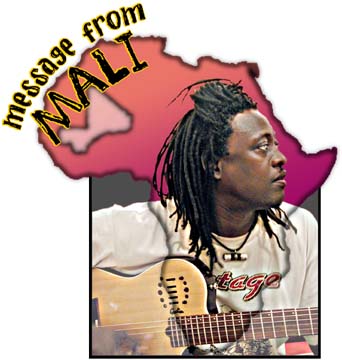
WHEN I CALLED MALIAN GUITARIST
HABIB KOITE [photo at
left] ON HIS cellphone, he was
rolling down the road on a tour bus traveling from North Carolina
to Tennessee deep in America's South.
The tour that brings Koité
and his band Bamada to Arcata for a show Saturday, March 5, also
includes several dates where he is paired with American blues
artists, demonstrating the link between traditional African music
and the blues.
Koité explained that
he often hears the sound of West Africa in American music, "I
am a Malian musician, and a lot of Mandinka music is based on
the pentatonic scale. There were a lot of people from West Africa
deported to the Americas during the slave trade period, and these
people mixed with other people over the years. At first they
continued to play their own music, and it evolved with time to
give the blues scale."
Koité writes his own
songs, but the roots of his music run deep into the past. As
he explained, his family name links him to the griots, court
musicians who passed their skills and songs from one generation
to the next.
"We are griot, even if
we don't do music. It is a line of griot since the [time of the]
Mandinka Empire. My father was a musician, but not to make money.
He had another job, he worked on a train, but he played [music]
all the time. My brother and I followed my grandfather and the
father of my grandfather, they were musicians, griots. But the
way I play guitar, it is not only about griot. I am griot but
I play many kinds of music. I play music from Malian traditional
instruments on guitar, play it like the kora.
"When I was growing up,
my father and my older brother both played guitar, and I naturally
followed, because it was there. After, when I started giving
music lessons at the INA (Institut National des Arts) in Bamako,
I was in charge of [the] classical guitar department. On top
of teaching `occidental' classical guitar, I also had to teach
traditional string instruments such as the kora or the kamale
n'goni, in the Malian style, and therefore dabbled in adapting
the guitar to emulate the sound of these instruments. The kora
has 21 strings so, while I try to play close [to the kora sound],
it's not the same, I cannot play exactly the same, it is not
possible."
A key difference is the fact
that the strings on the harp-like kora are plucked with both
hands. "With two hands playing, you are free to do bass
lines, rhythm and melody. It's not easy to do that on guitar,
but I try sometimes."
While his music has evolved
by absorbing western elements, he still feels a connection to
the music played by his ancestors. "The role of the musician
is to move people emotionally, and also to inform or to comment
about different things in life. I am a griot by birth and by
name and will always be. When you are a musician as well, you
can't be more griot than that.
"Many things have changed
since the days of griot, but one thing is the same. We play music
to make a message, to say something to the people. That's does
not change. I do the same. I try to say something with my music.
The music always has a message."
What is the message? "The
message is about peace, about compassion, about how people can
stay together with tolerance. People can joke and smile and laugh
together.
"I talk about the young
generation from my country, what is happening to them, what they
can try, what they want to do, what they dream. The TV in Africa
gives them a lot of images from [around] the world and sometimes
many of the young want to go out not knowing the reality of other
countries like America and Europe.
"They see the movies and
the videos for black American music, soul or rock music. It does
not show the reality of life here. America is a beautiful country
but you must work a lot to have money to live. It's not easy
to do that, it's not like a paradise you see on TV."
While he has traveled worldwide
playing his music, and he could live anywhere he wants to, Koité
still spends most of his time in Mali. "I travel a lot but
when I finish my tour I go home. I still live there because I
love my country and I want to show an example for the young people
that you can see the rest of the world, but still come back home.
What they take with them if they go is our culture, the soul
of the Malian people. They must have dreams, but it should not
only be to leave Mali, it must include making a better life at
home."
Habib Koité and
Bamada perform Saturday, March 5, at 8 p.m. in HSU's Van Duzer
Theatre. Tickets are $25, $20 for senior and children, $15 for
HSU students. For more information, call CenterArts box office
at 826-3928.
Bob
Doran
COVER
STORY | IN THE NEWS | PUBLISHER
STAGE
DOOR | THE
HUM | CALENDAR
Comments? Write a
letter!
© Copyright 2005, North Coast Journal,
Inc.
|