|


HOLLYWOOD ON BROADWAY
by TERRY KRAMER
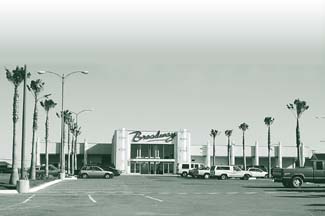
LANDSCAPING THE 100,000-SQUARE-FOOT
PARKING lot at the Broadway Cinema in Eureka posed a challenge
for co-owner David Phillips, but he met the match by turning
the black desert of asphalt into an oasis of palm trees. Phillips
chose palm trees because he wanted the landscape reflect a Hollywood-like
mirage.
"It's a movie theater and
we had to deal with the landscaping issues out there. We started
thinking `What is going to really say Movie Theater more
than anything?' And we thought palm trees would be good,"
he explained.
While palm trees seemed ideal
aesthetically, Phillips questioned whether or not these desert
trees would thrive in Eureka's foggy, wet climate.
 "At first I dismissed the idea, but then at
the same time I became aware, and suddenly I could see nothing
but palm trees growing in Humboldt County. There are gazillions
of palm trees that I had been utterly oblivious to, and it amazed
me. Then when I started looking them up and I realized that palm
trees do grow up here." "At first I dismissed the idea, but then at
the same time I became aware, and suddenly I could see nothing
but palm trees growing in Humboldt County. There are gazillions
of palm trees that I had been utterly oblivious to, and it amazed
me. Then when I started looking them up and I realized that palm
trees do grow up here."
While researching palm trees
in Humboldt County, Phillips discovered that the Canary Island
date palms, palms on the Arcata Plaza, at the Sequoia Park Zoo
and around old Victorian homes, are valuable trees. According
to Phillips, a large date palm adjacent to an apartment building
in Arcata was cut down because starlings inhabiting the canopy
were a nuisance.
"The response of the owner
of that particular apartment house was to chop that tree down,
and I think they really missed the boat because that tree was
worth about 5,000 bucks. There are people out there that would
kill to get a hold of a tree like that," he said.
Initially Phillips thought landscaping
with large palm trees would be cost prohibitive.
"During the process I dismissed
it as an impossibility economically. Then I ran across Bill Pierson
(owner, Pierson's Building Center) and he said, `Hey Dave, have
you ever considered palm trees over there?' and I said, `Yeah,
but it's never going to work. It's going to cost a gazillion.'
"Then he said he knew of
a broker where we could get the big guys, and it wouldn't cost
that much to get them," said Phillips. (He declined to reveal
the cost of the trees because he said he worked out special deal
with the broker, Neon Palm of Santa Rosa.)
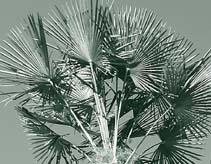
Phillips chose Mexican fan palm,
Washingtonia robusta, because its slender, skyrocketing growth
habit and small thatch canopy fit well into narrow median strips.
Although they will top 100 feet eventually, the palms will not
overpower the planting areas. There is also an overabundance
of them on palm farms right now which made the price more attractive,
Phillips said.
The palms at the Broadway Cinema
were grown on a farm in Southern California. According to Phillips,
farm-grown palms grow up to 4 feet a year under ideal circumstances.
Neon Palm delivered 30 bare-root trees, approximately 15-feet
tall on two semi-trucks. A third truck hauled the crane used
to install the trees. Prior to delivery Phillips had holes 3-feet
wide, 5-feet deep dug with an auger. Sand and topsoil were added
for backfill. The trees were delivered at 7 one morning and installed
by 4 the same afternoon.
Palm trees are practically maintenance
free. Phillips installed drip irrigation for each tree. In addition,
lighting at the the base of the trees will be added in the future
for effect.
"Eventually we will have
lights shining up at the trees so when the lights go on at night
the crowns will be lit up."
Landscaping the parking area
with palm trees accomplished more than adding beauty to a barren
area, Phillips learned. It enhanced the building's architecture,
a style Phillips calls nouveau deco.
"One of the things those
trees did to the facade is they added more than I ever imagined.
They brought a vertical element and they broke up the view and
interposed themselves more than I thought they would. It's almost
like they become an extension of the building itself, and they
become a very active part of the facade itself. I didn't expect
that to happen," he said.
Phillips plans to add more trees
in the future. A concrete triangular median strip that separates
the intersections of West Cedar, Albee Street and Broadway will
be landscaped with grass and palm trees.
"Caltrans and the city
(of Eureka) own this concrete triangle and it's a big, huge traffic
hazard. The city wants to give it to us. We want to take it and
expand our parking lot, and turn that into a little grassy area
and plant six more trees. It will be a nice bus stop and a place
for the bus to turn around," he said.
Public comments have been positive
for the most part, according to Phillips.
"Almost universally it
is really thought of well. I had a letter one of the City Council
people sent to me. It was a very brief letter that just said,
WOW!"
FEBRUARY CHECKLIST
- PLANT -- Fruit
trees, roses, berries, dianthus, gladiolus, lilies, pansies,
primroses, strawberries, artichokes, rhubarb, asparagus and cool
season vegetables can be planted this month if the weather is
dry. Sow sugar snap pea seeds for an early spring crop. If the
soil is workable, sow seeds of carrots, beets, onions and turnips.
Set out starts of broccoli, cabbage, cauliflower, salad greens,
lettuce and spinach toward the end of the month.
- PRUNE --
Finish pruning bush and tree roses along with cane berries, grapes
and blueberries. Prune after bloom is the rule of thumb with
deciduous flowering trees and shrubs. Remove spent blossoms on
camellias and early blooming rhododendrons.
- FERTILIZE --
Towards the end of the month fertilize asparagus, strawberries
and blueberries. Fertilize deciduous fruit trees 2 to 3 weeks
before bloom. Feed other mature trees and shrubs after spring
buds open.
- PATROL --
Watch out for slugs and snails. They will ruin spring flowering
bulbs in a jiffy. Deer will nibble on new growth, so cover susceptible
plants with netting, install a deer-proof fence, or get a big
dog.
|
Comments? E-mail the Journal: ncjour@northcoast.com
IN
THE NEWS | COVER STORY | ARTS ALIVE! | CALENDAR
© Copyright 2001, North Coast Journal,
Inc.
|