|
 
COVER
STORY | GARDEN | GOOD NEWS | CALENDAR | NEWS BRIEFS
Being there:
As war looms with Iraq, protestors
fill
the streets of San Francisco
Story & photos by ANDREW EDWARDS
In the midst of a march of thousands,
tens of thousands, their signs pumping up and down like pistons
in a massive anti-war machine, a daisy-chain of white prayer
flags flapped delicately in the breeze. At the poles were the
old, the young, the starry-eyed, the hard-bitten, veterans of
protests past, veterans of foreign wars, first-time protesters
(like myself), housewives, grandmothers, treesitters, everything
in between.
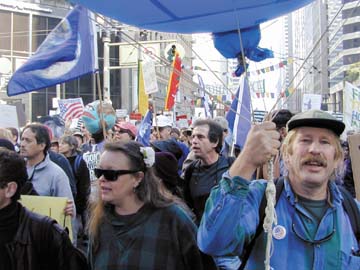
Farther down the seemingly endless
stream of marchers on San Francisco's Market Street, fed by tributaries
at every crossing, was Arcata City Councilman Dave Meserve, a
goofy grin peeking out from under his broom of a mustache. He
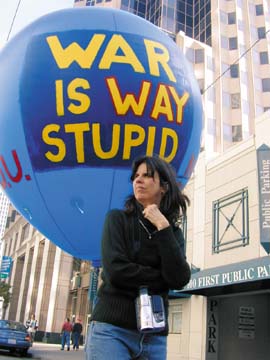
was holding down his 8-foot-wide balloon, its blue skin boldly
declaring that "War is Way Stupid." Behind him, framed
by glinting skyscrapers on either side, a banner proclaimed "So-Hum
for Peace." [in photo
below left]
 After
a long drive down, the Humboldt contingent was in action, at
the A.N.S.W.E.R. (Act Now to Stop War and End Racism)-organized
march on the Civic Center and City Hall this past Saturday. After
a long drive down, the Humboldt contingent was in action, at
the A.N.S.W.E.R. (Act Now to Stop War and End Racism)-organized
march on the Civic Center and City Hall this past Saturday.
For 70 of us it had begun the
afternoon before at the Arcata Co-op.
Mary Ann Lyons [in photo below right, near blue balloon], a longtime activist and the organizer of the
trip, was busy signing people up and taking fares ($25 for a
round-trip). Two buses, one gray, one yellow, stood ready, the
words "Sustainable Communities Bio-Diesel Road Show"
painted on their sides. Running on a cocktail of French-fry grease,
methanol and diesel, these "wheels" -- provided by
the Redwood Peace and Justice Center -- transport Humboldt activists
to a variety of events.
Eventually all the details were
taken care of and we were off, the buses each roaring a grinding
shimmy as they chugged into gear.
Before we even got out of town
brown meaty loaves from the Co-op bakery were passed around.
We ate sprawled on the pads and sleeping bags strewn across the
raised plywood platforms that covered the back two-thirds of
the bus, smiles spreading.
 As
we headed south twilight fell and then a full moon came up, its
reflection visible on the Eel River. Later, skeletal branches
of passing trees were bathed in the moon's ghostly silver light
as the bus wound farther down Highway 101. As
we headed south twilight fell and then a full moon came up, its
reflection visible on the Eel River. Later, skeletal branches
of passing trees were bathed in the moon's ghostly silver light
as the bus wound farther down Highway 101.
In the seats up front it was
forest-name central: Bee, Dragon, River and Sequoia, who had
just been pulled down from his tree-sit in the "Demon"
or demonstration forest, the day before. They talked of the forest
and their intimate connection with the trees, but they also discussed
the upcoming rally.
Tigress Bergman, 15, of Arcata,
a three-month veteran treesitter, explained "the hundredth
monkey theory." She said that at some point ideas reach
a critical mass and jump, exploding like wildfire, and become
unstoppable. One person can make a difference, she said, because
maybe they will be the person -- the hundredth monkey -- that
sends it to the next level. It was a hopeful thought.
Around 11 p.m. our caravan arrived
at the Berkeley Unitarian Universalist Fellowship. Our host was
Hal Carlstad, a long time activist who had been arrested more
than 170 times, by his own account, including four or five times
in Humboldt County. This was our lodging for the night.
The next morning we left around
8:30, excitement building.
"You guys are making history
today," Hal said as we were packing up. In the church, beforehand,
several activists discussed a "direct action" march
which was to take place after the official march was over: still
nonviolent but more confrontational -- and illegal.
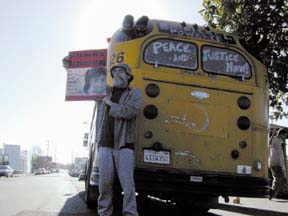 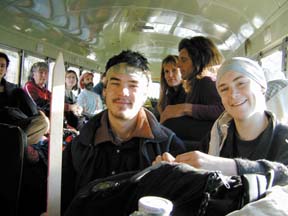
Left: Dave Short in front
of the "Sustainable Communities Biodiesel Roadshow"
bus, near the Arcata Co-op.
Top right: Sequoia and Dragon on the bus, heading to the march
Saturday morning.
In San Francisco we unloaded
at the Golden Gate University Law School, a block from Market,
the designated meeting spot for the Humboldt marchers.
Immediately things started happening.
Signs were waved, drums were beaten. Cars, ranging from taxicabs
to black Mercedes, honked as they passed. Some passengers yelled,
hanging out windows and flashing peace signs.
People came in from all sides;
soon more Humboldt activists were on hand as a bus that had left
Garberville early that morning arrived.
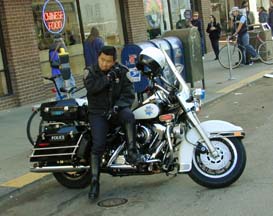
Some motorcycle cops pulled
up and told everyone to stay on the curb. I asked one of them,
Officer R. Vargas according to his badge, if he expected a busy
day.
"Not really," he said,
eyes covered by black sunglasses. "The last one [in October]
was very uneventful. All we're here to do is make sure everyone
gets from the Embarcadero to the Civic Center without getting
hurt or without any incident. We expect it to be about the same."
And with that he roared away.
Finally, 11 o'clock rolled around,
the official march start time, and we were off, moving down the
sidewalk.
Market Street was already choked
with people. Music blared. Cheers rolled, crescendoing from one
end of the street to the other like a gigantic vocal version
of the wave. Marchers with bullhorns led people around in chants.
So many were joining that the march stopped for nearly 20 minutes,
stalled in the rush.
The crowd was huge and mixed,
a melange of faces, colors, signs and slogans. Black, white,
Hispanic, gay, straight, in business suits, in black leather
studded with spikes. It seemed like everyone was there. A man
with a sign proclaiming he was a member of "People with
portfolios against a war with Iraq" marched next to the
very elderly members of the Lincoln Brigade, volunteers who had
fought against Franco in the Spanish Civil War of the 1930s.
"These men are very important,"
a woman who was taking their picture frantically explained to
me. "They were the first ones to fight against fascism."
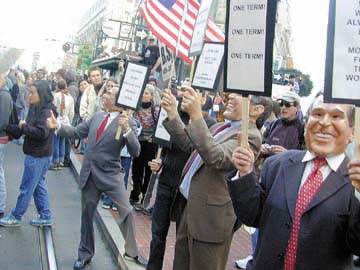 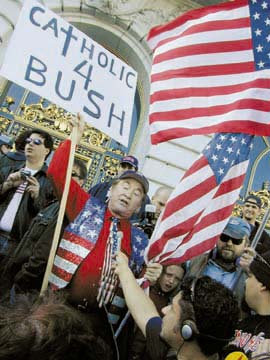
LEFT: The "Bushies" RIGHT: A representative
of "Catholics for Bush" is interviewed.
A troupe of Native American
dancers paraded in full regalia in front of masked marchers carrying
a sign bearing anarchy symbols that declared "No War but
Class War."
I saw a dark-faced man from
India, wearing embroidered gray robes and matching hat, holding
a glinting cherry-red origami crane over his head. Behind him
a girl in a black turtleneck with the neck pulled up over her
nose was handing out leaflets. A young woman from A.N.S.W.E.R.,
her head draped in a kaffiyeh, harangued the passing crowd, urging
them to donate.
As we rounded the corner to
the bus-lined Civic Center plaza in front of City Hall, the speakers'
stage and the square around it were already packed with people.
Behind the stage, which looked
out over a crowd stretching as far as the eye could see, journalists,
celebrity speakers and volunteers engaged in a chaotic round
of questions and answers.
A handler grabbed me and dragged
me to the vice president of the Sierra Club, Larry Fahn.
"War is the ultimate environmental
atrocity," Fahn said, dressed in a red flannel shirt that
looked self-consciously rustic. "We're not massing ships
and planes off Korea, because [this war] is about oil. We should
talk about a renewable energy future if we want real national
security."
In the background sang Joan
Baez, who performed at the 1963 "March on Washington,"
the gold standard of protest events.
One of the rally organizers,
a Palestinian-American and San Francisco native named Jess Ghannam,
talked to me about why he had gotten involved.
"Palestinians are subject
to a colonizing power, Israel," he said. "The U.S.
is getting prepared to act in the same way in Iraq."
He said twice as many people
were at this rally compared to the one in the fall. The actual
number was hard to guess. The official police estimate was 50,000,
while the organizers estimated up to 200,000. Whatever the number,
it was huge.
"I'm really surprised it
has come this far without a hitch," Ghannam remarked.
Longtime hippie activist Wavy
Gravy was speaking to a group of reporters as I passed
by.
"The last time we listened
to a Bush we spent how many years in the desert?" he asked,
his large face crinkled up in a smile. "Let's face it, we've
been Bush-whacked."
I climbed on stage to get a
picture of the crowd as Bonnie Raitt took the stage.
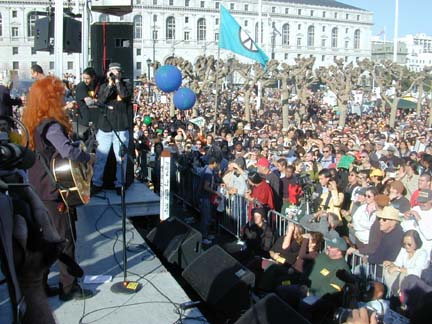
As she sang a Jackson Browne
song, repeating, "The world is long on hunger, short on
joy," leaning back into each chord she played on her acoustic
guitar, the crowd swayed back and forth in the sunlight. It was
clearly an emotional peak.
Other speakers took the stage,
including California Congresswoman Barbara Lee, the only member
of Congress to vote in 2001 against handing George W. Bush what
amounted to unchecked authority to conduct the war on terrorism.
Martin Sheen also spoke, doing President Josiah Bartlet so thoroughly
that afterwards he plunged into the crowd and started kissing
babies.
As the rally wound down, a young
crowd dressed in black began to form in one corner of the plaza.
As I walked by, I ran into a Humboldt activist who hadn't come
down with the bus.
It was Julie Ryan, a "bad-ass
feminist old school punk," clad head to toe in black. She
explained that this was the direct action protest I had heard
about earlier.
Behind us some young punks in
black masks and pink mohawks were starting to burn flags, drenching
them in hair spray and then torching them with lighters. Several
spat on the flags as they were melting on the concrete.
A leader, dressed in black from
head to foot, urged the crowd to follow either a green or red
banner, for tactical reasons. This was the real people's march,
he declared, they didn't need a $50,000 permit (like the one
A.N.S.W.E.R. had received for the main march) to take to the
streets.
"Whose streets? Our
streets!"
"One, two, three, four,
we don't want your fucking war!"
"Two, four, six, eight,
fuck the police state!"
"No justice! No peace!
Take it back to the streets!"
"What do we want? Class
war! When do we want it? Now!"
The renegade march rolled back
up Market, the same street the main march had taken hours earlier.
By now it was around 4 p.m. and the streets were pretty much
empty.
Music blared -- dub reggae and
punk rock -- from a shopping cart stuffed with a generator and
massive speakers draped in protest flags.
After a couple of blocks they
turned off Market and walked directly into traffic, past dazed
commuters, some of whom cheered them on.
By now the marchers were turning
into vandals, breaking windows, tipping over newspaper stands
and dragging them out into the street, spray-painting a parked
car. A yell went up: "Only targets!"
 The
targets were, according to one leader named Marco, the San
Francisco Chronicle, the Citibank building and the INS, but
other targets were decided upon and attacked along the way: Starbucks,
Wells Fargo, the International Bank. The
targets were, according to one leader named Marco, the San
Francisco Chronicle, the Citibank building and the INS, but
other targets were decided upon and attacked along the way: Starbucks,
Wells Fargo, the International Bank.
All the while the police presence
grew, but the officers stood back, slowly but steadily growing
in number, biding their time.
Finally, it happened. Plain
clothes officers jumped a rowdy who was trying to kick in the
window of Victoria's Secret. The crowd tried to rally to him
only to be cut off by horse officers. Panic set in and people
turned around and ran. The crowd dissipated.
I walked back to the buses,
my skin jumping with the excitement.
Lyons was waiting there, at
the buses with most of the passengers, some of whom were sitting
in circles on the concrete, smoking.
"That approach doesn't
produce change, it creates resistance," she said when I
told her about what had just happened. "It comes out of
frustration with the inability to communicate. If you can communicate,
you don't have to resort to violence."
We all got on the buses, just
as the sun was setting. We were bedraggled, tired, happy to have
been there, and excited to have seen all of those people in one
place for one purpose.
Some of the people on the bus
estimated that about 300 people had made it down from Humboldt
County to the protest.
I couldn't tell. I couldn't
think. My feet hurt. It had been a hell of a day.
Postcard
from Berlin:
These days, it's not easy being an American in Germany
by ARNO
HOLSCHUH
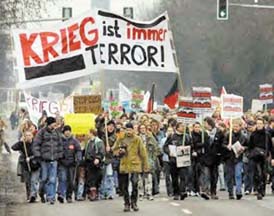
(photo of marchers in
Heidelberg courtesy of indymedia.de)
 Sitting
at my desk at the window of my apartment, I can see it all too
clearly: A large homemade banner hanging from the window across
the plaza proclaims "NO to the aggression of the USA!"
I'd like to think that the sign's authors don't hold a grudge
against me; after all, I'm not a big Bush fan myself. But I have
my doubts. Sitting
at my desk at the window of my apartment, I can see it all too
clearly: A large homemade banner hanging from the window across
the plaza proclaims "NO to the aggression of the USA!"
I'd like to think that the sign's authors don't hold a grudge
against me; after all, I'm not a big Bush fan myself. But I have
my doubts.
Welcome to Berlin in January
2003, home to Europe's most vocal critics of the war in Iraq.
As the drums beat louder in my home country, many people in Germany
are becoming increasingly critical of all things American. If
they're talking about my president, I can understand and agree.
But when they have a beef with me personally, that gets sticky.
And many do.
Everywhere I go, I am seen as
a walking, talking symbol of my country. I am constantly asked
questions which I cannot possibly answer. The young man at a
party asks me over the loud techno music: "Why are you attacking
Iraq instead of focusing on Israel and the Palestinians?"
At the grocery store, someone notices my accent and asks: "Don't
you worry about the consequences for the region?"
Answering is difficult, because
I know where these questions are coming from. I oppose our current
war plans. I know there are serious and intelligent people who
believe that war is necessary, but they have yet to convince
me. I think the Palestinians are being mistreated and peace is
impossible until that changes. I worry that the fledgling democratic
movement in Iran might be trampled underfoot in the wake of an
American-led attack on Iraq. Basically, I am a typical bleeding-heart
liberal when it comes to foreign affairs -- or better put, I'm
a German.
Because Germans hate the idea
of a war. Opinion polls put the anti-war sentiment at over 80
percent, and chancellor Gerhard Schröder won the election
last fall by spouting strident anti-war rhetoric. Why? It's not
cowardice as such; after all, Germany has more troops in peace-keeping
missions abroad than any other country besides the U.S.
To put it very simply, people
here have a very different understanding of what war can cost
than we do. That's not necessarily bad, in my view; Germans understand
war's ravages because they brought them upon themselves in two
world wars. Americans should be proud that our country was never
that ruthless, murderous or insane.
But consider this: If America
was "at war" in the same way that Germans understand
the phrase, it wouldn't just be the WTC that was reduced to rubble.
It would be most of Manhattan, and the rest of our major cities
as well. The largest cities in Germany were more than 80 percent
destroyed by Allied bombing. Major government buildings in Berlin
are still pockmarked from bullets by Soviet soldiers 58 years
ago. Very few people here are angry about that; this is a country
that has by and large been forced to face its past and accept
its guilt. But people are conscious of what bombs and house-to-house
fighting are like, and they are reluctant to visit that hell
on anyone. They cannot understand why we are so eager to do so.
It is this "we" that
bugs me the most. I write columns for a newspaper here in which
I try to get Germans to differentiate between different types
of Americans, or better yet, see us as individuals. Some Americans,
myself for example, speak German. Many more speak Spanish. More
of us voted for Gore than for Bush, and in my view it was largely
after the shock of Sept. 11 that we rallied behind the "Cowboy
from Texas," as Bush is sometimes called here. And when
you explain that to a Berliner, they generally nod in understanding.
Then they'll ask: What about
those Republicans? You can hear that they're just dying for me
to pin the blame on someone. This is the hardest part -- getting
the message across to Germans that Republicans are among the
nicest people you will ever meet. Working as a reporter for two
years in Humboldt taught me this much: You can disagree with
every political position a person has and still enjoy his or
her jokes. Most people here just don't get it; they've never
hitchhiked Highway 299 to Redding, so there's no way they can
know that only right-wingers in pickup trucks are nice enough
to give you a ride.
Of course, not everyone immediately
equates my American accent -- which Germans say sounds like I'm
trying to speak with potatoes in my mouth -- with the Bush administration.
This is an incredible city, and you can find critical thinking
in the most unexpected of places. In Café Zapata, a bar
with brick walls and a left-wing clientele, I was approached
by a scruffy young man who had obviously had one too many Becks.
"Hello. You are American?"
he asked in a slurring German.
"Yes, why?"
"Because I have to tell
you something. I love America. I love Americans. You saved Berlin
from the communists. I hope you have a wonderful time in Berlin
and are happy here."
"Thank you!" I said.
It was not what I had expected.
"But there is one thing,"
he added, fingering his bottom lip and staring at the cigarette
butts littering the floor.
"Yes?"
"I hate your government."
I could only agree.
Arno Holschuh is a former
Journal staff writer.
Back to NEWS
BRIEFS
COVER
STORY | GARDEN | GOOD NEWS | CALENDAR | NEWS BRIEFS
Comments? E-mail the Journal: ncjour@northcoast.com
© Copyright 2003, North Coast Journal,
Inc.
|