 
COVER
STORY | IN THE NEWS | ARTBEAT | FOOD | THE HUM | CALENDAR
January 12, 2006

TICKERTAPE: Fifty-seven-year-old Southern
Humboldt resident David Witherspoon -- known universally as "Daveau"
-- was killed in a head-on automobile accident near Benbow Saturday
morning, after Jedediah Perlmutter, 29, of Arcata, allegedly
lost control of his vehicle, crossing over Highway 101 into oncoming
traffic. Perlmutter was arrested on suspicion of manslaughter.
(Read more about Witherspoon in this week's The
Hum.)
Bindu Lang, a 25-year-old Arcata resident, was
given 27-to-life for sexual assaults committed against two girls,
aged 12 and 14, in 2004, according to a press release issued
by the Humboldt County District Attorney's Office. Lang was convicted
of the crimes earlier in the year.
The Eureka Police Department reported that a group
of 10 Asian males wreaked havoc at the Bayshore Mall Friday night,
attempting to pick a fight with a family of four inside Borders
Books before latching on to several juveniles inside Gottschalks.
The suspects allegedly followed this group of victims out to
the mall's parking lot, where they set upon the victims with
a hammer and pepper spray. Three of the suspects were arrested.
On a 3-2 vote, the City of Arcata last week passed
a resolution calling on Congress to impeach President George
W. Bush, with all the predictable results. The right-wing blogosphere
howled and screeched; the left-wing blogosphere wept tears of
joy.
YEE-HA! A QUEER MOVIE PREMIER: It was 10:30
a.m. on a humid and, at times, rainy Saturday. A line of folks,
mostly queer folks, wanting to see Brokeback Mountain
snaked from the ticket counter past the theater and down 10th
Street. Some wore cowboy boots and hats; one couple and a nearby
lesbian cursed their lackluster domestic partner benefits; and
multi-issue activist Fhyre Phoenix cased the cue with a petition
to keep non-local corporations from meddling in local campaigns.
In other words, it was the gayest movie premier of the year!
When the film finally began, nearly every lumpy old brokeback
seat in the Minor Theatre was spoken for.
The award-nominated, R-rated, gay cowboy romance
(sorry,Charlie -- see Filmland, Jan. 12, 2006 print edition)
was welcomed warmly here and has been lauded nationally, though
it has also spurred homophobic criticisms and was banned Friday
at a Utah megaplex. Brokeback Mountain stars Heath
Ledger and Jake Gyllenhaal as Wyoming sheepherders who fall in
love in 1963 and with the words "You know I ain't queer"
and "Me neither" commence a sporadic, 20-year affair
that remains torturously secret and star-crossed. (Ever noticed
that the only gay-themed films that receive any Oscars have really
tragic endings?: Monster, Boys Don't Cry, Philadelphia, Kiss
of the Spider Woman. What the heck?) Queer Humboldt, the
county's online LGBT resource and soon-to-be nonprofit, organized
the morning premier and collected a portion of ticket sales to
fund the Gay Pride Parade and Bingo with a Twist. Coordinator
Todd Larsen said he was happily surprised by Saturday's huge
turnout: "I'm overwhelmed," he said.
POMBO MAMBO: With some fancy investigative
footwork, Los Angeles Times writers Richard A. Serrano
and Stephen Braun have obtained documents that show how former
House Majority Leader Tom DeLay and Reps. John Doolittle and
Richard Pombo, both of California, actively tried to stop the
FDIC's investigation into Maxxam owner Charles Hurwitz's role
in the case of his collapsed Texas savings and loan. In their
Jan. 8 article, the Times writers compare the Hurwitz
case to the Jack Abramoff scandal: "... members of Congress
using their offices to do favors for a politically well-connected
individual who, in turn, supplies them with campaign funds."
But, they add, while such favors are common, "... it is
unusual for members of Congress to take direct steps to stymie
an ongoing investigation by an agency such as the FDIC."
Which is what Pombo, DeLay and Doolittle did. In
1999, DeLay wrote to the chairman of the FDIC to decry its investigation.
Then, Doolittle and Pombo, using "their power as members
of the House Resources Committee," subpoenaed sensitive
records from the FDIC, which included evidence the commission
had gathered in its case against Hurwitz. The FDIC begged that
such information not be made public.
Doolittle and Pombo spun around and, in 2001 (shortly
after the Sept. 11 attacks that had everyone distracted, as was
noted at the time in the Sacramento Bee), they put some
of the sensitive documents into the Congressional Record -- which
meant Hurwitz' lawyers could see them.
The FDIC, note the Times writers, called
this a "seamy abuse of the legislative process." The
FDIC dropped its case in 2002. Still, Hurwitz fired back with
a lawsuit, accusing the FDIC of attempting to press him into
selling some of his redwood forests to ameliorate his S&L
fiasco. Last summer a Texas judge ruled in favor of Hurwitz;
the FDIC is appealing.
The Times article notes various contributions
made by Hurwitz to DeLay, Pombo and Doolittle, and also notes
that Pombo and Doolittle had to pay about $20,000 from their
congressional accounts to put the subpoenaed sensitive documents
into the Congressional record.
On Jan. 10, in the Central Valley publication The
Record, Pombo danced back with a pugilistic response: "They
[regulators] were guilty of conspiracy," the Record
quoted him as saying. "'They were guilty of extortion. If
I ever run across another case like this I wouldn't hesitate
to do it again.'"
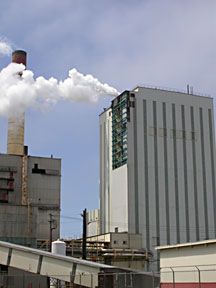
PULP MILL SUIT: On Jan. 2, Californians
for Alternatives to Toxics and the Environmental Protection Information
Center filed a federal suit against Evergreen Pulp, Inc, accusing
the mill of "significant and ongoing violations" of
its federal air quality permit. The groups note that Evergreen
has admitted, in documents filed with the North Coast Unified
Air Quality Management District for variance requests, that it
has exceeded emissions limits on occasion.
In a news release, CATS spokesperson Patty Clary
said Evergreen "could simply install equipment that's able
to keep its toxic waste out of the air." Evergreen, in its
numerous bids for different variances, has detailed its efforts
to do just that, saying that it just needs more time. The mill's
owner has been reluctant to shut down, in the meantime, to avoid
excess emissions, citing a desire to keep its workers employed.
Yet another variance hearing -- on the mill's lime kiln -- is
set for 9:30 a.m. Jan. 20 at the Eureka City Council Chambers
before the air quality board.
The environmental groups, however, are tired of
variance requests. "It was necessary to take this step because
compliance was not forthcoming," said EPIC's Larry Evans.
Left: Evergreen Pulp Mill. Photo by Heidi Walters.
POST-STORM PROPERTY DAMAGE: The Humboldt
County Assessor's Office announced Friday that area residents
with property damage exceeding $10,000 are eligible to have their
property value reassessed. Applications must be filed within
12 months of the damage, but taxpayers are urged to file ASAP.
Assessor Linda Hill said the property will be inspected and the
reappraisal will be based on the amount of damage and how long
the property is damaged. Forms are available at the Assessor's
Office 825 5th St., room 300, Eureka. 445-7663 or (866) 240-0485.
TOP
Former nuke sirens to pull tsunami duty
by HEIDI WALTERS
 Right:
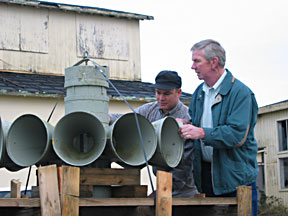
Troy Nicolini and Jimmy Smith. Right:
Troy Nicolini and Jimmy Smith.
Photo courtesy Nancy Dean, National Weather Service.
Thirty-two giant lilies-on-steroids-like alarms
lie dormant inside a rain-lashed, fog-wrapped, occasionally sun-struck
warehouse behind the Samoa Cookhouse on the peninsula. But sometime
in the near(ish) future, they'll be employed as tsunami sirens
for Humboldt, Del Norte and Mendocino counties.
Which is all good and well -- stupendous -- as
long as the power doesn't go out at the same time we have that
tsunami. See, the sirens -- and we're supposed to get 50 in all
-- won't work if the power goes out, which is why they've been
retired from their long, uneventful duty as San Luis Obispo County's
early warning system for the Diablo Canyon Nuclear Power Plant.
"We're replacing all 131 of our sirens down
here with battery backup ones," says Sharon Gavin, a Pacific
Gas & Electric spokesperson in San Luis Obispo. PG&E
runs the 20-year-old nuke plant and installed the early warning
system.
For 20 years the sirens -- each a four-foot-by-four-foot
wide and three-foot high array of fluted horns -- stood guard
on poles throughout SLO County, ready to blare the alarm in the
event of a leak or nuclear meltdown at the nuke plant. Upon hearing
the alarm, residents are not supposed to just scramble as far
away from SLO as they can get, because they'd just get in a traffic
jam, but instead tune in their radio or TV to receive instructions.
That never happened. And so, other than annual
tests that provoke the sirens into two mournful rise-and-fall
wails, and quarterly low-volume "growl" tests, the
sirens have just been silently gathering lichen. But in 2003,
when a deadly earthquake shook SLO County, crumbling buildings,
downing power lines and killing people, PG&E discovered that
the sirens don't work when the power's out. Not good. Hence the
new ones, with battery backup power.
Recently, PG&E put out the word that the "perfectly
good" (as Gavin puts it) old ones were going cheap -- er,
for free, including shipping. Up here on the North Coast, that
smelled like an opportunity to the National Weather Service's
Troy Nicolini, the Humboldt County Office of Emergency Services,
Humboldt County Supervisor Jimmy Smith and others. They said
ship 'em up and the Humboldt Bay Harbor, Recreation and Conservation
District would store them. They're not worried that the sirens
don't work without electrical power.
"I really don't think they'll be used for
anything else" other than a tsunami, says Nicolini.
Tsunami expert Lori Dengler, of HSU, says the sirens
are "wonderful" in many ways, not least of which is
that they get people talking about disaster -- disaster preparedness,
that is. She adds that education on what to do in the event of
a tsunami will determine who survives, not just sirens. "I
have students who think Arcata's [fire] siren is our tsunami
warning bell. But Arcata's lunchbell has nothing to do with tsunamis."
Dengler says the donated nuke sirens will be good
for when there's a distant earthquake that triggers a tsunami
on this coast, like a 1964 earthquake off the coast of Alaska,
which triggered the deadly tsunami that wiped out part of Crescent
City and killed a number of people. "It took about four
and a half hours for the tsunami to travel here," she says.
"Tsunamis travel about the speed of an airliner, so around
500 miles per hour in deep water. It's nine hours to Japan from
here; it's 14 hours to Chile." After that quake, Crescent
City acquired a siren.
So, in the event of a distant quake, North Coasters
-- given adequate warning -- would have plenty of time to get
to high ground. And nearly everyone agrees that the likelihood
of the power being out here on the North Coast at the same time
as a distant-quake-triggered tsunami is slimmer than the very,
very, very slim chance of a tsunami itself.
"But the sirens would not be particularly
useful for a Cascadia earthquake, right here," says Dengler.
That's because there wouldn't be time to sound the alarm, even
if it did still work, she says. Unlike a nuclear power plant
leak, where the wind direction at the time would determine who
flees and who just tapes up the windows, a near-quake, fast-arriving
tsunami dictates two responses that Dengler wishes everyone had
imprinted on their brains: High grounders, sit tight; low-grounders,
know your evacuation route and get to high ground immediately.
There's lots of work to do before the sirens can
be installed. And there's other protocol to sort out. "They're
going to have to figure out what is the chain of command for
triggering the alarm," Dengler says. "On June 15 [when
we had a tsunami warning], the Crescent City fire chief and the
Del Norte Office of Emergency Services officer were both on vacation.
And there was actually a bit of confusion as to who had the authority
to push the button. Finally I think somebody in the Sheriff's
office did it."
Nicolini says locations for sirens likely will
be Orick, Trinidad, Samoa Peninsula (probably it'll get three),
Woodley Island (one or two), King Salmon, Fields Landing and
Shelter Cove.
"They're going to trickle up," he says,
adding that Orick may be among the first locations to get a siren
because it's been busy preparing for an emergency. "Orick
is all positioned: They've got a crane ready, they've got a site,
they've got a pole already in position, they've got a shop for
repairs. Orick is just really a pro-active community."
Smith says he'd like to see the first one go up
in King Salmon. He lives there, but it's also undeniably a community-at-risk,
low-lying and prone to flooding in storms.
Meanwhile, back in SLO County, residents exhibit
mixed feelings about their new-fangled battery backup sirens.
Heck, there were mixed feelings about the old sirens, and nuclear
power in general. City of San Luis Obispo Mayor Dave Romero has
utmost confidence in the sirens. He says, besides, that he doesn't
"have any problems with the power plant nearby. I don't
have the fear some people have," he says. "There are
fewer negatives with nuclear power than other kinds of power."
He adds that the only limitation to nuclear power, really, is
a philosophical one: What to do with the waste? He thinks it
should go to Yucca Mountain, in Nevada, where "they've spent
billions preparing a place for it." But other folks think
it should stay on site in storage casks.
On the other hand, Jane Swanson of Mothers for
Peace, a SLO activist group, has been protesting the Diablo Canyon
nuclear power plant since before it was built, 20 years ago.
When Mothers for Peace heard PG&E was installing battery
backups for the sirens, it and a host of national groups shot
off a letter to the Nuclear Regulatory Commission demanding that
PG&E be required to go one step further and put in solar-powered
backups. "If you have battery-powered sirens" and an
earthquake knocks out the power, "the batteries only last
three days," Swanson says. "And there could be an aftershock
five days later." But the NRC only requires the regular
battery backups.
As for our getting the old, grid-dependent sirens,
she says, "I'm actually shocked out of my mind. You deserve
better."
Well, but these ones are free.
TOP
COVER
STORY | IN THE NEWS | ARTBEAT | FOOD | THE HUM | CALENDAR
Comments? Write
a letter!
© Copyright 2006, North Coast Journal,
Inc.
|