|

COVER STORY | IN
THE NEWS | OFF
THE PAVEMENT | ARTBEAT
TALK OF THE
TABLE | THE HUM | CALENDAR
December 7, 2006

Beyond the Super Burrito, Part II
by JOSEPH
BYRD
In a previous column, I
praised the indigenous foods of Mexico, noting that our Mexican-American
food is essentially "cowboy" food ("Ranchero")
and bar snacks (tapas). I also noted that they have become an
essential and welcome part of our own national cuisine. Still,
I'm dismayed by indignities such as "super burritos,"
"Mexican pizza," "chimichangas" and "taco
salad" (a commercially distributed extruded corn bowl into
which are plopped iceberg lettuce and various ingredients unrelated
to any known ethnicity). These low-labor/high-profit dishes account
for a large portion of sales, and that popularity may account
for the mediocrity that continues to bedevil most Mexic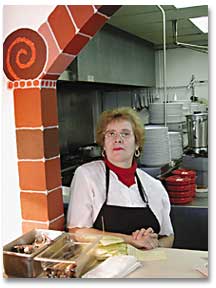 an
restaurants. an
restaurants.
However, as I indicated previously, things have
gotten better, and that's the direction I want to explore here.
For many years, long before we arrived in Humboldt
County, Mexican restaurants were dominated by one family. There
was no genuine competition, and thus no reason for improvement,
although I had on one occasion an excellent mole negro
at their place in Eureka. In those days of the late 1980s, most
Mexican restaurants did not serve liquor; consequently, the one
restaurant that did (it was not owned by the family) was hugely
popular. Evidently, a pitcher of margaritas can make up for a
lot of awful cooking. And since that restaurant was full nightly,
it became a self-fulfilling situation: If the locals don't care
about quality or variety, why knock yourself out?
Right: Rita Pimental of Rita's Cafe and Taqueria
The change came in the 1988 when Rita Pimentel
opened her tiny place on Wabash Avenue, cooking by herself, but
projecting from the kitchen both charm and a flair for delicious
tapas. True, the variety was nothing to get excited about, but
this was a taqueria, not a restaurant, and the food was excellent.
Rita's became first an underground legend, then something everyone
knew about, and suddenly it was jammed every day for lunch and
dinner.
Two years passed, and inevitably Rita was pressed
to expand. With her husband Elias in the role of "patrón,"
she moved to a large two-story building at the corner of 2nd
and C in Eureka, a former Italian restaurant she renamed Chapala.
The dining room was vast, with an entire banquet area upstairs.
The Pimentels were ambitious, investing in a new kitchen, commissioning
a mural and advertising.
Chapala had a much larger menu (though Rita
was burning her candle at both ends, doing everything). There
was birria (pot roast), barbacoa (in Mexico, barbecued
beef cheeks, but in the U.S., usually oven-braised chuck) and
whole chiles relleños. And there was Rita's simple
but masterful salsa, made with lots of garlic and charred chiles
Japones.
But the "clean up Old Town campaign"
had not yet taken off, and the streets nearby were littered,
the storefronts dingy, with prostitutes trolling in front of
her entrance and homeless men drifting back and forth. It was
only a block away from Roy's Club, but people were wary. Business
was up for a while, then fell back. Eventually she sold it to
one of her employees at a loss. And after a two-year sabbatical,
she bought up the lease on the old Wabash building. Foodies rejoiced:
Rita was back home.
Even as she retreated from the extensive Chapala
menu with its antojitos and specialty dinners, however,
Rita was planning a new, spiffy place, customized to her specifications.
This time she accepted the common wisdom, and found a good location
on Harris just beyond the mall, and there she created her new
restaurant, Rita's, to fit what she had learned about
gringo tastes in Humboldt. In short, she pulled back to what
was guaranteed to be accepted -- tacos, enchiladas, chiles
relleños and the ubiquitous chimichanga and "taco
salad." I may not like all these things, but I'm not going
to preach to someone who has found them successful, especially
when there are attractive alternatives. And Rita has become
successful -- so much that a new Fourth Street location is opening
shortly.
Rita is, at least for me, the mother of Mexican
food in the county. While she did not change the tapatia
culture, she brought her own home-cooking skills to it. Her tacos
today -- made with tiny commercial tortillas -- are intense and
flavorful, particularly the adobada, chorizo, barbacoa
and chicken tinga; her chiles relleños (the
very mild, but easily prepared Anaheim variety) are far superior
to the canned Ortega chiles many restaurants use. At its best,
her hot salsa is unequaled (this is something she makes every
day or two, so each batch is a little different; it should not
be confused with Rita's commercial salsa, which is less distinguished).
Around the time Chapala failed, another Eureka
restaurant attempted traditional tapas. Leillia Guerrero (Rita's
cousin) took over the little place across the street from the
Eureka Theater, calling it Don Juan's. A scant block from
the Eureka Inn and the museum, it is a location that has baffled
restaurateurs for years. Leila made the best tacos I've tasted
in Humboldt County, full of flavor and variety: cabeza
(beef head; no, it's not gross, just a very tender, flavorful
meat), lengua (tongue) and al pastór (lamb);
and, amazingly, she made her own carnitas -- true carnitas,
not the dry, baked stuff that is the product of political correctitude,
but pork slow-cooked in lard until tender and caramelized around
the edges (I'm told it is available on weekends at El Pueblo
Market). She did everything but make tortillas. Didn't matter:
The restaurant survived just a year.
This is The Big Test for a Humboldt restaurant.
You should have all the following:
1) A good location on a main street, with easy
parking;
2) A menu that has all the same stuff the other
places have;
3) No food that seems too unusual or overly ethnic;
4) Promotion: print ads, radio/TV spots, or a commercial
product line;
5) Capital to withstand a year until the public
"discovers" you.
Absent at least three of these, no matter the quality
of your cooking, you will fail.
Shortly after Chapala and Don Juan's closed in
1997, Pachanga opened on Fifth Street in Eureka, the creation
of Belim Espitia, her husband Garry and her extended family transplanted
from south Texas. It had a big, open kitchen, featuring a big
"comal," on which Belim's mother cooked flour tortillas.
They made everything from scratch. It quickly became a community
favorite, despite their eccentric and offbeat versions of traditional
dishes. Sometimes this works very well: Their Charros
("cowboy" beans) are utterly addictive. In addition,
they have eschewed the insipid "mild salsa" so common
elsewhere (basically stewed tomatoes with onion and mild green
chile), instead serving an imaginative repollo encutido
(pickled cabbage). It is the only place I've found chile con
queso. They cook with integrity and sincerity.
Throughout the early '90s, there was a brilliant
young cook, working anonymously in different restaurants, many
of which she made briefly successful with her Jalisco-based family
recipes, her dedication to quality ingredients and her intensive
labor. Her name was Maria Carmela Sandoval, and when a so-so
tiny steakhouse and bar became available on Fifth Street in Eureka,
she turned it into Carmela's.
Adding a larger location in McKinleyville, Carmela's
nearly doubled the local Mexican repertoire, with such dishes
as bollitos (deep-fried masa dumplings filled with chorizo
and potato), gorditas (meat-stuffed cornmeal buns) and
guaraches (sandal-shaped masa cakes covered with grilled
nopales -- cactus -- frijoles, and queso fresco). Her
chiles relleños feature traditional (but labor-intensive)
Poblano chiles, with Loleta cheese, topped with rich, homey tomato
sauce; her mole poblano is deep and complex, tamales are
large and bursting with spicy beef; and ceviche is chunky
and immaculately fresh. She buys local produce. In short, she
makes exquisite food. And corn tortillas, while not hand-patted,
are individually pressed every day, not assembly-line or commercial.
Yeah, if you are determined to undermine even this
creative chef, you can order taco salad, and the monstrosity
called a "Taco Supremo." But there is in many dishes
a direct line back to the regional cooking of Carmela's childhood.
My tastes, of course, are not everyone's. Those
who have discovered great food elsewhere are encouraged to e-mail
me c/o the Journal. New treasures may be just around the
bend. There is never too much information.

your
Talk of the Table comments, recipes and ideas to Bob Doran.
COVER STORY | IN
THE NEWS | OFF
THE PAVEMENT | ARTBEAT
TALK OF THE
TABLE | THE HUM | CALENDAR
Comments? Write a
letter!
© Copyright 2006, North Coast Journal,
Inc.
|