|

COVER STORY | IN THE NEWS | OFF THE PAVEMENT |
BOOK NOTES
TALK OF THE
TABLE | THE HUM | CALENDAR
October 26, 2006

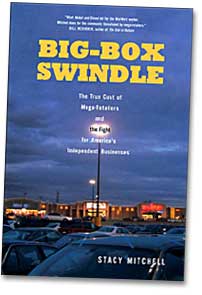
Big-Box Swindle
by
AMY STEWART
I 'm all worked up over the new book by Stacy Mitchell,
senior researcher for the Institute for Local Self-Reliance,
and you're about to get worked up over it, too. So pull up a
chair and let's go over some of the more relevant points raised
in Big-Box Swindle: The True Cost of Mega-Retailers and the
Fight for America's Independent Businesses.
 Not that this has
anything to do with us. Oh, heavens, no. But these little debates
over big boxes do flare up from time to time, and Mitchell covers
just about every kind of behemoth retailer, from chain bookstores
and record stores, to large electronics retailers, to the ever-present
Wal-Mart. We could almost pick any kind of retailer to use as
an example as we weave our way through her book. But what should
it be? How about oh, I don't know hardware stores? Just for kicks. Not that this has
anything to do with us. Oh, heavens, no. But these little debates
over big boxes do flare up from time to time, and Mitchell covers
just about every kind of behemoth retailer, from chain bookstores
and record stores, to large electronics retailers, to the ever-present
Wal-Mart. We could almost pick any kind of retailer to use as
an example as we weave our way through her book. But what should
it be? How about oh, I don't know hardware stores? Just for kicks.
Big Boxes, Bad Business . Mitchell begins making the case against
big box retailers by citing research on their negative effects
on other businesses. Here are just a few examples:
First of all, they're big. Just 10 mega-retailers
capture 30 percent of American spending. Home Depot and Lowe's
account for nearly half of all hardware store spending.
Because of their size, they put the squeeze on
vendors. New "pay by scan" technology means that vendors
do not get paid until an item is actually scanned and sold to
a customer. Home Depot has led the way in the garden center industry
by refusing to pay growers until a plant sells, thus shifting
the risk away from Home Depot and onto the growers. Mitchell
suggests that big boxes may wipe all inventory costs from their
balance sheet this way.
They send American jobs overseas. In response to
pressure from Home Depot and Lowe's to lower prices, Black &
Decker laid off 4,000 American workers and moved factories overseas.
If Black & Decker didn't do it, the chains would have simply
found another supplier that would.
They really put the squeeze on small vendors.
Mitchell reports that Home Depot's treatment of a small supplier,
Santa Fe Custom Shutters and Doors, was ruled in court to be
"malicious and fraudulent." The company took on debt
and increased its capacity to meet the terms of a Home Depot
contract, which the mega-retailer then canceled. The judge noted
that Home Depot routinely abused small vendors, and awarded $12
million in damages.
They don't just knock out their direct competitors.
Home Depot and Lowe's, for instance, perform over 26,000 installations
of windows, roofing, flooring and other products every day. While
contractors are often the first to cheer the arrival of a big-box
hardware store, they are surprised to learn that these retailers
are also after their clients.
Newspapers, banks and other business services are
particularly hard-hit by the arrival of the box. They are less
likely to advertise in local newspapers or do their banking locally,
and as local businesses fold, those banks and newspapers lose
customers they can't replace. (So if you were a real estate developer
looking to bring a big box to town, and you also owned a newspaper
and a bank, what impact would that have on your rivals? Well,
never mind. This is all hypothetical.)
Low Prices? Not So Much . Mitchell is all over the Myth of the Low
Price. "Corporate retailers commonly offer very low prices
at newly opened stores, sometimes sustaining losses at those
outlets for months or even years to gain market share,"
she writes. Consider the following:
A hardware store owner in Albany tracked prices
at a rival Home Depot. While individual prices varied, over a
couple of years Home Depot's prices gradually rose to match those
at other stores.
Mega-retailers often choose arbitrary prices, like
$11.67 for a denim shirt, to give the illusion that they have
bargained the price down as low as possible. In fact, the shirt
cited in this example was marked up by 250 percent.
Chains are well versed in how to influence shoppers'
perception of value. Mitchell cites a study that shows that combining
the color orange with bright lighting creates the perception
of low prices.
Most big boxes offer very low prices on items called
"signposts" that most consumers know the price of.
(This represents about 5 percent of items in a store.) The rest
of the items the "blinds" are priced higher because
customers don't know the going price anyway. Home Depot's founder
once described this strategy as "islands of losses amid
seas of profits." How poetic.
Low price guarantees that offer to beat the competitor's
price also offer the illusion of low prices, even though consumers
rarely take advantage of the offer and the store usually doesn't
drop the price for other customers.
Even customers who do take the time to comparison
shop may not be able to. Large chains may require vendors to
make an identical item with cheaper materials, and the customer
would never know. It may be cheaper, but it also might not last.
Oh, and let's not forget that as customers are
lured away from local businesses, they may find that niche products
are impossible to find. Using our hypothetical hardware example,
a chain store might not carry as many building materials that
work for historic homes, products that are particularly weatherproof
in a damp climate, or locally-made items.
Good for the economy? You do
the math . Small communities,
says Mitchell, are often tempted by the promise of increased
tax revenue. However, she cites research that shows that those
benefits may not materialize or are offset by losses. In one
town, big box stores produced an annual net tax loss of $468
per 1000 square feet, while Main Street shops produced a net
surplus of $326 per 1000 square feet. Why?
Many towns don't budget for the increased expense
of a big box retailer. She cites the example of Royal Palm Beach,
Florida, where the presence of Home Depot, Lowe's, and other
chains led to 1500 additional police calls every year and the
need for a new substation. Most chains have a policy to call
the police every time a crime occurs and to prosecute to the
full extent of the law, and those large parking lots and shopping
carts heaped with goodies can attract crime.
The increased costs of maintaining roads and sewers
are also a surprise to small communities. "Local downtown
and neighborhood businesses ... are efficient users of public
infrastructure and services," she writes. "Sprawling
megastores are not."
But what about that tax revenue? Studies show that
sales tax revenues may spike initially, but generally remain
the same "because consumers only have so much to spend;
sales gains in one location are mirrored by losses elsewhere."
Also, property tax revenues can decline as downtown and neighborhood
businesses are shut down.
And all those swell new jobs? Mitchell points out
that a new chain store gives the illusion of job creation because
all of those new sales associates in orange aprons are so visible.
Job losses are not as obvious as stores close, or businesses
downsize, gradually over a few years. In fact, many communities
do experience a net job loss.
She also cites extensive data that documents the
value of small, locally-owned businesses to a community. From
charitable donations, to community involvement, to a willingness
to do business with local vendors, to a reluctance to lay off
a long-time employee or cheat a customer, local businesses contribute
far more to the town than big boxes.
Well, isn't this all just supply
and demand? Actually, no. "Retail development
does not represent real growth," Mitchell writes. "It
does not generate new economic activity." Opening a new
store, she asserts, does not increase the amount of milk people
drink, nor does it increase their disposable income.
In fact, corporate retailers do not open new stores
because an area has unmet demand. They chose locations where
they believe they can pull customers away from local businesses.
They're also willing to cannibalize themselves, opening multiple
stores in a region and ultimately draining tax revenue away from
the first store. In general, megastores overbuild, providing
far more retail than an area can support.
But can't a big box fit into
the community if it's designed right? Mitchell is
critical of what developers call "lifestyle centers"
or "town centers" with words like "village"
or "center" in the name, although "they're not
really the center of anything." She describes these mixed
developments, with their wide, tree-lined sidewalks, faux architectural
elements and big boxes as anchors, as employing "carefully
crafted hucksterism designed to lull patrons into a warm nostalgia
that induces spending," although they may be located near
"genuine Main Streets that are barely functioning."
And what happens when one of those lifestyle centers
is built on a waterfront? "Big-box stores, strip shopping
centers, and malls are by far the worst type of development from
a water-quality standpoint," she writes, citing another
expert who explains that vast parking lots produce more runoff
and deliver it to a watershed faster than anything else.
So what's next? Big-Box Swindle ends with some inspiring
stories of citizen groups that have mobilized against the box.
I'll leave you with these examples not, of course, that this
has anything to do with us. But, you know, they're nice stories.
Frisco, Colorado stopped a Home Depot from coming
to town in part by reminding local businesses that the chain
sold more than hardware. It sells pet food; it gives construction
loans. Soon banks, pet shops, nurseries and other small businesses
joined the fight.
Main Street programs get involved in recruiting
new small business owners, much in the way that a manager of
a mall might recruit new tenants and help them succeed.
Hardware stores advertise the fact that they participate
in independent purchasing co-ops like Ace, Tru Value and Do It
Best, reminding customers that they, too, can negotiate low prices
through volume buying.
Local business band together to negotiate tax incentives
just like the big boxes do. The Austin Independent Business Alliance
regularly reminds the city council that its members collectively
employ 6,000 people, making them one of the top five employers
in the city.
Santa Fe created a "Santa Fe Shares"
card that works at regular credit card scanners and offers reward
points for shopping at local businesses.
"Shop Local" days include discounts and
cool prizes like iPods loaded with local music.
I've barely scratched the surface of this fine,
inspiring, rabble-rousing book. Pick up a copy at where else?
your local independent bookseller, and keep the discussion going.

Send book news to amystewart@northcoastjournal.com,
or write in care of the Journal at 145 G St., Suite A, Arcata,
95521.
COVER STORY | IN THE NEWS | OFF THE PAVEMENT |
BOOK NOTES
TALK OF THE
TABLE | THE HUM | CALENDAR
Comments? Write
a letter!
© Copyright 2006, North Coast Journal,
Inc.
|