 
COVER STORY | IN
THE NEWS | STAGE
MATTERS | ARTBEAT
TALK OF THE
TABLE | THE HUM | CALENDAR
August 17, 2006

CHRONICLING THE PAPER
WAR | RIO DELL REVAMP
| FIRE NET
CHRONICLING
THE PAPER WAR: Maybe you saw that article in the S.F.
Chronicle's Sunday magazine in which former Times-Standard
reporter Joel Davis gleefully reports on our anachronistic newspaper
war up here between the 150-year-old Times Standard and
2-year-old Eureka Reporter. Sure, Davis trots out the
requisite, irresistible cliches, starting with the headline —
"Rumble in the Redwoods: What happens when two
daily newspapers duke it out in a market town known more for
its weed than its writing" — and continuing in
the second paragraph — "But lift the Redwood Curtain.
. . ."
Still, Davis' account is filled with witty, pointed
imagery of Humboldt County, particularly when he describes the
newspaper war as being "like a cosmic collision where retail
gods with a twisted sense of humor decided to pair an economically
distressed newspaper industry with an economically distressed
city [Eureka], in a Darwinian race for readers and advertisers."
He calls Eureka Reporter owner Rob Arkley — also
chief of Security National Holding Co. as well as the fella behind
a number of town revitalization projects — "a sugar
daddy in a town that needed one," notes the beauty of the
area, the retiree-inspired leap in housing prices, and suggests
that some consider Arkley's generosity necessary as the "now-heavily
regulated lifeblood industries — timber and commercial
fishing — circle the drain." He adds that "[t]ourism
never really caught fire, it's too far, too cold," and that
Redwood National Park, instead of being the next Yosemite, "is
instead a soggy 'park, pee, stretch' stop."
In what feels like resentment-tinged commentary,
Davis — who worked for the T-S from 1988 to 1995
— talks about the tightwad atmosphere at the T-S.:
After noting T-S editor Singleton's "thrifty reputation,"
he adds that the "purchase of the Times-Standard
in 1996 from the notoriously tight Thompson Corp. may be one
of the few times where a Singleton buy was an upgrade."
Davis seems to express reluctant admiration of Arkley, noting
his arrogance (Arkley says he hasn't read the Times-Standard
in five years) while calling him an "outspoken doer who
revels in running through, over and around bureaucratic red tape"
using "deep pockets, iron will and considerable business
acumen. . . ."
Davis does a fairly straight-ahead job exploring
the newspaper battle, at least from an ideological standpoint.
Davis' take: The T-S, once conservative, now leans Left;
the ER, feared to be conservative, so far hasn't overtly
roared from the Right — except by existing, that is, and
being started by the Right's right-hand man. He notes that the
T-S says it isn't afraid of the ER, and that the
ER says the T-S is whining about competition. He
tells us that the ER so far appears to entertain opinions
both Left and Right, and he notes that the T-S has "counterpunched"
against Arkley's new paper by becoming a better paper and, recently,
winning a couple of awards. He alludes often to financials, especially
the bit about ER staff making loads more than T-S
staff, but only enough to tantalize and make us want to know,
specifically, who's making what profit — or not. And he
quotes Kevin Hoover, editor of the Arcata Eye, posing
the key hypothetical question: "If the Eureka Reporter
were to drive the Times-Standard out of business, then
what? Would Rob say, 'All right, it is free and clear, and I
don't have to offer diverse opinions?'"
Davis' answer: "Time will tell." And
then he wraps up the piece with another comment about that new
TV show everyone's squawking about, filmed in "the more
prosperous Vancouver, Canada," called "Eureka."
But perhaps Davis could have explored that time
element a bit more. Over the next few months, what's going to
happen? Our election will revolve mostly around the Balloon Track/Tract
project, with candidates and voters lining up for or against
Arkley's vision for it (a Home Depot-anchored deal with condos
over shops). Davis does mention that debate — but misses
the silly fun fact that the T-S calls it the "Balloon
Tract" and the ER calls it the "Balloon Track."
But he doesn't question how that controversy will play out in
the newspapers. Nor does he wonder who will win, then, when it
comes to truthful reporting. Will the "left-leaning"
Times-Standard be able to focus objectively on its business
opponent's project? Will the Eureka Reporter be credible
in anything it says about its owner's project? Will they both
stick safely to "objective" he said-she said reportage
till it's all over?
Time will tell. And, we sort of hope not. As long
as the letters-to-the-editor pages are generous, and the reporters
are having fun packing their muskets (with some inquisitive reportage)
for their next sally, it could be an even better "Rumble
in the Redwoods." The rest of the newspaper world, in its
bland mono-newspaperness, should be envious.
— Heidi Walters
TOP
RIO DELL REVAMP:
Speaking of community revitalization, residents of that SoHum
town with the lilting name can get all civic on Aug. 22 when
the Rio Dell City Council gathers to discuss how to spend $200,000.
"Free ice cream!" you cry. "A swimming pool!"
you squeal. Hold on, hold on — we can't promise the ice
cream will happen, but the pool — well, that could be part
of the dowry once you wed with Scotia, along with a number of
other town-fixin' goodies already underway. Besides, the $200,000
in question, a grant from the EPA, is specifically meant to be
spent on inventorying brownfields (areas contaminated by petroleum,
in this case) and developing a plan for cleaning them up. The
workshop is 6:30 to 8 p.m. on Tuesday, Aug. 22, at the Rio Dell
Fireman's Hall, 50 West Center St.
— Heidi Walters
TOP
FIRE NET: Fog chases
many coast dwellers uphill in the summer, into the sunshine,
and perhaps a like number of overheated mountain dwellers downhill
for the reverse therapy. But the fiery inland no doubt has put
a damper on a lot of the up-migration, lately, with only a few
intrepid coasters (the ones struck with gold fever, perhaps)
venturing inland to play on the rivers. The mountain dwellers,
meanwhile, are finding more than their usual respite downhill
— reveling in the coolness, yes, but also purging their
lungs of wildfire smoke.
It is, in other words, horribly hot and chaotic
up there in the mountains, with fire camps feeding 500 and more
firefighters, engines clogging twisty, narrow one-lane roads,
heavy smoke billowing in and out of river valleys at the wind's
whim, and scorched trees rolling onto the highways while the
ash rains down. Caltrans crews are on constant watch, said a
Six Rivers National Forest employee, especially on State Route
96 near Somes Bar and along the Salmon River highway, to clear
the errant rolling objects — or to stop traffic to let
an actual wall of flame roll by.
Those who don't flee their homes for the chilly
coast, and those who are fighting the fires, have been kind enough
to put fire updates onto a website. The site is filled with practical
news of fires all over the West, as well as condolences to families
who've lost someone in helicopter crashes. The Aug. 15 update
posted at 11:19 a.m. notes this about the Bar Complex/Bake Oven
Incident in the Trinity Alps Wilderness: 15,160 acres, 35 percent
contained but with estimated full containment unknown, 338 personnel,
and zero structures lost. "Fire has backed down to the New
River drainage and put off a significant amount of smoke ...
noticeable from Hoopa down to Weaverville," reads the commentary.
"Helicopters dropped water on hot spots and where needed.
There were several recons flown, along with a crew pick-up, and
holding the New River line with helicopter retardant drops. The
southern perimeter of the fire . . . continues to look really
good, with very little heat in this area. . . . The east side
of the fire is well into the rocks and seems to be held up in
the limestone. . . . Heavy smoke continues to hamper fire suppression
efforts, specifically with helicopters supporting firefighters
on the ground. Meanwhile, fire continues to back into Brushy
Creek drainage and is almost around the corner to the Immigrant
Trail. . . ."
For more play-by-play, check it out: http://yubanet.com/fire.shtml
— Heidi Walters
TOP
If Rio Dell and Scotia say 'I do'
story and photo by HELEN SANDERSON
On a sunny, summer afternoon in Scotia, you can
drive down Main Street and see plenty of Wrangler-wearing men
in T-shirts and boots heading home from a day's work at the Palco
mill. Kids clad in brightly colored bathing suits sprint through
a water sprinkler's path in the front yard, screaming and laughing.
With its rows of neat little houses, American flags waving from
the front porch, lush yards, immaculate soccer field, and stately
redwood storefronts, Scotia is idyllic in a countrified, Stepford
sort of way. But drive less than one minute north into Rio Dell
and the scene shifts dramatically. Groups of teens listlessly
watch traffic from the curb while a 30-something man in sweatpants
navigates a motorized wheelchair down the sidewalk with a child
on his lap.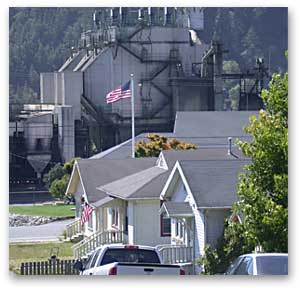
Main Street in Scotia and Main Street in Rio Dell,
connected by the narrow Eagle Prairie Bridge spanning one-fifth
of a mile over the Eel River, appear to be worlds apart. And
now that Scotia's owner, Pacific Lumber Co., is hoping their
employee-occupied houses can be sold and that the well-kept company
town can be annexed into the somewhat ramshackle, yet geographically
gorgeous City of Rio Dell, some residents are wondering whether
the plan to unite the towns, and allow Palco employees to buy
their Scotia homes, is such a good idea.
Right: Scotia, Calif.
The problem, many Rio Dell residents say, is that
while Scotia looks good on the surface, its infrastructure is
old and therefore could possibly become a burden to Rio Dell,
a city that is just beginning to get itself back on its feet.
"I see Rio Dell lifting itself by its boot
straps," said Jean Pyhtila, a Rio Dell real estate agent.
Make no mistake, many homes there are still rundown,
but in recent years new, upscale ones on the outskirts of town
have sprung up like dandelions in summertime. Long-neglected
problems with water and sewer services are all but resolved now.
Still, the state of Rio Dell is a little sad compared
to its neighbor. But at least it's, well, real. A town like Scotia
— meticulously maintained and company-owned — hardly
exists in the real world.
And by all accounts, residents of Scotia have it
good in ways that are unheard of anywhere else.
For one, everyone who lives in Scotia is employed
by the company, or their spouse is. The rent is cheap, ridiculously
cheap, ranging from $400 to $700. Any home repairs are paid for
by Palco, which spends up to $1 million a year maintaining the
town. Scotia residents have no water bills (there aren't even
water meters on the houses), the company pays for garbage disposal.
Even their electricity bills are artificially low because Palco
produces its own at a biomass plant in town.
Dan Dill, a fifth-generation Palco employee and
lead biologist for SCOPAC — the science arm of the company
that monitors wildlife and waterways on Palco's 200,000-plus
acres — said he shells out less than $700 a month for a
three bedroom, two bath house on Main Street. "This is like
subsidized rent," he said. He figures a comparable house
would cost at least three times that in Eureka.
But if Scotia is annexed into Rio Dell, all that
will change. The company will discontinue renting and any home
not bought up by an employee will be put on the open market.
While the sale of its 275 houses would help buoy
Palco's coffers, the company maintains that their primary motivation
is an altruistic one — to offer their employees the American
dream of owning a home. But before that can happen, the Humboldt
County's Local Agency Formation Commission (LAFCo) must OK the
annexation plans.
The City of Rio Dell has hired local consulting
firms Winzler and Kelly Consulting Engineers and PlanWest Partners
to study the infrastructure of Scotia — water, sewer and
roads — conduct a feasibility study and draft an environmental
impact report. The entire town of Scotia is one parcel so property
lines are being drawn. The cost for the studies are being paid
for by Palco.
Rio Dell Mayor Bud Leonard said that as long as
the annexation of Scotia leaves Rio Dell in a "revenue neutral"
position — meaning that it does not cost the city extra
to maintain Scotia after it receives sales and property taxes
— his city should jump at the chance to expand its sphere
of influence.
"Even at my age, and it is quite elderly (83),
I have a vision that the town has to grow," he said. "Whether
it be across the river, up to the Van Duzen [River] or whatever,
it can't be stagnant. This is an opportunity that only comes
once in a lifetime."
"It's a numbers game," said Kirk Gothier,
assistant Humboldt County planning director and LAFCo member.
"If the numbers work it will happen."
Others are more hesitant to take Palco's bait.
"The possible environmental clean-up needed
after so many years of industry could be very substantial and
more than Rio Dell can handle," warned Rio Dell resident
Sharon Wolff.
"We've got liabilities higher than the sky,"
said former mayor and Rio Dell dentist Ralph Roberts. His worry
is that Scotia, with its aging infrastructure and old houses
— built between the early 1900s and 1950s — won't
generate enough tax revenue. "Why should you take something
in that is worn out? "
Debra Garnes, a Rio Dell City Council candidate
and retired Sacramento Municipal Utilities District employee
said many residents are uncomfortable with the annexation.
"The reason for the discomfort is the lack
of answers," she said. "The Palco of old, that everyone
loved, is not in charge anymore. People are a little afraid of
the new Palco and who they are looking out for: themselves. That's
business."
No figures have been outlined on how much housing
in Scotia will cost. But Rio Dell Realty owner Dean Winkelhaus
roughly estimated the homes, which range in size from one-bedroom
duplexes to four-bedroom homes, to be worth anywhere from $200,000
to $400,000.
Dennis Wood, Vice President of Operations, said
that the impetus to sell the houses came from the requests of
employees who have long wanted to buy their homes. The values
of the houses, Wood said, will not be know for another few months.
And if the annexation fails? "[Scotia] can
form a community services district, which is actually unlikely,"
Gothier said. "Then if that doesn't work they would have
to form a homeowners' association to deliver services. It gets
harder the further away you get from a city to deliver services."
Mark Lovelace, a Palco-watcher and member of Humboldt
Watershed Council and also the Healthy Humboldt Coalition, is,
some might be surprised to know, a fan of Scotia .
"[Scotia] represents a lot of things we would
like to see elsewhere in Humboldt County," Lovelace said,
"a small, walkable community where people can live, work
and get the services they need all in one area. It also shows
that you can have industry and homes right next to each other
and have it be an enjoyable place to live."
The idea of annexing Scotia to Rio Dell, he says,
holds a lot of promise. However, "it needs to be a decision
of the people of Scotia and Rio Dell. Whether it works for Palco
should be secondary for them."
If LAFCo approves the annexation, the only thing
stopping the merger, and the home sales, would be the citizens
of Scotia. If 25 percent of registered voters protest, then the
deal could be shot down. And while it seems unlikely that a faction
of protesters would ever rise against the company's will, Lovelace
notes that in 2003, 18 percent of Scotia residents voted against
the recall attempt of District Attorney Paul Gallegos.
Beyond that, the nightmare scenario, of course,
would be if home sales were finalized and then the company went
under, leaving their employees without work to pay for their
homes. But Dill, who is looking forward to the possibility of
buying his house, believes that will not happen.
"The face of Palco may change, the kind of
lumber we sell may change, but we are not closing our doors,"
he said. "There is an enormous amount of timber in our woods."
On Wednesday, Aug. 23, at 6:30 p.m., the Rio Dell
City Council and Planning Commission will hold a joint meeting
to hear comments regarding the scope and content of the environmental
impact report of Scotia.
TOP
COVER STORY | IN
THE NEWS | STAGE
MATTERS | ARTBEAT
TALK OF THE
TABLE | THE HUM | CALENDAR
Comments? Write
a letter!
© Copyright 2006, North Coast Journal,
Inc.
|