 
COVER STORY | IN
THE NEWS | STAGE
MATTERS
TALK OF THE TABLE | THE HUM | PREVIEW | CALENDAR
July 6, 2006


ROAD APPLES | ST
BERNIE'S SAVED | STROLL WITH US
ROAD APPLES: Dennis
Mayo phoned last week from atop his horse, and as he rode around
the arena, clippety-slow-clippety-clop, he amiably asked just
where I got that horse doo-doo about the BlueRibbon Coalition's
being "financially supported by major timber, petroleum
and mining companies," as stated in last week's report on
a wilderness poll — some are calling it a push poll
— sponsored by the BRC. His question echoed those raised
by some of our letter writers in this week's paper.
"From a report the U.S. Public Interest Research
Group did in 2000, called 'The Blue Ribbon Coalition: Protector
of Recreation or Industry?'" I said.
"Naaay," whinnied the horse.
"I can guarantee that, locally, there ain't
nobody [like that] givin' us money," said Mayo, who is a
BRC representative here on the North Coast. "The stuff I
do here is outta my pocket."
The U.S. PIRG report contained a weighty list of
"corporate funders of the BlueRibbon Coalition," their
names said to have been culled directly from issues of the BlueRibbon
Coalition's magazine between 1991 and 1998. Among the more than
50 timber, petroleum and mining outfits listed were Boise Cascade
Corp., Louisiana Pacific Corp., Battle Mountain Gold Co., Echo
Bay Minerals Co., Meridian Gold, Chevron USA, Exxon Co. USA,
Western States Petroleum Association and several western states'
mining associations (including from Nevada, the third largest
producer of gold in the world.)
Well, that was then. This is now, said BRC's Western
Representative Don Amador last week, adding he didn't know where
U.S. PIRG came up with some of those big names. "That list
is old; it's out of date," Amador said, adding he "really
wished" the BRC were funded by big corporations. "The
lion's share of our money comes in small donations. We're a grassroots
group. It's almost ludicrous to make those assumptions, when
we get $100 from, even, the California Forestry Association.
That's chump change compared to what big industry gives to green
groups."
But what happened to the heavyweights? Well, said
Amador, in the early days the BRC (founded in 1987) was associated
with the Wise Use movement (that conservative backlash against
environmental regulations). "And then, in the mid- to late-'90s,
we changed our focus purposely to work on recreational access
to public land," he said. The BRC's current membership list,
predominated by off-road clubs and related shops, reflects that
sharpened focus.
According to the BRC's website, it became a non-profit
501(c)3 corporation in 1999. Amador said members, who each pay
$20 a year in dues, fuel the group (currently there are 12,000
individual members, he said, plus 1,100 businesses and organizations).
But the dues fall far short of the BRC's total revenues, judging
by figures in the BRC's tax reports posted on their website.
"Our members donate double and triple [their dues] throughout
the rest of the year," Amador said.
U.S. PIRG did not get back to us by press time.
— Heidi Walters
TOP
ST BERNIE'S
SAVED: Generations of St. Bernard's Catholic School devotees
— students, alumni, parents, staff — must have exhaled
a collective "Whew!" last week, after the school's
board of directors declared the almost 100-year-old Eureka institution
would indeed be open in the fall. Not much more than a month
earlier, the board had issued a warning that the school would
have to close if enrollment couldn't be boosted and more money
raised. The drop-dead date to announce the school's fate was
June 30. A couple days before that, the board announced that
while it still hadn't met its enrollment goals, it was gaining
ground on fund raising and in reshaping the school's business
approach to make it more self-sufficient. But the school might
still have to consolidate the pre-K-12 grades into one building,
and perhaps trim staff, said the board.
"There's still a lot of work to be done, I
can tell you that," said parent Darroll Meyer. He has coordinated
the drive to boost enrollment in the school's international academy,
which the board views as one key to the school's sustainability.
(For more on St. Bernard's and the challenges it faces, see "It's
a Family," June 22).
— Heidi Walters
TOP
 STROLL WITH US: None of the
traditional "Five W's" of journalism are as simple
as they're made out to be, and the one-word answers provided
in the standard-issue news story often obscure or cheapen everything
interesting. Who? John X. Johnson — but is he a saint,
a rake, a genius, a renegade? What's inside his head and his
heart? When? Yesterday at ten 'til noon — but maybe, if
you think about it another way, ever since the last election,
or the Civil War, or the moment apes started walking upright. STROLL WITH US: None of the
traditional "Five W's" of journalism are as simple
as they're made out to be, and the one-word answers provided
in the standard-issue news story often obscure or cheapen everything
interesting. Who? John X. Johnson — but is he a saint,
a rake, a genius, a renegade? What's inside his head and his
heart? When? Yesterday at ten 'til noon — but maybe, if
you think about it another way, ever since the last election,
or the Civil War, or the moment apes started walking upright.
So it is with "where." You can read the
words a thousand times — "the corner of 10th and L,"
"Hobie's Market," "Six Rivers National Forest,"
"the Nanning Creek watershed" — but unless you
have some intimate knowledge of the places in question, these
cease being descriptions and start becoming mere code words,
floating concepts detached from their intended meaning.
Starting this week, the North Coast Journal
will begin harnessing the awe-inspiring technology behind one
of the most disruptive new pieces of software in recent years
— Google
Earth — to combat this tendency, and to illustrate
our stories in ways that our predecessors five years ago never
would have imagined possible. And we'll be doing it with our
weekly Google Earth newsletter, a companion to the newsprint
Journal and the electronic Journal.
As far as we know, we're the first newspaper in
the world to do this, and we've got a wealth of information stocked
up and ready to go. It's easy to use — just go to our web
site and download a small file that should open up in your Google
Earth program automatically. (You may have to upgrade to Google
Earth 4, still a free program.) Click on the blue headlines on
the left-hand side of the screen, and the program will take you
to the locale of a story in this week's Journal. A bubble
will pop up, offering you a link to the story illustrated in
the scene. If you want, you can type in your address and get
driving directions. At other times, the view will zoom out, and
parts of the ground beneath Humboldt County will glow an unnatural
color, highlighting one of any number of themes: Pacific Lumber's
land holdings, neighborhoods where the poverty rate is above
50 percent, county parcels zoned for industrial use — a
world of information, beautifully presented. Use the controls
in your program to get a close-up of these areas, to tilt back
and look at them in perspective, or to fly around them at your
leisure.
Our Google Earth newsletter is still very much
a work in progress. We'll be adding new features over the coming
weeks, and as we hone our chops we hope to make it ever more
interesting and useful. We hope you enjoy it.
— Hank Sims
TOP
The Rise (or Fall) of Public Access TV
by LUKE T. JOHNSON
If public access television is supposed to represent
the voice of a community, Humboldt County has been effectively
muzzled by the state of public broadcast media over the years.
Despite three separate channels devoted to public, educational
and governmental programming (known as PEG), only a fraction
of a very diverse and impassioned Humboldt community actually
has been able to get its message out over the airwaves. Many
factors have contributed to Humboldt's paltry public access,
underfunding and arcane equipment being at the top of the list.
But all that will potentially change with the dawn
of Humboldt Area Access, a community media center designed to
educate community members by facilitating the production of original
public programming through state-of-the-art equipment. The media
center (HAA) will be housed at Eureka High School in the former
Art/Industrial Ed building, where construction should begin in
the next few months. Barring the passage of potentially troublesome
state legislation, HAA will be a model for community access.
The concept of a community media lab in Humboldt
has been brewing for a number of years. In 2003, the incorporated
cities on the North Coast re-negotiated their franchise agreement
with Cox Cable in an effort to stay up-to-date in the age of
Internet and satellite TV. As a part of that agreement, the cities
decided to put a percentage of the cable company's franchise
fees into funding a community media center, monies that would
also fund up to six public access channels. They ultimately decided
to build the media center at Eureka High both because of the
school's central location and because placing it at a school
would reinforce the educational mission of HAA.
Phillip Middlemiss has taught media and film classes
at Eureka High for years. He is licking his lips at the opportunities
for education and innovation he sees in the new media center.
He sees Humboldt Area Access as a chance for students to not
only explore their creative voices, but to engage and connect
with their community as well.
"We need to teach people how to be creative,"
he said. "The best way to teach personal expression is to
provide the tools and then get out of the way."
Middlemiss believes that students will thrive if
given the chance to produce programming "that is
as wild, rough, questionable-in-taste, polished and professional
as the students who create it." If students have an outlet
to demonstrate what really goes on in their lives, Middlemiss
said, they will not just be the delinquents local media make
them out to be.
"Students will become more interested in the
community when the community is more interested in them,"
he said.
But the Humboldt Area Access center is not just
for high school students. It will be open to anyone in the community
who wants to produce original programming, and will have all
the equipment and a trained staff available to help anyone get
their message on the air. Eileen McGee, who serves on the HAA
board, will be teaching an Adult Ed class with Middlemiss about
how to film and edit digital video to encourage more fodder for
public access.
McGee produces Seeking Solutions, a program
on Channel 12 that explores local public policy issues. She believes
that robust public programming, such that HAA would allow, is
a key component in bringing together a community as diverse as
Humboldt County.
"Using visual media to share cultural traditions
is a great way to celebrate our diversity," she said in
an email.
Sean McLaughlin, the newly hired Executive Director
of HAA, sees unlimited potential in Humboldt's media lab. McLaughlin
has served as president of Akaku: Maui Community Television since
1997. He sees some interesting similarities between Humboldt
and the Hawaiian community he served. Like the rural island communities
of Maui County, he said, Humboldt is a collection of "distinct
and somewhat disparate" communities, separated by a sea
of redwoods. He thinks the foundation that has already been laid
for HAA will ensure its success.
"The synergy with students and the community
together creates a phenomenal spark that will really excite people,"
he said from his (former) office in Maui.
But all that could slip away in Humboldt if a bill
working its way through the legislature is passed in its current
form. Assembly Bill 2987 is part of a broader national movement
to allow phone companies such as AT&T to offer cable television
services. As competition increases, supporters argue, cable prices
will be driven down and consumers will be better served. The
bill passed through the Assembly on a rare consensus vote, 77-0.
The bill was bitterly opposed by the cable industry,
sparking one of California's most expensive lobbying showdowns
of the year. Cable providers felt phone companies would have
a distinct advantage over their traditional television competitors
since most cable companies are locked into costly franchise agreements
with the cities they service. After a delayed vote in the Senate
Energy, Utilities and Communications Committee, an amendment
was written into the bill that would allow cable companies to
tear up existing contracts with cities.
The cable companies, not surprisingly, changed
their tune on the bill and now support it fully. It passed the
Energy, Utilities and Communications Committee, again with a
consensus vote (9-0), and will be one of the first orders of
business for the Senate Appropriations Committee when the Senate
reconvenes next month. The current language of the bill is frightening
for many of California's cities, placing the very notion of public
access in jeopardy, not to mention bigger projects such as Humboldt
Area Access.
State lawmakers admit there are still questions
that need to be answered in the specific language of AB 2987,
chief among them being the continued health of local public access.
Wendy Purnell, director of public affairs for Sudden Link Communications
in Eureka (formerly Cebridge Connections, which purchased Cox
Cable in May), said, "I'd hate to speculate because [AB
2987] is pending legislation, but some of the new language in
the bill could definitely impact the agreement we have for the
media center."
Sue Buske, a "guru" of cable television
contracts, helped re-negotiate the franchise agreement with Cox
in 2003 on behalf of local cities and the county. She has been
following the progress of AB 2987 very carefully and says that
if passed in its current form, the bill could indeed eliminate
the existing contract. But, she said, "literally hundreds
of people have been speaking to the harmful effects" the
bill could have on community media centers. If cable companies
are allowed to back out of their contracts with local governments,
those governments will no longer collect the fees that allow
them to fund things like the HAA. She has faith that something
will eventually be worked out to maintain the health of public
access.
"It's extremely evident that the Senate and
Assembly staff hasn't had time to grapple with several vexing
issues," she said, specifically protecting existing local
contracts and the franchise fees that come with them.
Sean McLaughlin agrees that AB 2987 is "scary,
but getting less scary." After attending the Alliance for
Community Media International Conference in Boston next week,
where he will receive the prestigious Buske Leadership Award
for his public policy service, he will come to Eureka to begin
work at Humboldt Area Access. He is confident the media center
will flourish.
"Building a media center at this particular
moment in history gives Humboldt the opportunity to have one
of the best new media centers in the country," he said.
"It can be a model for others."
TOP
Eric Rofes, 1954-2006
by CHRISTINA ACCOMANDO
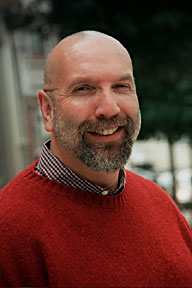 As
a professor of education at Humboldt State University, Eric Rofes
fused academia and activism in a rare and dynamic combination
that inspired students and colleagues alike. He brought his skills
as an organizer, passion for justice and keen intellect to work
that spanned the university. As
a professor of education at Humboldt State University, Eric Rofes
fused academia and activism in a rare and dynamic combination
that inspired students and colleagues alike. He brought his skills
as an organizer, passion for justice and keen intellect to work
that spanned the university.
To the shock of friends and colleagues, Eric died
Monday, June 26, of a heart attack in Provincetown, Mass., where,
after two decades of research, he was completing his 13th book.
He was 51 years old. A vibrant and influential leader, Eric's
sudden and untimely death is being mourned around the world.
"Eric was an absolute giant of the gay movement
— as an intellectual, an organizer and an activist,"
said feminist anthropologist Gayle Rubin. "He was a massive
presence, whose influence was felt across a broad range of constituencies
... It's as if a mountain has suddenly vanished."
This mountain of a man and national leader chose
to be in Humboldt for what turned out to be the last chapter
of his illustrious career. After joining HSU in 1999, Rofes continued
to present his work nationally and internationally. He could
have rested on his already impressive laurels, but Eric immersed
himself deeply in the work of community building and cultural
transformation at Humboldt. "For those of us lucky enough
to work with him at HSU, Eric Rofes was a life force," said
Kim Berry, Women's Studies program leader. "More than any
other person on campus he worked systematically to build institutional
change for social justice." Most recently, Eric co-chaired
HSU's Diversity Plan Action Council (DPAC), which he believed
could be the catalyst for diversifying HSU and transforming the
university culture, a process that he knew would require strong
leadership and sustained effort.
Among Rofes' long-term legacies is the groundbreaking
North Coast Education Summit, which he built from scratch five
years ago. With a radical focus on education, democracy and social
justice, the conference has grown exponentially each year, bringing
together hundreds of educators, students and community activists
from California and beyond. The Summit connects people across
disciplines, across regions and across differences of race, class,
gender and sexuality. Eric consistently saw fostering relationships
across differences as a key to effective organizing.
"Eric never took his friendships for granted,
nor his positions on the issues he cared deeply about, always
looking for greater complexity and possibilities for fostering
change," said UC Berkeley lecturer and long-time friend
Will Seng. "He changed the way we now think of gay men's
sexuality and, by his example, prompted many gay men to take
a closer look at feminism, class and racism."
Eric brought those complex intersections into his
organizing, his personal life, and his academic projects. He
was at the forefront of the Multicultural Queer Studies minor
at HSU, the first of its kind in the nation, designed as a rigorous
academic program and to help build intellectual, emotional and
political community. Rofes wanted to serve HSU students and offer
a model for the nation of a queer studies program that would
study sexuality and gender as part of a complex matrix that includes
race, ethnicity, class and culture.
"Eric and his partner Crispin were the first
gay people we met in Humboldt when we were looking to move here
from Southern California," said local organizer Todd Larsen,
speaking of Eric's impact on his life and community. "Their
friendship gave us a good feeling about moving to Humboldt. Eric
was not only a mentor to my partner Michael Weiss and myself
personally, but also an influential part in helping us develop
Queer Humboldt. He motivated us to be involved in community-building
efforts, including Queerhumboldt.org and events to help bridge
gaps between the LGBT and other members of our community."
Todd felt that one of Eric's many talents included helping people
"think about things from a different perspective. It was
like he had a bigger view of the world—a view that others
may not see at first."
Above all else, Rofes was a passionate educator.
"Eric was an extraordinarily gifted teacher whose courses
were rigorous and often life-changing," said education professor
Ann Diver-Stamnes. "His passion for teaching was fueled
by his commitment to students and by his belief in education
as having the power to transform society and reinvigorate democracy.
This belief guided his teaching and led him to develop pioneering
courses such as Education for Action and Gay and Lesbian Issues
in Schools."
David Bracamontes, outreach/program coordinator
at the MultiCultural Center, remembered the profound impact Rofes
had on his life. "I first met Eric at a weekend seminar
he taught, and that weekend changed who I was as a student and
a gay man. For the first time I had a role model, someone within
my community that I could respect and admire. This year I returned
to HSU as professional staff, and I was honored and humbled to
work side-by-side with this man who had changed my life."
Rofes inspired generations of students, from his
days as an elementary school teacher in the 1970s to his present-day
students at HSU. "Eric Rofes was a remarkable scholar and
teacher," reflected education graduate student and Ethnic
Studies lecturer María Corral-Ribordy. "He had the
capacity to see the brilliance in each of his students and nurture
our continued development from that point. His uncompromised
high expectations demonstrate great respect for our individual
potential." Eric inspired María to pursue a career
in education, encouraged her community activism and actively
mentored her in both efforts. She and Eric were among the co-founders
of PerfectUnion.net, a grassroots website that facilitates dialogue
and activism in the struggle for marriage equality.
In his article "Marriage and Civil Disobedience,"
Rofes described his 2004 San Francisco City Hall wedding: "I
joined thousands of people this weekend and defied the laws of
my state in a brazen act of civil disobedience. We didn't chain
ourselves to a building, sit down in the middle of a crowded
intersection, or occupy a public official's office until our
demands were met. We simply got married." He argued for
legal efforts paired with well-strategized direct action, pointing
out that civil disobedience can "take abstract and highly
charged issues and stamp human faces onto them."
His work was always visionary, but also pragmatic.
"He lived a life of inspiration as a servant and scholar
for the people. Unassuming yet undeniable, he wielded a practical
passion for change, beyond the armchair of revolution,"
recalls former HSU Ethnic Studies lecturer Issac M. Carter.
"I want to be a voice affirming the value
and heroism of long-term commitment to democratic processes of
community organizing," Rofes said in a 1998 speech. "We
may hate the endless meetings, be sick of licking envelopes,
feel frustrated working across different identities and political
visions, and be drained by community cannibalism, but we've got
to continue doing the work."
MultiCultural Center Director Marylyn Paik-Nicely
noted that Rofes always worked simultaneously within institutions
and at the grassroots level. "Eric was committed to and
intently focused on the project at hand and truly valued the
contributions of people around him. He brought people with their
expertise and experiences together to collaborate and create:
He really knew how to create communities for change." Like
his other colleagues, Paik-Nicely spoke to both the impossibility
of replacing Eric and the need to carry on his work, "We
must honor his spirit by continuing the challenging work of cultural
transformation at HSU and in the world."
Eric Rofes is survived by his lover of 16 years,
Crispin Hollings, and by his mother Paula Casey-Rofes and brother
Peter Rofes. A memorial service will be held Saturday, July 15,
at 3 p.m., at the San Francisco Metropolitan Community Church,
150 Eureka Street. HSU will hold a celebration of Eric's life
on Friday, August 25, 3:30 p.m., in Founders Hall Courtyard.
In lieu of flowers, the family requests that donations be directed
to the National Gay and Lesbian Task Force, 1325 Massachusetts
Ave NW, Suite 600, Washington, D.C., 20005, or the Highlander
Research and Education Center, 1959 Highlander Way, New Market,
Tenn., 37820.
TOP
COVER STORY | IN
THE NEWS | STAGE
MATTERS
TALK OF THE TABLE | THE HUM | PREVIEW | CALENDAR
Comments? Write
a letter!
© Copyright 2006, North Coast Journal,
Inc.
|