|

IN
THE NEWS | COVER
STORY | CALENDAR

The language of flowers
by AMY STEWART
WANT TO SHOW SOMEONE HOW MUCH
YOU appreciate them? Send them a lisianthus. Need to express
your respect for a good friend? How about a bouquet of sunflowers
and yellow roses?
Appalling, I know. Let me explain
what's going on. Our good friends at Hallmark have gotten themselves
into the florist business, and they've launched an ad campaign
called "The Meaning of Flowers" to kick it off. A gerbera
daisy means "happiness," according to Hallmark. A pink
rose means "thanks," and a lily means "mother."
(Yes, I know that "happiness" is an emotion, "mother"
is a person and "thanks" is an exclamation, but this
is not a grammar column, so we'll just have to forgive the lack
of parallel construction.)
For those of you who do not
usually spend much time reading crusty old Victorian gardening
books, let me explain how this all got started. The Victorians
invented something they called "The Language of Flowers,"
a charming form of communication in which the sentiments of,
for instance, an ardent suitor could be expressed by a particular
combination of flowers in a bouquet. Flower dictionaries that
defined the meaning of each flower became quite popular. I quote
here from Hill's Manual of Social and Business Forms,
published in 1886, which includes a Dictionary of the Language
and Sentiment of Flowers: "An extended and sometimes important
correspondence may be carried on by the presentation of bouquets,
single flowers and even leaves; the charm of this interchange
of thought largely consisting in the romance attendant upon an
expression of sentiment in a partially disguised and hidden language."
Mr. Hill goes on to explain
that a bouquet of jonquil and linden spells out, "I desire
to marry you." The recipient of this bouquet might respond
with a single field daisy, which means, "I will think of
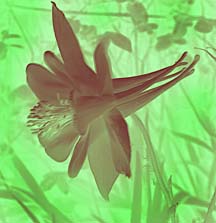
it," or perhaps a red columbine: "Anxious and trembling."
Pity the poor fool who receives a sprig of laurel in response,
displaying a measure of doubt regarding the sincerity of the
proposal: "Words, though sweet, may deceive."
All right, you get the idea.
The Victorians developed an ornate and sometimes absurd new language
using obscure and difficult-to-obtain flowers. Who, for instance,
would send a madder to someone to express "calumny"?
Or a coxcomb to signify "foppery"?
But now Hallmark has taken this
quaint tradition and turned it into something common, something
commercial. They have chosen less than a dozen flowers, all of
which, coincidentally, are known for their ability to hold up
well in a refrigerated truck, and they have applied a trite sentiment
to each of them. I regret to inform the Hallmark corporation
that a yellow rose does not mean "friendship" as they
advertise. Instead, according to Mr. Hill, it means "infidelity."
A sunflower does not mean "respect;" it means "false
wishes." You can see the sort of trouble a person can get
into.
Hallmark may be a newcomer to
the business, but this is only the latest insult from the floral
industry, which has, over the years, grown increasingly homogenized.
Gone are the regional favorites--I once unwittingly sent a bouquet
of dull, stiff gladiolus to a Hawaiian funeral, while the locals
brought leis of maile, lokelani, or pikake -- and gone are the
flowers with any scent at all.
I walked into a flower shop
in Sacramento last September and asked for a small bouquet of
anything that smelled good, and after a thorough search the staff
had to admit that not a single flower in their shop had any scent
at all, apart from that florist smell that is vaguely reminiscent
of new car smell. It was a low moment for me and, I thought,
for the industry as a whole.
That leaves only one option.
If you want good cut flowers, you've got to grow them yourself.
Here, then, are five sweetly scented flowers that you'll almost
never find at the florist, along with the Victorian definitions.
If you'd like to expand your cut flower repertoire, I've listed
a few books to help get you started.
Sweet peas ("delicate pleasures")
are sometimes bred for looks instead of scent. For old-fashioned
scented varieties, try "April in Paris" from Renee's
Garden Seeds or "Old Spice" from Shepherd's Seeds.
Soak seeds overnight before planting them to speed germination,
and work plenty of aged compost or manure into the soil before
you plant.
Heliotrope ("I adore you")
gives off a sweet, vanilla scent and will grow into a medium-sized
shrub in our climate. It'll also live happily in a container,
and the dark purple flowers hold up well in a vase.
Chamomile ("energy in adversity")
has a mild herbal scent and makes a great filler in bouquets.
Be sure to get German chamomile, or Matricaria recutita. Its
cousin, Roman chamomile, is a good ground cover but is not used
for cut flowers or for herbal tea.
Jasmine ("amiability")
survives just a few days in water but adds a dreamy scent to
flower arrangements. Try pink jasmine; it will climb a trellis
or sprawl on the ground. The jasmine that is used to make perfumes
and teas is Jasminum sambac, or Arabian jasmine. It's a little
harder to find, and it grows into an evergreen shrub, not a vine.
Lilac ("memory; fraternal
love") blooms for just a short time in the spring, but it
is worth the wait. "Lavender Lady" grows particularly
well in mild winter areas; some other varieties need a hard freeze
to perform well. When you pick lilac flowers, be sure to bash
the cut end with a hammer before putting them in the vase--it
helps them absorb water and last longer.
Even the weediest plants in
your garden can express far more sentiments than the average
Hallmark bouquet. According to Mr. Hill, bindweed means "humility,"
dandelion means "coquetry" and nasturtium means "splendour."
I'll let you string your own floral sentences together; for now
I'll send you mugwort and angelica: good luck and inspiration.
|
The
Literature of Flowers
Tussie-Mussies:
The Language of Flowers by
Geraldine Adamich Laufer ($15.95, Workman Publishing). A well-researched
guide to the lost art of putting together bouquets to express
a particular sentiment. Includes a glossary of flowers and directions
on assembling bouquets.
Annuals With Style by Michael A. Ruggiero and Tom
Christopher ($29.95, Taunton Books). A lavish full-color book
on selecting and growing annual flowers, with a lengthy list
of "Essential Annuals" in the back.
Arranging Flowers From Your Garden by Cynthia Bix and
Philip Edinger ($14.95, Sunset Books). A practical guide
to growing and arranging cut flowers with a distinctly West Coast
sensibility.
Creating a Cottage Garden in North America by Stephen
Westcott-Gratton ($29.95, Fulcrum Publishing). The cottage garden
is perhaps the ultimate cut flower garden -- it demands constant
plucking and deadheading just to keep it going. This book contains
a plant-by-plant directory of the best flowers for a glorious
cottage garden, large or small.
|
E-mail
announcements, plant recommendations, cuttings
and complaints to Amy Stewart.
Comments? E-mail the Journal: ncjour@northcoast.com
IN
THE NEWS | COVER STORY | CALENDAR
© Copyright 2002, North Coast Journal,
Inc.
|