|
 
IN
THE NEWS | IN
THE GARDEN | CALENDAR
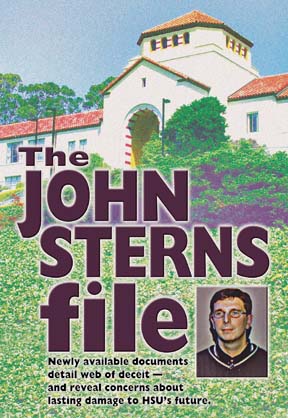
by ANDREW
EDWARDS and JUDY HODGSON
"MY USUAL PRACTICE IS TO
BE BRIEF," Judge John Feeney warned those in court last
week as he thumbed through the two-inch-thick file of defendant
John Frederick Sterns prior to sentencing.
"The immediate financial
damage has been quite substantial. Mr. Sterns clearly inflicted
a great deal of damage."
However, the judge continued,
that dollar figure -- $124,000 -- did not include the long-term
harm to Humboldt State University's ability to raise funds in
the future, the damage done to its integrity as an institution,
personal damage to the lives of Sterns's coworkers, the reduced
availability of scholarship funds for needy students and the
diversion of hundreds of hours of staff time to untangle Sterns's
web of deceit.
"It's impossible for any
of us to quantify our deep feelings of betrayal and frustration,"
Feeney said directly to Sterns as Sterns stood clad in a jailhouse-orange
jumpsuit handcuffed to a fellow inmate.
At one point even the prosecutor,
Deputy District Attorney Rob Wade, thought the judge might send
Sterns to state prison, which would have been highly unusual
for a first-time offender with mental problems. (After his arrest
last year Sterns was diagnosed with "schizoaffective disorder,"
characterized by severe mood swings and some of the psychotic
symptoms of schizophrenia.)
After all, Sterns had no prior
criminal record, had acknowledged his wrongdoing at an early
stage -- immediately after his arrest -- and he had already begun
to repay HSU.
In the end Feeney ordered Sterns
to serve the maximum time allowable in the county jail -- 365
days -- and to pay restitution to HSU for its out-of-pocket losses
(so far, Sterns has paid $46,000 of the $124,000 he owes the
university). With credit for time served, Sterns is scheduled
to be released as early as February, when he will begin five
years of probation. The maximum sentence could have been eight
years and four months in the much harsher environment of a state
prison.
At least one HSU official recommended
sterner punishment. Sean Kearns, director of university communications,
said in a letter written in March that Sterns "should spend
three years in prison, an amount of time roughly commensurate
with his tenure at Humboldt State." Additionally, Kearns
said Sterns "should be fined $300,000, roughly the equivalent
of three years' pay and benefits he received."
For a look behind the sentencing
of John Sterns, the Journal spent Monday in the Humboldt
County Clerk's office with the same file folder Feeney used to
reach his decision. Included with the preplea sentencing report
were 25 letters in support of the defendant from friends, family,
former co-workers and a college roommate. Also in the file were
damning letters documenting damage from HSU co-workers and alumni.
HSU President Alistair McCrone, on the record for the first time
about the Sterns affair, wrote the court that, "The credibility
of the fund-raising process and the University's ability to raise
funds in the immediate future have been compromised." (The McCrone letter is available here
as an Acrobat Reader PDF).
Here are some highlights from
the Sterns file:
Long-term effects: "To put it bluntly our credibility is shot
on both state and local levels. People have long memories, they
won't forget what has been done by someone in such a prestigious
position."
-- Gwynna Morris, past president
of the CSU Alumni Council, member HSU Alumni Association.
Administrative foot-dragging:
"While the impact to the campus
has been documented, much of what is known has not been disclosed,
and much of it will never be known. This is partly because the
former vice president charged with dealing with it was loathe
to acknowledge the depth of it."
-- Sean Kearns, director
of University Communications, Humboldt State University.
Clean up: "The monetary repercussions have been calculated
to date, but the long-term negative consequences are ongoing
and will continue for years to come. We have been left to make
the apologies and the corrections. We have been left to try to
construct meaningful and honest relationships with the donors
who gave in good faith and were dishonored in the misappropriation
of their gifts."
-- Judith A. Wyland, Sterns's
administrative assistant from September 1999 until his termination
in March 2001.
Missed opportunity: "Behind smoke and mirrors, Sterns brought
no significant funds to Humboldt State during a period when philanthropy
in higher education across the nation was very robust. The losses
represented by these missed opportunities during a boom period
cannot be recovered. When the picking was ripest, Humboldt State
was essentially absent."
-- Sean Kearns
The report and letters present
a fuller picture of the man guilty of defrauding HSU, a man who
engendered as much love and support from acquaintances as he
did animosity and loathing from his co-workers.
"I fully believe that he
is of criminal and evil mind and spirit and will continue to
do more of the same if given the opportunity," wrote Mary
Wells, HSU senior development officer. Yet Ruth Shapiro, who
worked for Sterns at the Asia Foundation in San Francisco prior
to his arrival at HSU in 1998, said in a letter to the court
that "these actions are so out of character, that I can
only believe his illness has had a terrible effect on him."
Since his removal Sterns has
tried to make amends, working as a consultant for a family friend,
going to counselling and taking medication.
There was one slip, though,
last November. When he was applying for a new job he once again
falsified information on his résumé -- more flagrantly
than he did when originally applying for employment at HSU. His
errors were caught, however, and Sterns entered into another
round of counselling and medication for his illness, according
to the court file.
Sterns's attorney, Marion Miller,
speaking in court just prior to sentencing, said her client is
a sick man, characterizing his behavior as not unlike "Dr.
Jekyll and Mr. Hyde."
Since the Sterns case never
went to trial, much of the information regarding exactly how
he manipulated the system, deceived so many people for so long
and kept his subordinates in line has not been made public. The
Sterns file chronicles a pattern of behavior from 1998 to March
2001 where Sterns moved to consolidate control, punish insubordination,
and advance himself personally. The file also reveals a serious
lack of oversight on the part of his superiors -- HSU Vice President
Don Christensen and ultimately President Alistair McCrone.
"How did Sterns do it?"
writes Communications Director Kearns of his superior. "Two
answers: 1. Very methodically. 2. He was allowed to do it."
Sterns dismantled the very structure
of his own departments by insulating his subordinates from the
rest of the university and browbeating those who stepped out
of line or threatened his primacy.
"John Sterns did everything
he could to make me leave, since I was one of few people who
could reveal his wrongdoings," wrote Wells. "He made
my work life miserable." She described how he had denied
her status and pay commensurate to her ability, gave her gratuitous
negative feedback on good work and restricted her access to information.
Other co-workers echoed Wells:
"He is a mean-spirited and manipulative man," wrote
Pamela Allen, the former HSU director of alumni relations who
also worked under Sterns and eventually left the county for employment
elsewhere.
He also elevated less qualified
staff members so they'd be more likely to be at his "beck
and call," and discontinued publication of the weekly faculty-staff
newsletter and the alumni magazine, The Humboldt Stater
leaving funds available to spend elsewhere.
According to a special audit
ordered by the Chancellor's Office following Sterns's arrest
last year, Sterns pocketed some of the money, mostly false travel
reimbursements. The rest of the funds he shifted to other projects
and purchases, increasing his own reputation as a fund-raiser
and his popularity with the faculty for his ability to find money
for equipment purchases.
"He presented himself as
a wunderkind, falsifying reports, falsifying fund-raising
levels, falsifying contracts with potential donors and speaking
in circles that spiralled upward," wrote Kearns. "Perhaps
because they thought he was making them look very good, the former
vice president and president apparently were not inclined to
question his actions seriously."
HSU was honored by the Council
for Advancement and Support of Education, a national organization,
in 1998 and 1999 for its fund-raising successes which were based
on falsified reports filed by Sterns, claiming he had increased
donations by 78 percent.
Although investigators said
HSU officials cooperated during the investigation, the Sterns
file suggests that cooperation may have been less than enthusiastic
by Sterns's immediate supervisor, Christensen, who attempted
to minimize damage to the university's public image. In one instance,
Sterns emptied a scholarship fund, which was established by a
retired professor, of $10,000. It was quietly replenished from
other discretionary funds by Christensen and the professor was
never notified.
Once it was realized that funds
had been misappropriated, attempts were made to fix things. Kearns,
in his letter, said, "The university was left having to
shunt funds repeatedly from one account to another to cover the
extravagances and deceptions of Sterns." There has never
been any evidence that top university officials, to protect their
own reputations, tried to cover-up Sterns's misdeeds.
In the end, after Sterns's confessions
-- "a defense attorney's nightmare," according to probation
officer Angie Circe, who prepared the preplea report for the
court -- the university was left on shaky ground; Sterns was
left in debt and in jail.
It was clear Judge Feeney struggled
with his decision, weighing the defendant's lack of criminal
history and his documented mental illness against the damage
caused by his activities. It was also clear that the judge was
moved by the passionate and revealing letters that asked that
Sterns be sent to prison.
"I believe John is morally
bankrupt," wrote Wyland. "His charm and intelligence
must not be a barrier to the consequences of his crimes. He should
be barred from having any job that employs holding the public
trust."
|
"John Sterns's
actions shattered my 14-year career at Humboldt State University
and severely disrupted my personal life... I began thinking that
Sterns might retaliate in some hideous manner. On one occasion
I was fearful of entering my own home."
-- PAMELA
ALLEN,
former director of HSU Alumni Relations
"To my knowledge,
Sterns exhibited not a shred of concern. Once, when I suggested
that his reorganization effort should be taken with concern that
`every step taken be an honorable one,' he reflexively and giddily
laughed it off, blurting, `Oh, my! Honor has nothing to do with
it.' That is the comment I will remember most about him."
-- SEAN
KEARNS,
HSU director of university communications
"John's plan was methodical and cruel. He dismantled an
entire department and financial record- keeping. He needs to
feel the punishment that we have all been unjustly dealt. I believe
John is morally bankrupt. His charm and intelligence must not
be a barrier to the consequences of his crime. '
-- JUDITH
A. WYLAND,
HSU administrative assistant
|
"I'm certain I won't
ever understand the reasoning behind sending a white-collar criminal
...to prison when soon after that, to lessen prison overcrowding,
we release a much more violent and/or public-threatening criminal
back onto the streets."
-- STERNS'S
FATHER
"If I were asked to
make a list of people I know who might be capable of doing something
morally wrong or illegal, John Sterns's name would not even be
considered."
-- STERNS'S
SISTER-IN-LAW
"He is a sick man. He is not evil. He is not a sociopath.
He doesn't lack empathy for the people he has hurt. Overwhelmingly,
he has lived his life, often to his detriment, with consideration
of how to help people, how to support them, how to make them
feel better about themselves. '
-- STERNS'S
WIFE
"Since March I have been rebuilding my life with some major
setbacks. Repaying damages to Humboldt State is my first priority.
I want to become a better husband, father and friend. My actions
have caused great hurt within these relationships and I have
amends to make here as well. I close by repeating my deep remorse
and shame and my unwavering commitment to recovery."
-- JOHN
STERNS
|
Radio Station KHSU survives
THE CRIMINAL ACTIVITY OF JOHN
STERNS wreaked havoc not only with the university funds, but
with the long-term viability of auxiliary university programs
consolidated under Sterns' control during his tenure. One program,
radio station KHSU, the campus affiliate of the Corporation for
Public Broadcasting and National Public Radio, was particularly
hard hit.
When Sterns came on board he
replaced Roger L. Hawkins, a Eureka accountant who had been performing
financial audits for the station, with one from San Francisco.
That accountant never existed. Sterns himself created the facts
and figures and gained access to funds that he alone controlled.
In one instance, the court file
revealed that $7,600 of fictitious travel expenses paid to Sterns
came out of the KHSU general fund.
After Sterns was indicted, Hawkins
was rehired to audit and to reconstruct the books Sterns had
fabricated. The cost was more than $50,000 above and beyond the
estimated $11,000 in lost staff time and miscellaneous expenses.
"In short, KHSU's ability
to carry out our mission of serving the community is severely
hobbled by our funding problems and the administrative wreckage
around us," wrote Terry Green, KHSU station manager, in
a letter to the court regarding Sterns.
The station had to lay off three
of its seven full-time employees in the wake of the debacle.
"The fiscal uncertainty
and atmosphere of anxiety and chaos resulting from Mr. Sterns's
actions have been extremely demoralizing to KHSU's professional
staff and volunteers," wrote Charles Horn, the station's
development director.
Station officials had feared
they would also lose or have to repay critical public funding
from the Corporation for Public Broadcasting. The corporation
sent its own auditors to examine the books, but in the meantime
those funds were not halted and the station is still broadcasting.
(The audit found that despite Sterns's deceptions, he had not
done as much damage to the station as he did to other parts of
the university).
In a wave of sympathy from listeners,
KHSU recently concluded a successful spate of fundraising, pulling
in a combined $120,494 during the fall and spring drives.
"We were without federal
funding for most of this year (because of Sterns) and our listeners
really helped pull us through," said Charles Horn from his
office in a phone interview.
IN
THE NEWS | IN THE GARDEN | CALENDAR
Comments? E-mail the Journal: ncjour@northcoast.com
© Copyright 2002, North Coast Journal,
Inc.
|