|
 
May 10, 2001
Morris Graves -- 1910-2001
![[photo of Morris Graves]](news0510-graves.jpg) MORRIS GRAVES, the internationally
famous visionary painter, died at his lakeside home in Loleta
May 5 at the age of 90. MORRIS GRAVES, the internationally
famous visionary painter, died at his lakeside home in Loleta
May 5 at the age of 90.
Graves, who moved to Loleta
in 1964, left a priceless legacy in many ways. His paintings,
imbued with spirituality, hang in galleries and homes around
the world. His generous gifts to the Humboldt Arts Council included
a major body of 20th century and ancient art that became the
core of the HAC's permanent collection. The gift helped spur
the council's current move to its new center in the former Carnegie
Building, which last year was renamed the Morris Graves Museum
of Art.
Graves was the youngest and
most famous of a group painters that came to be known as the
Northwest School, the first group of Northwest artists to establish
an aesthetic identity for the region.
In a December 1996 Journal cover story, "Birth
of an artist," Wallace Graves
wrote this about his famous brother:
"Commencing with a show
at New York's Museum of Modern Art in 1942, Morris' paintings
were added to major private and public collections throughout
America and have been exhibited around the world. He was awarded
a Guggenheim Fellowship in 1946, the first Duke and Duchess of
Windsor international art award in 1954, a grant from the National
Institute of Arts and Letters in 1956 and the following year,
upon his nomination by the writer William Faulkner, was elected
to the Institute.
"His art is the subject
of half a dozen full-length books, and his paintings and constructions
have inspired dozens of poems and responses by such writers as
Lawrence Ferlinghetti and the musician-poet John Cage."
"The Nature of Beauty,"
a special HAC exhibit that included a sampling of works by Morris
Graves covering more than six decades, was the subject of a Journal
cover story Dec. 28, 2000. In that article, Robert Yarber, Graves' long-time
assistant, is quoted as saying:
"Morris has given his art,
he's given his money. In a sense he's trying to give the spirit
and pass it on as he is getting ready to leave this material
plane. He's saying to us, `It's your turn now.'"
Wallace Graves, a long-time
Journal contributor, preceded his brother in death in
1999.
Yarber will administer the Graves
estate and will head the Morris Graves Foundation. He said plans
are for Graves' Loleta home, the Lake, to be used as a retreat,
a place where artists can escape the modern world and find serenity
while they search for beauty.
To learn more about Morris
Graves, see the current issue of The
Palette, a publication of the Humboldt Arts Council, which
includes "Morris Graves -- a Short Biography" by Robert
Yarber and "Beauty Alone Has No Opposite," an essay
by Wendy Butler. Both pieces are also online at www.thepalette.com.
Chief administrator
to resign
County Administrative Officer
John Murray has announced he is resigning late this year. Murray
has held the post since 1997 when he was promoted from his position
as director of public works.
"For a job like that, he
was the man of the hour," said Roger Rodoni, 2nd District
supervisor. Murray combined an "ability to deal with human
idiosyncrasies" with an "unfathomably deep background
and amount of experience."
He needed both, Rodoni said,
"to navigate this ship of state through some pretty precarious
waters in the last few years," especially the continuing
budget crunch.
Sources in county government
said Murray will be retiring rather than seeking another position
and is likely to stop working in October. The county is recruiting
a replacement but has not started interviewing candidates.
Yakima seeks
buyer
Yakima Products Inc., one of
the North Coast's more successful non-timber manufacturing concerns,
has made public that it is seeking new ownership.
The Arcata-based company is
experiencing enough growth that it needs an infusion of capital
to continue on its present course, according to President and
Chief Executive Officer Duncan Robbins. He said the company has
been expanding at a rate of 20 percent a year.
Robbins said the sale will not
necessarily mean the company will move, although new owners could
choose to relocate.
"My belief is that it would
be very difficult to relocate us," Robbins said, because
current employees enjoy living in Humboldt County.
Yakima began in 1979 when Arcata
residents Don Banducci and Steve Cole purchased a small mom-and-pop
company that manufactured foot braces for kayaks from a couple
in Yakima, Wash. Once in Arcata, the company began producing
car racks for outdoor gear, such as kayaks and bicycles. By the
mid-1990s the company had grown to more than $20 million in sales
and was purchased in 1994 by KRANSCO, an international company.
The following year the company moved its manufacturing division
to Tijuana, Mexico and shipping facilities to San Diego. The
headquarters -- including engineering, advertising and sales
functions -- stayed in Arcata. (See Yakima Into the Future, January
1996.)
Employment in Arcata initially
dropped but has since recovered. Today the company employs 135
people in Arcata.
Activism,
photos and the law
The Legacy of Luna describes the 738 days Julia Butterfly Hill spent
sitting in a redwood to try and save it -- but the book's own
legacy is turning out to be a little sordid.
Douglas Riley-Thron, a professional
photographer and Arcata native, has announced his intent to sue
HarperSanFrancisco for copyright infringement. Riley-Thron claims
Harper used two of his photos to illustrate Legacy without
his permission.
"I never even gave them
the photos," he said. "I'm still not sure where they
are."
The photos were used on the
first two editions of the book -- about 38,000 copies. The images
have since been pulled, but the photographer said he has not
been compensated.
Riley-Thron said he originally
asked for $500 for the use of his images but payment was refused.
"They said, `We aren't going to pay you and we aren't going
to take the pictures out of the book," he said.
Harper later agreed to pay $500
in response to an invoice he sent, but Riley-Thron said that
offer came too late. "They had already printed 38,000 books."
Now that he is suing, Riley-Thron
is asking for a lot more than $500. He said he isn't sure of
an exact amount but has been advised by his attorney that Harper
"probably did about $200,000 or $300,000 worth of violations
under copyright law."
Riley-Thron said he considered
it a "slap in the face of a fellow activist" that Hill
did not step in and help him gain compensation. "I think
that would be the decent thing to do, but I'm not going to call
her and beg her."
Representatives of HarperSanFrancisco
were not available for comment, but Hill said in a written statement
that Riley-Thron had given his OK for the pictures to be included.
She stated he "verbally agreed to be a part of this project
and we believed he had followed up with a written agreement.
"It is my understanding
that HarperSanFrancisco tried to resolve this matter in a reasonable
manner over the course of the last year and that Riley-Thron
has rejected their offers," she said.
Mattole
conflict flares
The conflict between protesters
and Pacific Lumber over timber harvesting escalated last week
as six more protesters were arrested, bringing the total for
the season to 19.
There has been an increased
law enforcement presence in the area in the last week, according
to protesters. Wildlife surveys necessary to begin timber harvesting
are being carried out by the Department of Fish and Game, which
requires officers of the agency to access the property.
But protesters think the new
aggressive policing may have a different purpose. "It seems
unnecessary that they [law enforcement] would be going in there
just to do wildlife surveys," said an activist calling himself
"Shunka." He suggested law enforcement was actually
"hunting protesters."
Josh Brown of the Mattole Forest
Defenders said he thought the company was preparing to begin
harvesting.
"We're expecting sometime
this week or next week," Brown said. Despite the arrests,
there is still a "sizable contingent" in the woods,
he added. The most recent estimate the Mattole Forest Defenders
have given of its numbers in the woods is 20.
Brown said EarthFirst! and the
Mattole Forest Defenders were preparing for actions to slow the
harvest. Tactics used might include gate blockades or what he
called "employee outreach" -- approaching fallers as
they cut down the trees and trying to convince them not to. The
organizations will also hold an "action camp" May 18-20
to collect and train activists for the Mattole campaign.
"We're calling all our
supporters," Brown said.
PL closes
old-growth mill
A piece of Humboldt County's
industrial heritage became history this week as Pacific Lumber's
Mill B in Scotia stopped spinning its saws.
"Basically, we can't get
a steady supply of the logs it processes," said PL spokesperson
Mary Bullwinkel. The mill, which had been running since 1910,
was built to mill old-growth redwoods. Those logs have become
scarce as their supply dwindled, regulations grew and lawsuits
to curtail harvest increased.
The closure will put 100 people
out of work, Bullwinkel said. Some may find work in other parts
of PL's business, but most will have to start looking elsewhere.
PL still has one old-growth
mill, Mill A, but it is set up for fir rather than redwood logs.
Accessibility
workshop
Business owners and government
officials worried about whether they are in compliance with the
Americans with Disabilities Act can get a clearer idea of what
they face at a May 10 workshop, 9 a.m-noon at the Samoa Cookhouse.
The workshop is being put on
by the Department of Justice's Civil Rights Division. Topics
covered include readily achievable barrier removal, alternatives
and historic preservation.
The ADA has been a source of
concern in the business community. Businesses with barriers to
access for the disabled have had costly lawsuits filed against
them. [See Access and Dollars,
March 8].
For more information, call 269-9595.
Suzie Baker
papers restored
During her lifetime, Blue
Lake Advocate columnist Suzie Baker collected 119 volumes
worth of notebooks, clippings, photos and miscellaneous materials
-- all of which was donated to Humboldt State University in 1967.
HSU photocopied and bound the collection for convenience, but
those copies have faded into illegibility.
Until May 12, that is. That's
the day the Humboldt County Historical Society will unveil the
newly preserved Suzie Baker Foundation papers on microfilm. The
newly organized collection not only represents an improvement
in clarity and legibility over the old bound copies but also
includes new material.
It is also the first step toward
even greater convenience in accessing the papers. Starting later
this month, the papers will gradually be made available on the
Internet. To view samples, go to library.humboldt.edu/humco.html.
Carrying
more than letters
Humboldt County is on the edge
of the largest food drive of the year. A massive undertaking
that supplies food banks until Christmas, the drive brings in
more than 40,000 pounds of nonperishable food.
As part of the annual Letter
Carrier's Food Drive, letter carriers will pick up canned and
dry goods left by mailboxes and deliver them to the food bank
May 13.
"It's tremendously important"
to Humboldt County food banks' success, said Doug Moyer, coordinator
for Eureka food bank, Food for People. "We have ongoing
collections and donations from the community but we only have
three food drives a year and this is the biggest one."
Trails and
ranches
The California Coastal Conservancy
has funded two projects in Humboldt County that could mean improved
access to the North Coast's natural beauty.
The conservancy allocated $1
million for the purchase of a 225-acre ranch on the Lost Coast.
The property, located five miles west of Ferndale, has a broad
bluff overlooking the ocean and supports steelhead trout, bald
eagles and mountain lions.
Some nearby residents have expressed
dismay that another piece of property has gone into public ownership,
but the land will not be officially public. The conservancy granted
the money to a Virginia-based private non-profit group, the Conservation
Fund. That group will buy the ranch and turn administration of
the property over to the Bureau of Land Management, which will
allow cattle grazing to continue.
A former rail line running from
Blue Lake to Arcata may become the next leg in Humboldt County's
trail network. The conservancy has granted the Redwood Community
Action Agency $160,000 to lay the groundwork for a rails-to-trails
conversion of the Arcata and Mad River Railroad Corridor, popularly
known as the Annie and Mary line.
The money will cover a feasibility
study and initial design work for the potential 6.8-mile trail.
Special attention will be paid to ameliorating concerns of adjacent
landowners. RCAA expects completion within the next year and
a half.
"As a trail, the Annie
and Mary would serve local neighborhoods, provide a route through
forests from Blue Lake to the California Coastal Trail and help
visitors explore more of the North Coast," stated Sen. Wes
Chesbro, the senate's appointee to the conservancy.
RCAA has some experience on
this turf. The organization took over responsibility from the
county for the Hammond Trail in 1985 and has been building additional
sections ever since [See Linking Hammond Trail,
July 13, 2000].
Back to the recent past
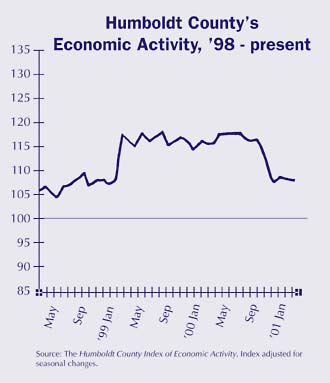
Humboldt County is travelling
back in time: A national economic downturn and high energy prices
are combining to erase gains the Humboldt economy made over the
last two years.
"We had been gradually
increasing until 1999," said Steve Hackett, associate professor
of economics at Humboldt State University and executive director
of the Humboldt County Index of Economic Activity. The
economy then experienced "a burst of activity that maintained
itself until late 2000. Then with the combination of the energy
crisis and the economic slowdown, we're back to where we were
in 1999."
Hackett acknowledged the slowdown
may last awhile. In the meantime, there are "some businesses
struggling with lower demand and much higher production costs."
 Like
the national figures, local manufacturing is showing the signs
of strain. According to the Index, the manufacturing sector dipped
4.4 percent in March. Even more telling is the change since last
year: Activity in the sector was 14.5 percent lower than in March
2000. Like
the national figures, local manufacturing is showing the signs
of strain. According to the Index, the manufacturing sector dipped
4.4 percent in March. Even more telling is the change since last
year: Activity in the sector was 14.5 percent lower than in March
2000.
Manufacturing problems are more
than just statistics. In addition to the imminent closure of
Eel River Sawmill, Pacific Lumber Co. announced last week 100
jobs will be lost due to the closure of its old-growth redwood
mill (see related story).
Humboldt residents are not necessarily
tightening their belts, however. The retail sector went up while
manufacturing declined. Hackett said that both nationally and
locally, "Consumers are less confident than they were a
year ago, and yet if you look at consumer behavior, they keep
buying houses and cars and vacations."
That spending could eventually
lead to problems with consumer debt, but right now vacationers
are helping to grow Humboldt County's tourism industry. The hospitality
sector of the Index increased 11.4 percent during the month of
March. Current hotel occupancy rates are 23 percent higher than
they were just two years ago. And this is a purely northern phenomenon:
Occupancy rates at Bay Area hotels were down 8.5 percent from
a year ago.
Hackett warns that we shouldn't
pin all our hopes on tourism.
"The big uncertainty is
what's going to happen with gasoline and electricity prices,
and the concern is they may have a deleterious effect on the
tourism industry."
The latest American Automobile
Association study found that prices are higher in Eureka than
in any other spot in the continental United States. The state
average is $1.84 a gallon, while Eurekans pay more than $2.10.
Many feel gas prices are only going to increase this summer.
Prices for electricity are also
about to go up. Hackett said that for all of the talk and the
occasional blackouts, price caps have kept electricity prices
from rising as much as the commodity's shortage dictates. The
Public Utilities Commission is expected to commit itself to a
new rate schedule soon, however, and it will "put much higher
numbers on the people who use a lot of energy," Hackett
said.
"Once the PUC becomes committed
there will be tremendous economic incentives" to conserve,
Hackett said.
Klamath
water kept in river
A request by Klamath Basin farmers
to reopen the irrigation project that feeds their lands was denied
in federal court last week.
Farmers in Eastern Oregon and
Northeastern California have irrigated their land with water
diverted from the Klamath River and its headwaters in Klamath
Lake since 1907. Threatened coho salmon in the river and endangered
sucker fish in the lake often suffer from lack of water.
The Bureau of Reclamation, which
controls the irrigation project, decided with the mountain snowpack
that feeds the river at less than one third of its normal size,
there would not be enough water to irrigate crops and protect
fish -- and the fish come first. The bureau has shut down 90
percent of the irrigation flows to farmers.
The farmers' lawsuit aims to
force the bureau into giving them water. The farmers had asked
for a preliminary injunction to keep water flowing until the
court case could be decided; injunctions are only issued when
there is a great likelihood the lawsuit will succeed.
In San Francisco last week Judge
Ann L. Aiken wrote that the Endangered Species Act gives fish
species priority over the farmers and recommended that the farmers
negotiate long-term solutions outside of court.
Dances with -- bears?
IF YOU ARE GOING TO ENTER A
DEN," SAID BEAR BIOLOGIST RICH CALLAS, "it is critical
to make sure the bear is tranquilized." While that might
seem self-evident, even seasoned veterans like Callas make the
occasional mistake in dosage.
"We had one instance where
it was not. No one got hurt but my adrenal level went up,"
Callas said in a telephone interview from Redding.
Which begs the question: What
on earth was he doing crawling into a bear den?
![[photo of Melissa Crew with bear cub]](news0510-cub.jpg) DFG wildlife biologist Melissa Crew with
bear cub. DFG wildlife biologist Melissa Crew with
bear cub.
Callas and his crew of wildlife
biologists were checking on females and their cubs as part of
a 10-year study of bear reproduction in two areas of Siskiyou
County. Callas just completed his winter work, opening bear dens
to count cubs and put radio collars on hibernating female bears.
After a female has a radio collar,
she will be visited by Callas for the next several years. He
uses flights in small planes to find the general location of
a den, then approaches on foot. He often has to dig through a
few feet of snow to find dens.
"We've been looking at
how old they are, what their ages are and how they reproduce,"
Callas said. The idea was to get a picture of "how a female's
ability to produce cubs changes when she ages," he said.
The data will be added to the Department of Fish and Game's stockpile
of information on bears, which is used to evaluate the effect
of hunting on the bear population. The department then makes
recommendations on hunting quotas to the state Fish and Game
Commission.
But for Callas, the means are
more interesting than the end. "Personally," he said,
"I have a great interest in wildlife. Bears to me are fascinating
animals for many reasons. They are long-lived, intelligent and
have evolved some complex strategies for survival. Getting a
chance to work on them is a great opportunity."
And the study has yielded a
wealth of information on the species.
The western edge of Siskiyou
County may support the highest density of bears, measured in
average number per square mile, anywhere in the western United
States; litter sizes averaged between 1.5 and 1.9 cubs per female;
the "home range," or area a bear covers looking for
forage, is between 14,000 and 22,000 acres; and the infant mortality
rate in this area is about 50 percent, possibly due to predation
by male bears.
![[photo of Callas]](news0510-rich.jpg) Rich Callas, bear biologist Rich Callas, bear biologist
"Adult males will eat the
cubs," Callas said, adding that such behavior is normal.
He said that bears are "omnivorous -- they will eat anything."
Early in the spring, when food sources are scarce, adult males
"will eat the cubs as a source of protein."
It is sometimes more than hunger,
Callas said. "If a male bear sees a female with a young
cub in the spring he will kill that cub and bring her into estrus
so he can breed with her."
Many dens are located in hollow
spaces high in trees -- as much as 100 feet off the ground. It
remains unclear just how bears know that these dens, which are
often almost invisible, are there. "In some of these large
Douglas fir trees you can see where bears have climbed them for
many years. Sometimes a trail of bear tracks will spiral around
the tree."
Those dens Callas has to pass
by, because the hibernating bears are still "very alert,"
Callas said. If he tranquilized a bear hibernating in a tree
and it ended up stumbling out, "it could fall 70 feet,"
he said.
As such, he doesn't yet know
why some female bears appear to prefer hibernating with their
cubs in a tree. "It may be that females are taking their
yearlings up off of the ground to protect them from predation
by male bears, but we don't know."
Those dens that he can access
are made in hollow logs or in trees close to the ground. The
same principle that prevents him even looking at dens high in
trees applies here: The bear's health and safety come first.
"It's not good for the bears" to be disturbed during
hibernation, Callas said.
But with his hands-on technique
(and courage), he doesn't have to disturb them. Just open the
cave, peek in, tranquilize the bear and cub and do your work.
By the time the bear wakes up, she'll never even know he was
there.
Reported by Arno Holschuh
COVER
STORY | ARTS ARCATA! | CALENDAR
Comments? E-mail the Journal: ncjour@northcoast.com
© Copyright 2001, North Coast Journal,
Inc.
|