|
 
IN
THE NEWS | PUBLISHER | CALENDAR
![A dying breed - Humboldt's small loggers are getting regulated out of business [photo of Gary Giannandrea]](cover0508-photohed.jpg)
by KEITH EASTHOUSE
by ANDREW
EDWARDS
SITTING IN HIS OFFICE, ABOVE
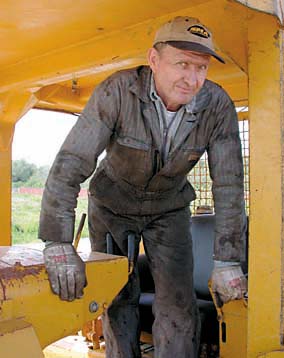
HIS FEED WAREHOUSE in north Arcata, Gary Giannandrea [photo above] still
dresses like the logger he once was. A sharp-eyed, ruddy-faced
man, he's wearing the baseball cap, the ragged-cuffed jeans,
the leather boots of a woodsman. But, he quips, it's only because
he hasn't had the money to buy new clothes.
"I've employed up to 26
men, plus truck drivers at [the same] time," Giannandrea
said. "I worked solely for private ranches. I have not logged
a stick in two years."
And it's not just him. Many
other small contract loggers, self-made men who saw an opportunity,
scraped enough money to buy their first piece of equipment and
worked hard getting their businesses off the ground, have been
driven to other jobs.
Giannandrea runs his feed store,
does some trucking, and picks up whatever other opportunities
he can find on the side. Duane Willfong [in photo below],
just down the road on Giuntoli Lane, started logging in the early
`70s; these days he does mechanical work. Ken Bareilles of Eureka
is now a full-time lawyer; he passed the bar in 1969, but until
last year he'd been in the woods continuously since he bought
his first "Cat" in 1975.
 While
the Pacific Lumber Co. and Sierra Pacific Industries draw the
headlines and the controversy, small loggers have ended up as
collateral damage in the region's never-ending timber wars. Some
have moved into environmental restoration work, while others
have gotten out of the forestry field entirely. Many have simply
left the area. While
the Pacific Lumber Co. and Sierra Pacific Industries draw the
headlines and the controversy, small loggers have ended up as
collateral damage in the region's never-ending timber wars. Some
have moved into environmental restoration work, while others
have gotten out of the forestry field entirely. Many have simply
left the area.
The $10 to $30-per-hour jobs
that small loggers like Giannandrea used to provide to local
men, many fresh out of high school, and the young families those
men supported, are disappearing from the North Coast.
"That's [a lot of] men
who are no longer being fed by the local economy, who have moved
out of town," Giannandrea said, referring to his work force
in years past. "These are men with families, with multiple
numbers of kids."
Why can't people like Giannandrea,
Willfong and Bareilles do the work they used to do? The reasons
are complicated, but nearly everyone interviewed for this article
agreed that the ever-increasing amount of paperwork needed to
complete timber harvest plans (THPs) in the state of California
is largely responsible.
"Very little changes in
the basic methods or rules of timber harvesting, but all this
regulatory stuff has gotten to the point where it's absolutely
ridiculous," said Willfong, sitting in his powder-blue-upholstered
camper trailer office. "It's all baloney, totally baloney.
I've got other words for it, but for the sake of this interview
it's all baloney."
Are all the regulations adding
up to greater protection for the environment? Not according to
one prominent environmental activist.
"The difference is CDF
is requiring all these regs and stuff and when you look at what's
happening on the ground nothing changes," said Cynthia Elkins,
program director for the Garberville-based Environmental Protection
Information Center. "They're stacking the record to make
it hard for citizens to take legal action. They're more concerned
about that than they are about the environmental impacts on that
land."
Steve Matzka of the Humboldt
State University Forestry Department stated the obvious -- and
summed up the problem for small loggers -- when he said: "The
more limitations, the more regulations, the higher the costs."
The
age of regulation
According to Matzka, back in
the 1960s and very early `70s it was relatively simple: If a
landowner wanted to log on his property, all he had to do was
have a professional forester fill out a form, similar to the
type still used today in Oregon and Washington state. The timber
plan was then reviewed by CDF foresters. It's not like there
weren't rules, but in many ways getting a THP was a rubber-stamp
process like registering a car at the DMV: If your ducks were
all in a row, off you went.
Then came the `70s and the passage
of two laws that forever changed forestry in California: The
Z'Berg Nejedly Forest Practice Act of 1973, which imposed a series
of restrictions aimed at reducing erosion and other damage caused
by logging; and the California Environmental Quality Act (CEQA),
which set up a procedure for reviewing the environmental impacts
of logging.
A key change was that the forestry
department no longer was the only state agency involved in reviewing
private lands logging. Instead, any state agency that had an
interest in protecting the environment -- notably the regional
water boards and the Department of Fish and Game -- could now
comment and suggest changes to THPs, beginning their transition
to cumbersome legal documents. Add in the federal Endangered
Species Act, also passed in the early `70s, and suddenly cutting
down trees had become a complicated -- and expensive -- business.
In the past 10 years more and
more analysis has been required, as new endangered plants and
animals are protected. It is all adding up to new layers of paperwork.
"We do require more information,
more thorough analysis, as things change in the academic community
and elsewhere," said Dennis Hall, deputy chief at CDF resource
management. "These projects are a lot more complicated than
even 10 years ago."
Not that the restrictions are
all bad, not even close. Loggers and environmentalists alike
have an interest in a healthy, sustainable environment, "good
stewardship," as Willfong put it.
"Every one of us has an
emotional connection to the forest," said Bill Sise, a forester
and 32-year veteran of the HSU Forestry Department.
Tracy Katelman of the Willits-based
Institute for Sustainable Forestry, a group that works to promotes
good forestry practices, said, "The regulations are in place
for a reason; the problem is the paperwork."
Donald P. Gasser of the University
of California at Berkeley, an expert on the California Forest
Practices Act, said in a recent study that while the law has
"measurably improved" soil and water quality over the
past 20 years, it has also proven "a burden wherever applied,
particularly among non-industrial private forest landowners."
The problem, he said, is a lack of flexibility; the law imposes
the same strict rules statewide, despite the fact that California's
forests are extremely diverse.
"Attempts to regulate California's
huge forest lands through prescriptive rules are seen as constraining
to management and productivity as well as expensive at all levels
of implementation," Gasser wrote in his study, based on
information provided by 23 land managers, loggers and regulators
in the private sector.
Gasser said that the minimum
preparation cost for a THP is $8,000 to $12,000, with some costing
well over $20,000 -- five to 10 times what it was a decade ago.
The greater expense has sent
private forest landowners in one of two directions, according
to Gasser: Some are cutting their lands faster and more thoroughly
so as to offset the cost of regulation and to reduce the need
to harvest in future years; others aren't cutting at all and
instead are selling their lands, either to developers who build
subdivisions or to farming interests who clear the land to make
way for other crops, such as grapes in places like Mendocino
and Sonoma counties.
A
politicized process
Of course, the economics of
forestry is not the only thing that's changed. The whole process
is also more political than it used to be.
The fact that several agencies
now review THPs has created rivalries that can get in the way
of sound decisions. "Turf battles between regulators place
more emphasis on political power than on environmental quality,"
Gasser said. While it doesn't involve small loggers, such a battle
is currently going on in the Van Duzen watershed, where the North
Coast Regional Water Quality Control Board and the forestry department
are at odds over the pace of logging on Pacific Lumber lands.
Additionally, legal challenges
from environmentalists have injected politics into forestry.
The timber wars of the late `80s and early `90s in particular
led to a flurry of environmental challenges to timber sales on
the North Coast; the impacts are still being felt today, not
least in the THPs themselves, which have became more complex
in part so that they are more easily defensible in court. What
was once a simple two-page form has turned into a document sometimes
inches thick.
Take the example of Janice and
Gordon Tosten, partners in the 5,000-acre "Stewart Family
Ranch" near Alderpoint. The Tostens have been working more
than a year on getting a Nonindustrial Timber Management Plan
for their land. It has cost them over $100,000 dollars.
To get an NTMP a myriad of surveys
has to be completed by a veritable gaggle of experts: a timber
cruise to see how much is there, a geological survey, an archeological
survey, a flora and fauna survey, a survey of any creeks and
draws. The people doing these surveys are typically paid between
$50 and $100 an hour.
After the survey work is done
things get really expensive. The various agencies responsible
for signing off come out and suggest whatever mitigation they
think is necessary: culverts for streams, improved roads, more
stable log decks -- and that's all before any actual logging
plan has been developed.
Using the Tostens' ranch as
a rough example: They are allowed to harvest 800,000 board feet
of timber each year (a board foot is a 1 foot by 1 foot piece
of lumber 1 inch thick). At $500 per thousand board feet (anything
less and "you're pretty much giving it away," Janice
Tosten said), it's worth $350,000 at the mill after "dockage,"
the portion of the tree that can't be milled. The Tostens will
see about 15 percent of that. First there's the timber plan itself
and the annual upkeep it mandates: $120,000. Then there's the
logging and trucking costs: about $154,000. Add in other costs,
like $5,000 for insurance, $5,000 for taxes, and $6,000 for yearly
owl hoot and biological studies, and the Tostens are left with
a relatively modest profit of $60,000; that's not only for them
-- they work on the ranch year-round -- it's also for the two
other families who work it with them.
Such economic realities do not
encourage light-on-the-land logging.
"If you want to do good
forestry out there you're not going to make any money,"
said Katelman of the sustainable forestry group. "If you
clearcut you'll make money, and if you clearcut and subdivide,
you're hitting the jackpot. That's not what we want to see."
The bread-and-butter timberland
owners, people with 40, 80, 160 acres of land, many of whom have
been growing the trees for years as a sort of retirement fund,
have even less of a profit margin. A small plan can run anywhere
from less than $5,000 to $50,000, depending on what happens after
it goes into agency review.
All of this leaves small loggers
who used to contract out with private
landowners competing for a shrinking
pool of employers.
Bad
market
Of course, regulations aren't
the only problem.
People wouldn't be as worried
if the timber market was like it was in 2000.
"Money can conquer all
odds," as Willfong put it.
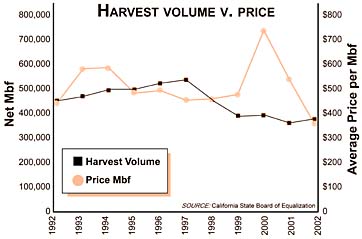
The average price for timber
coming out of Humboldt County back then was $733 per thousand
board feet. Last year that price had fallen to $349. As the season
starts this year it's hovering just below $500.
Partially that's because log
prices have been driven down by imports from less regulated areas
such as Oregon, Washington and in particular British Columbia,
which still has large swaths of old-growth. Because an economic
downturn in Asia has reduced demand, those prime logs have been
shipped down the coast to Humboldt County mills. They have a
variety of advantages.
Most importantly, they are already
processed with the useless parts of the logs (or dockage) already
removed, so the mill produces more lumber for its time.
Also, the supply is fairly steady
and can keep mills going through the winter.
"[If you use imported logs]
you don't have to be involved with the logging down here, with
all that unpredictability," said Bareilles.
There are other problems with
logging in California. The cutting season has been shortened
over the years by a month or more, in part to avoid logging during
the nesting season of imperiled birds such as the northern spotted
owl and the marbled murrelet. And workers' compensation costs
in the state have skyrocketed.
As if all that weren't bad enough,
almost no timber has been available for logging in the state
and national forests in the last year, mainly due to environmental
challenges and restrictions imposed by the Northwest Forest Plan,
which governs logging on public lands in Washington, Oregon and
northwestern California.
Possible
solutions
So what's being done? For the
past several years a group of foresters, landowners and even
some environmentalists have been working on something called
the Buckeye Forest Project. (See "The
Trail to Cooperation," Nov. 15, 2001.) They've taken
a piece of land and run it through the regulatory maze to illustrate
just how exasperating the process has become. The goal is to
highlight the system's flaws and eventually formulate some concrete
recommendations on how to improve it.
"[We're going to tell the
state] here's what's really happening," said Jim Able, the
forester who's been directing the project. "How can we give
the Legislature some specifics on how to turn this thing around
so we still get the same environmental protections, [but do it]
like other states do it? Their forests look the same as our forests
and they're not strangling their economy."
Other groups such as the Alliance
for Sustainable Jobs and the Environment, of which Katelman is
the co-chair, have been trying to bring together timber workers
and environmentalists to find common ground -- and, they hope,
figure out a way to make the system work for everyone.
"If
you're taking care of your forests you're taking care of your
workers," Katelman said.
Finally, some loggers have gone
into the environmental restoration field, where they are essentially
trying to undo the harm that results when a forest is cut.
Redwood National Park, which
contains large portions of cutover land, has long employed loggers
in such work, which typically involves shoring up or removing
logging roads, revegetating and using bulldozers to restore the
land to its original contours.
Steve Hackett got out of the
logging business in 1995 after his family was forced to sell
their 3,000-acre ranch west of Scotia. After three years of stalled
harvests because of studies mandated after the spotted owl was
listed as an endangered species, they'd been driven out of business.
"You can imagine what a
three-year delay will do for a small business with a $60,000-a-year
interest payment," Hackett said.
Now he does forestry and restoration
contract work, helping logging companies restore areas that have
been harvested. He said he misses managing his family's land.
On the other hand, he's happy to be out of the logging business.
"If you were to do a business
plan in `95 about what the prospects were, there were none,"
Hackett said. "It's even tougher now than it was then."
Tough
transitions
Meanwhile, independent loggers
are disappearing with fewer and fewer young people taking their
places.
When Willfong first went into
the logging business, he could just knock on people's doors and
ask if they wanted some logging done on their land. Regulatory
overhead was hardly a worry. Doing business that way today is
simply not possible, said Willfong, who has yet to find any logging
work this year.
Giannandrea said some small
loggers are so desperate for work that they are bidding less
for jobs than it will cost to do them.
"I don't feel that I can
be competitive because people are so hungry they're outbidding
jobs just to work," he said, adding that his primary professional
focus is his feed store.
But for those who depended on
the logging jobs that men like Giannandrea provided, there is
no fallback plan, and sometimes transitions out of the industry
can be hard.
"One of [my ex-employees]
works in the farm country now driving tractor, plowing ground,"
Giannandrea said. "And he complains to me that if it wasn't
for stealing food out of the fields he'd have a tough time making
it. You know? That's what's going on."
Sise, the long-time forestry
professor, summed it up like this: "It's kind of what happens
to these people. They just don't make transitions well. Their
fathers, their grandfathers, their brothers, their uncles have
been doing it forever. They get the dirt and the chips in their
blood. And it's hard to get out of it."
Editor Keith Easthouse contributed
to this report.
IN
THE NEWS | PUBLISHER | CALENDAR
Comments?
© Copyright 2003, North Coast Journal,
Inc.
|