|
 
by ARNO HOLSCHUH
ABOUT 10 MINUTES INTO THE INTERVIEW,
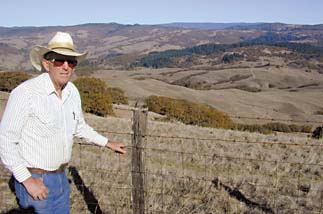
John Rice [photo below
left] stops in the middle of a
sentence and looks down the dirt road that runs through his impressive
Eastern Humboldt cattle ranch.
There's a car coming up the
way -- unusual in this part of the county, three quarters of
an hour past Bridgeville on one-lane roads. "It's the new
mailman," Rice says.
"He must be lost."
 It's not hard to get lost here. Remote and sparsely
populated, these wide stretches of pasture with clumps of timber
have few landmarks or signs of development. It's not hard to get lost here. Remote and sparsely
populated, these wide stretches of pasture with clumps of timber
have few landmarks or signs of development.
But some humans know the land
intimately. Rice has worked and lived on this land for almost
40 years. He can point out ancient stands of oak, tell you where
his cattle cross Indian Creek, kneel down and name the grasses
that form an amber carpet across his pastures. Peering across
the valley, he can even pick out the cabin he grew up in, before
his current house was built. "My mother taught me sixth,
seventh and eighth grade in that cabin," he says.
And he wants to keep the ranch
in the Rice family. "I hope that somebody in the family
will continue to go on with the ranch," he said. But while
Rice has successfully managed his land, he admits it's getting
tougher to keep a cattle ranch running.
That's why Rice, like many other
ranchers and small-scale timberland owners, has become part of
the Buckeye Conservancy. A group of landowners worried about
keeping Humboldt's open space in family hands, the conservancy
is bringing people from all sides of the environmental debate
together to look for common ground.
Through advocacy, education
and legal tools, the conservancy is trying to achieve the one
goal that everyone can agree on: Keeping open space open.
"We haven't been really
been represented by a particular body," Rice said. "I
think the Buckeye Conservancy can help."
Ranchers are by their nature
independent people. Families used to riding herd across thousands
of acres of their own range are understandably proud of their
self-sufficiency; it's a way of life. Global realities are making
that voluntary isolation hard to maintain, however.
"We're beyond the point
where the landowner will have total control over his destiny,"
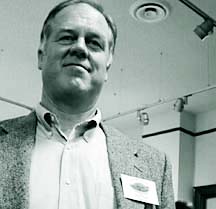
said Andy Westfall, a rancher, timberland owner and chairman
of the board of the conservancy. "Those days are just gone."
[Westfall in photo below
right]
 The end of those days has been heralded
by two developments that the settlers who pioneered these ranches
could never have foreseen: the global marketplace and environmental
regulation. The end of those days has been heralded
by two developments that the settlers who pioneered these ranches
could never have foreseen: the global marketplace and environmental
regulation.
The essential problem for a
rancher today is one of free-market economics. The price of beef
has gone down precipitously in the last 20 years, from $1 a pound
in 1980 to just 72 cents now -- and that doesn't even take inflation
into account.
"The big question then
is: How have I been able to survive. The answer is that I, like
a lot of other ranchers in Humboldt County, have a little timber.
Utilizing that properly has helped the bottom line," Rice
said.
But it has also brought ranchers
into much closer contact with state regulators. The costs to
have a logging operation licensed by the state can be prohibitive,
Rice said, especially for small landowners.
And not being able to do modest
timber harvesting can have environmentally counterproductive
effects, Westfall said. Some landowners may harvest more than
they initially want to -- just to cover the costs associated
with the regulatory process.
If the cost of the studies necessary
for timber harvest plan approval makes harvesting unfeasible,
a small landowner may "consider whether or not it's worthwhile
to hold that property." If sold, the land could become available
for development.
In that sense, environmental
regulations may have an unintended effect: pushing more land
into development while punishing those who want to harvest modest
amounts of timber.
"Right now the regulatory
environment is punishing to those who are good stewards of their
land," Westfall said.
That's where the conservancy
comes in. In an attempt to provide a model of what they consider
sensible regulation, the conservancy has started the Buckeye
Forest Project. The project entails taking a small team of government
officials, landowners and members of the public out to a piece
of property and working out a way to make good forest stewardship
pay for small landowners.
"We're going to put together
a long-term management plan, address habitat issues, restoration
projects and timber harvesting," Westfall said.
Timber harvesting isn't the
only area where the relationship between regulation and ranching
needs improvement, Rice said. Another example would be species
protection law: People who work the land they own now live in
fear of having an endangered species found on their property,
he said.
Rice's land provides habitat
for a wide range of wildlife -- a healthy herd of blacktail deer
as well as high numbers of black bear, mountain lion, wild turkey,
coyote and bobcat. "We have pretty much everything,"
he said.
In a perfect regulatory world,
Rice should be rewarded for managing his land in such a way that
it retains its habitat values. In reality, Rice has "real
fear" that his land may be harboring an endangered species.
"If they found an endangered
plant on my land tomorrow, they'd immediately want to rope off
that area," he said. For ranchers operating on narrow profit
margins, that's not acceptable.
If, on the other hand, the law
were to look at how the species might be integrated into ranch
activities, Rice said he would welcome the regulators. "If
they were to say, `Is there something we can do here with you
and not foul up your operation?'... I don't know of a rancher
who would not be interested in that," he said.
 Through
the conservancy, ranchers have found an unusual ally in their
efforts to improve the effects of environmental regulation: environmentalists.
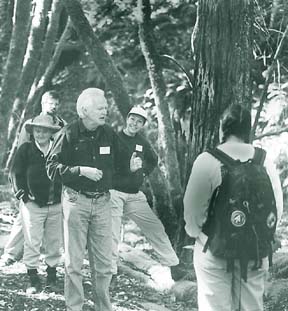
Rondal Snodgrass, emeritus director of the nonprofit land trust
Sanctuary Forest, said he hoped the conservancy would cause government
to "take a new look at environmental regulation, taxation
and their impact on these landowners. [Photo at left shows Snodgrass leading a group
hike] Through
the conservancy, ranchers have found an unusual ally in their
efforts to improve the effects of environmental regulation: environmentalists.
Rondal Snodgrass, emeritus director of the nonprofit land trust
Sanctuary Forest, said he hoped the conservancy would cause government
to "take a new look at environmental regulation, taxation
and their impact on these landowners. [Photo at left shows Snodgrass leading a group
hike]
"You have to make it so
that the landowners can do a good environmental job and still
have an economically feasible operation," he said.
That's not just in the interest
of ranchers and environmentalists, Snodgrass said. A much wider
community is being affected by the decisions made in the hinterland,
because it is the working landscapes of ranches and timberland
that provides Humboldt's more densely populated coast with its
quality of life.
Surveys conducted in Humboldt
County have shown that clean air and water are among the most
important factors in calculations of that quality of life.
"By maintaining the ranches,
timber and relationship to the land in a way that produces clean
air and water, landowners are providing exactly what people want,"
Snodgrass said.
"The public -- beyond the
landowners -- needs to see the economic and social value of open
space," he said.
Snodgrass knows the alternative
all too well. Raised in an Oregon ranching family, he said he
watched his family "give up those ranches and farms because
of economic pressures."
"Our family didn't have
a relationship with other ranchers and farmers so we could get
together and say, `How are we going to keep the land?' So that
land got dispersed. Now it's been developed," he said.
Even ranchers and timberland
owners who are able to keep the land in their custody during
their lives face a big problem when they are ready to pass the
land on to their children.
The estate tax, triggered by
the death of the landowner, is based on the assessed value of
the land. If the land is developable, that value is likely to
be very high -- possibly too much for the children to pay. It
doesn't matter that the children have no intention of developing
their land; the mere possibility is enough to drive the price,
and the tax, up.
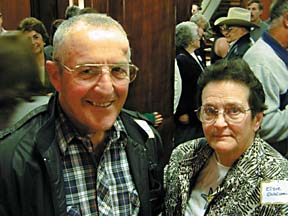 "I'm third generation, and
you'd like to see the land stay in the family, but you can't
always get what you want," said Henry Giacomini, a Ferndale
dairy farmer. "I'm third generation, and
you'd like to see the land stay in the family, but you can't
always get what you want," said Henry Giacomini, a Ferndale
dairy farmer.
It is that desire that brought
Giacomini and his wife Elsie to the Morris Graves Museum for
a Buckeye Mixer Nov. 2.
[In photo at right] The Giacominis
are interested in seeing if the conservancy can help them find
more information on conservation easements, legal tools which
can yield cash to landowners while lowering the assessed value
of the property, making it easier to pass on.
"Our land is worth more
all the time, so yes, I'm interested," Giacomini said.
Conservation easements are the
official and legally binding equivalent of a promise to keep
your land undeveloped and healthy. An environmental group like
the Pacific Forest Trust will usually pay handsomely for that
promise. In one recent case, a rancher was paid $1.3 million
for a conservation easement by the Santa Rosa-based group.
At the same time, by making
it impossible to ever develop the land, easements ruin the market
value. That means less estate tax and an easier time passing
the land on.
Westfall said that he foresees
putting an easement on his land in the future. "I'm open
to the idea, because I don't see that kind of restriction as
being contrary to our long-term goals," he said. "We
don't want to see our property under subdivision pressures."
The Buckeye Conservancy, Westfall
said, "will in the future be a facilitator for landowners
who want to pursue easements."
But there's a problem with conservation
easements, one best seen as not only legal but cultural. "I
think if you ask most ranchers today, they'd be skeptical of
any kind of easement because you're giving up rights to your
property," Westfall said.
"An easement isn't something
I need to do right now," Rice said. As long as he can find
a way to keep his land together without an easement, Rice said
he is likely to avoid them. At the very least, he would need
"to know a lot more about it," he said.
Through his membership in the
conservancy, he'll get a chance to learn. "One of the things
the Buckeye Conservancy can do is help ranchers and small timber
owners discover and analyze the different options out there for
staying on the land," Westfall said. "There are some
types of easements that will work for some families."
Easements aren't the only issue
where education can defuse rachers' mistrust. One of the most
important functions of the conservancy will be to just get people
together, Rice said.
"The Buckeye Conservancy
seems to me to have a good mix of people: There are large and
small landowners, and people from the environmental community
are talking to us," he said.
"If we can keep that and
get dialogue between all of us, that will be a win-win situation.
Of course you always come down to the hard questions, and those
need to be talked out," he said.
Those "hard questions"
include, most importantly, a discussion about whether his style
of land use is appropriate at all. "Some people will think
no activity on the land is best," he said.
"But we have to have activity
to pay our bills and make some money. We want to stay in business."
Getting others to understand how important that is to everyone
in Humboldt County is "the kind of thing that can be figured
out with the Buckeye Conservancy."
Common-sense
stewardship
GOOD LAND MANAGEMENT practices
aren't just important because of environmental concerns. Rice
said that he has always managed his land conservatively because
doing so safeguards his future prosperity.
"The cow is just a tool
that we use to harvest the grass," he said. "We use
the cattle to utilize that grass; we gain weight on the calf
through grazing and then we sell the calf."
"Just following common
sense, if we damage the pasture, we're damaging our bottom line,"
he said.
That philosophy of common-sense
stewardship extends across Rice's current ranch and timber operations.
When Rice harvests timber on his land, for instance, he seeds
the ground disturbed by the logging with native grasses afterwards.
That helps hold the land in place to prevent erosion and preserve
the soil that is producing timber -- and income.
It also extends back in time
to 1951, when his mother and father bought the ranch. At that
time, environmental concerns weren't the subject of state regulation;
they hadn't even been fully articulated as problems yet.
But John's father Lee still
cared about good management practices. "We changed things
when my father took over," Rice said.
The previous owner had been
rough on the land when harvesting timber, he said. "There
were landings right in the creek, and a lot of dirt and silt
was pushed in." Without environmental law, that was all
perfectly legal -- but Rice said he still didn't think it was
right.
"My father was pretty business-minded,
but he still didn't like some of the things that went on at that
time," Rice said. The reason?
"You live out here long
enough and you just get a close connection to the land."
IN
THE NEWS | CALENDAR
Comments? E-mail the Journal: ncjour@northcoast.com
© Copyright 2001, North Coast Journal,
Inc.
|