|
 
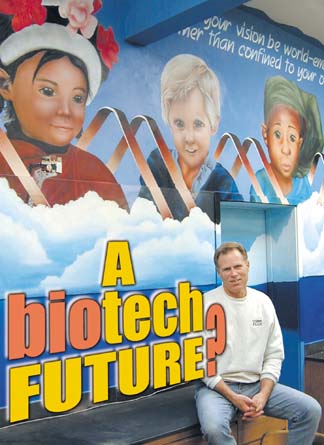
by BOB DORAN
SIDEBAR:
PORTABLE COMPANIES, ANYONE?
IN THE 21ST CENTURY WE WILL FIND A WAY TO LOOK INTO and predict
the future -- not with a time machine, but with a computer chip.
We will be able to look at human
DNA, the code that shapes us, and read it to find predictors
for genetic diseases like cancer. Once we identify the causes
of specific cancers, we will be one step closer to finding a
cure.
And if Bill Schaser has his
way, Humboldt County will play an important role in the manufacturing
of these high-tech biochips. If all goes according to plan, 800
to 1,000, high-paying high-tech manufacturing jobs will be created
by this venture into the science of the future.
Schaser, a retired Eureka High
School science teacher, is an initial investor and the education
director for Iris BioTechnologies Inc., a company that is on
the ground floor of the new and highly competitive biochip industry.
Born in Seattle, Schaser grew up in the Bay Area and moved to
Humboldt County when he was 17 to attend Humboldt State University.
"I came to Humboldt as
a forestry major, but that didn't take," he said in a conversation
at his home at the end of a winding road in Eureka. He and his
wife, Kay, built the split shingle-covered house by hand from
the bottom up, even milling the wood themselves.
Schaser graduated from HSU with
a degree in physical education, with an emphasis on physical
therapy, and a zoology minor. At first he put his degree to work
teaching physically handicapped kids. Eventually he joined the
staff at Eureka High teaching physiology and biology.
If his name and his face seem
familiar, it's because he was one of those at the center of last
week's Journal cover story. "High
School Diplomacy" told of an exchange program that sent
Eureka High students to Kaiping, China, and brought 10 high school
students and their teachers from China to Eureka. Schaser was
instrumental in arranging the exchange. He had previously led
student groups on trips to England and Russia and acted as host
for visits from those countries.
Twenty-five years ago Schaser
and his wife acted as hosts for another exchange program, one
that brought a young man by the name of Simon Chin from Burma
to Humboldt County.
"Kay was involved in some
sort of outreach program that involved getting kids out of the
inner city, especially Asian kids," said Schaser. "The
idea was for them to see what the rest of America is like. We
ended up with Simon Chin and another kid. Simon was 14 or 15.
He'd only been in the country for six months. They came up from
Chinatown [in San Francisco] on the bus and within 24 hours they
were totally at home."
![[photo of Schasers with Chin, 1975]](cover1221-1975.jpg) Bill and Kay Schaser with Simon Chin in 1975 Bill and Kay Schaser with Simon Chin in 1975
Simon stayed close to the Schasers
over the years, often visiting on vacations.
"He was very bright, a
regent scholar working under Glenn Seaborg, the Nobel laureate,"
Schaser said. "That's Seaborg as in the element, Seaborgium."
(Seaborg, who died in 1999,
was chairman of the Atomic Energy Commission in the 1960s and
served as an associate director of the Lawrence Berkeley National
Laboratory from the '70s until his death. He was the co-discoverer
of plutonium and nine other transuranium elements, including
Seaborgium.)
Chin graduated at the top of
his class at Berkeley with a degree in chemical engineering and
initially went to work for a struggling chip manufacturing firm,
helping make operations more efficient. When it was bought out
by Dupont, he continued under the new ownership.
"He became the kind of
a quality control guy for all the Dupont subsidiaries up and
down the West Coast," said Schaser. Chin specialized in
management restructuring, utilizing team building, something
Schaser calls "the Asian way."
Eventually Chin left Dupont
and went to work for an American company that was operating overseas
building high-powered microscopes designed for examining chips.
Two years ago he decided it was time to start his own company.
The genome chip business was brand new.
![[photo of Bill Schaser and prototype biochip]](cover1221-bill.jpg) Bill Schaser,
with inset photo of a Bill Schaser,
with inset photo of a
prototype biochip, smaller than a quarter.
"I don't think Simon knew
much about DNA, but he met with friends at UCSF who knew all
about it. He became very knowledgeable," Schaser said.
Recent technological advances
have led to rapid advances in knowledge about human DNA. The
year 2000 saw two major developments. In March President Clinton
and British Prime Minister Tony Blair announced that the data
collected by the Human Genome Project will be available to all
via the Internet. Then in June Dr. Francis Collins of the Human
Genome Project and his counterpart in private business, Dr. Craig
Venter of Celera Genomics, made a joint announcement: We now
have a rough draft of a map of the human genome.
"Once you can read your
genome, you can see the future," said Schaser.
The next step is to take the
knowledge and put it to work. Iris and other companies are using
this genetic data to create an analysis system that will pinpoint
the causes of genetic disease. The key is devising a way to mount
representations of gene segments -- called oligos -- on a silicone
chip, creating what is called a biochip.
We have all seen models of the
DNA molecule showing it as a double helix -- a twisting ladder
with 46 chromosomes. The chromosomes are comprised of approximately
three billion rungs, or base pairs, made of anywhere from hundreds
to thousands of genes.
Imagine the ladder split in
two, then further dismantled into microscopic gene segments that
are fused into an array of tiny pits on the face of a chip. The
result is a biochip.
In Iris' first major project,
the arrays will include genes bits corresponding to known anomalies
that indicate breast cancer. Matching an individual's DNA against
the array, doctors will be able to pinpoint the gene causing
the cancer, Schaser explained.
"The key is specificity.
You take the cancer cell, look at it and identify what genes
are causing the problem. The future in medicine is to tailor
treatment to the specific gene," says Schaser.
"At this point they have
identified 4,000 to 5,000 genetic diseases. Some are extremely
rare, some are fairly common. Our game plan is to focus on something
specific and there's a need for a good cheap breast cancer test.
The idea -- and for Simon this borders on evangelism -- is to
make diagnosis very, very affordable. That is his mission.
"It's a complete revolution
in medicine, the ultimate level of diagnosis. Right now we look
at effect; with this we'll be looking at cause. Then we can stop
the illness at the protein level or at the expression level.
"The biochip will enable
us to pinpoint the cause of a disease, at least the genetic basis.
My [role], as educational director, is taking that and looking
at how you nurture your DNA. In other words, how do you live
properly to limit the expression of that gene? Or if it can't
be done through nurturing, what kind of drug can eliminate the
disease?
"Someone asked me, `What's
the sense of knowing if there's nothing you can do about it?'
Part of my job as the education director is to say. `Wait a minute,
how do you nurture your genes?'
"It's what you eat, what
you drink, what you breathe and beyond that, the environment
you live in. Is it a stressful environment?
"I believe very strongly
that your health is affected by what you think. Good thoughts
are good for you. Bad thoughts can go beyond you. If you express
bad thoughts, you trigger chemicals that trigger someone else's
DNA and make them feel cruddy. You can trace it there. If that's
true -- and I think it is -- then on every level your health
becomes your own responsibility.
"Health costs are rising.
The projection is they'll be 20 percent of the GNP by the end
of the decade. We can't afford that. We can't compete globally
paying out that much for our health care.
"The bottom line is that
the individual has to be more responsible. I absolutely believe
the 21st Century is the century of responsibility. It will be
bumpy getting there. I'm as evangelical on this as I can be.
It fits into everything I teach. Ecologically, population-wise,
all issues come down to responsibility."
So why would a business like
Iris locate in Humboldt County instead of the Silicon Valley?
"I'm an initial investor
and the education director," Schaser continued. "When
I looked at the business plan [for Iris], I said, `Can this be
in Humboldt County?'"
Schaser answered his own question:
"Absolutely. The only thing
we're short on here is the capital. We have investors here, but
we need more to insure that it will happen here. We're finishing
our prototype, then it all comes down to raising five million
bucks.
"We're ramping up, figuring
that within five years we'll have 800 to 1,000 employees. This
is a perfect place to be. It's a non-polluting industry. In terms
of the end product, everything can be flown in and out. The chip
is no bigger than the size of your fingernail. It's `value added,'
something like Holly Yashi earrings.
"The chips themselves will
be made someplace else and shipped in. We just put the oligos
on. I don't know for sure that it's going to happen in Humboldt
County, but it's going to happen one place or another. If some
other community comes up with the venture capital it could move
somewhere else. But two of the investors happen to own [property]
in McKinleyville. I'd like to see it happen there -- or somewhere
in Humboldt County.
"This is my community.
I came here when I was 17. I believe it's just the kind of industry
this area is looking for. As a teacher I see all these bright
kids leave. Some want to leave, but there are a lot who would
like to stay if they found the right work. This is a wonderful
environment.
"People should be able
to make a decent living in Humboldt County using their brains.
This is an opportunity where I can be part of creating a business
that offers good jobs, a business that will be compatible with
this community.
"That's my vision and my
mission at this point. If I can do that, I'll know I've done
something good."
PORTABLE
COMPANIES, ANYONE? by Arno Holschuh
![[photo of Nelson and Agredano]](cover1221-agreda.jpg) IRIS BIOTECHNOLOGIES INC. ISN'T the only company
eyeing Humboldt County (see above story). A number of other young
entrepreneurs have similar thoughts -- or they have already arrived
-- because of quality-of-life factors such as clean air and water,
low crime, affordable housing and recreation. IRIS BIOTECHNOLOGIES INC. ISN'T the only company
eyeing Humboldt County (see above story). A number of other young
entrepreneurs have similar thoughts -- or they have already arrived
-- because of quality-of-life factors such as clean air and water,
low crime, affordable housing and recreation.
In 1997 Jim Nelson and Rene
Agredano, husband and wife, had fast-paced, cosmopolitan lives.
"We were living in San
Francisco and working in Silicon Valley," Nelson said.
With good salaries, they had
managed to save what they thought was a down payment for their
first house. But when they started looking, they found all the
homes in their price range fit into one category.
"Crappy," Nelson said.
"Living there, working
there, we were spending four hours a day in the car," he
recalled.
To relax, they would drive up
the coast to Humboldt.
"We were vacationing up
here around New Year's 1998 and saw the prices of homes."
Nelson decided he could get a few nice buildings and acreage
here for the same price as one of the homes in his price range
in San Francisco.
So the couple made the move
up Highway 101, bringing their marketing communications company
with them.
"We're definitely happier
up here, and it is definitely the quality of life that brought
us here and keeps us here," Nelson said. "People wave
and say hi."
Agreda Communications, as their
company is called, manufactures large-format graphics, corporate
IDs, logos, sales brochures, packaging -- "pretty much anything
that has to do with information design and marketing," Nelson
said.
They've had a lot of success
working right out of their home in Cutten. Nelson said they can
sell just about anywhere, "thanks to the internet and Federal
Express. The majority of our clients are in the Bay area, back
east or overseas."
Peter Shikli sees a similar
opportunity for other high-tech businesses to relocate to Humboldt.
Shikli owns a business in Newport Beach called "Bizware.com"
that produces the nuts and bolts programming that powers business
websites, and is interested in moving to Humboldt County for
the quality of life -- and the educated workforce that Humboldt
State University and College of the Redwoods produce.
It's hard to find good programming
help these days, Shikli said, and that's hurting businesses elsewhere
in the state.
"The shortage of knowledge
workers is kind of endemic. It is critical in the view of my
colleagues and competitors.
"What I noticed is that
this shortage is not evenly distributed throughout the world."
He said because of the educational programs at local institutions,
there is a surplus of knowledge workers, those who are trained
to work in computer information fields.
Shikli said he thinks a lot
of those knowledge workers could be convinced to stay in Humboldt,
even if a business owner paid lower wages, because the cost of
living is lower on the North Coast than elsewhere in the state.
And of course, there's the the
quality of life in Humboldt County.
"They like the place they
are residing," Shikli said.
Shikli sees a much bigger opportunity
than just relocating his business here. He wants to bring other
companies with him.
"When I came to look around
at Humboldt, I noticed there were basically two ways to go --
open our own satellite office, which would be very low scale
and have very little involvement in the community." The
other was to establish a "tech hub" by inviting other
high-tech businesses along.
"We'll have over 100 people
working out of the tech hub," Shikli said, once the facility
is established. A location has not been selected, but a decision
is expected very soon, he said.
But a business doesn't have
to be high-tech to relocate to Humboldt County.
Kent and Sally Gurley moved
to Arcata from Boulder, Colo., earlier this year because Boulder
had become too urban and too expensive. They brought their dye
and fabric manufacturing business with them.
"Boulder has become a lot
like San Francisco -- very high-tech, housing is expensive, commercial-lease
space is expensive. It's not very attractive for a manufacturing
operation," said Kent. So they began to look for an alternative
home for their new dye manufacturing plant and found Humboldt
County "fit our lifestyle parameters."
What are those parameters?
"A university, beaches,
mountains and the ocean," Sally said.
The mental environment was also
important to the Gurleys. Their company, Indigo Troupe, produces
non-toxic, environmentally sound dyes and fabrics and hand-woven
rugs. They wanted to locate where their values would be appreciated.
"Arcata seems to be a very
environmentally conscious community, which is important to us,"
Sally said.
"It was clear that the
only kind of growth the community was interested in supporting
right now was environmentally conscious industry. There is a
certain mutual respect there between the company and the community,"
Kent said.
The new group of Humboldt entrepreneurs
faces one critical problem: There is an inherent tension between
starting new businesses and maintaining quality of existing life.
Businesses move here because of the open land, lack of traffic
and the small town feel. But each additional enterprise takes
Humboldt a step away from the rural heritage entrepreneurs are
attracted by.
"We have to find a really
balanced approach," said Jim Kimbrell, executive director
of the Arcata Economic Development Corp. Kimbrell said one strategy
is to "only grow in those areas of our economy that will
be compatible with the existing quality of life."
But Kimbrell also said some
change is inevitable as the rest of the state gets crowded.
"We have to accept that
the growth in California's population will impact us. Maybe it
won't be as much as in other parts of the state, but we cannot
expect we're not going to be affected."
The Gurleys serve as a reminder
of the dangers of overdevelopment. Boulder, they say, became
a bad environment for business because it grew to the point where
it was too expensive and crowded. When they look at Arcata, Kent
said, "It looks a lot like Boulder 10 years ago."
IN
THE NEWS | CALENDAR
Comments? E-mail the Journal: ncjour@northcoast.com
© Copyright 2000, North Coast Journal,
Inc.
|