|
 
by BOB DORAN
SIDEBAR: STORIES
TRANSFORMED - Dell'Arte's "Rag and Bone Shop"
IN THE KEET TV STUDIOS ON HUMBOLDT HILL, JAN KRAEPELIEN and Chag
Lowry are editing a tape. On the screen is Merv George, a leader
in the Hupa community, telling a story about his career as a
rock `n' roll musician.
"I got to play for President
Nixon one time," George recalls, explaining how his band
set up on a flatbed truck at the airport when Richard Nixon came
to town along with Lyndon Johnson and then Gov. Ronald Reagan
and their wives for the dedication of the Lady Bird Johnson Grove.
![[photo of Chag Lowry and Jan Kraepelien]](cover1207-chagjan.jpg) Chag Lowry and Jan Kraepelien at KEET
studio Chag Lowry and Jan Kraepelien at KEET
studio
This is just
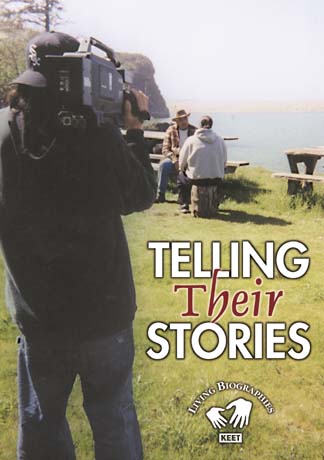
one part of a three-hour interview, shot with a digital video
camera by a crew from the Living Biographies Initiative, funded
in part by the North Coast Cultural Trust, which is in turn funded
by a million dollar endowment for "Community Partnerships
for Cultural Participation," received by the Humboldt Area
Foundation from the Lila Wallace Reader's Digest Fund.
Living Biographies grew out
of an idea that came up early in community meetings during the
planning phase of the trust, said Peter Pennekamp, HAF executive
director.
"Out of the process came
all these things that people believed collectively would take
culture in the county to the next level of public engagement.
"During the focus groups
there were plenty of ideas that got discarded. We looked for
ones that got picked up in a variety of places. An example is
the Living Biographies program which was first suggested by American
Indians, then some Portuguese people from the Eel River Valley
got really excited about it.
![[photo of Merv George]](cover1207-mervgeorge.jpg) Merv George during video interview
Merv George during video interview
"When we met with some
ranchers, they were falling out of their seats they were so excited
about it. We interviewed some of the new Hmong immigrants and
they were excited about it. Eventually you see that this is something
that's on people's minds."
The basic idea is simple: People
tell their stories and someone records them. How the stories
are recorded and shared has changed over time.
At first the program was administered
through the Humboldt Historical Society. Kathleen Stanton was
hired and she coordinated a series of public meetings, looking
for people to tell their stories.
One meeting held at the Humboldt
County Library invited people to share old photographs. An announcement
caught the attention of Kay Gott Chaffey who had a strong interest
in history.
"My husband's folks were
long-time residents here," said Chaffey in a recent interview.
"Keith [Chaffey's husband] taught here for years and years
and so did his mother, Adele. His grandfather built those barns
you see in the Arcata Bottom, the ones that are falling down
now. They had a history here.
"Keith thought nobody was
interested in his stories. I was going through pictures his mother
had. I said, `Here's a picture of you with your class at Dow's
Prairie,' and he said, `Nobody wants that.'
"He had written every child's
name under their picture. I took it to this program at the library
around the time Living Biographies started. They had somebody
there to photograph your photographs. I took Keith's pictures
down and they ended up displaying them."
The other purpose of the meeting
at the library was to find people who wanted to tell their stories.
Chaffey signed a list. Next the word went out seeking people
who wanted to do the interviews.
Since I had some knowledge of
Humboldt history and experience doing interviews from my work
at the Journal and other publications, I volunteered.
Before long I found myself recording meetings and teaching other
volunteers how to operate a tape recorder.
Stanton pulled a group of high
school students from St. Bernard School into the process. Her
feeling was that connecting young people with their elders was
perhaps as important as gathering stories. She was also busy
collecting names and profiles of elders in the community in preparation
for the interview process.
When she distributed the first
list of names I looked down it and saw Kay Chaffey's name. Kay
was my folk dance teacher in college, and I knew that she had
written a book about her experience as a WASP, the Women Airforce
Service Pilots. I told Stanton, `I know her. I know she has some
interesting stories to tell. I'd like to interview her.'
I ran into Kay in town and mentioned
that I was involved in Living Biographies. She was thrilled at
the prospect of having one of her old students interview her.
She said she was ready any time and we talked about when we might
get together with a tape recorder.
The interview didn't happen
right away. Stanton wasn't quite ready to go. By the time we
did sit down, Living Biographies had changed hands. In March
1999 the program's administration moved from the Historical Society
to the Humboldt Arts Council and KEET, the public television
station.
Our day finally came in June
1999 and my interview with Kay was one of the first. A crew from
KEET led by Kraepelien set up lights in the Chaffeys' living
room. The student videographer, Katie Musick, ran the camera
while Kay and I sat in comfortable chairs. I had a couple of
pages of notes and Kay had stories to tell.
In this case, my role was minor.
I steered the conversation, but for the most part all I had to
do was let the stories unwind. We started with her childhood
and moved quickly to her experiences flying planes during World
War II. Chaffey is passionate about the subject and these were
tales she had told many times.
"I'd just written a book
about them," she adds, "so they were fresh. And for
the 50th anniversary of World War II, I had given 21 presentations."
![[photos of Kay Chaffey]](cover1207-kaychaffey.jpg) Left, Kay Chaffey holds a model
of the Left, Kay Chaffey holds a model
of the
P-38 Lockheed Lightning she flew in the war.
Right, Chaffey in 1943 in a Stearman primary trainer.
She was comfortable with the
process, in part because she has been an interviewer herself.
She is part of an organization, the North Coast Vintage Aircraft
Society, and for years has been helping to gather the oral histories
of their members on tape. She knows the importance of sharing
stories.
"To them, to the individual
men, it's important that somebody besides their family has interest
in what they have to say, in their life, in what they did. The
fact is they are part of history, an important part."
Eventually our interview moved
on to her place in Humboldt County history -- flying supplies
during the flood of 1964 --to her career as a dance teacher at
Humboldt State. Few will dispute the fact that Chaffey is responsible
for the level of interest in international folk dance on the
North Coast.
After we finished, the camera
was packed up, the lights and cords were put away, and the next
phase began. A copy of the tape was made for Katie Musick, the
videographer. She made a log of what was on it, noting highlights
that would eventually be used for a half hour program. (Music
has since gone on to Sonoma State University where she found
work in the media department because of her video experience.)
At the KEET studio the three
and a half hours of talk were edited down and photos from Kay's
personal collection were added. The show became the first in
the series.
Since then Living Biographies
Program Administrator Shelley Mitchell, Kraepelien, a crew from
KEET and a lot of volunteers have been busy.
"We've done over 100 interviews
so far," said Kraepelien. "There will be 200 by the
time we're finished. The interviews we've done so far have a
wide range of topics and subjects.
"We've talked to people
from pioneer families. People like Silas Morrison whose family
moved into the Bear Creek area in 1852. Gladys Strope's family
has been here since the late 1800s and worked with Noah Falk
who set up the town of Falk. His first mill was where Humboldt
State University dorms are now.
"Sam Swanlund talks about
his dad who was the mayor of Eureka. Sam does hand-tinted photographs.
He learned the technique from his mother. That's how he put his
kids through college. He'd get up at 6 a.m. every Sunday morning."
A program called "The Ladies
of Orick" shows two old friends, Blanche Blankenship and
Jean Hagood, sharing stories about the past with each other,
laughing and having a great time.
![[photo of Orick Ladies]](cover1207-orickgals.jpg) Blanche Blankenship and Jean Hagood, Blanche Blankenship and Jean Hagood,
during their interview, "The Ladies of Orick"
![[photos of Ben Chin]](cover1207-benchin.jpg) Ben Chin today, and at bottom, in
his WWII military police uniform. Ben Chin today, and at bottom, in
his WWII military police uniform.
An interview with Ben Chin introduces
us to one of the first Chinese families to come back into Humboldt
County after the entire Asian community was banished in the late
1800s.
Gladys Strope's interview moves
from recollections of her family history to her personal role
in setting up the county's mental health facilities. It's an
example of one of the programs goals, to connect personal histories
to the history of the whole community.
"Through the Living Biography
program you meet Gladys as a person first, then we interweave
these other elements. She was instrumental in getting the facilities
here," Kraepelien said. "It's the same with the show
on Silas Morrison. We see his family history, then we learn about
his work with developmentally disabled kids. It's his life and
that was an important facet of it.
![[photos of Gladys Strope]](cover1207-gladys.jpg) Gladys Strope, whose family
has been in Gladys Strope, whose family
has been in
Humboldt county since the late 1800s.
"As we move into the second
portion of interviews we want to draw in other ethic communities
-- people from the Portuguese community, the Italians, the Swiss,
Latinos and the Hmong and Laotian community."
The Native American community
is already an important part of the series. So far about 25 have
been interviewed. Chag Lowry came on board in October 1999, filling
a position funded primarily by a grant from the California Council
for the Humanities.
"My job is to facilitate
interviews with Native elders," said Lowry. He stressed
the fact that it was important that those conducting and videotaping
the interviews come from the Native community.
"For years our people have
been approached for their songs and their knowledge by people
who put it away in museums and used it without their input. The
way we're doing it, they are involved every step of the way.
For instance we won't air this program on Merv without showing
it to him first."
"Merv talks about his parents'
experience in the boarding schools," Kraepelien continued.
"They weren't allowed to speak their own language in boarding
schools. That was one of the things that almost killed the culture.
You couldn't dress Indian, you couldn't speak Indian, you couldn't
be culturally Indian at all."
In one Living Biographies segment
two Yurok women, Jessie Van Pelt and Evelina Hoffman, speak in
the Yurok language as they demonstrate the construction of a
traditional basket.
![[photo of Yurok women]](cover1207-yurokgals.jpg) Jessie
Van Pelt and Evelina Hoffman discuss traditional Yurok basketry. Jessie
Van Pelt and Evelina Hoffman discuss traditional Yurok basketry.
"One thing we're doing
is preserving our language," said Lowry. "We will use
these tapes to teach the Yurok language. The Yuroks are the largest
indigenous tribe in California but there are less than 20 fluent
elders who speak the language.
"Jessie Van Pelt was raised
by her grandmother who was raised here prior to contact. This
is really the last generation that has those memories of what
Indian life was like before settlement. It's important to reach
out to them now, to get their stories now and show them now --
not just to preserve them but to show them as living, breathing,
human people.
"We have a couple of younger
people doing the videography. They are now involved in their
culture, in their ceremonies. They are good role models. It's
important to connect them with elders in their community.
"In one of the interviews,
Aileen Figeroa -- who is 88 years old, she's a Yurok elder --
she taught songs to a Yurok girl, Ashley Bones. Ashley's sister
Cynthia was the videographer. Here's Eileen who has songs from
her family that are over 200 years old. She's sharing them with
Ashley, and Ashley sings them in our ceremonies today. That whole
process being captured on video is priceless.
"The knowledge needs to
be recorded, the basketry, the sacred sites, knowledge about
ceremonies; it all needs to be preserved and used in a respectful
way," Lowry said.
"And it's been great working
with Jan and with KEET. They are very respectful. It's gone a
long ways toward healing in the Indian community, righting some
of the wrongs that have been done in terms of how our history
and culture have been shown in the mainstream in Humboldt County
and California."
![[photo of teachers in Ferndale school house]](cover1207-schoolhouse.jpg) Left, Jan
Kraepelien videotapes a gathering of Left, Jan
Kraepelien videotapes a gathering of
teachers at Ferndale school house.
![[photo of Max Brotman]](cover1207-teen.jpg) Max
Brotman, teen videographer. Max
Brotman, teen videographer.
![[photo of drag saw interview]](cover1207-saw.jpg)
Retired loggers Oral Whitlow
and Andy Burgess
discuss drag saw technique.
A half hour Living Biography
show is aired on KEET-TV 13 each Wednesday at 7:30 p.m. and repeated
Sundays at 10 a.m. with a newly edited show
featured the first Wednesday of each month. The Merv George
interview is sceduled to run on Dec. 13 and 17, delayed by the
KEET Holiday Auction.
Stories Transformed![[photo]](coverside1207-bones.jpg)
Left to right,
Emilia My Sumelius,
Stephen Buescher and Laura Muñoz.
COULD AN ORAL HISTORY program
like Living Biographies serve as inspiration for a wacky Dell'Arte-style
comedy?
Why not?
"Michael Fields wrote a
grant specifically to do a theater piece based on the interviews
in the Living Biographies series," said playwright Lauren
Wilson, who wrote this year's Dell'Arte holiday show, "The
Rag and Bone Shop."
The show is funded in part by
a grant from the Creation and Presentation program of the National
Endowment for the Arts, said Fields, explaining that the grant's
purpose is to provide greater access for the arts.
"The holiday tours are
seen by over 8,000 people," he added. "That's a larger
audience than anything else we do."
Fields introduced Wilson to
Jan Kraepelien (see main story above), who gave her a pile of
the tapes to watch. Wilson looked at almost all of the edited
shows and at raw footage from a few others. Then for good measure
she talked with some of the interviewees.
![[photo of Lauren Wilson]](coverside1207-lauren.jpg) Playwright
Lauren Wilson Playwright
Lauren Wilson
Among them were
Paul Mazzuchi, a retired timber mill worker, Dan Raymond, who
was involved with workmen's comp in the logging industry; and
Donna McKillips, a piano teacher who recalled her days as a child
actress in the silent film era.
Wilson found that those who
were interviewed for the series were profoundly affected by the
experience.
"All of them said how wonderful
is was that people were showing an interest in them. They weren't
used to it. They were more used to being treated as senile or
in the way by the younger generation."
In her story the old people
are literally in the way. Stephen Buescher --is simply
amazing -- plays Bucky, an overly energetic advance man for a
dot-com. The company he represents wants to put a warehouse on
the lot where an elderly couple, played by Emilia My Sumelius
and Laura Muñoz, operate a curio store.
The play is by no means realistic.
It's a wild romp full of strange characters with lots of word
play and -- since this is after all a Dell'Arte show -- healthy
doses of physical comedy.
Sumelius and Muñoz disappear
into a number of additional roles, including a sweet turn as
an old shoe and a frilly hat. Bridget McCracken steps in to address
the audience directly, introducing different sections and occasionally
slipping into the action. (She is marvelous playing Fatty Arbuckle,
star of a film Donna McKillips was in when she was young.)
While the piece is nothing at
all like an episode of Living Biographies, Wilson succeeds in
conveying the overall message of the series. After being mangled
in a series of misadventures, Bucky learns to respect and embrace
the wisdom of his elders.
Since it opened the day after
Thanksgiving, "The Rag and Bone Shop" has played to
communities throughout the North Coast including shows at schools
and a jaunt up to Oregon. The North Coast Co-op and Coast Central
Credit Union once again joined with dozens of co-sponsors allowing
Dell'Arte to forego admission.
The show returns to Dell'Arte's
Studio Theater for performances Dec. 8-17. (See Calendar
for details.) It is recommended for audiences aged 7 to 107.
Admission is free with a ticket, which can be picked up at Coast
Central Credit Union branches and the Co-op.
You are asked to bring canned
food items for Dell'Arte's holiday food drive. For more information
call 668-5663.
IN
THE NEWS | ARTS! ARCATA | CALENDAR
Comments? E-mail the Journal: ncjour@northcoast.com
© Copyright 2000, North Coast Journal,
Inc.
|