|
 
IN
THE NEWS | FROM
THE PUBLISHER | CALENDAR
by SALLY
UPATISRINGA
IT CAME SO SILENTLY, THE WAY
CARL SANDBURG'S FOG CREEPS IN on little cat feet. It came and
never left and life changed forever. The years that followed
became a time of giving up.
First racquetball fell by the
wayside, then workouts at the gym and finally the stationary
bicycle. Long walks were replaced with shorter walks, followed
by the necessity of walking with a platform cane. Today, walking
alone is limited to indoors.
As hands became clumsy with
numbness, quilting no longer offered pleasure. Enjoying the art
of others is a mixed blessing. It's wonderful to hold fabric
to my face and enjoy the feel of varied textures. Counting stitches
in a just-completed quilt and talking patterns with a friend
is special. It still hurts, though, knowing that that part of
life is over.
It's hard, feeling old and limited
when I am still in my forties and accustomed to creating and
living my own lifestyle.
July
1997 and the Jones family reunion at the Box R Ranch is in full
swing. In the mountains east of Ashland, the Box R is a favorite
retreat for my mother's family. This day is muggy and soon there
will be flashes of lightning and the crashing of thunder followed
by heavy summer rain. The heat makes it impossible for me to
do much of anything so I am content to lie on the bed and read
and nap. I'm also enjoying eavesdropping on the conversations
others are having on the deck outside my bedroom window.
In the early afternoon there
is still no rain but there is a new voice coming from the living
room. Sharon, the wrangler from the Box R, has come to tell us
about the riding lessons and trail rides that are available.
The three youngest children and their fathers head for the corral.
The children return from their
adventure just ahead of the rain. They are bursting with stories
of horses and saddles and learning to ride forwards and in reverse.
Sharon is a good teacher, they tell us, and she knows the names
of all the horses and they, horses and children, listen to her
and do what she tells them to do. One father allows that the
horses understand directions much better than the children!
 The reunion is over and my husband Vis and I have
returned to Pine Lodge, our vacation home on this beautiful mountain.
It is cool here, and quiet after all the activity of the weekend.
I like to sit on the deck and listen to the wind in the pine
trees. There are books to read, cards, dominoes and music. I
enjoy them all. However, no matter what I do, not far from the
surface, there is the memory of the children and their horse
stories. The reunion is over and my husband Vis and I have
returned to Pine Lodge, our vacation home on this beautiful mountain.
It is cool here, and quiet after all the activity of the weekend.
I like to sit on the deck and listen to the wind in the pine
trees. There are books to read, cards, dominoes and music. I
enjoy them all. However, no matter what I do, not far from the
surface, there is the memory of the children and their horse
stories.
I love horses. I love everything
about them -- the way they smell, their velvety noses, the magical
way they communicate with their ears. I always wanted a horse
of my own but in my father's words, "A horse doesn't produce
anything." And he was correct. An animal that requires so
much food and care is a luxury. In the past, once in a great
while an opportunity to ride would come along and I would climb
on, hold on and hope for the best. All in all, however, it was
never very satisfactory.
But if there is a horse gentle
enough for 7-year-old Danny, would that same horse be gentle
enough for me? I wonder. Multiple sclerosis has taken a toll
on my body and I find it difficult to maneuver even shallow steps
with my legs feeling like sacks of cement. The very idea of me
on a horse is laughable, but there it is! I want to ride that
horse -- any horse. Perhaps I could just sit on a horse?
To ride or not to ride has become
a question that only I can address and so I will ask the wrangler
for advice. Sharon listens to my request. It is a rather fractured
recital and shaky because I am so afraid that the answer will
be no. But when I finally get the question out, her response
is, "Let's do it." No hemming and hawing, no rolling
of eyes -- just, "Let's do it." And so we do!
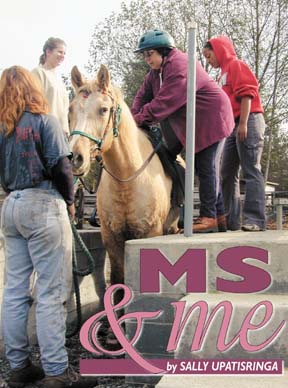
Sharon
has found a large wooden box for me to use as a step. I stand
on the box and her helper stands next to me, ready to lift my
leg up and over Amigo. Sharon stands at the horse's head, reins
in hand. Amigo just stands calm and cool. I love him already.
Lifting my leg up and over is
not easy and the helper apologizes profusely over the need to
give my butt a shove. I take it all in good humor and try to
help him do the same. Nevertheless, he is embarrassed and I remind
myself that, after all, he is a teenager.
At last, I'm on a horse, sitting
tall in the saddle. The moment of absolute joy is quickly gone
because now I must do something -- make the horse go forward
or backward, something. I will soon learn that one of Sharon's
favorite teaching techniques is to ask her students, "Who's
driving, you or the horse?" For a while, my answer will
be, "the horse." But in the meantime I sit there, grinning
from ear to ear and thinking, "This is ever so much better
than racquetball!" I'm wearing borrowed boots that don't
quite fit. I need a box and a shove on the butt in order to get
on, but who cares?
Sharon, is smiling, too, as
she leads Amigo and me to the ring. Now for the hard part, do
what the teacher tells me to do. Please God, let this be all
right. Don't let me fall off. Don't let me embarrass myself.
Don't let me hurt Amigo. This is so exciting. Thank you.
"We
don't have to do this, Sharon." I'm perched on the platform
that seems to have appeared overnight after it became obvious
that using a box to mount and dismount was of questionable intelligence.
There are two steps to the platform that has been built between
two trees, and a railing on two sides. I'm sitting on the railing
watching Sharon lead Amigo to the ramp. On the other side of
the ramp, in order to make a lane for the horse to walk through,
Sharon has placed, upside down, a large metal watering trough.
Amigo does not want to walk through this lane, much less stop
and let me get on. Sharon takes Amigo through the lane
again and again. Amigo does not change his mind. I begin to feel
guilty. After all, I don't have to learn to ride. Amigo is sweet
and gentle and he will enjoy letting me brush him and feed him
carrots. Deep inside, however, is that small voice of total honesty
that says, "I want to ride that horse!"
Sharon's response to "We
don't have to do this" is unexpected. She tells me that
a horse wants to do what is asked of him. He just needs to be
treated with respect and kindness. She is right. Soon Amigo enters
the lane and stands quietly, even when Sharon climbs on top of
the watering trough and jumps up and down, making a hellish noise.
The time is now. All the waiting
and working and praying and finger-crossing is over. Sharon stands
at the horse's head and I, leaning forward and holding tight
to the saddle horn, get my left leg (yes, the left leg,
my strongest) over the saddle and I am on. The beginning
is over.
Each
day finds me at the Box R Ranch ready for a lesson. I work in
the small arena. I learn how to stop and go, how to change directions
and how to ride up to a line drawn in the dirt and stop. When
I don't stop in time, Sharon says, "Oops, you fell over
the cliff. You're dead." And then I try again. I have five,
maybe six lessons and then on a wintry October afternoon Sharon
and I take our longest ride, up the road to the big house, through
the beautiful meadow and back to the ranch. This is Sharon's
last day at the Box R. Soon all the horses will be taken to their
homes. Soon I too will go home to Eureka and take up the threads
of my normal life, whatever that means. Except, life will never
be the same. Every day and every night I will remember and celebrate
those days of lessons and that last wonderful ride. I will yearn
for a return to the freedom that being on horseback has come
to mean.
Sharon
is not at the Box R Ranch in the summer of 1998 but a new wrangler
is and I drive over to introduce myself. Randy knows about me
and tells me that Amigo is ready to ride. Amigo! He's back
and ready to ride! Nichole, our 14-year-old niece, is spending
a few weeks with us and she is almost as excited as I am. We
hurriedly sign release forms, find helmets that fit and head
for the ramp. I will be on Amigo and Nichole will ride Bodry.
Nichole and I do some work in
the arena and then, with Randy walking ahead of us, we take a
short ride to the old immigrant cemetery. I have never visited
the cemetery because it is an uphill walk on uneven terrain.
This day I don't have to stay behind and later listen to someone
else's description of the trail (part of which is the historic
Applegate Trail), the cemetery, the critters they saw, and the
fun they had. Now it is my turn to experience all those things
and I do and in my soul I hear the words, "This is the day
the Lord hath made; let us rejoice and be glad."
Amigo had been a little reticent
about standing at the ramp while I mounted and now he refuses
to stand there while I dismount. In fact, he plunges backward,
throwing me and then falling and rolling on my legs. Randy rushes
to pull me out from under the horse. Amigo scrambles up and away
and Randy helps me to a sitting position before going to find
something for me to sit on. I rest awhile before I get up and
walk around, checking to make sure nothing is broken or otherwise
damaged. Randy decides that in the future, Nichole will ride
Amigo and I will ride the more mellow Bodry. It is a good decision
and under Randy's kind tutelage the two of us bloom.
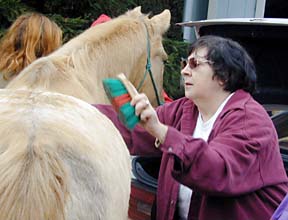
Mornings find us at the Box
R Ranch. I brush Bodry by standing close to him while leaning
on my platform cane. This little exercise helps us get to know
one another. While he is being saddled I stand at his head, scratching
his face and talking to him.
Once mounted, I become just
another student learning to be a horsewoman. Randy works gently
but firmly, and gradually I learn to drive my horse passably
well. In the ring Bodry and I make figure eights around small
cans that have been set out by Randy. As the lessons progress,
the cans are placed closer and closer together and all three
of us celebrate when Bodry and I complete the course with no
misses.
This beautiful summer of riding
includes excursions to many places. The immigrant cemetery is
always a favorite destination. As I sit in the saddle and look
down on that small plot of land, I think about the men and women
and children whose sense of adventure led them to this special
land. Our great-grandfather and his widowed mother were part
of that great migration and they homesteaded right here, on Box
R land. Longer trips take us up into the rocks to marvel at the
volcanic work completed how many eons ago. One trail allows us
a view of Mount Shasta, that mystical, cloud-shrouded mountain
that towers over all of Siskiyou County.
Now
I begin to learn in earnest. There is so much to know. Before
the workday begins, the horses are watered, fed, groomed and
saddled. It is a social time, if you will, allowing horses and
humans to welcome one another to the new day. Horses are not
saddled for the entire day. When there is a length of time between
rides, they are relieved of the heavy burden of tack.
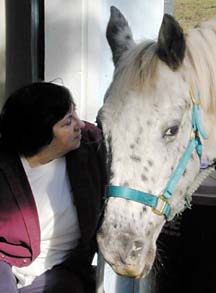 In
October of 1998 I buy a horse of my very own! Lucy is a leopard
appaloosa, beautiful to look at and beautiful to ride. [photo at right] Lucy
understands very quickly that I am not your average beginner;
I have some special disabilities and she, Lucy, must take those
disabilities into account if we are going to make this partnership
successful. She understands and a beautiful relationship is born. In
October of 1998 I buy a horse of my very own! Lucy is a leopard
appaloosa, beautiful to look at and beautiful to ride. [photo at right] Lucy
understands very quickly that I am not your average beginner;
I have some special disabilities and she, Lucy, must take those
disabilities into account if we are going to make this partnership
successful. She understands and a beautiful relationship is born.
Lucy stays on the mountain when
winter comes, but I go home to Eureka. I miss her and call Sharon
often to inquire after her. Christmas finds us at Pine Lodge
and Sharon rides Lucy over for a visit. Because of winter snow,
Lucy is not wearing horseshoes and we agree that I will not ride.
Instead, I brush her and feed her apples and she responds by
rubbing her head against me. Her winter coat is very heavy but
I worry anyway and offer to send her a horse blanket. Sharon,
horsewoman and mountain resident, smiles and assures me that
Lucy's coat is coat enough.
The next spring arrives and
suddenly I own a second horse, Stella, a palomino. [photo below left] During
our many quiet times together, Sharon and I had talked about
my need for a second horse, since it's impractical for me to
ride alone. Stella is bossy and soon she is the dominant horse.
She eats and drinks first while Lucy stands back, waiting patiently
for her turn.
Nichole and I are back on the
mountain. A portable corral is installed at Pine Lodge and Lucy
and Stella come to spend the summer. How exciting it is to have
our horses just outside the door. Sharon spends nights with us
and I am grateful to her because frankly, I know little about
horses and I worry that a crisis will happen at 2 o'clock in
the morning!
 Sharon
and Nichole build a hitching post next to the deck and the horses
are tied there when we groom and saddle them. Lucy learns to
stand at the deck so that I can mount and dismount. Every morning
Nichole gets up at 6:00 and staggers out to feed and water the
horses and then stumbles back to bed. I guess this disease has
some perks after all because when I hear Nichole get up to do
chores, I just snuggle down under the covers and go back to sleep. Sharon
and Nichole build a hitching post next to the deck and the horses
are tied there when we groom and saddle them. Lucy learns to
stand at the deck so that I can mount and dismount. Every morning
Nichole gets up at 6:00 and staggers out to feed and water the
horses and then stumbles back to bed. I guess this disease has
some perks after all because when I hear Nichole get up to do
chores, I just snuggle down under the covers and go back to sleep.
We ride in the cool of the morning
and sometimes again in the evening. The heat makes me very ill
and mid-day finds me in the living room surrounded by fans. Nichole
is in charge of the horses and she does a wonderful job of keeping
the water troughs full, scooping poop and keeping the corral
clean. Sometimes Nichole and Sharon ride together while I'm staying
cool. One day Nichole is surprised to find that she has learned
to canter. She grows in confidence and self-reliance and becomes
a treasured companion.
When Nichole leaves, the horses
are taken to their winter pasture. My heart hurts as I watch
the trailer take them away. Now it is my turn to leave. Back
in Eureka, Vis and I talk about stabling Stella and Lucy on the
North Coast. Vis, who is not particularly fond of horses, is
amenable to the idea. He has watched the change in me as I have
discovered a new life with horses and he likes and encourages
that change. There is just one big question. Where will I find
a place with stables, ramps for mounting and dismounting, someone
to ride with me, help me on and off and take care of the horses
as well?
Deep
in the recesses of my mind is the sliver of a memory of a place
called Camelot. Pursue that sliver, a little voice tells me.
I do and I find Camelot and this Camelot is in Trinidad.
Camelot is the home of Doug
and Nancy Jager. Doug loves horses; Nancy does not, but together
they have created a magical place for folks like me.
The 4-H Trail program was born
in 1985. There are paddocks, a wheelchair-accessible mounting
ramp, an arena, trails and horses, several of them large gentle
Norwegian fiords. Everyone who participates in the program is
a volunteer and everyone belongs to 4-H.
The volunteers do many things
scoop poop, groom horses, clean tack, repair equipment, etc.
Their most important role, however, is to help clients ride.
Every rider has a headwalker who has a lead rope attached to
the horse's bridle so she will be in control. These 4-H volunteers
have special training and strong people and horse skills. Sidewalkers
walk along on either side of a rider, one hand resting on the
person or horse as needed.
Riders start every ride in the
arena where they are encouraged to try many things -- stretching
exercises, following commands, playing games. Sometimes a fiord
is fitted with a circingle, a large pad with handles but no stirrups.
All manner of exercises are designed to make stiff muscles more
limber, loosen joints, teach independence and confidence. And
it's all accomplished under the guise of having fun!
One visit to Camelot and I know
that this is the place. Doug and Nancy's daughter, Sally, is
now an integral part of the program and we have a long talk about
me and my horses.
On a cold and drizzly day, Stella
and Lucy arrive at Camelot. Vis and I hurry over to see them.
The trip from Ashland was long and the horses are tired and confused
and very happy to hear a familiar voice -- mine.
Within a few weeks they are
settled in and I am ready to begin a new odyssey in this wonderful
world of horses, one so close to home I can venture north every
weekend all year round to that magical place called Camelot.
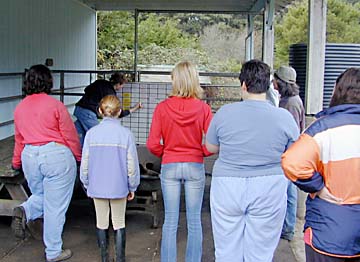
Sally Friedley fills in the assignment
board as the 4-H volunteers wait for their instructions.
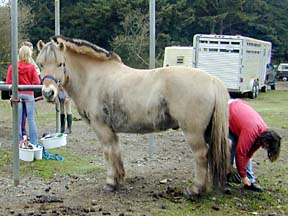
A large gentle Norwegian fiord
named Christoff is groomed before being saddled up for riding.
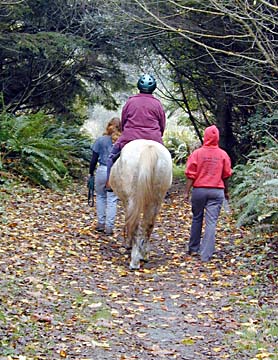
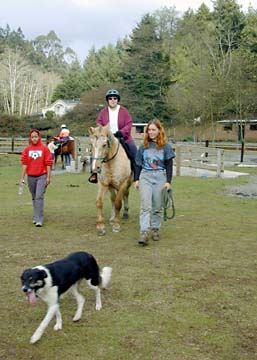
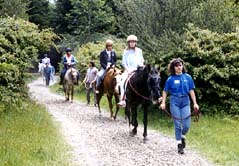
Upatisringa rides Stella along
the trail with her headwalker, Natalie Herman, and sidewalker,
Sara Beyene.
A horseman helps the
disabled -- and himself
by KEITH
EASTHOUSE
 LIKE
MANY PEOPLE, DOUG JAGER USED TO FEEL UNCOMFORTABLE around those
who were physically or mentally handicapped. LIKE
MANY PEOPLE, DOUG JAGER USED TO FEEL UNCOMFORTABLE around those
who were physically or mentally handicapped.
"I would try and ignore
them, look the other way. It took a lot of maturing and developing
for me, but now these guys are my friends."
Sitting out in the November
sunshine at Camelot, his 6-acre spread in Trinidad, Jager smiled
briefly. A large outdoorsy man of 62, Jager has ridden horses
since he was a teenager and seems the picture of health. But
he's got his own physical problem, polyneuropathy, a disorder
of the nervous system that has interfered with his ability to
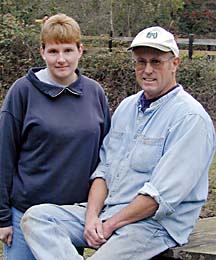
detect sensation and maintain his balance. [Doug Jager at right in photo, with daughter Sally
Friedley on the left]
"It's like having your
body encased in a glove," Jager said, explaining that if
he were to put his hand on a hot stove, he would be able to feel
it, "but not until I was burned deeply."
As for his balance, it's fine
as long as it's daytime or he's in a well-lighted place where
he can see. In the dark it's a different story, for the simple
reason that there's no horizon to orient himself. "If it's
dark, I'm in trouble. I need to use my eyes."
Looking back on it, he sees
now that the condition was coming on in the 1980s, but it wasn't
diagnosed until the 1990s. So it had nothing to do with his decision
17 years ago to open up his 4-H Trail program to handicapped
kids and adults.
Jager, a retired professor emeritus
of forestry and watershed management at Humboldt State University,
became a 4-H leader in 1977, when his daughter Sally was 10 (4-H
does not allow kids to ride until that age). A Trinidad woman
helped him out with the program, which basically involved teaching
kids to ride and care for horses and take part in competitions.
In 1985 she dropped out, giving Jager an opportunity to take
things in a different direction.
 "I
wasn't keen on dragging kids to horse shows," he recalled,
so when a colleague at HSU mentioned a program in Australia in
which disabled kids rode horses as therapy, Jager decided to
do something similar. "I
wasn't keen on dragging kids to horse shows," he recalled,
so when a colleague at HSU mentioned a program in Australia in
which disabled kids rode horses as therapy, Jager decided to
do something similar.
"It seemed like a nice
thing to do," Jager explained. "My wife and I and our
kids were very fortunate. We hadn't had these sorts of problems
and this was a way for us to help out people who weren't as lucky."
The deceptively simple act of
riding a walking horse provides an array of benefits to the handicapped.
For someone in a wheelchair, riding stimulates muscles that would
normally be used for walking and so helps prevent them from atrophying.
Those with cerebral palsy are prone to having their hips and
knees lock together; horseback riding stretches muscles in those
areas and can allow someone to avoid the standard surgery to
correct the problem -- cutting the muscles on the inside of the
legs. Finally, climbing onto a horse offers a psychological boost.
"If you're in a wheelchair, you're always looking up at
people. On a horse, you don't have to do that," Jager said.
A few years back, Jager had
to mount a fight when the 4-H organization, concerned about liability
issues, decided that it was no longer going to continue to exempt
his program from the restriction that a child had to be 10 years
old to get on a horse. Jager wrote a paper on the value of getting
disabled kids up on a horse as early as age 2 or 3; collected
a sheaf of letters from parents and physicians saying the same
thing; and made a verbal presentation to 4-H officials. It took
awhile, but he eventually persuaded the organization to reinstate
the exemption.
Today the program is going strong
and currently serves about 20 handicapped people. Jager said
twice as many could be involved if he could find more volunteers
(if you're interested, contact him by e-mail).
As for Jager, his disease, a
degenerative condition, is slowly gaining the upper hand. He
has problems with pain and insomnia and he doesn't ride as vigorously
as he used to. If he lives long enough, he could end up in a
wheelchair.
Jager imparted this information
matter-of-factly, with no hint of complaint or self-pity. "There
are lots of people out there worse off than I am," he said.
Then he said something else, something that showed that the disabled
kids and adults he's worked with over the years have taught him
about coping. "It's the abilities they have that are important,
not the disabilities," he said.
IN
THE NEWS | FROM THE PUBLISHER | CALENDAR
Comments? E-mail the Journal: ncjour@northcoast.com
© Copyright 2002, North Coast Journal,
Inc.
|