|
 
story & photos by ARNO HOLSCHUH
IN 1964, WHEN EEL RIVER SAWMILLS
INC. WAS JUST SIX YEARS OLD, it was destroyed.
The flooded Eel River ruined
the sawmill. The company's already-milled timber and the stockpile
of cut trees waiting to be processed -- the log deck -- were
washed away. After the waters receded, the company had lost so
much money that it had a negative net worth.
Mel McLean, Eel River's founder
and owner, borrowed heavily to rebuild the operation, putting
up everything he owned as collateral. By 1973, the company had
achieved a complete recovery, with both output and employment
up 50 percent.
Today, the company is again
facing possible closure. But this time, there is no flood to
blame.
![[photo of sawmill entrance]](cover1025-entrance.jpg) A slow decline reduced the
number of employees from an all-time high of around 450 in the
late 1980s to 320 earlier this year. Then, early this summer,
came the biggest cuts: 200 workers were laid off. The remaining
workers have been told they will probably be laid off next month
and there's a good chance never be called back. The company is
$45 million in debt and management claims it is unlikely to produce
a profit in the near future. A slow decline reduced the
number of employees from an all-time high of around 450 in the
late 1980s to 320 earlier this year. Then, early this summer,
came the biggest cuts: 200 workers were laid off. The remaining
workers have been told they will probably be laid off next month
and there's a good chance never be called back. The company is
$45 million in debt and management claims it is unlikely to produce
a profit in the near future.
This isn't the way employees
thought things would happen. McLean, who died in 1999, had promised
the mill would be a source of jobs and prosperity for generations
to come. Part of that promise was the idea, manifested in a stock
ownership plan, that the workers should eventually gain ownership
of the facilities.
What went wrong? Some say it
is the market for finished lumber, depressed for the last two
years, down even further since the Sept. 11 attacks and flooded
with cheap imports. Some say it is the dwindling flow of logs
coming out of national forests. Some workers allege management
is to blame and have filed a lawsuit to that effect.
One thing is clear, however.
Unless circumstances change or a sale is arranged -- and soon
-- a company that was presented as a workers' paradise will shut
its doors.
![[photo of Dennis Scott]](cover1025-Scott.jpg)
"I' ve been here 24 years,
so I've seen a lot of different cycles of recession and a lot
of good times," said Dennis Scott, Eel River's president.
[photo at right] During his tenure, the timber industry has busted
and boomed.
"We've had some awfully
good years," he said.
And why not? As Scott points
out, Eel River Sawmills is a modern and efficient facility. The
mill is ideal for processing second-growth logs with a minimum
of waste. Drying kilns, added during the 1990s, allow the company
to sell its product at a premium.
"We have a good sawmill,"
Scott said, "but we have to have an adequate supply of properly
priced logs. And we don't."
Eel River Sawmills, like many
of Humboldt County's once numerous small mills, relied on outside
sources for almost all its logs. Until 1990, that meant logs
harvested from national forests -- primarily Six Rivers National
Forest. "When I came here [in 1977], we hardly had any timberland
of our own and relied on the Forest Service timber," Scott
said.
It was a sweet deal for mills
like Eel River. Fifty-one percent of Forest Service timber was
set aside for small mills to protect them from competition from
timber giants like Louisiana Pacific or Simpson Timber. The volume
was huge -- around 150 million board feet were sold out of Six
Rivers every year into the 1980s.
![[Graph: Six Rivers National Forest Harvest Volumes 1980-2001]](cover1025-graph.jpg)
No cash was required up front,
meaning that the small mills without capital reserves didn't
have to incur large debt to secure a log supply. "Those
were the days when we were a very good company," Scott said.
"Then the spotted owl was listed."
When the northern spotted owl
was listed as threatened under the federal Endangered Species
Act in 1990, it touched off an intense debate over what was permissible
and sensible land use. While private landowners wanting to harvest
timber fought for what they considered to be their property rights,
the land that was most severely affected was in the National
Forest system.
"In the early 1990s. we
started to run into situations with the spotted owl, and that
started to affect volumes," said Jim Hall, timber management
officer with Six Rivers National Forest. It became clear that
the effects of the owl listing would be profound when the forests
were asked to set aside "management areas" to protect
the birds.
"We had to set aside 2,300
acres for every known spotted owl pair," Hall said. That
cut the volume of timber taken out of the forest to about one-third
its previous size. Sales dropped to less than 60 million board
feet of timber being sold every year.
In 1992, lawsuits cut sales
even further, to around 11 million board feet. In 1993, that
number dropped again to just over 5 million. That was also the
year the Clinton administration crafted the Northwest Forest
Plan, which was designed to allow for at least some timber harvesting
while protecting spotted owl habitat. Timber sales crept back
up -- 1996 saw almost 10 million board feet of timber sold out
of Six Rivers.
As the Forest Plan was implemented
and litigation was resolved, it became easier to harvest some
timber. By 1999, close to 30 million board feet was being sold
annually -- far below historic harvest levels, but still a significant
number. But in 2000, with new legal challenges, the number dropped
back to 4.4 million.
When the spotted owl was first
listed, "we knew there was going to be a reduction in timber
from Forest Service land. So we tripled our private timberland
holdings," Scott said. But that land came at a cost.
"Of course, when you buy
land and timber, you have to incur debt, whereas forest service
timber didn't require cash." This, he said, is where the
$45 million in red ink comes from -- buying land on credit to
cushion against the blow of reduced national forest sales.
But Eel River's private land
holdings -- estimated at their height to be about 50,000 acres
-- weren't enough. "You may have acres and acres in timberland,
but you'll still have trouble getting enough plans through the
regulatory process to supply the mill," Scott said.
And Eel River has steadily sold
off pieces of the timberland base it acquired in the early 1990s.
Today the company owns some 24,000 acres, far from enough, it
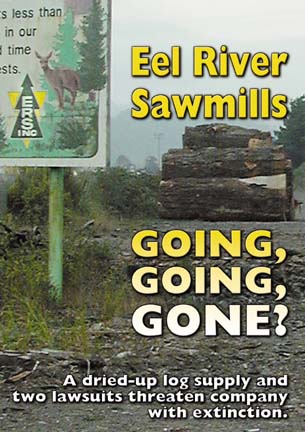
says, to keep the mill running. The company's log deck, filled
to capacity in good times, looks like a deserted parking lot.
The mill doesn't have any logs, Scott said.
"And a sawmill without
logs isn't any good."
"The problem is not the
spotted owl or the environmentalists," said Clifford Crowl,
a 32-year veteran of Eel River Sawmills. The problem, Crowl said,
is the way the company is being run. "Management has to
take responsibility."
Crowl is one of several current
and former Eel River Sawmill employees who say the dream of a
prosperous, employee-owned mill was achievable. But they believe
that dream has been bungled -- or sabotaged -- by management.
In 1988, the employees were
told they owned 46 percent of the company through the employee
stock ownership plan, or ESOP. Long before the idea came into
vogue in Silicon Valley, McLean had decided to use company stock
in addition to salaries to compensate his employees. Majority
ownership was supposed to follow at McLean's death. Many at the
company viewed the stock plan as their retirement.
That transfer of ownership to
the employees never happened. When talks about a sale began recently,
Crowl and other employees learned the ESOP only owned the equivalent
of 21 percent because the shares were purchased with a loan and
that loan wasn't fully paid off.
Feeling betrayed, Crowl and
fellow Eel River veteran Tom Swain decided in the fall of 2000
that they wanted to go to court.
"We realized we had to
file a lawsuit because they are going to sell the mill and we're
supposed to own it," Crowl said.
Eureka attorney Bill Bertain,
who represents Swain and Crowl, said, "Promises were made
to the employees that they would own the majority of the stock
in the Eel River Sawmills. We want the promise kept."
That promise's clearest form,
according to Bertain, is a June 9, 1999, memo from Scott to Eel
River employees. In the memo Scott states that there "is
a plan in place which will transfer the majority of the voting
stock to employees over time."
That, said Bertain, amounts
to a legally binding promise. "Not all enforceable promises
have to be written documents signed by both parties," he
said.
With Eel River Sawmills apparently
diving toward bankruptcy, one might wonder why employees would
be so eager for ownership. The answer came in a second complaint,
filed by two other Eel River employees with Bertain as their
attorney in June.
In the second complaint, plaintiffs
Colin Dazzi, Dean Blake and Jerry Milburn -- all of whom had
worked at least 20 years at Eel River -- allege the company was
driven into the ground by Scott's bad management.
In eight pages the complaint
alleges that Scott sold timberland for less than market value,
imported pine logs from New Zealand for more than market value
and generally "engaged in gross mismanagement."
But the complaint claims Scott
is more than incompetent. He is also alleged to have enriched
himself through real estate dealings and to have built a luxury
home for himself near Willits with company funds. The complaint
also contends Scott "fostered the toleration of sexual harassment"
in the workplace and used Eel River's money to settle sexual
harassment claims.
"Not true," said Bill
Bragg, Scott's attorney. "In any business the size of Eel
River, there are going to be incidences of alleged sexual harassment
in isolated circumstances. The responsibility of the company
is to respond in a professional manner, and this is what Eel
River did." Bragg also denied all other allegations of impropriety
and gross mismanagement.
The lawsuits' most immediate
effect was to put a halt to the sale of Eel River Sawmills to
the Pacific Lumber Co. PL had expressed interest in purchasing
some of Eel River's assets as early as February. Negotiations
were chilled when Bertain filed for a lis pendis, a legal
tool that calls the ownership of a piece of property into question.
Eel River is "a very good
operation," said John Campbell, PL's former president and
current chairman of the PL board. "That's why we were showing
an interest in it." However, "No one wants to go into
an operation that is being litigated," Campbell added.
That was exactly what Bertain
and his clients wanted -- to prevent a sale that could have dismantled
the company and "preserve the assets so they could be operated
as a company under their corporate structure" -- in short,
to keep Eel River Sawmills in existence.
Bertain and his clients still
believe the company is salvageable. The cutbacks in Forest Service
logging, Bertain said, are "a factor, but we note that other
former buyers of National Forest timber are still operating --
Blue Lake Forest Products and Schmidbauer Lumber, for instance."
Those mills may be operating,
but they certainly aren't thriving. Bruce Taylor Sr., president,
founder and co-owner of Blue Lake Forest products, said, "It
is a difficult and trying time for all mills. We buy logs wherever
we can." He said his mill survives on a combination of logs
from tree farms, small landowners, tribal lands and timber imported
by barge from Washington.
"This is one of the toughest
businesses around," said Mark Anderson, a silviculturist
with Schmidbauer Lumber. "You aren't allowed many mistakes."
What's happening at Eel River "is no different from what's
happening to mills up and down the coast."
That argument doesn't faze Crowl.
"Business is tough, yeah, but it's tough all over."
There's no reason Eel River can't survive if other mills are,
he said.
Crowl isn't alone in his thinking.
A group of investors known as Englewood Forest Products has continued
negotiations for the purchase of the entire Eel River Sawmills,
betting they can operate it at a profit. And some sources in
the industry say there is still enough timber available from
small landowners to feed the mill.
All that's missing, Crowl said,
was the leadership.
"With the right management,
the men can get ahold of that mill and run it and we'd all have
jobs."
![[photo of Kevin Wicke]](cover1025-Wicke.jpg)
After being told they were going
to be laid off at the end of November, some Eel River employees
have resigned themselves to the fact that they are likely to
lose their jobs.
"The way it looks now,
it's not just a temporary layoff," said Kevin Wicke, who
has worked for Eel River for 15 years. [in photo at left]
Wicke and many like him face
some tough choices if they lose their jobs. As a trained saw
filer, Wicke made a good salary at Eel Rivers. If and when the
company closes, he will have to find another means of supporting
his family.
"I haven't looked for a
job in 15 years," he said. "I could go other places
-- get a job in a saw shop, maybe. But I might have to leave
the area, and I wasn't really prepared to do that." Even
if he did find work in a saw shop, Wicke said, he is likely to
face "a big pay cut."
Even so, Wicke considers himself
"one of the lucky ones."
"My wife works and has
really good [health] insurance. She doesn't get paid a whole
lot, but at least we'll have insurance." Others are going
to have to face the responsibility of supporting and insuring
their families in a job environment that is both unfamiliar and,
since the economic downturn, increasingly harsh.
"A lot of people are going
to wake up one morning and realize they don't have a job. It
will be hard on a lot of people."
The hardship will be faced by
more than Eel River's employees and their families. Scott estimated
Eel River contributed $3 million annually to the local economy
through wages.
"Most of those folks [working
at Eel River] live in Fortuna, and it's hard to replace that
income," said Cliff Chapman, executive director of the Fortuna
Chamber of Commerce. "I'm sure there will be a ripple effect."
One man waiting to feel that
ripple is Jerry Austin, who owns and runs the Oak Place, a discount
furniture store in Fortuna.
"A lot of people from Eel
River spent money at my business," he said. As mill workers
lose their jobs and leave town, their homes will likely be taken
over by young retirees.
"And those people don't
really need any furniture. Maybe if a lampshade got broken during
the move, OK, but they already have their furniture," Austin
said. "This could definitely push me out of business."
IN
THE NEWS | IN THE GARDEN | CALENDAR
Comments? E-mail the Journal: ncjour@northcoast.com
© Copyright 2001, North Coast Journal,
Inc.
|