|
 
COVER
STORY | CALENDAR
Oct. 24, 2002
Davis
comes to town
by
GEOFF S. FEIN
Gov. Gray Davis said the state
is working hard to reach an appropriate compromise to complete
a fiber optic project that would link Eureka with Ukiah.
Caltrans and Pacific Bell are
at an impasse over $2 million to $3 million in fees that Caltrans
is seeking in exchange for giving Pacific Bell the right-of-way
to lay 21 miles worth of fiber optic line south of Eureka --
all that's missing in the link between the county seats of Humboldt
and Mendocino.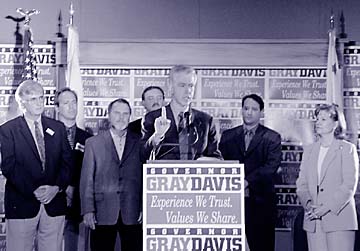
"The Pac Bell offer (is)
not quite good enough," Davis said.
The project is considered vital
by business and education leaders in the Humboldt region. Pac
Bell has proposed setting up an escrow account to hold the disputed
fees until a judge decides the case. So far, Caltrans has not
signed the proposal.
The governor made his comments
about the Caltrans-PacBell standoff after addressing more than
100 Democrats inside the Wharfinger Building in Eureka on Monday.
Davis said he wants to see a
compromise worked out between the parties.
Gov. Gray Davis
addresses supporters at the Wharfinger Building.
His wife, Sharon, stands at right.
Accompanied by his wife, Sharon,
Davis made a brief campaign stop in Eureka to drum up support
for his re-election bid. Davis is in a close race with businessman
Bill Simon, the Republican hopeful.
Although Davis was almost 90
minutes late, supporters still gave him a standing ovation when
he arrived and cheered and applauded whenever the governor spoke
of his administration's achievements.
Davis said he came to Eureka
because the North Coast is an important part of the state.
"I'm not taking any vote
for granted," he said.
During his speech, Davis was
periodically interrupted by protesters who said the governor
had done little to protect old-growth forests. At one point about
six of the protesters shouted out that the governor was a liar
when it came to his forest policies. Davis appeared unfazed,
saying the state is doing its best to save old-growth redwoods.
About a dozen Simon supporters
set up a stage on the street outside the building to also protest
Davis' appearance.
"I've made some mistakes,
but I have worked hard to improve the life of those in California,"
Davis told the crowd inside.
Davis reminded the throng of
Democrats that he recently signed a bill, the first of its kind
in the country, that would significantly reduce vehicle emissions
by 2009. The governor termed the legislation a global warming
bill.
Davis said the law will "show
the rest of the world we can improve the environment."
California is the first state
in the nation to allow workers to get paid 55 percent of their
salary for up to six weeks should they have to take time off
to care for a sick relative, he said.
Davis also reminded the crowd
that he is not to blame for the state's energy woes.
"In 2001 few people believed
me when I said Enron was ripping us off," he said.
Since then, Enron has admitted
guilt and one company executive is going to jail and more should
follow, Davis said.
"We are turning the corner
on this," he said of the energy crisis that gripped California
in the spring and summer of 2001.
Davis received the loudest applause
when he announced he had signed a bill to protect a women's right
to choose even if Roe v. Wade, the landmark U.S. Supreme Court
case legalizing abortion, were one day struck down by the U.S.
Supreme Court.
Arcata
opposes Iraq war
The Arcata City Council is back
in the anti-war business.
The council voted 4-1 last week
to adopt a resolution against the looming conflict in Iraq. The
vote came a day after residents expressed almost universal opposition
to the war at a packed public forum.
The city's stand is reminiscent
of its opposition to the Gulf War 11 years ago.
In wording the resolution, the
council avoided saying that it spoke for all of the citizens
of Arcata. The resolution does note, however, that many community
members had come forward asking the council to adopt the resolution.
Robert Nobel was the only council
member to oppose the resolution, saying that he did not want
to add his voice to the rising tide of resentment against the
United States.
But even Nobel said he wants
President Bush to make clear there is proof behind the administration's
justification for war before action is taken.
Thompson
bill to aid rivers
Rep. Mike Thompson will introduce
a bill in Congress to provide $200 million to help the North
Coast recover from the massive fish kill last month on the Klamath
River.
The fish kill, in which as many
as 30,000 salmon may have died, has damaged the local economy,
Thompson said.
Shortly after the kill, Thompson
presented Interior Secretary Gale Norton with 500 pounds of dead
salmon at a press conference in Washington D.C.
Thompson told the Humboldt County
Board of Supervisors earlier this week that the bill would provide
federal funds to help landowners and tribes throughout the Klamath
basin. There will also be $20 million in emergency funds for
five California and three Oregon counties, Thompson said.
The bill will require the Department
of Interior to regularly report to Congress on the status of
the Klamath River.
"This administration thinks
folks in the upper basin have more rights than those in the lower
basin," Thompson said. "We need to change that mindset."
Part of the battle over water
in the Klamath River has been between farmers in southern Oregon
in the upper part of the basin and salmon-dependent communities
downriver.
Thompson said water rights have
been overprescribed in the upper basin meaning the legal right
to use water exceeds the amount of water that's available.
Thompson said agricultural interests
have been adept at turning the battle into one of farmers versus
Humboldt County hippies.
"We had a dickens of a
time explaining this to folks," he said. "(Farmers)
built a tremendous political machine."
Energy authority
in works
Humboldt County is going to
receive $454,000 to set up a regional energy authority that would
be charged with finding ways to more efficiently use energy in
the region.
The authority would also represent
county interests at legislative and regulatory proceedings.
The best part of the proposal
is that it won't cost the county anything. The money and services
to set up the authority are free.
The money will cover staff salaries,
training, the purchase of office equipment, identification of
high impact projects and development of long-term projects.
The money is coming from a program
run by the state Public Utilities Commission that allows citizens
to get funding that previously went through Pacific Gas &
Electric and other utility companies.
The program is funded through
public discharge funds, which come from fees on ratepayers' utility
bills. Humboldt County ratepayers have paid approximately $1.5
million into the public discharge funds, but have yet to get
any of that money back until now.
The county's proposal was one
of only 40 accepted by the state, out of 300 statewide applications.
It is the only application from Northern California to be approved.
Humboldt County was chosen because
of the involvement of the Humboldt Energy Task Force, a body
looking to more efficiently use energy in the region.
Revamping Highway 299
A plan to rebuild a seven-mile
section of Highway 299 between Willow Creek and Buckhorn Summit
will cost at least $120 million and probably won't be built until
2007 at the earliest.
The purpose of the project is
to reduce the number of vehicle accidents and to provide a better
truck route from the Central Valley to the North Coast.
The county will see economic
gains from an improved road between port facilities on Humboldt
Bay and Interstate 5, Humboldt County Supervisor Roger Rodoni
said this week.
Rodoni is a member of the Humboldt
County Area Governments, an agency made up of representatives
from all cities and municipalities in the county.
Highway 299, built back in the
late 1920s, has a seven-mile section where the road is winding
and narrow and marked by steep climbs and descents. Large freight
trucks can't negotiate the twists and turns along the highway.
That has forced companies to either transfer cargo to smaller
trucks in Redding or to use Highway 101.
"We are one of three counties
without the same road service as the rest of the state,"
said Supervisor Bonnie Neely.
The speed limit along this hazardous
stretch is only 25 mph. Nonetheless, the accident rate is 50
percent higher along it than on similar routes in the state,
according to Chris Cummings, project manager with Caltrans.
It costs the state $850,000
annually to maintain this portion of Highway 299 -- triple the
cost for similar routes, Cummings added.
By realigning the highway, Caltrans
hopes to bring speed limits up to 50 mph., reduce the number
of accidents and allow large trucks to bring goods from Redding
to the North Coast.
Even though the project is not
in Humboldt County, the county has contributed $46,000 toward
the $2.5 million study of the project's potential environmental
impacts. Trinity and Shasta counties have contributed a combined
$150,000. The study could be finished as soon as 2004.
More one-way streets?
The Arcata City Council is considering
a plan to turn Eighth and Ninth streets into one-way routes and
widening sidewalks along H Street.
Under the traffic plan presented
to the council by the city planning staff last week, traffic
on Eighth street would flow one way heading east between I and
F streets; traffic on Ninth street, meantime, would flow one
way heading west between F and G streets to I Street.
The cost to reconfigure the
streets is estimated at around $50,000. The city included the
amount in its 2002-2003 budget.
Sidewalks along H Street, which
are currently five feet wide, would be widened to either eight
or 12 feet.
The council is expected to make
a final decision on the street and sidewalk changes at its Nov.
6 meeting.
Halloween safety tips
The Eureka Police Department
is offering tips on how to keep those little monsters, ghosts
and princesses safe on Halloween.
Parents are reminded that children's
costumes should be short enough to prevent them from tripping
and falling; costumes should be bright enough to be visible by
motorists; reflective strips should be sewn onto the front and
back of costumes to make them more visible; swords, wands and
other accessories should be made of soft flexible material; avoid
masks that may obstruct a child's vision; make sure costumes
are flame resistant.
Children should also carry a
flashlight; trick-or-treat on well-lit streets; stay on sidewalks;
only cross at street corners; and never enter a stranger's house.
COVER
STORY | CALENDAR
Comments? E-mail the Journal: ncjour@northcoast.com
© Copyright 2002, North Coast Journal,
Inc.
|