|
 
by BOB DORAN
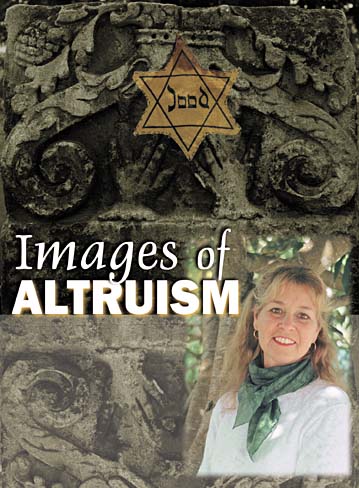
ELLEN LAND-WEBER (in above
photo) SORTS THROUGH boxes of photo
prints stored in the office at her home on Fickle Hill. She pulls
out one box full of pictures of graveyards, haunting images taken
when she was in Poland and Czechoslovakia.
Among them is a shot of a wall
in Cracow, Poland, a patchwork of masonry covered with Hebrew
lettering. Land-Weber explained that the wall is made of broken
tombstones. During the Nazi purge of Polish Jews, the grave markers
were pulled up and used for paving stones in a deliberate policy
to demoralize the people. The idea was to wipe out any memory
of the past.
![[photo of tombstone memorial]](cover1005-RemuCemCracow.jpg) A wall collage memorial
of salvaged tombstones that had been taken from a Jewish cemetery
during WWII. A wall collage memorial
of salvaged tombstones that had been taken from a Jewish cemetery
during WWII.
After the War the broken stones
were assembled into a new kind of memorial. "It's a testimonial
to the endurance of spirit of the people," said Land-Weber,
"and it's also a condemnation."
On Saturday Land-Weber will
celebrate the completion of a memorial project of her own, one
she has been working on for 15 years. A show of Land-Weber's
photographs at the First Street Gallery in Eureka marks the publication
of To Save a Life: Stories of Holocaust Rescue.
Land-Weber has assembled a collection
of photos and personal stories of Jews who lived through the
War and of those who helped them, rescuers who hid Jews in their
homes to help them evade the Nazis.
"Everybody knows about
the horror stories -- the camps, the atrocities, emaciated skeleton
bodies," she said. "This is an upbeat side of it, if
you can call it upbeat. These people suffered too, but they lived
through it."
![[photo of Tina Stobos]](cover1005-TinaStrobos.jpg) At
left, Tina Strobos, who rescued many Jews from Nazi capture.
She poses next to her portrait painted by one of the people she
was hiding during that period. Below is Louise van Santen, who
was rescued by Strobos. At
left, Tina Strobos, who rescued many Jews from Nazi capture.
She poses next to her portrait painted by one of the people she
was hiding during that period. Below is Louise van Santen, who
was rescued by Strobos.
![[photo of Louise van Santen]](cover1005-vanSanten.jpg)
The seed for To Save a Life
was Land-Weber's involvement in research for another book.
"It started with Pearl
and Sam Oliner, They were professors at Humboldt State, retired
now. They wrote this landmark book on altruism, The Altruistic
Personality. It was a study of altruism using people who
rescued Jews as subjects. Of course Sam was a rescued Jew himself.
"Altruism is extending
help to another without thinking about your own safety, putting
another person ahead of yourself to help them. A lot of altruistic
acts are momentary --is drowning, you don't think, you just jump
in and try to save them.
"But these actions were
of an altogether different order. They were deliberate decisions
made over a period of time. And the rescue activities often extended
over years and years and involved whole families."
Land-Weber volunteered to work
on the Oliner's book, a scholarly sociological study that endeavored
to pinpoint the nature of altruism so it could be taught to others.
Like the Oliners, Land-Weber is a professor at HSU, but sociology
is not her field. She teaches photography.
"I was interested in the
subject because of my Jewish heritage," she said. "I
started out working as an interviewer for them, and I was also
taking photographs hoping they would need them."
After conducting interviews
for the Oliners, Land-Weber wanted to take her side of the project
further and decided she would put together a book of her own.
"The initial idea was coming
from the standpoint of a photographer. My plan was to do a series
of portraits accompanied by a story, but an abbreviated story.
That amount of information was based on the first question on
the Oliner's interview schedule. It was: `Now, please tell me
in your own words what happened.'
"My original conception
was to follow in the tradition of the `photo book' that was developed
in the '30s with Walker Evans and James Agee's Let Us Now
Praise Famous Men or Margaret Bourke-White and Erskine Caldwell's
You Have Seen Their Faces. They were documentary studies
where photography and text were independent yet intertwined,
working together to tell the story. Each gave an understanding
to the subject but coming from different perspectives."
She returned to the people she
had spoken with for follow-up interviews and expanded the range
of subjects.
"The Oliner's study didn't
involve the people who were rescued. I talked with some of the
people who the rescuers had helped as well. I was more interested
in the human story. My project gradually evolved out of that
interest.
The stories she gathered were
compelling, so compelling that she changed her mind about the
nature of the book. "I ended up visiting the people again.
Some of them I spoke with three times and when I interviewed
them again I realized that the story was too complex. The fact
is that the pictures didn't tell the whole story. You really
have to read it."
The stories are powerful personal
histories that, added together, paint a picture of what life
was like for Jews and for those who protected them during the
war.
"One person I interviewed
was Bert Bochove. He and his wife had as many as 26 Jewish people
hiding in his house at one time. It started with a friend asking
for help, the Bochoves said, `Stay with us.' Pretty soon that
person's husband came and then someone else needed help. It grew
into a whole network. There were a whole series of challenges
to deal with.
"They had to figure out
how you keep everyone fed. Some could never go out. Others, those
who didn't look Jewish, could go out. They were able to pass
as non-Jewish people. But some were stuck inside for well over
a year. And you have to think about keeping up their morale.
"Some (of the rescuers)
paid a price. One woman I interviewed, a Polish woman, was sent
to a concentration camp because she was caught. She barely survived
herself."
As Land-Weber's project took
shape, she began the search for a publisher. It wasn't easy finding
one, in fact at one point she gave up and put the book away for
several years. She wanted to share the stories she had collected,
but she couldn't publish them by herself.
That changed in the mid-'90s
as technology advanced and a new medium was gaining speed --
the Internet. Land-Weber decided to put the book online and set
about learning html. coding.
"I thought I'd get it on
the Web and get it out of my life," she said. "But
then I started getting all this mail. People were actually reading
it. I won some awards -- best of this, best of that, awards from
places like the History Channel."
Online the project took on a
life of its own.
"It was really satisfying.
In some ways it's even better than writing a book because people
write to me and share their feelings. Some are relatives of people
I had interviewed. In some cases they didn't know these stories.
"One person who wrote to
me was the son of one of the people who was rescued. He had seen
this wedding picture of his mother and father that accompanied
their story. He had never seen it before.
"Another person who was
writing to me was a reviewer from Booklist, the journal of the
American Library Association. One of her specialties was Holocaust
literature. She just loved it and wanted to see it published.
She suggested some university presses that might be interested.
One was University of Illinois Press who put the book out."
Online the collection of stories
had grown. For the book Land-Weber trimmed down the number of
stories and photos. She continues to add material to the Web
version as she finds time to transcribe more interviews. In both
forms text and images work together to show us how some true
heroes reacted in the face of what seemed to be overwhelming
odds.
"These were ordinary people
at an extraordinary moment in time. It wasn't that they looked
for the opportunity to help people. But when it came, they took
it. And most people did not, sometimes because it was dangerous
or scary. Sometimes because they just didn't want to get involved.
When people read these stories they ask themselves the question:
`What would I have done?'
"You don't know. You never
can know."
| The
show of photographs from To Save a Life: Stories of Holocaust
Rescue will be on exhibit from Oct. 3 to Nov. 4 at HSU's
First Street Gallery, 422 1st St., Old Town, Eureka. The gallery
is open Tuesday through Saturday, noon to 5 p.m. Land-Weber will
be on hand for a public reception and book signing during Eureka's
Arts Alive! October 7, 6-9 p.m. For
additional information call 443-6363. |
IN
THE NEWS | ARTS ALIVE! | EDITORIAL | CALENDAR
Comments? E-mail the Journal: ncjour@northcoast.com
© Copyright 2000, North Coast Journal,
Inc.
|