|
COVER STORY | IN
THE NEWS | STAGE
MATTERS | DIRT | ARTBEAT September 21, 2006
|

|
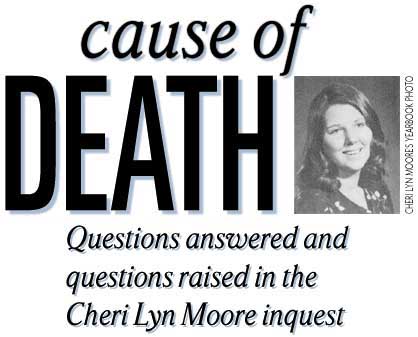
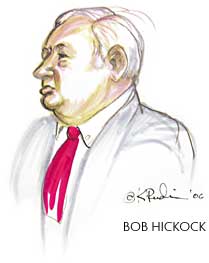
Last week's coroner's inquest into the death of Cheri Lyn Moore looked like a normal trial on the surface. It took place in a courtroom. There was a jury. The witnesses — most of them members of the Eureka Police Department, members of which shot and killed Moore following a two-hour standoff in April — were sworn to tell the truth, the whole truth and nothing but the truth, so help them God. It looked like a trial, but it really wasn't a trial at all. It was much more informal, for one. Jurors could write down questions on a piece of paper and pass them to the bench, and they would be read to the witnesses at the end of their testimony. There were no opening or closing arguments, the sections of a trial where lawyers attempt to make a coherent narrative out of the fragmented evidence presented. But the crucial difference was the complete absence of the adversarial system that is the cornerstone of the American justice system. There was only one lawyer present to question witnesses — Bob Hickock, a retired prosecutor and investigator for the district attorney's offices in Mendocino and Humboldt counties. In a sense, Hickock was acting both as the prosecution and the defense. Perhaps because he had no opposing counsel telling an opposite story, Hickock was very sporadic when it came to following up key bits of testimony. He wouldn't pounce. So the inquest raised nearly as many questions as it answered. The jury's findings in the case were limited. By statute, the jury could only rule as to Moore's cause of death — an issue that was never in contention. The jury found, as expected, that Moore had died of multiple gunshot wounds. But it was also able to pass on recommendations to law enforcement agencies: that officers receive more training in dealing with the mentally ill, and that mental health personnel be present in future crisis situations involving the mentally ill. Several things could happen now. Though the investigation into the shooting has been complete for some time (as Jim Dawson, the head of the multi-agency team that performed it, testified) District Attorney Paul Gallegos still has the option of bringing criminal charges against the police officers involved. Also, there is the possibility that Moore's relatives may file a lawsuit against the City of Eureka. People who know him say that San Francisco attorney Dennis Cunningham is interested in leading such a suit. In 2005, Cunningham led a legal team that successfully sued the City of Eureka and Humboldt County over its use of pepper spray against non-violent timber protesters. If the shooting ever receives a day in court, the following questions — some unanswered, some answered only partially — will be further fleshed out. |
|
 Why
did the police order Moore's friend to hang up on her?
Why
did the police order Moore's friend to hang up on her?
Sgt. Lynne Soderberg, the head of the Eureka Police Department's crisis negotiation team, was called into work as soon as it was clear that there would be a standoff between Cheri Moore and the police. As she was driving down, she passed the standoff itself — in downtown Eureka, on G Street between Fifth and Sixth streets. As she pulled up, an officer came up to her and told her that a man had come up to him to tell him that he had Moore on the phone. Soderberg ordered the man to hang up and not call again. It turned out that she had lost her last chance to talk to Moore — neither Soderberg nor her staff, located back at police headquarters, would establish effective communication with her again.
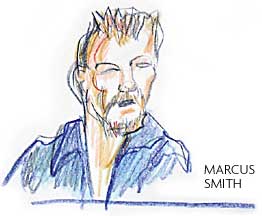
The man on the cell phone was Marcus Smith, a friend of Moore's. He had been driving by on his way to work when he spotted the large police contingency outside her apartment. Concerned for his friend, and knowing that she had been unstable in recent days, he pulled over to try to help her. He got her on his cell phone, talked with her a bit, then offered the phone to an officer at the scene. Soon after, Soderberg told him to hang up.
Soderberg testified that she didn't realize that Smith was offering the phone to the police — she was just following standard procedure, which seeks to limit contact between a barricaded subject and third parties. The procedure was important, she said, because if the police do not have control over communications, any number of things can happen — a friend might try to give away police locations and tactics, or may inadvertently make the person more hostile.
 Why
were the police so concerned about Moore's flare gun?
Why
were the police so concerned about Moore's flare gun?
One of the original officers on the scene, Kevin Lawson, testified that when he and Ofcs. Mike Quigley and A.J. Bolton first poked their heads in the room and looked down the hall, he believed that the weapon Moore was pointing at them might not have been a flare gun, but a regular sidearm. He also testified that he took Moore's voice for a man's, and so reported that there may have been two people in the apartment. Lawson's reports led to some initial confusion about how to respond, though neither proved correct.
But the police department did know that Moore was in possession of a flare gun, as Quigley had seen it in when he was called to her apartment a few days earlier. Later, spotters posted across the street from the apartment could see and identify the flare gun through the windows, as Moore pointed it toward her front door, out toward the street and occasionally at herself.
Eureka Police Chief David Douglas testified that he believed the combination of Moore's erratic behavior and the unknown quantity the flare gun represented posed a serious threat to the building, and to another resident down the hall who would not or could not evacuate. As Craig Pasquini, an employee at Humboldt County's Mental Health Department, had testified, Moore had told him she was prepared to burn down the building; Douglas had received that information, he said, and he took her threat seriously.
 While
at the scene, Douglas said, he learned that there was a vacant
space above the ceilings in the apartment; he said he feared
that the building would quickly catch fire if a flare were lodged
up there, out of the fire department's reach.
While
at the scene, Douglas said, he learned that there was a vacant
space above the ceilings in the apartment; he said he feared
that the building would quickly catch fire if a flare were lodged
up there, out of the fire department's reach.
What was the rationale behind the "hands-free" strategy?
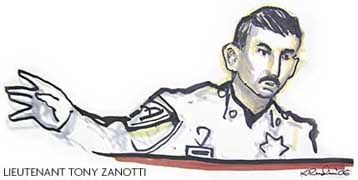
When the police arrived, they set up a command post in the Heuer's Florist office, which was located on a half-level in between the ground floor and the second floor. Four key people were stationed at the post: Douglas, Soderberg, Lt. Tony Zanotti (the overall commander) and Ofc. Todd Wilcox (the SWAT team commander).
During this time, several plans for ending the standoff were discussed, according to the testimony of several of these officers. There was the chance that negotiations would succeed, and Moore would be talked down. There was a plan to tackle Moore and take her into custody in the event that she opened her door. There was a plan to charge the apartment in the event the flare gun was fired. Eventually, according to Zanotti, Wilcox developed an intermediary plan — to charge the room in the event that one of the two spotters stationed across the street saw Moore at a window with her hands empty.
 "This
contingency plan was based on surprise — to overwhelm,
and to get to her before she can rearm herself or flee into another
room inside the house," testified Sgt. Michael Johnson,
a member of the SWAT team that eventually broke down Moore's
door and entered the room.
"This
contingency plan was based on surprise — to overwhelm,
and to get to her before she can rearm herself or flee into another
room inside the house," testified Sgt. Michael Johnson,
a member of the SWAT team that eventually broke down Moore's
door and entered the room.
There was no testimony that revealed the existence of a contingency plan — what the team should do if Moore picked the gun up in the time it took for the SWAT team to bust down the door and run down the hall. This was a strange omission, considering that it would have taken only a moment to pick the gun up again, and that Moore had threatened to shoot at the police if they forced entry into her apartment.
Minutes after the spotters were given the order to radio in if she had both her hands free, one of them did. The SWAT team, as per instructions, charged the door at that moment.
Why didn't the spotter with the best view of Moore see her hands?
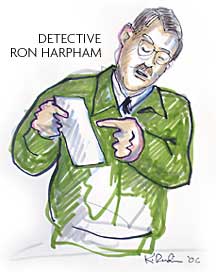
The police department had stationed two of its officers across the street from Moore's apartment to watch her movements and report them to everyone else at the scene. One of them, Det. Ron Harpham, was positioned on the second floor of the Vern's Furniture building directly across G Street from Moore's apartment. He had a straight view into Moore's apartment. The other, Ofc. Robert Mengel, was on the roof of the building just south of Vern's, and was looking at Moore's apartment from above and at an angle. Nevertheless, it was Mengel who gave the signal saying Moore's hands were empty, triggering the SWAT team to enact the "hands-free" strategy just moments after it had been put into place.
Mengel has since moved to Idaho and could not appear
at the inquest. Instead, Jim Dawson, chief investigator for the
District Attorney's office and the head of the multi-agency team
that investigated the shooting, read the interview he conducted
with Mengel on the afternoon of April 14. Mengel had told Dawson
that he had seen Moore pull back a curtain with one hand, while
she reached to open a window with another, and so sent the "hands-free"
signal. (For reasons that are unclear, Mengel, at 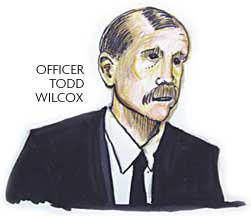 least at some point during
the morning, had been watching Moore down the sights of his rifle,
which he kept trained on her windows. The rifle was not equipped
with a scope.)
least at some point during
the morning, had been watching Moore down the sights of his rifle,
which he kept trained on her windows. The rifle was not equipped
with a scope.)
Remarkably, though Harpham was on the stand for nearly 40 minutes, Hickock did not ask him what he had observed at the moment Mengel sent word to the SWAT team. That took a follow-up question from the jury.
"She had opened up the curtain, and she had presented about two-thirds of her body," Harpham said. "I could not see her right hand." He said that Moore was fussing with something in the window, but that he never saw her right hand free. He heard Mengel give the signal over his radio, and heard Wilcox, the SWAT commander, shout "Go" one or two seconds later. At the moment he heard "Go," he saw Moore turn in the window, raising her right hand above the ledge and into his line of sight. She was holding the flare gun.
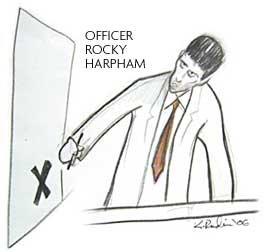
"She either grabbed it from her waistband — I'm speculating — waistband, window ledge, desk, or maybe she had it in her hand all along," Harpham said. (Harpham's younger brother Rocky, a member of the SWAT team, testified that he saw her pick up the gun. Johnson, who was right behind Rocky Harpham, said that Moore had the gun in her hand when he first spotted her in the apartment.)
Why didn't the SWAT team use the defensive devices it had available?
 One
of Det. Ron Harpham's first duties at the scene of the standoff
was to deliver ballistic shields to the beat officers then stationed
in the hallway — Quigley, Lawson and Bolton (see sidebar).
Those shields stayed put when the officers were relieved by the
SWAT team. But when the team stormed Moore's apartment, the shields
were left where they were.
One
of Det. Ron Harpham's first duties at the scene of the standoff
was to deliver ballistic shields to the beat officers then stationed
in the hallway — Quigley, Lawson and Bolton (see sidebar).
Those shields stayed put when the officers were relieved by the
SWAT team. But when the team stormed Moore's apartment, the shields
were left where they were.
Several of the officers testified that there were two reasons for this. First, the shields were bulky, and the team believed that they would be a hindrance. The SWAT team had surveilled a neighboring apartment, and saw that the hallway leading from the door to the front room, where Moore would be, was very narrow. It was thought that the shields would slow the team's movement down the hall, ruining the element of surprise that the "no-hands" plan depended on.
Also, SWAT members testified that they were uncertain how useful the shields would be against a flare pistol. Though the shields were designed to stop bullets, they didn't know what effect they would have against a burning flare. They said that they had no experience with marine flares being used as weapons.
Why didn't the SWAT team use less than lethal force?
One of the members of the team, Ofc. Tim Jones,
carried a compressed air rifle that fired plastic pellets containing
pepper spray, which are designed to burst upon impact. This less-lethal
weapon, as it is known, is designed to incapacitate a person,
though it is not 100 percent effective in doing so. However,
Jones was only the third member of the SWAT team to go 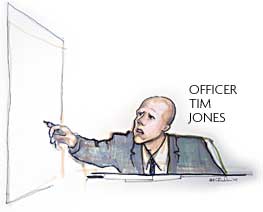 through
Moore's front door and enter her front room. By the time he got
there, the two officers in front of him — Rocky Harpham,
who carried a shotgun, and Sgt. Michael Johnson, who carried
a rifle — had already confronted Moore, and had opened
fire. When he got there, Jones also opened fire with the air
gun.
through
Moore's front door and enter her front room. By the time he got
there, the two officers in front of him — Rocky Harpham,
who carried a shotgun, and Sgt. Michael Johnson, who carried
a rifle — had already confronted Moore, and had opened
fire. When he got there, Jones also opened fire with the air
gun.
Why didn't Jones enter first, giving the police another non-lethal chance to incapacitate Moore? According to his Jones' testimony, it is not standard SWAT practice to have a less-lethal weapon be the first brought to bear on a potentially violent subject. The weapon might not have succeeded in immediately halting Moore, he said, leaving her to possibly fire the flare gun at the officers or at the walls of roof of the building.
Douglas was asked if the use of tear gas was considered. He said that commanders had thought that the use of tear gas would be ineffective, as Moore had several of her windows open.
How did Moore come to be shot in the back of the head?
Dr. Susan Comfort, a medical examiner from the Shasta County Coroner's Office, performed the autopsy on Moore's body, and testified at the inquest about her findings. She described as best she could each of the multiple wounds that Moore had received throughout her neck and torso from the nine shotgun and rifle shots she had taken. She received the fire in the front of her body or her profile, except in one instance — she had a single rifle wound squarely in the back of her head.
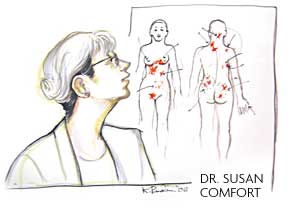 How
she came to receive this wound was never explained at the inquest.
Indeed, the testimony of the SWAT members who fired upon her
seemed to contradict the physical evidence. None of the officers
reported that Moore ever faced away from them while they shot.
How
she came to receive this wound was never explained at the inquest.
Indeed, the testimony of the SWAT members who fired upon her
seemed to contradict the physical evidence. None of the officers
reported that Moore ever faced away from them while they shot.
Rocky Harpham — who has since moved to Texas — was the first in building, and the first to shoot. He said he opened fire when Moore had turned to nearly face him, flare gun in hand, and saw her fall backwards into a chair. Johnson said that as he remembered it, Moore was facing him and pointing the flare gun directly at him when he fired. He said she slumped forward and fell to the side. Jones said that she walked backwards as she was shot, and continued to do so until she fell back. None of the officers said that Moore had ever turned to face away from them from the moment they opened fire.
Comfort said she had no way of determining if the rifle round Moore received to the back of the head was the fatal one.
COVER STORY | IN
THE NEWS | STAGE
MATTERS | DIRT | ARTBEAT
TALK OF THE
TABLE | THE HUM | CALENDAR
Comments? Write a letter!

© Copyright 2006, North Coast Journal, Inc.